
Counterconditioning & Aversion Therapy: How It Works, Real Examples & Why the Ethics Are So Contested
Counterconditioning is the mechanism behind one of psychology’s most controversial therapeutic techniques. Aversion therapy deliberately pairs unwanted behaviors with unpleasant stimuli — making alcohol trigger nausea, or smoking feel genuinely disgusting — to replace positive associations with negative ones. It shows real short-term promise for treating addictions and harmful behaviors, yet long-term effectiveness is inconsistent, and its ethical history includes some of the darkest chapters in modern clinical psychology.
Key Takeaways
- Counterconditioning replaces a positive conditioned response with an incompatible negative one, which is the core mechanism driving aversion therapy.
- Clinical uses include Antabuse for alcoholism, rapid smoking for cigarette cessation, and covert sensitization for a range of unwanted behaviors.
- Short-term results are often promising, but high relapse rates occur once patients leave structured treatment settings.
- Extinction — the weakening of a conditioned response without ongoing reinforcement — is the primary reason aversion therapy so often fails long-term.
- The use of aversion techniques in conversion therapy is universally condemned by major mental health organizations and is now illegal in many jurisdictions.
What Is Counterconditioning?
Counterconditioning is a learning process in which an established conditioned response is replaced by a new, incompatible one. Rather than simply extinguishing an old association, counterconditioning actively competes against it — pairing the same stimulus with a very different outcome until the new response dominates. Joseph Wolpe, whose work on systematic desensitization brought counterconditioning into mainstream clinical practice, described this as reciprocal inhibition: two incompatible responses cannot coexist, so the stronger one wins.
The principle works in both directions. Systematic desensitization uses counterconditioning to replace fear with relaxation, pairing anxiety-provoking stimuli with a calm physiological state. Aversion therapy flips this logic — replacing pleasure or desire with disgust or nausea. Both draw on the same foundational mechanism rooted in classical conditioning, where repeated stimulus pairings reshape automatic responses over time.
How Aversion Therapy Uses Counterconditioning
Aversion therapy applies counterconditioning by pairing a previously desired behavior or stimulus with something genuinely unpleasant. Before treatment, alcohol might function as a conditioned stimulus producing pleasure and relief. The therapy introduces a powerful unconditioned stimulus — a nausea-inducing drug, a mild electric shock, or an intensely aversive image — immediately after the target behavior. Through repetition, the previously pleasurable stimulus becomes associated with the aversive response instead.
The timing is critical. Just as Pavlov’s dogs only formed reliable associations when the bell closely preceded the food, the aversive consequence must follow the target behavior quickly and consistently. Each pairing strengthens what starts as a weak new association until it begins to override years of positive conditioning. What once felt rewarding gradually triggers avoidance, disgust, or fear. This is counterconditioning in action — not just adding punishment, but actively replacing one learned response with another.
Aversion therapy also involves elements of operant conditioning: the aversive consequence functions as positive punishment, reducing the likelihood of the behavior through its immediate unpleasant outcome. Most clinicians recognize that both classical and operant mechanisms are at work simultaneously during treatment.
Aversion Therapy Examples in Clinical Practice
Understanding how aversion therapy actually works in practice is clearest through its major clinical applications. Each one illustrates how counterconditioning gets applied — and where it tends to run into trouble.
Antabuse for Alcoholism
Disulfiram, sold under the brand name Antabuse, is one of the most well-known aversion therapy examples in clinical use. FDA-approved since 1951, it works by blocking the enzyme aldehyde dehydrogenase, causing toxic levels of acetaldehyde to accumulate when alcohol is consumed. The result — flushing, vomiting, rapid heartbeat, dizziness, and chest pain within 10 to 30 minutes of drinking — is reliably unpleasant enough to deter most people from trying.
The conditioning logic is straightforward: alcohol (conditioned stimulus) repeatedly paired with severe illness (unconditioned response) eventually triggers nausea and avoidance on its own. In supervised settings where compliance is ensured, Antabuse produces meaningful reductions in drinking. The problem is what happens after supervision ends. Most patients eventually stop taking the medication, and without it, the aversive pairing disappears. Drinking no longer causes illness. Extinction begins almost immediately, and relapse becomes common. Research consistently shows that Antabuse works best as one component of comprehensive treatment — not as a standalone intervention (Fuller et al., 1986).
Rapid Smoking for Cigarette Cessation
Rapid smoking is a more direct behavioral approach that forces patients to inhale cigarette smoke roughly every six seconds — far faster than normal — until severe nausea sets in. The goal is to transform a pleasurable, habitual behavior into something physically overwhelming. Positive associations with smoking — relaxation, routine comfort, oral satisfaction — get replaced by associations with dizziness, intense unpleasant taste, and nausea resembling nicotine poisoning.
Multiple sessions across days or weeks are designed to build and reinforce the aversive association. Like Antabuse, rapid smoking can produce genuine short-term reductions in smoking. Safety concerns limit its use today: the procedure carries cardiovascular risks and requires careful health screening. It has largely been supplanted by safer and often more effective alternatives such as nicotine replacement therapy and cognitive-behavioral approaches, though it remains a historically significant aversion therapy example.
Covert Sensitization
Covert sensitization is an imaginal form of aversion therapy developed by Joseph Cautela in the 1960s. Rather than exposing patients to real aversive stimuli, the technique asks them to vividly visualize both the unwanted behavior and intensely unpleasant consequences — in full sensory detail. A person trying to reduce alcohol use might be guided to imagine reaching for a drink, then imagine extreme nausea, vomiting, and humiliation in vivid detail, immediately and repeatedly linked to that action.
What makes covert sensitization distinct is its accessibility. No drugs, no shocks, no medical equipment required — just structured imagery and a trained clinician guiding the visualization. It has been applied to alcohol and drug misuse, compulsive eating, sexual behavior disorders, and various unwanted repetitive behaviors. Because it produces no physical risk, it avoids many of the ethical and safety complications of overt aversion methods.
Effectiveness evidence for covert sensitization is mixed. Some studies show meaningful reductions in target behaviors, particularly when combined with broader treatment programs (Cautela, 1967). The technique’s reliance on imagery means outcomes depend heavily on the patient’s ability and willingness to engage with the visualization. Those who struggle to generate vivid mental imagery tend to show weaker responses. Like other aversion approaches, covert sensitization faces the generalization problem: imagined consequences don’t always translate into changed behavior in real-world environments where the original triggers remain powerful.
Self-Harming and Repetitive Behaviors
Aversion procedures have been applied to self-injurious behaviors — particularly in individuals with severe developmental disabilities who engage in dangerous head-banging, self-biting, or skin picking. Methods range from mild electrical stimulation contingent on the harmful movement, to bitter-tasting substances applied to fingers to discourage hair pulling. These interventions are considered last-resort options, used only when less restrictive behavioral approaches have failed and the behavior poses genuine physical danger.
Modern applied behavior analysis strongly prefers functional behavioral assessment followed by positive reinforcement strategies. When aversion is used at all for self-harm, it now appears only within comprehensive behavior support plans under extensive ethical oversight, never as a standalone technique.
Aversion Therapy vs Systematic Desensitization
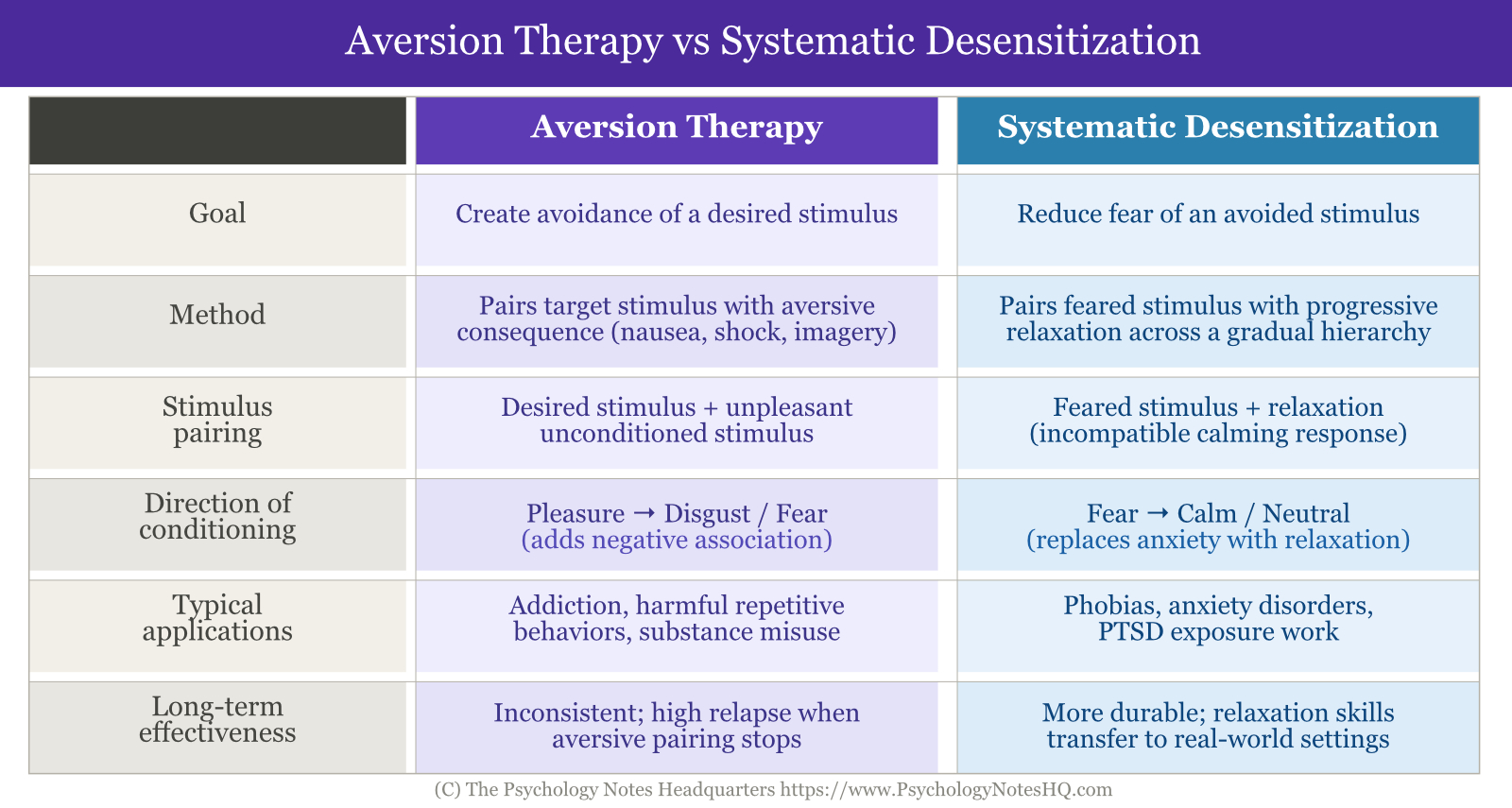
These two techniques both rely on counterconditioning, but they work in opposite directions toward opposite goals.
Systematic desensitization, developed by Wolpe, is used to reduce fear and anxiety. It pairs a feared stimulus with progressive relaxation, gradually replacing the anxious response with calm. The target population is typically someone who wants to stop fearing something — heights, spiders, social situations — and the process moves from least to most threatening stimuli in a slow, graduated hierarchy.
Aversion therapy, by contrast, is used to create avoidance. It pairs a desired stimulus with something unpleasant, replacing attraction or craving with disgust or fear. The target population is typically someone who wants to stop being drawn to something — alcohol, drugs, a harmful behavior. There is no graduated hierarchy; the pairing is direct and deliberately intense.
Both approaches share the limitation of context-dependency: responses learned in a clinical setting don’t always transfer to the environments where the behavior naturally occurs. But systematic desensitization has generally produced more consistent long-term outcomes, likely because reducing fear through relaxation is easier to maintain without continued clinical support than sustaining a drug-induced aversive response in the real world.
Why Aversion Therapy Often Fails: The Extinction Problem
The effectiveness gap in aversion therapy — promising early results followed by high relapse rates — comes down largely to extinction. Counterconditioning creates a new association, but it does not erase the original one. The old positive associations with alcohol, cigarettes, or other behaviors remain encoded; they are suppressed by the newer aversive learning, not deleted.
When the aversive stimulus disappears — medication stops, supervised sessions end — the conditioned aversion begins weakening. Each time the patient encounters the old stimulus without the aversive consequence, the new learning erodes. Drinking without getting sick is an extinction trial. Smoking at a normal pace without becoming nauseated is an extinction trial. Spontaneous recovery, the well-documented phenomenon where extinguished responses resurface after a rest period, means even patients who appear to have lost their cravings can find them returning unexpectedly weeks or months later.
Context-dependent learning compounds this problem. The Little Albert experiment demonstrated how conditioned fear responses generalize across similar stimuli — but aversion therapy conditioning tends to be narrowly tied to the clinical setting where it was established. A bar, a social gathering, or a stressful evening at home contains very different cues than a therapist’s office. The aversive association learned in one context may not activate reliably in another. Meanwhile, the real-world reinforcers for the original behavior — stress relief, social connection, pleasure — remain fully intact and unaddressed.
Perhaps the most fundamental limitation is that aversion therapy tells the person what not to do without teaching them what to do instead. It creates a behavioral void. Without alternative coping strategies, stress management skills, or new sources of reward, the underlying needs that the problem behavior served go unmet. Return to the familiar behavior becomes almost inevitable for many patients, not because the conditioning failed entirely, but because nothing was built to replace it.
Ethical Concerns and the Conversion Therapy Controversy
Aversion therapy raises genuine ethical questions even in its legitimate applications. Deliberately inflicting physical discomfort or psychological distress as a treatment method sits in tension with the foundational clinical principle of non-maleficence. Informed consent becomes complicated when treatment involves making someone violently ill. Vulnerable populations — children, individuals with cognitive disabilities, people in coercive institutional settings — may be unable to provide truly voluntary consent to aversive procedures. Risk-benefit analysis requires that less aversive options be exhausted first and that the potential harm of the treatment doesn’t outweigh the potential harm of the behavior it targets.
These concerns, serious as they are, pale against the history of conversion therapy — the attempt to change sexual orientation using aversion methods. From the 1960s through the 1990s, LGBTQ+ individuals were subjected to electrical shocks paired with same-sex imagery, nausea-inducing drugs paired with erotic stimuli, and other coercive aversion procedures, all based on the scientifically false premise that homosexuality was a disorder requiring treatment. Many of these procedures were conducted without genuine consent, often in institutional settings where refusal was impossible.
The harm caused was extensive and well-documented: depression, anxiety, shame, post-traumatic symptoms, and in some cases suicide. No credible evidence ever supported the effectiveness of sexual orientation change efforts. The American Psychological Association, American Psychiatric Association, American Medical Association, and every other major mental health organization have issued strong statements condemning the practice. Conversion therapy is now illegal in many jurisdictions, particularly for minors. This history stands as a permanent reminder of how behavioral techniques can be weaponized in service of social prejudice rather than genuine therapeutic benefit — and why the power to deliberately cause distress requires extraordinary justification and oversight (APA, 2009).
What Works Better: Modern Alternatives
Contemporary treatment for addiction and harmful behavior has largely moved beyond aversion-only approaches toward methods that address the full complexity of why people engage in those behaviors.
Cognitive-behavioral therapy targets the thoughts, beliefs, and cognitive patterns that maintain problem behaviors. It teaches concrete coping strategies, identifies triggers, and builds relapse prevention skills that travel with the patient into real-world environments. The skills learned in CBT don’t disappear when treatment ends — they become tools the person carries indefinitely.
Motivational interviewing works with the patient’s own ambivalence about change rather than imposing change through external punishment. By helping people explore and articulate their own reasons for wanting to behave differently, it builds intrinsic motivation that tends to be more durable than motivation driven by fear of an aversive consequence.
The most effective modern programs combine pharmacological support, psychological therapy, peer support, and skill-building — treating addiction and harmful behavior as complex phenomena with biological, psychological, and social dimensions. Learned helplessness research reminds us that when people feel they have no control over outcomes, behavioral change becomes nearly impossible; effective treatment must restore a sense of agency, not just create aversion. Aversion techniques may still have a limited role within these comprehensive frameworks, but the evidence no longer supports them as primary or standalone interventions.
Conclusion
Counterconditioning is a powerful learning mechanism, and aversion therapy is a genuine clinical technique — not pseudoscience. The problem isn’t the principle; it’s the limits of what pairing stimuli with unpleasant consequences can achieve on its own. Short-term behavior suppression is real. Long-term behavior change requires more: addressing root causes, building alternative skills, and creating the conditions for new habits to survive contact with the real world. Aversion therapy works best when it serves as one piece of a larger therapeutic puzzle — not the whole picture.
References
- American Psychological Association. (2009). Report of the American Psychological Association Task Force on Appropriate Therapeutic Responses to Sexual Orientation. APA.
- Cautela, J. R. (1967). Covert sensitization. Psychological Record, 20, 459–468.
- Fuller, R. K., Branchey, L., Brightwell, D. R., Derman, R. M., Emrick, C. D., Iber, F. L., James, K. E., Lacoursiere, R. B., Lee, K. K., Lowenstam, I., Maany, I., Neiderhiser, D., Nocks, J. J., & Shaw, S. (1986). Disulfiram treatment of alcoholism: A Veterans Administration cooperative study. JAMA, 256(11), 1449–1455.
- Wolpe, J. (1958). Psychotherapy by reciprocal inhibition. Stanford University Press.
- Rachman, S., & Teasdale, J. (1969). Aversion therapy and behaviour disorders: An analysis. University of Miami Press.
- Elkins, R. L. (1991). An appraisal of chemical aversion (emetic therapy) approaches to alcoholism treatment. Behaviour Research and Therapy, 29(5), 387–413.
- Hall, S. M., Tunstall, C., Rugg, D., Jones, R. T., & Benowitz, N. (1985). Nicotine gum and behavioral treatment in smoking cessation. Journal of Consulting and Clinical Psychology, 53(2), 256–258.
How to cite this article:
The Psychology Notes Headquarters. (2026). Counterconditioning & Aversion Therapy: How It Works, Real Examples & Why the Ethics Are So Contested. Retrieved from https://www.psychologynoteshq.com/aversiontherapy/
For interest sake Who is Alexandra?Doing a good job.I am compiling the tutorials.They are good.I am Felix Ambrose Sixpence a university lecturer in Counselling /psychology in Malawi Africa.Keep it up.Can we suggest topics at times?
Kind Regards
Hi Felix,
I’m just someone who is passionate about Psychology. :-) I’m glad to hear that the posts are helpful to you. Spread the word and tell your students to come check out this website. :-) Yes, please feel free to suggest topics by leaving me comments on this site.
A
Alexandra, keep it up. You are doing a tremendous job. I personally is benefiting from your psychology lessons. Thank you.
Hi Mackson,
Thanks!
A
Very beneficial therapy which I used for my freind who is suffering from obsessive disorder. Thanks for post.
Hi Benjamin,
Just curious, how exactly did you use this therapy?
Thanks,
A