
Understanding Bullying Through Bronfenbrenner’s Ecological Systems
Bullying is not simply an individual behavior problem but an ecological systems theory bullying phenomenon shaped by interactions across multiple environmental levels. Bronfenbrenner’s ecological systems theory provides a comprehensive framework for understanding how family dynamics, school climate, peer relationships, community factors, and cultural values converge to create or prevent peer aggression. The five nested systems—microsystem, mesosystem, exosystem, macrosystem, and chronosystem—reveal that effective Bronfenbrenner bullying prevention requires coordinated intervention across all ecological levels rather than focusing solely on individual perpetrators or victims (Espelage & Swearer, 2010).
Key Takeaways
- Bullying emerges from interactions across five ecological systems: microsystem (family, school, peers), mesosystem (connections between settings), exosystem (indirect influences), macrosystem (cultural norms), and chronosystem (time and development).
- Family microsystem factors including harsh parenting, inconsistent discipline, and low warmth predict both bullying perpetration and victimization, while supportive family environments serve as protective factors.
- School climate, teacher supervision quality, and peer group dynamics within the microsystem create conditions that either facilitate or prevent bullying behaviors.
- Cultural norms about aggression, gender expectations, and societal inequalities at the macrosystem level shape what forms of bullying are tolerated or condemned.
- Effective prevention requires multi-level interventions addressing family support, school policies, community programs, and cultural values rather than single-level approaches targeting only individual students.

Bronfenbrenner’s Ecological Framework Applied to Bullying
Urie Bronfenbrenner’s ecological systems theory revolutionized developmental psychology by emphasizing that children develop within nested environmental systems, each influencing and being influenced by the others. When applied to bullying, this framework reveals that peer aggression cannot be understood or addressed by examining only the bully and victim. Instead, bullying represents a complex interaction among individual characteristics, relationship dynamics, institutional practices, community contexts, and cultural values.
The microsystem encompasses the immediate environments where children directly participate: family, classroom, peer group. These settings provide the most proximal influences on bullying behavior through daily interactions, relationship quality, and behavioral modeling. A child’s experiences with parents, teachers, and peers directly shape whether they engage in, witness, or experience bullying.
The mesosystem comprises connections between microsystems—for example, the relationship between home and school or between peer groups and family. When parents communicate effectively with teachers or when values align across settings, children receive consistent messages about acceptable behavior. Conversely, disconnections between microsystems can create opportunities for bullying to flourish undetected.
The exosystem includes settings that don’t directly involve the child but still affect their experiences. Parental workplace stress, school district policies, neighborhood safety, and media environments all indirectly influence bullying by shaping the resources, stressors, and norms within the microsystem. A parent’s job stress might reduce their emotional availability for discussing peer problems, while community violence might normalize aggression.
The macrosystem represents the broader cultural context—societal values, ideologies, laws, and customs. Cultural beliefs about aggression, gender roles, discipline, and intervention shape how bullying is defined, tolerated, or addressed. Countries with strong anti-bullying policies and cultures emphasizing collective responsibility show lower bullying rates than those where aggression is culturally accepted.
The chronosystem captures time-related changes across individual development and historical periods. Bullying patterns shift across developmental stages, peaking during middle school when social hierarchies are being established. Historical time matters too—the emergence of cyberbullying represents a chronosystem change that has transformed the landscape of peer aggression.
This ecological perspective shifts focus from “fixing” individual bullies or victims to addressing the systems that produce bullying. It recognizes that the same child might bully in one context but not another, depending on environmental supports and constraints.
Microsystem: Direct Environments Where Bullying Occurs
Family Microsystem
Family relationships form the foundation of children’s social and emotional development, profoundly influencing their involvement in bullying. Research consistently demonstrates that parenting styles and their impact on child behavior predict both bullying perpetration and victimization (Baldry & Farrington, 2000).
Harsh, punitive parenting creates risk for bullying perpetration. Children who experience physical punishment, verbal aggression, or psychological control at home learn that power and dominance are acceptable ways to resolve conflicts. They may replicate these patterns with peers, using aggression to establish control. Authoritarian parents who emphasize obedience without warmth often produce children who either become aggressive themselves or develop the submissive behaviors that make them vulnerable to victimization.
Inconsistent discipline similarly predicts bullying involvement. When parents enforce rules unpredictably—sometimes ignoring misbehavior, sometimes responding harshly—children fail to internalize consistent behavioral standards. This inconsistency undermines the development of self-regulation and empathy, both protective factors against bullying perpetration.
Lack of parental warmth and emotional support increases vulnerability to both bullying and victimization. Children who don’t receive affection, validation, and emotional responsiveness at home often seek belonging and status through peer relationships. When healthy relationship skills haven’t developed at home, they may resort to aggression or become easy targets for peers. Conversely, warm, supportive families buffer against bullying by building self-esteem and teaching positive relationship skills.
Sibling relationships also contribute. Families where sibling aggression is tolerated or encouraged normalize peer aggression. Children who regularly experience or perpetrate sibling bullying often extend these patterns to school contexts. However, supportive sibling relationships can provide protective effects, offering practice in conflict resolution and emotional support.
Parent-child communication quality matters enormously. Families where children feel comfortable discussing peer problems, where parents listen without judgment, and where collaborative problem-solving occurs show lower rates of bullying involvement. These communication patterns help children navigate peer conflicts constructively and seek help when needed.
Attachment quality established in early childhood continues influencing peer relationships. Securely attached children develop trust in relationships and confidence in seeking support, reducing both perpetration and victimization risk. Insecurely attached children may struggle with relationship skills or seek dominance to compensate for emotional insecurity.
School Microsystem
The school environment powerfully shapes bullying through climate, policies, supervision, and teacher-student relationships. Schools with positive climates characterized by respect, inclusion, and clear behavioral expectations show significantly lower bullying rates than those with negative or chaotic climates (Espelage & Swearer, 2010).
Teacher supervision quality directly affects bullying frequency. Inadequately supervised spaces—hallways, bathrooms, playgrounds, buses—become hotspots for bullying. Teachers who actively monitor, intervene consistently, and maintain presence during transitions prevent many bullying incidents. Conversely, inconsistent or absent supervision communicates that adults won’t protect victims or hold bullies accountable.
School policies and their enforcement create the structural framework for bullying prevention. Schools with clear definitions of bullying, transparent reporting procedures, and consistent consequences show better outcomes than those with vague or unenforced policies. However, punitive zero-tolerance approaches often backfire by excluding struggling students without addressing underlying causes. Restorative approaches that emphasize accountability, empathy-building, and relationship repair show more promising results.
Teacher-student relationship quality influences both perpetration and victimization. Students who feel respected, supported, and valued by teachers show lower bullying involvement. Teachers who model respectful communication, respond empathetically to distress, and create inclusive classrooms foster prosocial peer relationships. Conversely, teachers who use sarcasm, favoritism, or harsh discipline may inadvertently model or reinforce bullying behaviors.
Classroom composition affects bullying dynamics. Large class sizes reduce individual attention and increase supervision challenges. Diverse classrooms can either reduce bullying through exposure to difference or increase it if diversity isn’t actively valued. Student-teacher ratios, classroom stability, and grouping practices all influence the peer ecology.
The physical environment matters too. Crowded, poorly maintained schools with inadequate space for all students create stress and competition that fuel aggression. Well-designed schools with defined spaces, good sightlines for supervision, and adequate resources support positive behavior.
Peer Group Microsystem
Peer relationships constitute the immediate context where most bullying occurs. Understanding peer group dynamics reveals why bullying persists even when adults intervene with individual students.
Social hierarchies naturally emerge in peer groups, and bullying often serves status-seeking functions. Adolescents, particularly during middle school, actively negotiate social standing through inclusion, exclusion, and demonstrations of power. Bullying can elevate perpetrators’ status by displaying dominance, controlling resources, or enforcing group norms. This instrumental use of aggression for social gain makes bullying resistant to simple moral appeals.
Peer reinforcement powerfully maintains bullying. When classmates laugh at humiliation, share gossip, or otherwise reward bullying, they strengthen the behavior regardless of adult consequences. Even passive observation can reinforce by providing the audience bullies seek. Research on bystander behavior and helping in groups reveals that diffusion of responsibility often prevents intervention even when peers disapprove of bullying.
Bystander roles critically shape bullying outcomes. Students adopt various roles beyond bully and victim: reinforcers who encourage bullying, assistants who join in, defenders who support victims, and outsiders who remain uninvolved. The distribution of these roles within a peer group determines whether bullying escalates or stops. Interventions that mobilize defenders and shift group norms prove more effective than targeting individuals.
Friendship quality provides crucial protection against victimization. Children with even one close friend experience less victimization and psychological harm than friendless peers. Friendships offer emotional support, ally assistance during conflicts, and evidence of social value that contradicts bullies’ degradation. However, not all friendships protect equally—supportive, stable friendships defend better than superficial or aggressive peer connections.
Peer norms about aggression vary considerably across groups. Some peer cultures tolerate or celebrate aggression as normal conflict resolution, while others strongly condemn it. These norms develop through repeated interactions, influential members’ behavior, and collective responses to aggression. Changing peer norms requires addressing group-level dynamics rather than individual attitudes alone.
Group identity affects bullying patterns. In-group/out-group dynamics based on race, ethnicity, gender, social class, or interests can fuel intergroup bullying. Students may bully to establish or maintain group boundaries, particularly when groups compete for status or resources. Identity-based bullying often reflects broader social prejudices reinforced at multiple ecological levels.
Mesosystem: Connections Between Microsystems
The mesosystem encompasses interactions between microsystems, and these connections critically affect bullying prevention and response.
Home-School Connections
Parent-teacher communication quality directly influences bullying outcomes. When parents and teachers communicate regularly, share information about concerns, and coordinate responses, they create consistent expectations across settings. This collaboration allows earlier detection of bullying, more comprehensive intervention, and unified messaging about acceptable behavior (Georgiou & Stavrinides, 2013).
Conversely, poor home-school connections hinder effective responses. Parents unaware of school bullying can’t provide home support or advocate for intervention. Teachers unaware of family stressors may misinterpret behavioral changes. Mutual distrust between parents and schools creates adversarial responses that ultimately harm children.
Parental involvement in school activities—volunteering, attending events, joining committees—strengthens home-school mesosystems. Involved parents become visible presences who increase adult supervision, model school engagement, and signal that the school community extends beyond institutional boundaries. Their presence also provides information about peer dynamics and school culture that might not emerge through formal channels.
Alignment versus conflict between home and school values shapes children’s behavioral choices. When families and schools share expectations about respect, conflict resolution, and appropriate behavior, children receive consistent messages supporting prosocial choices. When values conflict—for example, families encouraging aggressive self-defense while schools prohibit all physical contact—children face contradictory demands that complicate behavioral regulation.
Peer-Family Alignment
The relationship between peer group values and family expectations influences how children navigate peer pressure and social conflicts. When peer norms align with family values, children face no conflict in choosing prosocial behavior. When peers reward aggression while families discourage it, children must choose between peer acceptance and family approval—a difficult negotiation particularly during adolescence when peer influence intensifies.
Parental monitoring of peer relationships represents an important mesosystem connection. Parents who know their children’s friends, understand peer group dynamics, and maintain involvement in peer activities can provide guidance for navigating difficult social situations. However, excessive or intrusive monitoring can backfire by damaging trust or provoking resistance.
Family discussions about friendships and peer conflicts help children process social experiences and develop problem-solving skills. Parents who ask open-ended questions, validate emotions while exploring solutions, and share their own experiences teach children to analyze peer dynamics critically. These conversations create mesosystem connections by bringing peer experiences into the family context for reflection and guidance.
Exosystem: Indirect Influences on Bullying
The exosystem includes settings that don’t directly involve children but affect their bullying experiences through impact on microsystems.
Parental Work and Stress
Parental work conditions indirectly influence children’s bullying involvement through effects on parenting quality and family functioning. Job stress, long working hours, inflexible schedules, and job insecurity all reduce parents’ emotional availability for children. Stressed parents show less patience, warmth, and consistent discipline—parenting characteristics that predict bullying involvement (Bowes et al., 2009).
Unemployment or underemployment creates similar risks through financial strain and parental distress. Economic hardship increases family conflict, harsh discipline, and parental depression, all of which elevate children’s bullying risk. Conversely, workplace policies supporting work-family balance—flexible schedules, family leave, reasonable hours—enable more responsive parenting.
Exosystem Example: Identifying the Correct Answer
Which is an example of a child’s exosystem that does not work favorably for the child?
A) Child gets bullied in school
B) Mother gets a job promotion and has less time to supervise homework
C) Teacher plays favorites
D) Child is asthmatic
The correct answer is B. A parent’s workplace is a setting the child never directly participates in, which is exactly what defines the exosystem: an environment the child is not part of but that still shapes their daily experience. When a mother’s promotion means less time available for homework supervision, that workplace change reaches the child indirectly through reduced parental oversight.
The other options do not fit the exosystem definition. Option A describes bullying happening directly within the child’s microsystem, since school is a setting the child directly experiences. Option C also sits in the microsystem, since teacher favoritism is a direct classroom interaction. Option D describes an individual trait rather than an environmental system altogether.
School District Policies
District-level policies and resource allocation affect individual schools’ capacity for bullying prevention. Districts that mandate evidence-based anti-bullying programs, provide implementation training and resources, and hold schools accountable for outcomes show better results than those leaving prevention to individual school initiative.
Professional development for teachers represents crucial district-level support. Teachers need training in recognizing bullying, intervening effectively, creating inclusive climates, and addressing bias. Districts that invest in ongoing professional development equip teachers with skills that translate to improved student outcomes.
Resource allocation decisions affect prevention capacity. Funding for counselors, social workers, psychologists, and behavior specialists enables schools to address mental health needs, provide social skills training, and intervene with at-risk students. Inadequate staffing leaves schools unable to implement comprehensive prevention programs regardless of policy mandates.
Neighborhood and Community Factors
Community safety and violence exposure shape children’s bullying behavior by normalizing aggression and creating stress that spills into schools. Children who witness community violence or live in dangerous neighborhoods show higher rates of aggression, possibly reflecting learned responses to threat or trauma responses manifesting as hypervigilance and reactivity.
Social cohesion and collective efficacy within neighborhoods affect bullying. Communities where residents know each other, share responsibility for children’s wellbeing, and intervene when problems arise provide extended supervision and support that buffers against bullying. Fragmented communities lacking social ties leave children with fewer adult connections and less informal monitoring.
Neighborhood resources—parks, libraries, recreation programs, mentoring organizations—provide structured activities and adult supervision during non-school hours. These resources reduce unsupervised time when bullying often occurs and offer prosocial alternatives to aggressive peer cultures.
Media Environment
Media exposure represents an important exosystem influence, though research findings remain somewhat mixed regarding direct effects. Exposure to violent video games and television content correlates with increased aggression in some studies, possibly through desensitization, aggressive script learning, or arousal effects (Anderson et al., 2010). However, media effects vary by child characteristics, family context, and consumption patterns.
Social media platforms and digital communication create new contexts for cyberbullying, representing an exosystem factor that has fundamentally changed bullying dynamics. Platform design, content moderation policies, and algorithm functions all shape what cyberbullying looks like and how it spreads. These technological factors operate beyond individual children’s control but profoundly affect their experiences.
Media literacy education helps children critically evaluate media messages about aggression, power, and conflict resolution. Schools and families that teach analytical media consumption may buffer against negative effects while preserving positive media engagement.
How Can a School Use a Social-Ecological Perspective to Identify Learner Vulnerabilities?
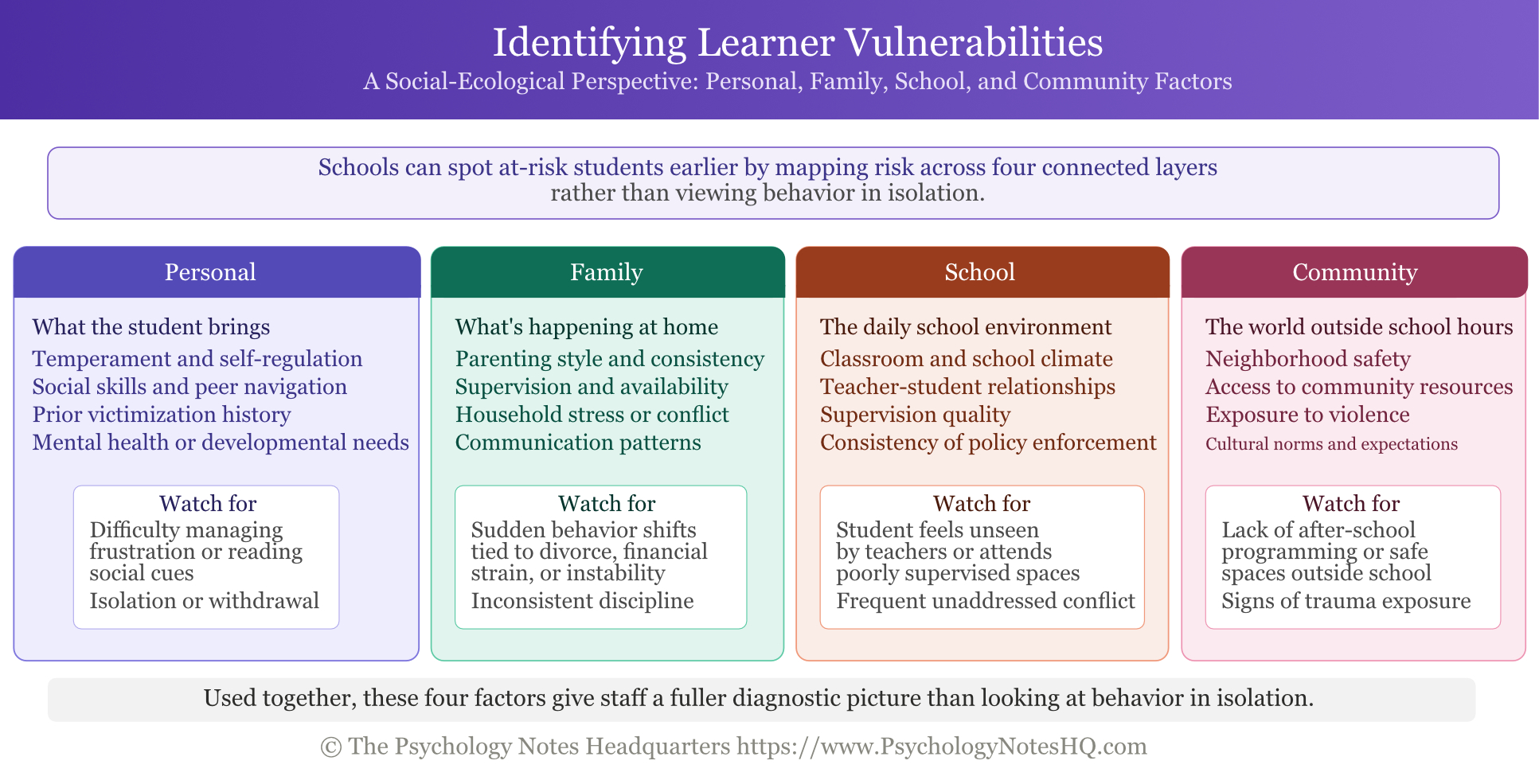
A school applying a social-ecological perspective looks past the individual student and asks where risk is building up across four connected layers: personal, family, school, and community. This framing draws on the broader social-ecological model of bullying (Espelage & Swearer, 2010), which treats peer aggression as the product of interacting personal, relational, and environmental factors rather than an individual trait. Mapping vulnerabilities this way helps staff catch warning signs earlier and respond with the right kind of support instead of a one-size-fits-all discipline response.
Personal Factors
This layer covers what the student brings to the situation: temperament, self-regulation skills, social skills, prior victimization history, and any mental health or developmental needs. A student who struggles to read social cues or manage frustration is more likely to be drawn into conflict as either target or aggressor, so schools start here by looking at individual coping and social skill gaps.
Family Factors
Here the school considers what is happening at home: parenting style, supervision levels, family stress, and communication patterns. A student going through a divorce, financial hardship, or inconsistent discipline at home may show behavior changes at school long before anyone names the underlying cause.
School Factors
This layer includes classroom climate, teacher-student relationships, supervision quality, and how consistently policies are enforced. A student who feels invisible to teachers or attends a poorly supervised school is more vulnerable regardless of what is happening at home.
Community Factors
Finally, schools look outward at neighborhood safety, access to community resources, and cultural norms the student is exposed to outside school hours. Exposure to community violence or a lack of after-school programming can compound risks building up in the other three layers.
Used together, these four factors give staff a fuller diagnostic picture than looking at behavior in isolation. A student flagged through this lens might need a counselor referral for personal factors, a parent conference for family factors, a change in classroom seating for school factors, or a connection to a community mentoring program, rather than a single generic intervention.
Macrosystem: Cultural Values and Societal Structures
The macrosystem represents the broadest ecological level, encompassing cultural ideologies, societal structures, and institutional systems that shape bullying across all other levels.
Cultural Norms About Aggression
Societies vary dramatically in their tolerance for aggression as acceptable conflict resolution. Cultures emphasizing honor, dominance, or competitive individualism may implicitly or explicitly condone aggressive responses to perceived disrespect or challenge. In such contexts, bullying behaviors that establish dominance hierarchies align with broader cultural values, making intervention more difficult.
The “boys will be boys” mentality illustrates how cultural norms excuse aggression. When physical fighting is dismissed as natural male behavior rather than addressed as harmful aggression, boys receive messages that violence is acceptable and intervention unnecessary. This cultural framing affects parent responses, teacher intervention, and peer attitudes across all ecological levels.
Conversely, cultures emphasizing cooperation, harmony, and collective wellbeing create macrosystem contexts that discourage bullying. When cultural values prize empathy, inclusion, and peaceful conflict resolution, these ideals filter through institutional policies, family practices, and peer norms.
Gender Norms and Bullying
Cultural gender socialization profoundly shapes bullying patterns. Traditional masculinity norms often encourage physical dominance, emotional restriction, and competitive aggression in boys. These expectations manifest in higher rates of physical bullying among boys and reluctance to report victimization due to perceived weakness. How gender expectations shape developmental tasks illustrates how deeply gender norms affect behavior across contexts.
Girls face different but equally constraining gender norms emphasizing relational harmony and indirect aggression. Cultural expectations that girls should be “nice” and avoid open conflict channel female aggression into relational forms—gossip, exclusion, rumor-spreading. While often dismissed as less harmful than physical bullying, relational aggression causes significant psychological damage.
Gender nonconforming students face particular vulnerability to bullying, reflecting macrosystem-level heteronormativity and rigid gender expectations. LGBTQ+ students report higher victimization rates across numerous studies, demonstrating how cultural values about gender and sexuality create hostile climates even in otherwise well-managed schools.
Socioeconomic and Racial Inequalities
Structural inequalities at the macrosystem level create vulnerabilities to bullying. Students from marginalized racial or ethnic groups often face discrimination-based bullying reflecting broader societal racism. These experiences can’t be addressed solely through school intervention when rooted in systemic oppression permeating multiple ecological levels.
Socioeconomic inequality affects bullying through multiple pathways. Poverty concentrates in under-resourced schools with larger class sizes, fewer counselors, and stressed teachers—microsystem factors that facilitate bullying. Economic segregation reduces cross-class contact that might reduce class-based bullying. Material disparities become visible markers for exclusion and ridicule.
School funding disparities tied to property taxes create dramatically different prevention capacities across districts. Wealthy communities can afford comprehensive programs, adequate staffing, and quality professional development that poorer districts cannot provide despite potentially greater need. This systemic inequity reflects macrosystem-level choices about resource distribution.
National Policies and Legislation
Anti-bullying legislation represents macrosystem intervention that can filter down through all ecological levels. Countries and states with comprehensive anti-bullying laws that mandate prevention programs, establish reporting procedures, and require accountability show lower bullying rates than those without such frameworks (Kärnä et al., 2011).
Finland’s KiVa program exemplifies effective macrosystem-level intervention. This national program combines curriculum, training, monitoring, and systemic support across all schools. By addressing bullying as a societal priority rather than individual school responsibility, Finland has achieved significant reductions in bullying rates.
However, legislation alone proves insufficient without implementation resources and cultural change. Laws mandate action but don’t necessarily provide funding, training, or political will for meaningful change. Effective policy requires aligned resources and cultural commitment.
Chronosystem: Bullying Across Time and Development
The chronosystem encompasses changes across individual development and historical periods, both crucial for understanding bullying.
Developmental Timing
Bullying follows predictable developmental patterns, typically peaking during middle school when adolescents actively negotiate social hierarchies and peer group belonging becomes paramount. This developmental period combines several risk factors: puberty-related stress, school transitions disrupting established relationships, intensified peer influence, and abstract thinking enabling more sophisticated relational aggression.
Elementary school bullying often involves more physical aggression and overt forms, reflecting younger children’s less developed social cognition and emotion regulation. As children mature, bullying becomes more subtle and relational, incorporating psychological manipulation that younger children can’t execute.
High school often shows declining physical bullying but persistent relational and cyberbullying. Older adolescents develop more sophisticated conflict resolution skills and perspective-taking abilities that reduce overt aggression. However, social hierarchies remain important, and digital communication provides new avenues for harassment.
Developmental transitions represent particularly vulnerable periods. Moving from elementary to middle school, changing schools, or entering new peer groups disrupts established relationships and requires renegotiating social positions. These transitions create opportunities for bullying to emerge or escalate.
Historical Changes and Cyberbullying
Historical time powerfully shapes bullying through technological and cultural changes. The emergence of digital communication represents a chronosystem shift that has fundamentally transformed peer aggression. Cyberbullying extends bullying beyond school hours and physical locations, reaching victims in their homes through smartphones and social media.
Digital bullying differs from traditional forms in important ways. Permanence means harmful content persists indefinitely, creating ongoing psychological harm. Anonymity reduces accountability and empowers perpetrators who might not bully face-to-face. Audience size magnifies humiliation as content spreads rapidly across networks. The 24/7 nature prevents respite that previously occurred when children left school.
Yet cyberbullying doesn’t exist independently of traditional bullying—most cyberbullying victims also experience school-based bullying, suggesting that online harassment extends rather than replaces in-person aggression. The same ecological factors operate in both contexts: family support buffers against harm, peer norms influence participation, school policies affect responses, and cultural values shape what’s tolerated.
Generational differences in technology use create mesosystem challenges when parents and teachers lack familiarity with platforms where bullying occurs. Adults struggle to supervise spaces they don’t understand, creating supervision gaps that perpetrators exploit.
Long-term Consequences
Longitudinal research reveals that bullying involvement predicts numerous negative outcomes extending years beyond the actual experiences. Children who experience chronic victimization show elevated rates of anxiety, depression, and suicidal ideation that persist into adulthood (Copeland et al., 2013). Victims demonstrate lower educational attainment, employment difficulties, and relationship problems in adulthood.
Bullying perpetrators face concerning long-term outcomes too, including higher rates of criminal behavior, substance abuse, and relationship violence. While some bullies achieve short-term social gains, their reliance on aggression often undermines healthy adult functioning.
These long-term consequences highlight why chronosystem thinking matters for prevention. Early intervention during childhood may prevent trajectories toward chronic victimization or persistent aggression. The developmental timing of intervention affects its potential impact.
Interactions Across Systems: The Power of Ecological Thinking
The true value of ecological analysis lies not in cataloging individual system influences but in understanding their interactions. Bullying emerges from complex feedback loops across levels rather than simple additive effects.
Consider a scenario illustrating cross-system interactions: A student from a family experiencing economic hardship (exosystem) lives in a neighborhood with high violence exposure (exosystem/macrosystem). This creates family stress reducing parental monitoring and emotional availability (microsystem). The student attends an underfunded school with inadequate counseling and large class sizes (exosystem affecting microsystem). The school reflects cultural norms tolerating aggression among boys (macrosystem). Peer groups emphasize dominance hierarchies (microsystem). Home-school communication is minimal (mesosystem). This student faces dramatically elevated risk for both perpetration and victimization.
Now imagine systematic changes: Community investment in economic opportunity (exosystem), violence prevention (exosystem), and school funding equity (macrosystem). Workplace policies supporting work-family balance (exosystem). Cultural campaigns challenging aggressive masculinity norms (macrosystem). School implementation of comprehensive prevention programs with adequate staffing (microsystem). Strong home-school partnerships (mesosystem). These multilevel changes transform the ecological context, reducing bullying risk far more effectively than targeting the individual student.
This ecological cascade demonstrates why single-level interventions often fail. Counseling an individual bully while leaving toxic peer norms, inadequate school climate, family stressors, and cultural values unchanged produces minimal lasting change. The unchanged ecology continues producing bullying behaviors.
Conversely, favorable conditions at multiple levels create protective cascades. Ecological influences on adolescent identity formation demonstrate how positive contexts across systems support healthy development, just as negative conditions undermine it.
Implications for Prevention and Intervention
Ecological analysis reveals that effective bullying prevention requires coordinated intervention across multiple systems rather than isolated programs targeting individual students.
Microsystem-Level Interventions
Family interventions address parenting practices that contribute to bullying. Parent training programs teaching positive discipline, emotional coaching, and communication skills reduce harsh parenting while increasing warmth and monitoring. These programs show effects on both perpetration and victimization by creating more supportive home environments.
School-based interventions include classroom management training for teachers, social-emotional learning curricula for students, and whole-school climate initiatives. Programs teaching empathy, emotion regulation, conflict resolution, and perspective-taking build protective skills. Teacher training in recognizing and responding to bullying enables more effective intervention.
Peer intervention programs mobilize bystanders as allies. Training students to recognize bullying, support victims, and report incidents safely shifts peer norms while reducing bully reinforcement. Peer mentoring and buddy systems provide structured prosocial peer connections.
Mesosystem-Level Interventions
Home-school partnership programs establish regular communication channels, involve parents in prevention efforts, and coordinate responses to incidents. When parents and teachers share information and expectations, children receive consistent messages across contexts.
Community-school partnerships extend adult supervision and support. After-school programs, mentoring initiatives, and community involvement in schools provide additional caring adults and structured activities that reduce bullying opportunities.
Exosystem-Level Interventions
Community programs addressing neighborhood safety, economic opportunity, and social cohesion create contexts supporting families and children. Investment in parks, libraries, recreation programs, and community organizations provides resources that buffer against risk factors.
Workplace policies supporting parents—flexible schedules, family leave, living wages—enable more responsive parenting by reducing work-family conflict and economic stress.
Media literacy education helps children critically evaluate media messages about aggression while navigating digital spaces safely.
Macrosystem-Level Interventions
Policy advocacy and legislation establish frameworks requiring comprehensive prevention, adequate funding, and accountability. Effective policies mandate evidence-based programs while providing implementation resources.
Cultural campaigns challenging norms about aggression, promoting empathy and inclusion, and addressing prejudice create macrosystem change that filters through all other levels. Public health approaches treating bullying as preventable rather than inevitable shift collective responsibility.
Addressing structural inequalities—poverty, discrimination, educational disparities—creates more equitable conditions reducing bullying vulnerabilities. While challenging, systemic change proves necessary for sustainable reductions in bullying.
Evidence-Based Comprehensive Programs
Several programs successfully implement ecological approaches. Finland’s KiVa program operates at national (macrosystem), district (exosystem), school (microsystem), and classroom (microsystem) levels simultaneously. Norway’s Olweus Bullying Prevention Program similarly addresses multiple ecological levels through whole-school intervention.
These programs share common features: clear policies and expectations, teacher training and support, student social-emotional learning, parent involvement, comprehensive monitoring, and continuous evaluation. Their success demonstrates that coordinated multilevel intervention produces meaningful change.
Conclusion
Understanding bullying through Bronfenbrenner’s ecological systems reveals that peer aggression emerges from complex interactions across family, school, peer, community, and cultural contexts. Effective prevention requires addressing the systems that produce bullying rather than focusing solely on individual perpetrators and victims. Ecological systems continue influencing development in adulthood, making early intervention crucial for preventing long-term negative trajectories. By recognizing bullying as an ecological phenomenon, we can design comprehensive interventions that create safer, more supportive developmental contexts for all children.
References
- Anderson, C. A., Shibuya, A., Ihori, N., Swing, E. L., Bushman, B. J., Sakamoto, A., Rothstein, H. R., & Saleem, M. (2010). Violent video game effects on aggression, empathy, and prosocial behavior in Eastern and Western countries: A meta-analytic review. Psychological Bulletin, 136(2), 151-173.
Baldry, A. C., & Farrington, D. P. (2000). Bullies and delinquents: Personal characteristics and parental styles. Journal of Community & Applied Social Psychology, 10(1), 17-31.
Bowes, L., Arseneault, L., Maughan, B., Taylor, A., Caspi, A., & Moffitt, T. E. (2009). School, neighborhood, and family factors are associated with children’s bullying involvement: A nationally representative longitudinal study. Journal of the American Academy of Child & Adolescent Psychiatry, 48(5), 545-553.
Bronfenbrenner, U. (1979). The ecology of human development: Experiments by nature and design. Harvard University Press.
Copeland, W. E., Wolke, D., Angold, A., & Costello, E. J. (2013). Adult psychiatric outcomes of bullying and being bullied by peers in childhood and adolescence. JAMA Psychiatry, 70(4), 419-426.
Espelage, D. L., & Swearer, S. M. (2010). A social-ecological model for bullying prevention and intervention: Understanding the impact of adults in the social ecology of youngsters. In S. R. Jimerson, S. M. Swearer, & D. L. Espelage (Eds.), Handbook of bullying in schools: An international perspective (pp. 61-72). Routledge.
Georgiou, S. N., & Stavrinides, P. (2013). Parenting at home and bullying at school. Social Psychology of Education, 16(2), 165-179.
Kärnä, A., Voeten, M., Little, T. D., Poskiparta, E., Alanen, E., & Salmivalli, C. (2011). Going to scale: A nonrandomized nationwide trial of the KiVa antibullying program for grades 1-9. Journal of Consulting and Clinical Psychology, 79(6), 796-805.
How to cite this article:
The Psychology Notes Headquarters. (2026). Understanding Bullying Through Bronfenbrenner’s Ecological Systems. Retrieved from https://www.psychologynoteshq.com/bronfenbrenner-ecological-systems-bullying/