
Identity vs Role Confusion: Erikson’s Stage 5, Fidelity, and Real-Life Examples
Identity vs role confusion is the fifth stage of Erik Erikson’s theory of psychosocial development, occurring during adolescence between ages 12 and 18. During this stage, teenagers explore their independence and develop a sense of self. Success in this stage leads to the virtue of fidelity—the ability to commit to others and accept others despite ideological differences—while failure results in a weak sense of self and confusion about one’s place in the world.
Key Takeaways
- Identity vs role confusion occurs during adolescence (ages 12-18) when teens explore independence and develop sense of self through questioning values and trying roles.
- Successful identity development involves actively exploring options and making commitments, while role confusion results from forced identity or failure to explore meaningful possibilities.
- The Erikson stage 5 virtue is fidelity—the ability to commit authentically to relationships, beliefs, and identity while accepting others despite ideological differences.
- Social influences shift dramatically from parental authority to peer groups, with friendships and social circles becoming primary contexts for identity experimentation and formation.
- Identity vs role confusion examples include teens experimenting with clothing styles and friend groups, choosing majors based on passion versus parental pressure, and navigating authentic versus curated digital identities on social media.
Understanding Identity vs Role Confusion
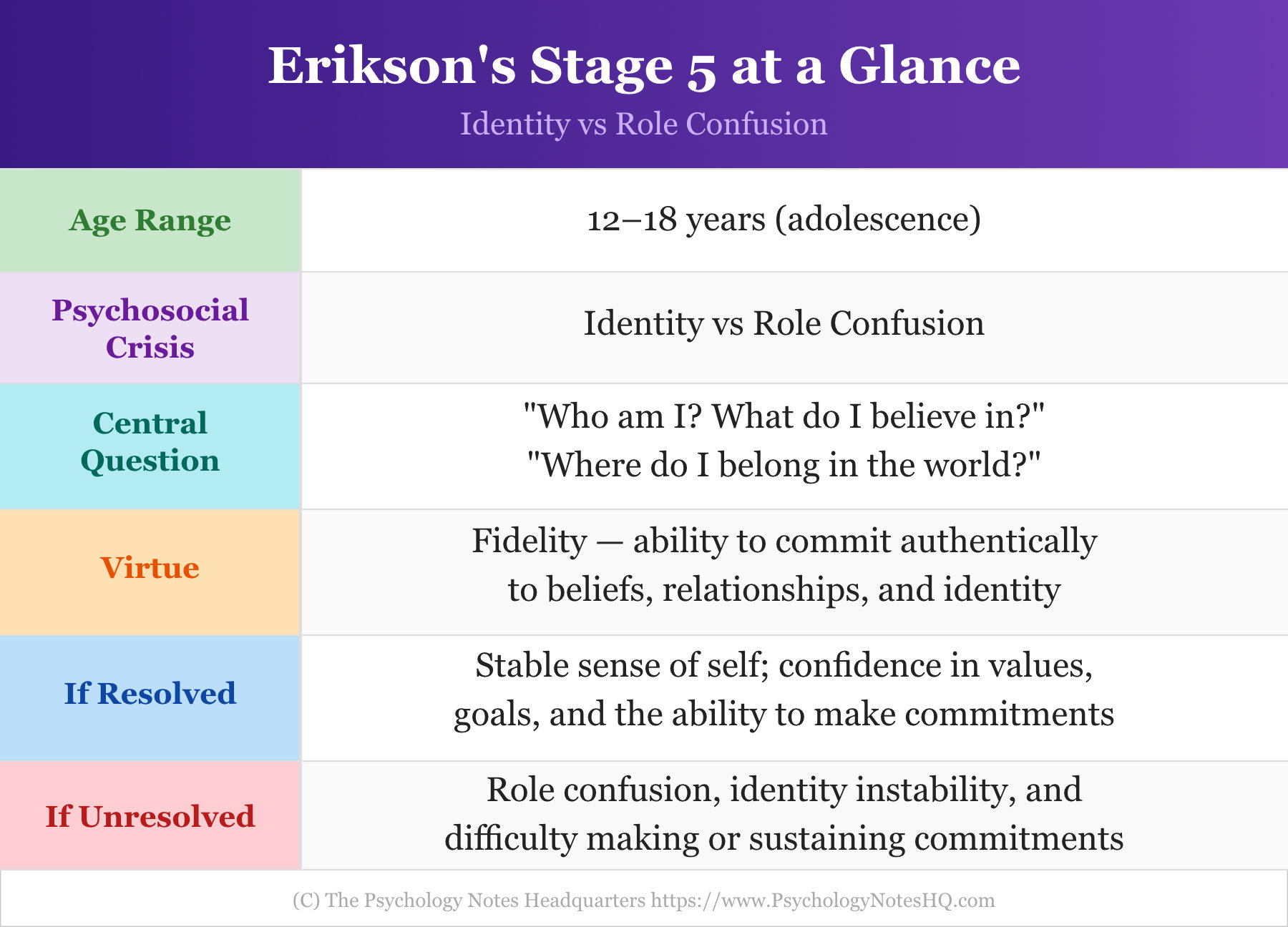
Erik Erikson’s fifth psychosocial stage occurs during adolescence, roughly ages 12 to 18, though contemporary extended adolescence may push this stage into early twenties for some individuals. This stage builds on earlier successful resolution of trust, autonomy, initiative, and industry, providing foundations for the complex identity work of adolescence.
Why adolescence proves critical for identity formation becomes clear when considering the multiple transitions converging during this period. Teenagers experience dramatic biological changes through puberty, cognitive advances enabling abstract thinking and self-reflection, increasing independence from family, expanding social worlds, and pressure to make future-oriented decisions about education, career, and relationships. These simultaneous changes create both necessity and opportunity for identity development.
The psychosocial crisis of this stage pits identity against role confusion. Adolescents must develop a stable, cohesive sense of who they are—their values, beliefs, goals, and place in the world—or risk confusion, instability, and uncertainty about identity. This isn’t just teenage angst but fundamental developmental work establishing the self that will carry forward into adulthood.
Erikson stage 5 virtue, fidelity, emerges from successfully navigating this identity crisis. Fidelity represents the capacity for authentic commitment to beliefs, relationships, and chosen identity despite inevitable conflicts with others’ different values and choices. This virtue enables the intimate relationships of Stage 6 and all subsequent adult psychosocial stages.
The Core Conflict: Identity vs Role Confusion
Developing Identity: The Exploration Process
Identity development involves actively exploring various possibilities for who one might become—trying on different roles, questioning inherited values, experimenting with beliefs and behaviors, and eventually making commitments forming a coherent self-concept. This exploration is healthy and necessary, not a problem to be eliminated.
Key Aspects of Healthy Identity Development:
- Values exploration – Questioning childhood values and determining which to keep, modify, or reject based on personal reflection rather than blind acceptance
- Belief examination – Exploring religious, political, and philosophical beliefs to develop personally meaningful positions rather than automatically adopting parents’ views
- Goal formation – Identifying personal aspirations and life directions based on interests, abilities, and values rather than others’ expectations
- Role experimentation – Trying different social roles, activities, and identities to discover what feels authentic and fitting
- Self-reflection – Developing capacity to examine oneself objectively, understand personal characteristics, and integrate them into coherent identity
The exploration process often involves what Erikson called “psychosocial moratorium”—a period where society grants adolescents time and space to explore without demanding immediate commitments. This might include trying different extracurricular activities, dating various people, changing college majors, or taking gap years before career decisions. While this exploration may look like aimlessness, it serves crucial developmental purposes.
Identity achievement represents successful completion of exploration leading to genuine commitments. Adolescents who’ve explored options and made self-directed commitments develop strong, stable identities. They know who they are, what they believe, and where they’re going. This doesn’t mean their identities never change—mature identity remains open to growth—but they possess solid foundations.
Identity moratorium describes adolescents actively exploring without yet making firm commitments. They’re asking questions, trying possibilities, and searching for answers. This represents healthy identity work in progress. Problems arise only if moratorium extends indefinitely without eventual commitment, becoming chronic indecision rather than productive exploration.
Role Confusion: The Identity Crisis
Role confusion occurs when adolescents fail to develop clear, coherent identity, resulting in uncertainty about who they are, what they believe, and where they fit. This confusion creates insecurity, instability, and difficulty making decisions or commitments.
Key Aspects of Role Confusion:
- Identity foreclosure– Accepting identity without exploration, typically adopting parents’ expectations or cultural defaults without questioning whether they fit personally
- Identity diffusion – Failing to explore or commit, remaining adrift without direction, purpose, or stable self-concept
- External pressure – Being pushed into roles or identities by parents, society, or circumstances without opportunity for personal exploration
- Overwhelming options – Becoming paralyzed by too many choices, unable to commit to any direction
- Fragmented self – Developing contradictory, inconsistent identities across contexts without integration
Identity foreclosure represents premature commitment without adequate exploration. These adolescents accept ready-made identities—following parents’ career plans, adopting family religious beliefs without question, or conforming to cultural expectations without considering alternatives. While appearing stable, foreclosed identities lack genuine personal investment and may create later crisis when individuals realize they’re living someone else’s life.
Identity diffusion describes adolescents who neither explore meaningfully nor make commitments. They drift without direction, avoiding decisions, lacking goals, and showing little investment in forming identity. This may reflect lack of opportunity for exploration, overwhelming anxiety about choices, or simply not engaging with identity work. Diffused individuals struggle with all decisions requiring self-knowledge and direction.
Being pushed into identity without choice creates role confusion even when individuals appear successful externally. The medical student pursuing medicine only because parents demanded it may excel academically while experiencing profound identity confusion about who they truly are and what they genuinely want. External success doesn’t guarantee internal identity coherence.
Role confusion manifests in various ways: constantly changing friend groups without forming stable connections, frequent major changes without clear direction, inability to make or keep commitments, feeling like an imposter or fake, uncertainty about basic preferences and values, or performing different personas in different contexts without authentic core identity.
The Basic Virtue: Fidelity
Successfully resolving identity versus role confusion develops the virtue of fidelity—the psychological strength of adolescence and early adulthood. Fidelity represents more than faithfulness in relationships, though that’s included. It encompasses the capacity for authentic commitment to self, others, beliefs, and causes despite inevitable conflicts and differences.
Core Aspects of Fidelity:
Fidelity begins with commitment to one’s own identity. Having explored options and made genuine choices about who to be, adolescents with fidelity remain true to themselves even under pressure to conform or compromise. They’ve developed strong enough identity that external pressures don’t shatter self-concept. This doesn’t mean rigidity but rather having solid core identity allowing appropriate flexibility.
The ability to relate sincerely to others depends on fidelity. Only individuals secure in their own identity can engage authentically with others. Without stable identity, relationships become performances or desperate attempts to merge with others’ identities rather than genuine connections between distinct individuals. Fidelity enables honest, authentic relating because one has a self to bring to relationships.
Accepting others despite ideological differences requires fidelity’s strength. Adolescents and young adults encounter people with very different values, beliefs, and life choices. Fidelity enables maintaining commitment to one’s own beliefs while respecting others’ rights to different positions. This tolerant pluralism—”I know who I am and what I believe, and you’re entitled to your different views”—depends on secure identity.
Fidelity enables all subsequent adult commitments—to intimate partners, careers, parenthood, communities, and causes. Without fidelity developed during identity formation, adults struggle with commitment. They fear being trapped, change directions constantly, or remain perpetually uncertain. Fidelity provides the psychological capacity for the sustained commitments characterizing adult life.
Social Influences on Identity Formation
During childhood, parents serve as primary influences shaping values, beliefs, and self-concept. Adolescence brings dramatic shift as peer groups, social circles, and broader social contexts become increasingly important for identity development. This shift from parental to peer influence is normal and necessary, not rejection of family but expansion of social world.
The Role of Peer Groups
Peer groups provide crucial context for identity exploration and formation. Within peer relationships, adolescents experiment with different personas, test out beliefs and values, receive feedback about who they are, and compare themselves to age-mates. Peer groups offer relatively safe spaces for identity experimentation that wouldn’t be possible under constant parental supervision.
Different friend groups may reflect different identity explorations. A teen who spends time with artistic friends, athletic teammates, and academic competitors explores different aspects of potential identity. Trying on different social roles within various peer contexts helps adolescents discover which feel authentic and which don’t fit.
Peer acceptance and rejection powerfully affect identity formation. Adolescents who feel accepted develop more positive, confident identities. Those experiencing rejection may develop negative identity—defining themselves in opposition to mainstream values—or confused identity marked by desperate attempts to fit in anywhere. Social acceptance matters enormously during this stage.
Romantic Relationships
Dating and romantic relationships provide additional identity formation context. Through romantic involvement, adolescents explore intimacy, learn about relationship dynamics, discover preferences and deal-breakers, and integrate romantic identity into overall self-concept. Early romantic relationships serve partly as identity exploration rather than genuine intimacy, which requires established identity (Stage 6).
Social Experimentation
Adolescence typically involves trying various activities, styles, and affiliations seeking what fits. This experimentation may look chaotic or faddish to adults but serves serious developmental purposes. Trying different clothing styles, music preferences, slang, activities, and social groups allows adolescents to test possible identities and receive social feedback about them.
Real-World Examples of Identity Development
Experimentation with Styles and Groups
Sixteen-year-old Maya has changed her appearance and friend group three times this year. She started as a preppy student athlete, shifted to alternative style with artistic friends, and now dresses more conservatively while joining academic clubs. Her parents worry about her instability, but Maya is actively exploring different aspects of potential identity, trying on different personas to see what feels authentic.
This represents healthy identity exploration. Maya experiments with different social roles and presentations, gets feedback from herself and others about what fits, and gradually narrows possibilities toward genuine identity. If she continues exploring, she’ll eventually integrate various tried aspects into coherent identity reflecting her authentic interests, values, and preferences.
Career and Educational Choices
Eighteen-year-old James faces college major decision. His parents expect him to major in business and eventually join the family company. James has always complied with parental expectations, earning good grades and staying out of trouble. However, he’s passionate about environmental science and dreams of working in conservation. The conflict between parental pressure and personal passion creates identity crisis.
If James chooses business only to please parents without personal investment, he’ll experience identity foreclosure. He’ll have role without genuine identity, potentially leading to later crisis when he realizes he’s living someone else’s life. If he chooses environmental science based on authentic passion despite parental disappointment, he’ll develop stronger, more genuine identity even though the decision creates family conflict.
Identity vs Role Confusion Examples
A high school junior volunteers for multiple causes—animal rescue, political campaigns, religious youth group—trying to discover what resonates with personal values. This exploration helps clarify beliefs and priorities forming identity foundation.
A college freshman changes majors three times within first year, exploring different academic interests and career paths before finding one matching abilities, interests, and values. While appearing indecisive, this represents productive identity work.
A teenager who always followed parents’ conservative religious views begins questioning beliefs, reading about different philosophies, attending various religious services, and eventually developing personal spiritual identity that differs somewhat from family tradition. This exploration, though potentially creating family tension, represents healthy identity development.
Impact of Modern Culture and Social Media
Contemporary adolescents navigate identity formation in dramatically different context than previous generations due to digital technology and social media. These influences create both new opportunities and significant challenges for identity development.
Digital Identity Formation
Social media platforms become major arenas for identity experimentation and presentation. Adolescents curate online personas through profile pictures, posts, bios, and interactions, experimenting with different self-presentations. This online identity work can facilitate exploration by allowing teens to try different personas relatively safely before integrating them into offline identity.
However, digital identity formation also creates complications. The permanence of online content means experimental identity phases become documented and potentially embarrassing later. The public nature of social media means identity experimentation happens before audiences including peers, family, and strangers, adding pressure and reducing safety.
Social Media Pressures
Social media intensifies social comparison, a process already prominent during adolescence. Teens constantly compare their lives, appearances, and achievements to carefully curated presentations of peers and influencers. This comparison can undermine identity formation by creating pressure to conform to idealized standards rather than develop authentic identity.
The quantification of social acceptance through likes, comments, and followers adds concrete metrics to peer evaluation previously more ambiguous. Low engagement can feel like personal rejection affecting identity development. High engagement can reinforce certain identity presentations while discouraging others.
Authentic Self vs. Curated Persona
Social media creates tension between authentic identity and curated persona. Adolescents may develop distinct online and offline identities, performing idealized versions online while feeling their real selves remain hidden. This fragmentation can complicate identity integration, creating confusion about which version represents true identity.
Some adolescents develop skill navigating multiple personas across platforms—professional on LinkedIn, social on Instagram, authentic on close friends’ private accounts. While this context-appropriate identity variation demonstrates sophistication, it can also reflect identity diffusion if no coherent core identity integrates various presentations.
Cyberbullying and Identity
Online harassment and cyberbullying can severely damage identity formation. Cruel comments, exclusion from online groups, or public shaming attacks developing identity at vulnerable moments. The visibility and permanence of online bullying amplifies harm compared to offline peer cruelty.
Benefits and Opportunities
Despite challenges, digital technology also offers identity formation benefits. Online communities allow adolescents to connect with others sharing niche interests, identities, or experiences they might not find locally. LGBTQ+ teens in conservative areas can find accepting communities online. Teens with unusual interests can connect with like-minded peers globally.
Access to diverse information, perspectives, and role models online expands identity possibilities beyond immediate environment. Teens can explore various cultural, philosophical, and lifestyle options impossible in previous generations, potentially facilitating broader exploration and more authentic identity choices.
Identity Statuses: Marcia’s Framework
Psychologist James Marcia expanded Erikson’s theory by identifying four identity statuses based on whether adolescents have explored options and made commitments. This framework helps understand different paths through identity development.
Identity Achievement: Adolescents who’ve actively explored various options and made genuine personal commitments demonstrate identity achievement. They know who they are, what they believe, and where they’re going. This represents successful resolution of identity versus role confusion, developing strong, stable identity. However, identity achievement doesn’t mean identity never changes—it means having solid foundation allowing continued growth.
Identity Moratorium: Adolescents actively exploring without yet making firm commitments are in moratorium. They’re asking questions, trying possibilities, examining options, and searching for answers. This represents healthy identity work in progress. Most adolescents pass through moratorium before achieving identity. The key is continuing exploration toward eventual commitment rather than remaining indefinitely uncommitted.
Identity Foreclosure: Adolescents who’ve made commitments without adequate exploration experience foreclosure. They’ve accepted ready-made identities—often parents’ plans or cultural defaults—without considering alternatives. While appearing stable, foreclosed identities lack personal investment and may create later crisis when individuals realize they’re living inauthentic lives. Foreclosure prevents genuine identity development.
Identity Diffusion: Adolescents who neither explore meaningfully nor make commitments show identity diffusion. They drift without direction, avoiding decisions, lacking goals, and showing little identity investment. Diffused individuals struggle with decisions requiring self-knowledge and direction. This represents failure to engage with identity work and indicates role confusion.
Understanding these statuses reveals that identity development isn’t simply success or failure but involves different patterns and pathways. Most healthy identity development includes moratorium phase of active exploration before achievement. The goal isn’t rushing to premature foreclosure but allowing sufficient exploration supporting genuine commitments.
Conclusion
Identity vs role confusion represents the central challenge of adolescence, as teenagers explore independence and develop coherent sense of self through questioning values, trying roles, and making authentic commitments. Successfully navigating this stage through active exploration and self-directed choice develops the virtue of fidelity—the capacity for authentic commitment to identity, relationships, and beliefs while accepting others’ different choices. While contemporary influences like social media complicate identity formation by adding public performance dimensions and intensifying social comparison, they also offer unprecedented access to diverse perspectives and communities supporting exploration. Whether choosing college majors, experimenting with friend groups and styles, or navigating digital personas, adolescents engaged in identity work lay crucial foundations for all subsequent adult development.
References
- Erikson, E. H. (1968). Identity: Youth and crisis. W. W. Norton & Company.
- Marcia, J. E. (1966). Development and validation of ego-identity status. Journal of Personality and Social Psychology, 3(5), 551-558.
- Marcia, J. E. (1980). Identity in adolescence. In J. Adelson (Ed.), Handbook of adolescent psychology (pp. 159-187). Wiley.
- Arnett, J. J. (2000). Emerging adulthood: A theory of development from the late teens through the twenties. American Psychologist, 55(5), 469-480.
- Kroger, J. (2007). Identity development: Adolescence through adulthood (2nd ed.). Sage Publications.
- Pew Research Center. (2018). Teens, social media and technology 2018.
How to cite this article:
The Psychology Notes Headquarters. (2026). Identity vs Role Confusion: Erikson’s Stage 5, Fidelity, and Real-Life Examples. Retrieved from https://www.psychologynoteshq.com/identity-vs-role-confusion/