
Erikson vs Piaget: How Psychosocial and Cognitive Development Differ
Piaget vs Erikson is one of the most common comparisons in developmental psychology — and also one of the most misunderstood. The two theories are not competing explanations of the same thing; they are answering entirely different questions. Erikson asked how social relationships shape who we become across a lifetime. Piaget asked how children’s thinking changes as they grow. If you want a deep dive into either theory on its own, see the full breakdown of Erikson’s eight psychosocial stages or Piaget’s four cognitive stages. This article focuses specifically on where the two theories align, where they diverge, and what those differences actually mean in practice.
Key Takeaways
- Erikson’s eight psychosocial stages span the entire lifespan from birth to death, while Piaget’s four cognitive stages focus exclusively on childhood through adolescence
- Erikson emphasizes social relationships and identity formation through resolving psychological crises, whereas Piaget focuses on individual cognitive construction through schemas and equilibration
- Piaget views development as driven by biological maturation and individual exploration, while Erikson sees cultural context and social interactions as primary developmental forces
- The theories complement rather than contradict each other, with Erikson explaining emotional development and Piaget explaining cognitive growth during the same periods
- Real-world behaviors like toddler negativity, school achievement, and teenage rebellion can be understood more fully by integrating both theoretical perspectives
Core Philosophies: Nature vs. Nurture
Piaget’s View
Jean Piaget approached development through the lens of cognitive constructivism, proposing that children actively construct knowledge through interaction with their physical environment. His theory emphasizes biological maturation as the primary driver of cognitive change. Children are not passive recipients of information but active learners who build mental structures called schemas through direct experience.
Piaget viewed the child as a “little scientist” conducting experiments on the world. Through these experiments, children discover cause-and-effect relationships, develop logical reasoning, and construct increasingly sophisticated understandings of reality. This discovery process happens largely independently, driven by the child’s innate curiosity and cognitive structures rather than by social teaching.
Central to Piaget’s theory are the concepts of schemas, assimilation, accommodation, and equilibration. Schemas are mental frameworks for understanding the world. When children encounter new experiences that fit existing schemas, they assimilate the information. When experiences contradict existing schemas, disequilibrium occurs, prompting accommodation—the modification of schemas to fit new information. This process of equilibration—moving from disequilibrium to equilibrium—drives cognitive development forward.
Piaget proposed universal stages that all children progress through in an invariant sequence, regardless of culture. These stages reflect fundamental reorganizations of cognitive structures that occur according to biological timetables. While environment can accelerate or delay development slightly, the sequence remains fixed. This universality reflects Piaget’s emphasis on biological maturation and innate cognitive structures.
Erikson’s View
Erik Erikson approached development from a psychosocial perspective, emphasizing how social relationships and cultural contexts shape personality and identity. Unlike Piaget’s focus on cognitive structures, Erikson examined emotional conflicts that arise from interactions with others and society’s expectations at different life stages.
Erikson proposed that development occurs through resolving psychosocial crises—conflicts between opposing tendencies that must be balanced. Each stage presents a unique crisis such as Trust vs. Mistrust or Identity vs. Role Confusion. Successfully navigating these crises produces virtues like hope, will, or fidelity. These are not cognitive achievements but emotional and social capacities that enable healthy functioning.
Social context occupies center stage in Erikson’s theory. Development does not happen in isolation but through relationships with caregivers, peers, mentors, and society at large. Cultural values, historical contexts, and social institutions profoundly influence how individuals navigate developmental stages. An individual’s identity emerges not just from internal processes but from dialogue with their social world.
Erikson’s theory spans the entire lifespan, recognizing that development continues from birth through old age. Each stage builds on previous ones, and unresolved conflicts from earlier stages affect later development. This lifespan perspective acknowledges that adults continue growing, facing new challenges and developing new capacities throughout life. Identity is not fixed in adolescence but continues evolving through adulthood.
Side-by-Side Age Comparison
The following chart compares Erikson’s eight psychosocial stages with Piaget’s four cognitive stages, showing how they align across developmental periods. Notice that Erikson’s theory extends well beyond childhood into adulthood and old age, while Piaget’s stages conclude with formal operational thinking in adolescence.
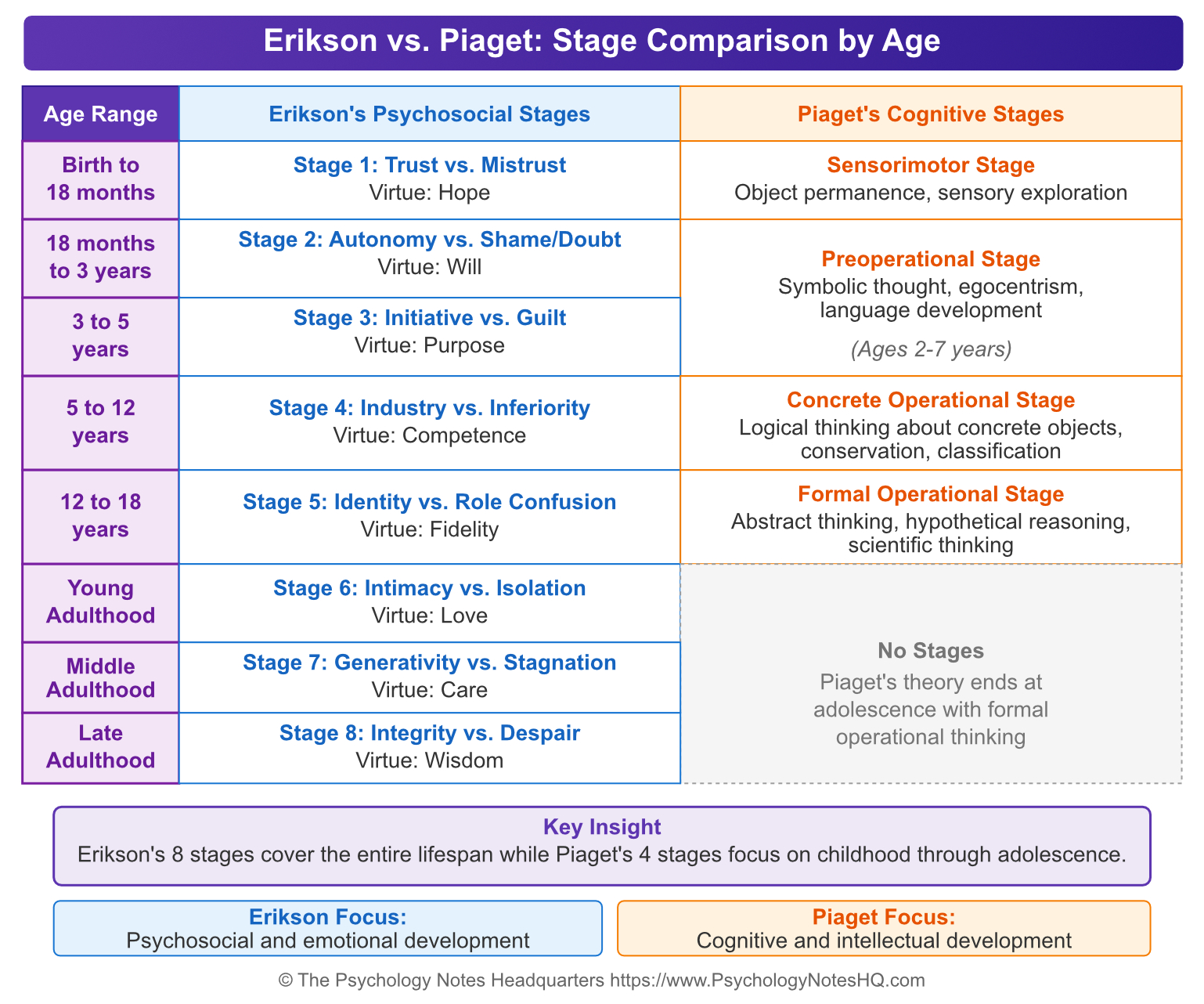
The chart reveals several important patterns. Both theories recognize infancy, early childhood, middle childhood, and adolescence as distinct developmental periods. However, Erikson subdivides childhood more finely and adds three adult stages absent from Piaget’s theory. The overlap during childhood years shows how cognitive and psychosocial development proceed simultaneously—children are both constructing logical thought and navigating social-emotional conflicts during the same periods.
Key Differences: Why They Matter
Lifespan vs. Childhood
Perhaps the most obvious difference between Erikson and Piaget lies in scope. Erikson’s eight stages cover the entire human lifespan from birth to death, while Piaget’s four stages end with the emergence of formal operational thought in adolescence. This distinction reflects fundamentally different assumptions about when meaningful development occurs.
Piaget believed that cognitive structures reach their mature form with abstract logical thinking in adolescence. Once formal operations develop, no new cognitive stages emerge—adults simply apply these mature structures to increasingly complex content. Development essentially concludes by late adolescence, with adult thinking representing refined application of formal operational logic rather than qualitatively new ways of thinking.
Erikson, conversely, recognized that psychological development continues throughout adulthood. His three adult stages—Intimacy vs. Isolation (young adulthood), Generativity vs. Stagnation (middle adulthood), and Integrity vs. Despair (late adulthood)—acknowledge that adults face new psychosocial challenges requiring continued growth. Forming intimate relationships, contributing to the next generation, and achieving acceptance of one’s life represent developmental tasks as significant as childhood challenges.
This difference matters practically. Piaget’s theory offers little guidance for understanding adult development, while Erikson provides frameworks for comprehending midlife crises, career transitions, retirement adjustments, and aging challenges. Erikson’s lifespan perspective validates the reality that adults continue growing psychologically even after cognitive structures mature.
The distinction also reflects different disciplinary origins. Piaget, trained in biology, focused on cognitive structures analogous to physical organs that reach mature form. Erikson, trained in psychoanalysis, emphasized personality and identity that continuously evolve through life experiences and relationships. Both perspectives contribute essential insights, but Erikson’s broader scope offers more comprehensive coverage of human development.
Conflict vs. Equilibrium
Erikson and Piaget conceptualized the mechanism of developmental change quite differently. Erikson described development as proceeding through psychosocial crises—conflicts between opposing tendencies that must be resolved. Piaget described development as equilibration—the process of achieving balance between assimilation and accommodation when encountering information that challenges existing schemas.
Erikson’s crisis model emphasizes tension and resolution. Each stage presents a conflict such as Autonomy vs. Shame and Doubt or Industry vs. Inferiority. These are not problems to solve but tensions to balance. Healthy development involves achieving a favorable ratio favoring the positive pole while recognizing some experience of the negative pole is inevitable and even adaptive. Successfully navigating crises produces virtues—strengths like will, competence, or wisdom.
Piaget’s equilibration model emphasizes cognitive reorganization. When children encounter experiences that fit existing schemas, they assimilate easily. When experiences contradict schemas, disequilibrium creates cognitive conflict. This discomfort motivates accommodation—modifying schemas to incorporate new information. Equilibration is the back-and-forth process of assimilation and accommodation that eventually produces more sophisticated cognitive structures.
The difference reflects distinct domains. Erikson’s crises are social-emotional conflicts arising from relationships and societal expectations. A toddler’s struggle for autonomy while fearing caregiver disapproval represents genuine psychological tension. Piaget’s disequilibrium is cognitive—mental discomfort when expectations clash with reality. A child believing heavy objects sink faster experiencing equal sinking rates faces cognitive conflict.
Both mechanisms drive development but through different processes. Erikson’s model explains how emotional capacities and identity emerge through navigating social challenges. Piaget’s model explains how logical thinking develops through confronting cognitive contradictions. Understanding both mechanisms provides richer explanations of development than either alone offers.
Social vs. Individual
Perhaps the most fundamental philosophical difference between Erikson and Piaget concerns the role of social relationships in development. Erikson placed social interaction at the center of development, while Piaget emphasized individual construction of knowledge.
For Erikson, development is inherently social. Psychosocial stages are defined by relationships—with caregivers in infancy, with peers and teachers in school years, with intimate partners in young adulthood, with the next generation in middle age. Identity emerges through dialogue with others and integration into social roles. Culture, history, and social institutions profoundly shape developmental trajectories. Individuals cannot develop in isolation because the self is fundamentally social.
Piaget, while acknowledging social factors, emphasized the child as lone constructor of knowledge. His famous metaphor of the child as “little scientist” captures this individualistic focus. Children discover logical principles through direct action on physical objects rather than through social teaching. While peers can create cognitive conflict that promotes development, the fundamental process of equilibration happens internally. Cognitive structures are constructed individually through exploration.
This difference has profound practical implications. Erikson’s theory suggests development requires supportive relationships, responsive caregivers, and appropriate social contexts. Intervention focuses on improving relationship quality and social environments. Piaget’s theory suggests development requires opportunities for active exploration and discovery. Intervention focuses on providing appropriately challenging materials and activities.
Neither extreme captures developmental reality completely. Children are both social beings developing through relationships and individual constructors of knowledge through exploration. Contemporary developmental science recognizes both processes as essential. Vygotsky’s sociocultural theory, for instance, bridges this divide by emphasizing how cognitive tools are socially transmitted while being individually internalized.
Understanding this difference helps interpret the theories appropriately. Erikson illuminates social-emotional development that inherently involves others. Piaget illuminates cognitive development where individual construction plays a larger role. Both processes occur simultaneously, making both perspectives valuable.
A child’s ability to navigate both Piagetian logic and Eriksonian trust is heavily influenced by their microsystem in Bronfenbrenner’s Ecological Theory.
3 Real-World Examples of Overlap
The Toddler’s “No”
Every parent of a two-year-old recognizes the phenomenon: relentless negativity and opposition to nearly every request. This challenging behavior can be understood through both Erikson’s and Piaget’s lenses, with each theory illuminating different aspects.
From Erikson’s perspective, the toddler’s “No!” represents healthy progression through Autonomy vs. Shame and Doubt (ages 18 months to 3 years). By refusing parental directives, toddlers assert their separate identity and exercise emerging will. Saying “No” establishes psychological boundaries—”I am not you and I have my own desires.” This opposition tests limits, explores the extent of personal control, and practices decision-making. Successfully navigating this stage requires caregivers who allow appropriate autonomy while maintaining necessary limits. The toddler’s negativity is not defiance requiring elimination but healthy identity development.
From Piaget’s perspective, the same behavior reflects egocentrism characteristic of the Preoperational stage (ages 2 to 7 years). Preoperational children cannot yet take others’ perspectives or understand that different viewpoints exist. When a toddler says “No!” to bedtime, they genuinely cannot comprehend that parents have valid reasons for the request. The child’s desires feel absolute and universal—if they do not want something, it should not happen. This cognitive limitation, not willful disobedience, explains much toddler opposition.
Both perspectives contribute essential insights. Erikson helps us appreciate that opposition serves important identity functions and should be partly accommodated through choices and autonomy opportunities. Piaget helps us recognize that toddlers literally cannot yet understand others’ perspectives, tempering expectations for reasoned negotiation. Together, the theories suggest responding with both autonomy support (offering choices) and gentle, patient limit-setting that acknowledges cognitive limitations.
The Science Project
Consider a ten-year-old working on a school science project investigating plant growth under different light conditions. The child plans the experiment, maintains consistent conditions over weeks, records data, and presents findings. This scenario illuminates different developmental processes through Erikson’s and Piaget’s frameworks.
Through Erikson’s lens, this project represents Industry vs. Inferiority (ages 5 to 12 years) in action. The child experiences the satisfaction of completing complex, sustained work. Successfully executing the project builds the virtue of competence—confidence in abilities to master tasks and produce quality work. The child learns that effort leads to accomplishment and develops productive work habits. Teacher recognition and parental praise reinforce feelings of industry. If the project fails due to inadequate support or harsh criticism, feelings of inferiority might develop instead.
Through Piaget’s lens, the same project demonstrates Concrete Operational thinking (ages 7 to 11 years). The child shows logical reasoning about concrete objects and events. Planning requires understanding cause-and-effect relationships (light affects growth). Maintaining consistent conditions demonstrates understanding of controlled experiments and conservation (keeping everything the same except the variable). Recording data involves classification and seriation. The systematic, logical approach would have been impossible during the Preoperational stage and represents concrete operational achievements.
Both perspectives enhance understanding. Erikson explains the emotional meaning—why successful completion builds lasting self-confidence and work ethic. Piaget explains the cognitive prerequisites—what mental operations make such systematic investigation possible. Teachers can use both theories: structuring projects to be cognitively appropriate (Piaget) while ensuring recognition and support that build industry (Erikson).
Teenage Rebellion
Teenage rebellion—questioning parental authority, challenging societal norms, experimenting with different identities—represents a nearly universal developmental phenomenon. Both Erikson and Piaget offer explanatory frameworks that complement rather than contradict each other.
Erikson’s Identity vs. Role Confusion (ages 12 to 18 years) provides the psychosocial explanation. Adolescents must integrate childhood identifications, emerging sexual maturity, and societal expectations into a coherent identity. This requires exploring different roles, ideologies, and relationships. Questioning parental values is not disrespect but necessary identity work—teens must critically examine inherited beliefs to determine which fit their emerging selves. Rebellion tests which parental rules truly matter versus which can be renegotiated. Successfully navigating this stage produces fidelity—the ability to commit to values and relationships despite inevitable contradictions.
Piaget’s Formal Operational stage (ages 11+ years) provides the cognitive explanation. Adolescents newly develop abstract thinking and hypothetical reasoning. For the first time, they can imagine alternative possibilities, think about thinking, and reason about ideals versus reality. This new cognitive capacity makes them see contradictions in adult behavior and societal hypocrisy previously invisible. Parents who say “Do as I say, not as I do” face formal operational analysis that reveals the inconsistency. Authority based on “Because I said so” no longer satisfies teens who can now demand logical justification.
Together, the theories explain why rebellion typically emerges in adolescence. Piaget shows why teens newly possess cognitive tools to critique authority and imagine alternatives. Erikson shows why they are motivated to use these tools—identity formation requires examining rather than blindly accepting inherited values. Parents understanding both perspectives can respond more effectively, providing logical explanations that respect formal operational abilities while maintaining boundaries that support healthy identity exploration.
Conclusion
Erikson and Piaget represent complementary pillars of developmental psychology, with Erikson illuminating psychosocial and identity development across the lifespan while Piaget maps cognitive growth through childhood and adolescence. Their key differences—lifespan versus childhood focus, crisis versus equilibration mechanisms, social versus individual emphasis—reflect distinct but equally valid aspects of human development. Real-world behaviors from toddler opposition to teenage rebellion make more sense when viewed through both theoretical lenses. Rather than choosing between these giants, contemporary understanding integrates their insights, recognizing that children simultaneously construct logical thinking and navigate emotional conflicts.
References
- Erikson, E. H. (1950). Childhood and society. W.W. Norton and Company.
- Erikson, E. H. (1968). Identity: Youth and crisis. W.W. Norton and Company.
- Piaget, J. (1952). The origins of intelligence in children. International Universities Press.
- Piaget, J., & Inhelder, B. (1969). The psychology of the child. Basic Books.
- Ginsburg, H. P., & Opper, S. (1988). Piaget’s theory of intellectual development (3rd ed.). Prentice-Hall.
- Chapman, M. (1988). Constructive evolution: Origins and development of Piaget’s thought. Cambridge University Press.
How to cite this article:
The Psychology Notes Headquarters. (2026). Erikson vs Piaget: How Psychosocial and Cognitive Development Differ. Retrieved from https://www.psychologynoteshq.com/erikson-stages-vs-piaget-stages/