
Autonomy vs Shame and Doubt: Erikson’s Stage 2 & Toddler Independence
Autonomy vs Shame and Doubt is the second stage of Erikson’s psychosocial theory, occurring between 18 months and 3 years, when toddlers begin asserting independence and developing the virtue of Will. Watch any two-year-old for five minutes and you will witness an epic battle between “I do it myself!” and the inevitable frustration of learning. The real-life examples from this stage help caregivers understand how to support a child’s emerging independence while protecting their fragile self-confidence.
Key Takeaways
- Autonomy vs shame and doubt examples — from potty training to toy selection — show how toddlers build independence through physical mastery and everyday decision-making between 18 months and 3 years.
- The virtue of autonomy vs shame and doubt is Will: the capacity for self-determination that emerges when toddlers exercise appropriate control without excessive criticism or overprotection.
- Key milestones include potty training, self-feeding, walking, and the power of saying no, which represents healthy identity development rather than defiance.
- Parents who allow age-appropriate independence while providing patient support help children develop confidence, while those who shame mistakes foster lasting self-doubt.
- Successfully resolved autonomy leads to self-determined adults with healthy confidence, while unresolved shame can manifest as imposter syndrome and perfectionism.
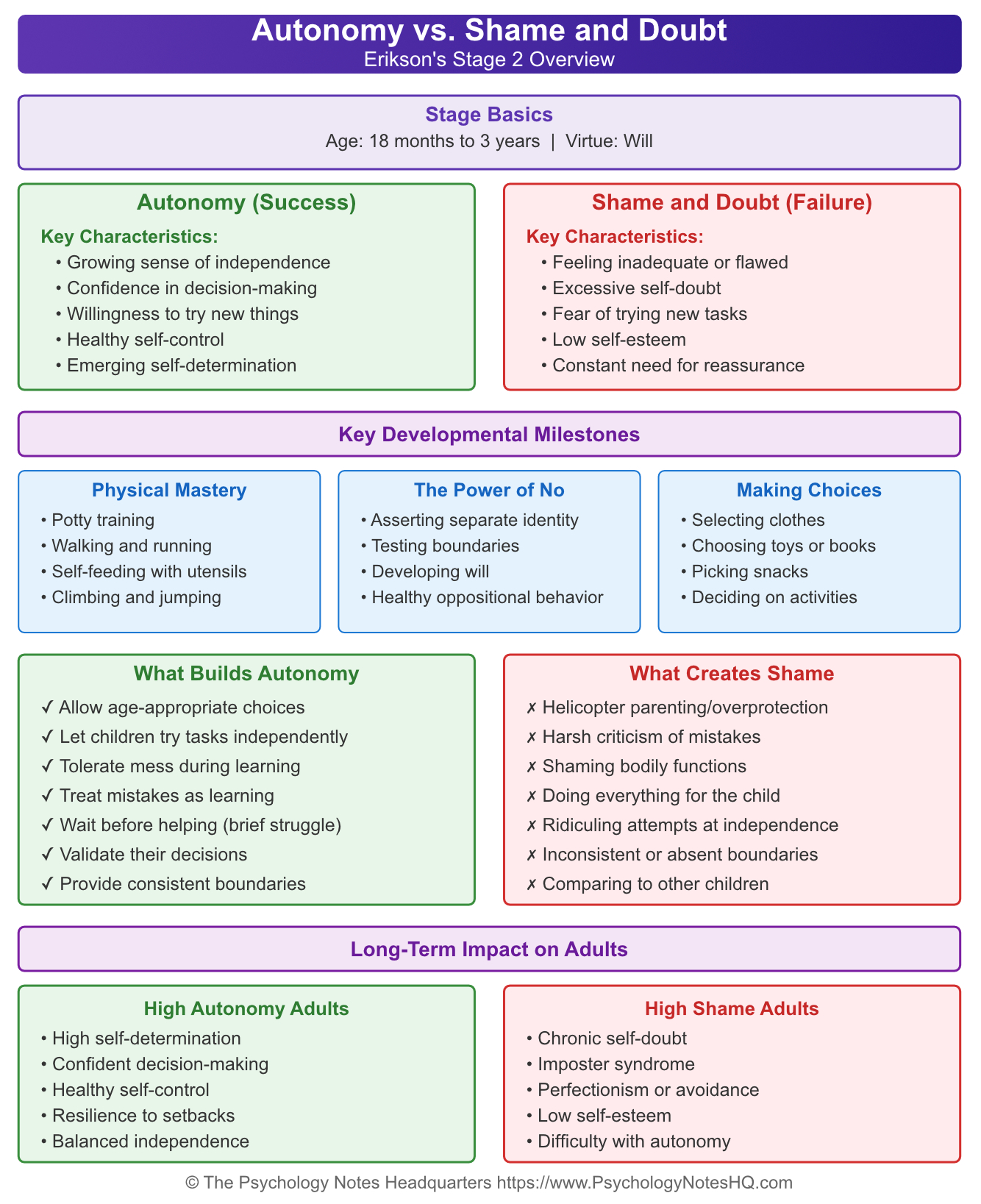
Download this overview in PDF format
Understanding Stage 2: Autonomy vs Shame and Doubt
Erik Erikson’s psychosocial development theory proposes eight stages across the human lifespan, each presenting a central conflict requiring resolution. Stage 2, Autonomy vs Shame and Doubt, builds directly on the trust established in Stage 1. Infants who developed basic trust in their caregivers and world now face a new challenge: asserting their emerging independence while navigating the boundaries of acceptable behavior.
The Erikson Stage 2 age ranges from approximately 18 months to 3 years, though these boundaries are flexible. This period coincides with dramatic physical and cognitive developments. Toddlers gain mobility, language skills, and cognitive abilities that enable them to act on the world in new ways. They can walk away from caregivers, manipulate objects, communicate desires, and begin understanding cause-and-effect relationships. These capabilities create both the possibility and necessity for greater independence.
Autonomy, in this context, means developing a sense of personal control and the ability to make choices within appropriate limits. It involves discovering “I am separate from others and can influence my world.” Toddlers developing healthy autonomy feel capable, confident in trying new things, and secure in their growing independence. They understand they can make decisions and affect outcomes through their actions.
Shame represents the negative pole of this stage’s conflict. It emerges when toddlers feel exposed, inadequate, or fundamentally flawed. Shame is distinct from guilt — guilt involves feeling bad about specific behaviors, while shame involves feeling bad about oneself. A child experiencing shame internalizes “I am bad” rather than “I did something wrong.” This global self-judgment can profoundly impact identity development.
Doubt accompanies shame, manifesting as uncertainty about one’s abilities and judgment. Toddlers experiencing excessive doubt question whether they can trust their own capabilities. They hesitate to try new things, constantly seek reassurance, and feel anxious about making even simple decisions. This self-doubt interferes with the very exploration and practice necessary for developing genuine competence.
The conflict between autonomy and shame-doubt is not an either-or proposition. Erikson emphasized achieving a favorable ratio rather than eliminating shame and doubt entirely. Some shame and doubt are protective — they help children recognize limitations and develop appropriate caution. The goal is sufficient autonomy to foster confidence and initiative while maintaining enough awareness of limitations to exercise appropriate self-control.
Successfully navigating this stage produces the virtue Erikson called Will. The virtue associated with autonomy vs shame and doubt — Will — is the determination to exercise free choice and self-restraint despite the inevitable experience of shame and doubt. It is the foundation for healthy self-determination throughout life, enabling individuals to pursue goals persistently while accepting reasonable limits.
Key Milestones: The Quest for Independence
Several developmental achievements characterize the Autonomy vs Shame and Doubt stage, each presenting opportunities for either building confidence or fostering doubt.
Physical Mastery
The most visible markers of growing autonomy involve physical accomplishments that reduce dependence on caregivers. Potty training stands as the quintessential Stage 2 challenge, representing perhaps the first major expectation that toddlers control their own bodies according to social rules. The process requires physical maturation, cognitive understanding, and emotional readiness. How caregivers approach this milestone profoundly impacts the autonomy-shame balance.
Success in toileting represents mastery over one’s own body — a powerful statement of self-control and independence. Children who achieve this milestone with supportive, patient guidance develop confidence in their ability to meet expectations and control their physical selves. Conversely, harsh criticism of accidents, excessive pressure before readiness, or shaming responses to normal setbacks can create deep shame about bodily functions and self-doubt about competence.
Walking and gross motor skills continue developing throughout Stage 2, with toddlers progressing from tentative first steps to running, climbing, and jumping. Each new physical capability expands the child’s world and opportunities for independent action. The toddler who can walk to the toy shelf and retrieve a desired toy exercises autonomy in a way the immobile infant cannot. Parents who allow safe exploration while setting appropriate boundaries support this developing mastery.
Self-feeding represents another critical physical milestone. The progression from being fed to finger foods to attempting utensils involves considerable coordination and practice. The process is inevitably messy — food ends up everywhere except mouths initially. Parents who tolerate this mess as a necessary part of learning enable children to develop feeding competence and the satisfaction that comes with “I did it myself.” Those who criticize messiness or maintain complete feeding control prevent children from developing this fundamental self-care skill.
The “Power of No”
Perhaps nothing defines the terrible twos more than the word “No!” shouted in response to nearly every parental request. While exhausting for caregivers, this oppositional behavior represents healthy developmental progress rather than defiance requiring elimination.
Saying “No” serves multiple developmental purposes. First, it asserts the toddler’s separate identity. By opposing caregiver wishes, the child establishes psychological separateness — “I am not you and I have my own desires.” This differentiation is essential for developing a coherent sense of self. Second, “No” tests the boundaries of acceptable behavior and the consistency of rules. Toddlers need to understand which limits are firm and which are negotiable. Third, refusal represents exercising will — the very virtue this stage aims to develop.
Understanding the developmental significance of negativism helps parents respond more effectively. While limits must be maintained for safety and socialization, not every disagreement requires a power struggle. Offering choices within acceptable parameters allows toddlers to exercise autonomy while caregivers maintain necessary control. “Do you want to wear the red shirt or blue shirt?” gives the child decision-making power within limits the parent can accept.
The key is distinguishing between opposition as identity development and genuine misbehavior requiring correction. A toddler saying “No!” to bedtime is testing boundaries and asserting independence — normal and necessary. The same toddler hitting a sibling has crossed a boundary requiring firm, immediate intervention. Responding appropriately to this distinction — firm on safety and respect, flexible on preferences — supports healthy autonomy development.
Making Choices
Autonomy develops through practice making decisions and experiencing their consequences. Toddlers need age-appropriate opportunities to exercise choice throughout daily routines. Choosing which shirt to wear, which toy to play with, or which snack to eat provides practice in decision-making within safe parameters.
The key is offering choices caregivers can accept. Asking “What do you want for lunch?” creates problems when the toddler chooses candy. Asking “Do you want cheese or turkey in your sandwich?” provides real choice within acceptable options. This approach respects the child’s developing autonomy while maintaining parental guidance.
Making choices and experiencing outcomes teaches cause-and-effect relationships and personal agency. The toddler who chooses the red cup and receives juice in the red cup learns their choices produce predictable results. The child who picks a particular toy and gets to play with it understands they can influence their environment. These experiences of agency build confidence and competence.
Importantly, choices should be offered only when genuine options exist. Asking “Do you want to take a bath?” when bathing is non-negotiable sets up conflict. Better to state “It’s bath time. Do you want bubbles or no bubbles?” This maintains the necessary routine while offering real choice within it.
5 Practical Autonomy vs Shame and Doubt Examples
Abstract developmental principles become concrete through everyday scenarios that either support autonomy or foster shame and doubt.
Example 1: The Wardrobe Battle
Two-and-a-half-year-old Jackson insists on wearing his red superhero shirt every single day. On this particular morning, he also selects bright orange pants, green striped socks that do not match, and his yellow rain boots despite clear skies. His mother’s first instinct is to redirect him toward a more coordinated outfit. After all, they are visiting grandparents who might judge her parenting based on Jackson’s mismatched appearance.
However, recognizing this as an autonomy-building opportunity, she makes a different choice. “You picked out your whole outfit by yourself! Those are great choices.” Jackson beams with pride. At grandma’s house, when asked about his unique fashion sense, the mother explains he is learning to dress himself and make his own choices.
This scenario demonstrates supporting autonomy over social conformity. Jackson’s clothing choices harm no one and allow him to exercise decision-making power. By validating rather than criticizing his selections, his mother builds his confidence and willingness to make independent choices. The implicit message is “Your decisions matter and you are capable of making them.”
Contrast this with a parent who says “You look ridiculous. Go change into matching clothes immediately.” This response shames the child’s choices and abilities, suggesting his judgment is fundamentally flawed. The child learns that autonomy leads to criticism, making him less likely to exercise independence in the future.
The key is distinguishing battles worth fighting from those worth surrendering. Mismatched socks provide autonomy practice. Running into the street requires immediate parental control for safety. Wise parents choose their battles carefully, allowing autonomy wherever reasonably possible.
The Takeaway: Validating mismatched clothing choices fosters decision-making confidence over social conformity.
A parent’s ability to allow exploration is often dictated by their own stress levels, a factor in the Exosystem of Bronfenbrenner’s ecological theory.
Example 2: Potty Training Success
Twenty-month-old Sophia has been using the potty successfully for two weeks. One afternoon, deeply engaged in playing with blocks, she ignores her body’s signals until too late. She has an accident in her pants, soaking through to the carpet.
Her father’s response determines whether this normal learning setback builds shame or remains a neutral part of the learning process. He takes a deep breath to manage his own frustration about the carpet, then calmly says “Oops, you had an accident. That’s okay, accidents happen when we’re learning. Let’s get you cleaned up.” He helps her change clothes without commentary or criticism, has her help clean up as she is able, and encourages her to try using the potty next time.
This response treats the accident as a normal, expected part of learning rather than a failure or something shameful. The message is “You are learning a new skill and mistakes are part of learning, not evidence you are bad or incapable.” This approach maintains Sophia’s confidence and motivation to continue practicing.
Contrast this with a parent who responds with anger: “What is wrong with you? You know better! You are acting like a baby. This is disgusting and now the carpet is ruined. You should be ashamed of yourself.” This response creates profound shame, linking normal physiological accidents with being fundamentally flawed. Children receiving such messages internalize that their bodies are shameful and they are incompetent.
The long-term impact of these different responses extends far beyond toilet training. Children who learn that mistakes lead to shaming criticism become afraid to try new things or risk failure. Those who learn that mistakes are learning opportunities develop resilience and willingness to persist through difficulties.
The Takeaway: Treating accidents as normal learning experiences builds confidence and resilience rather than shame about bodily functions.
Example 3: Self-Feeding
Eighteen-month-old Marcus is determined to use a spoon by himself. His parents have been feeding him to avoid mess, but today he grabs the spoon and insists “Me do it!” His father loads the spoon with yogurt and hands it to Marcus, who immediately turns it upside down, dumping yogurt on his lap. Marcus looks distressed.
His father’s response is crucial. He could take the spoon back, saying “You’re making too much of a mess. Let me do it.” This protects the kitchen but undermines Marcus’s developing autonomy. Instead, he says “It’s tricky! Let’s try again together.” He places his hand over Marcus’s on the spoon, helping guide it to his mouth successfully. After several guided trials, he reduces support, letting Marcus attempt more independently. The process is slow and messy, but Marcus successfully feeds himself several spoonfuls.
This approach balances support with independence. The father acknowledges the difficulty, provides scaffolding to ensure some success, then gradually transfers control to Marcus. The mess is treated as an inevitable and acceptable cost of learning. Marcus develops both the physical skill of using utensils and the emotional confidence that comes with “I did it myself!”
The alternative — continuing to feed Marcus to avoid mess — prevents skill development and sends the message that he is incapable. While expedient short-term, this approach prolongs dependence and denies Marcus opportunities to develop competence. Children need opportunities to practice skills within their growing capabilities, even when that practice is imperfect.
The Takeaway: Tolerating mess during self-feeding practice develops both physical competence and emotional confidence in independent abilities.
Example 4: Toy Selection
Three-year-old Amara’s bedtime routine includes choosing one book for her mother to read. The bookshelf contains twenty options ranging from simple board books to longer picture books. Tonight, Amara selects a very short board book she loved as an infant. Her mother’s first thought is to redirect her toward something more age-appropriate that would take longer to read.
Instead, recognizing this as Amara’s choice, she simply says “You picked the moon book! That’s one of your favorites.” They read the brief book together, with Amara turning pages and pointing to pictures. Amara then spontaneously chooses a second book, this time selecting a longer one. They read that one too.
By respecting Amara’s initial choice without criticism, her mother validated her decision-making. Amara felt autonomous and competent in her choice. This confidence allowed her to make a second choice, extending the reading time naturally. Had her mother criticized or overridden the first choice, Amara might have felt her preferences did not matter or her judgment was inadequate.
This example illustrates how small daily choices build autonomy. Selecting a bedtime book is a low-stakes decision where any choice is acceptable. These practice decisions help toddlers develop confidence in their judgment and learn that their preferences matter. The accumulated effect of many such small choices builds the foundation for healthy autonomous functioning.
The Takeaway: Respecting low-stakes preferences validates decision-making and builds confidence that choices matter.
Example 5: Problem Solving
Two-year-old Devon is working on a simple puzzle with four large pieces. He picks up a piece and tries to force it into the wrong space, pushing harder when it does not fit. His grandmother, sitting nearby, automatically reaches to help. She catches herself, instead waiting and watching.
After ten seconds of unsuccessful attempts, Devon puts down the piece and picks up a different one. He tries this piece in several spots, then successfully places it. He looks up at his grandmother with pride. “You did it!” she exclaims. “You figured out which piece goes there.”
This scenario demonstrates the power of allowing struggle before providing help. The grandmother’s initial instinct to immediately assist would have deprived Devon of the satisfaction of independent problem-solving. By waiting, she gave him the opportunity to persist, try different strategies, and succeed on his own.
The ten-second wait is strategic. It provides enough time for the child to try different approaches without becoming so frustrated that they give up entirely. If Devon had continued struggling past his frustration tolerance, the grandmother would have stepped in with support: “That one doesn’t fit there. Should we try a different piece?” This balances promoting independence with preventing excessive frustration.
Children who regularly experience supported problem-solving develop persistence and confidence in their abilities. They learn that initial failure does not mean ultimate defeat and that they have resources to overcome challenges. This lesson, learned through countless small moments in toddlerhood, becomes the foundation for resilient, confident functioning throughout life.
The Takeaway: Allowing brief struggle before offering help develops persistence and confidence in independent problem-solving abilities.
The “Shame and Doubt” Trap
While most parents genuinely want to support their children’s development, certain well-intentioned approaches actually undermine autonomy and foster shame and doubt.
Overprotection
Helicopter parenting—constantly hovering over children, anticipating every need, and preventing any discomfort—has become increasingly common. While motivated by love and concern for children’s wellbeing, this approach prevents the very experiences toddlers need to develop autonomy.
When parents never let toddlers try things independently, children receive an implicit message: “You cannot do this yourself. You are not capable.” A toddler who never attempts stairs because a parent always carries them does not develop the physical skill or confidence that comes from mastering stairs with support. The child who never chooses their own clothes because parents always select coordinated outfits does not practice decision-making.
Overprotection also prevents children from experiencing and managing frustration. The parent who immediately solves every problem deprives the child of learning persistence and problem-solving. While preventing short-term distress, this approach creates long-term vulnerability. Children never learn they can tolerate difficulty and overcome challenges.
The key is distinguishing appropriate protection from overprotection. Preventing a toddler from touching a hot stove is essential safety. Preventing that same toddler from attempting to put on their own shoes is overprotection. The first protects from genuine danger; the second prevents healthy struggle and learning.
Finding the right balance involves offering the minimum assistance necessary while allowing maximum appropriate independence. This requires tolerating some mess, some mistakes, and some frustration while maintaining safety. It means being close enough to support but far enough to let children try.
Excessive Criticism
The most direct route to shame and doubt is harsh criticism of normal developmental efforts and mistakes. When toddlers attempting new skills receive criticism, ridicule, or anger for predictable failures, they internalize deep shame about their abilities.
Consider a toddler learning to pour juice from a small pitcher. The task requires motor control they are still developing. Spills are inevitable. A parent who responds to spills with anger—”What is wrong with you? Why can’t you do this simple thing? You are making such a mess!”—creates shame. The child learns that attempting new things leads to harsh judgment and that mistakes reveal fundamental inadequacy.
This pattern extends beyond specific skills to general self-concept. The child repeatedly criticized for normal developmental struggles develops a core belief of incompetence. They begin to see themselves as inadequate, incapable, and disappointing to others. This shame becomes part of their identity rather than being limited to specific situations.
The long-term consequences are profound. Children who develop shame-based identities become adults who fear judgment, avoid challenges, and struggle with persistent self-doubt. They may develop perfectionism—setting impossibly high standards to avoid criticism—which paradoxically guarantees failure and reinforces shame. They may avoid attempting anything where success is uncertain, drastically limiting their life experiences.
The antidote to excessive criticism is responding to mistakes and failures as learning opportunities. “You spilled some juice. That’s okay—pouring is tricky. Let’s wipe it up together and try again.” This response normalizes mistakes, maintains the child’s dignity, and encourages persistence. The child learns that errors are temporary setbacks in learning, not evidence of fundamental inadequacy.
Long-Term Impact: From Toddler to Adult
The autonomy developed—or shame internalized—during Stage 2 reverberates throughout the lifespan, shaping adult personality and functioning in profound ways.
The Virtue of Will
When toddlers successfully navigate the Autonomy vs Shame and Doubt stage, they develop what Erikson called Will—the capacity for self-determination and self-control despite inevitable experiences of shame and doubt. Will represents more than stubbornness or determination. It is the balanced ability to exercise free choice while accepting reasonable limitations, to persist toward goals while recognizing when to adjust course, and to maintain self-direction without becoming rigidly controlling.
Adults who developed healthy Will in toddlerhood exhibit several characteristic patterns. They demonstrate high self-determination, setting their own goals and pursuing them persistently. They make decisions confidently without excessive second-guessing or constant need for external validation. They tolerate setbacks and failures without catastrophizing or abandoning efforts entirely. They can delay gratification when necessary but also know when to prioritize immediate needs or pleasures.
These adults exhibit healthy autonomy in relationships—maintaining their own identity and preferences while remaining open to influence and compromise. They neither cling dependently nor maintain rigid independence that prevents intimacy. They can ask for help when needed without experiencing this as shameful dependence.
Perhaps most importantly, adults with well-developed Will exercise appropriate self-control. They regulate impulses and emotions without becoming rigidly over-controlled. They pursue goals through sustained effort while remaining flexible about methods. They set boundaries with others while respecting others’ boundaries. This balanced self-regulation reflects the fundamental lesson of Stage 2: I can control myself and influence my world within appropriate limits.
Adult Insecurity
Conversely, unresolved shame and doubt from Stage 2 manifests in various adult psychological difficulties. The most direct connection is to generalized low self-esteem and chronic self-doubt. Adults who internalized shame in toddlerhood often struggle with persistent feelings of inadequacy despite objective accomplishments.
Imposter syndrome—the psychological pattern where successful people cannot internalize their achievements and fear being exposed as frauds—has clear roots in Stage 2 shame. These individuals achieved external success but maintain internal conviction of inadequacy. No amount of external validation resolves the fundamental self-doubt because it originates not from reality but from internalized childhood shame.
Perfectionism represents another common manifestation. Adults with unresolved Stage 2 shame set impossibly high standards, believing anything less proves their inadequacy. They equate mistakes with fundamental failure and may avoid attempting anything where they cannot guarantee success. This rigid perfectionism paradoxically guarantees frequent feelings of failure, reinforcing shame.
Relationship difficulties often trace to Stage 2 issues. Some adults with shame-based identities become excessively dependent, unable to trust their own judgment and constantly seeking others’ direction and approval. Others develop counterdependent patterns, refusing all help and maintaining rigid self-sufficiency because depending on others feels shameful. Neither extreme allows for healthy interdependence.
Control issues—either excessive need to control everything or difficulty exercising any control—often originate in Stage 2. The toddler whose appropriate autonomy attempts were crushed may become an adult who feels powerless and unable to influence their environment. Conversely, the toddler whose every whim was indulged without appropriate limits may become an adult who cannot tolerate any frustration of their desires.
Can these patterns change? Fortunately, yes. While early experiences create tendencies, humans maintain neuroplasticity and capacity for change throughout life. Therapy, particularly approaches focused on shame resilience and self-compassion, can help adults rewrite shame-based narratives. Corrective experiences in relationships—partners, friends, or therapists who respond to vulnerability without shame—gradually build new internal models. Deliberately practicing self-compassion and treating oneself with the kindness one would offer a struggling toddler helps heal early wounds.
Conclusion
Autonomy vs Shame and Doubt represents a critical juncture in psychosocial development where toddlers establish fundamental orientations toward independence, competence, and self-worth. Parents and caregivers who allow age-appropriate independence, respond patiently to normal mistakes, and maintain appropriate boundaries enable children to develop the virtue of Will—healthy self-determination balanced with realistic self-control. Those who overprotect, criticize harshly, or fail to provide necessary limits foster shame and doubt that can persist throughout life. The key lies in providing numerous opportunities for toddlers to practice autonomy within safe parameters, treating mistakes as learning experiences, and celebrating growing competence. Successfully navigating this stage creates confident, self-directed individuals capable of pursuing goals while accepting reasonable limitations.
References
- Erikson, E. H. (1950). Childhood and society. W.W. Norton and Company.
- Erikson, E. H. (1968). Identity: Youth and crisis. W.W. Norton and Company.
- Tangney, J. P., & Dearing, R. L. (2002). Shame and guilt. Guilford Press.
- Brown, B. (2012). Daring greatly: How the courage to be vulnerable transforms the way we live, love, parent, and lead. Gotham Books.
- Maurer, D., & Maurer, C. (1989). The world of the newborn. Basic Books.
- Sroufe, L. A., Egeland, B., Carlson, E. A., & Collins, W. A. (2005). The development of the person: The Minnesota study of risk and adaptation from birth to adulthood. Guilford Press.
How to cite this article:
The Psychology Notes Headquarters. (2026). Autonomy vs Shame and Doubt: Erikson’s Stage 2 & Toddler Independence. Retrieved from https://www.psychologynoteshq.com/autonomy-vs-shame/