
Montessori and Erikson: How a Prepared Environment Supports Psychosocial Growth
The Montessori prepared environment is more than a classroom design philosophy — it maps directly onto the psychosocial needs Erik Erikson identified across childhood. While Montessori approached development as an educator and physician, and Erikson as a psychoanalytic theorist, their conclusions converge on the same point: children need specific conditions to develop autonomy, initiative, and competence. The prepared environment in Montessori is built to provide exactly those conditions, stage by stage.
Key Takeaways
- The Montessori prepared environment directly supports Erikson’s first four psychosocial stages by providing freedom, structure, and age-appropriate challenges for healthy ego development.
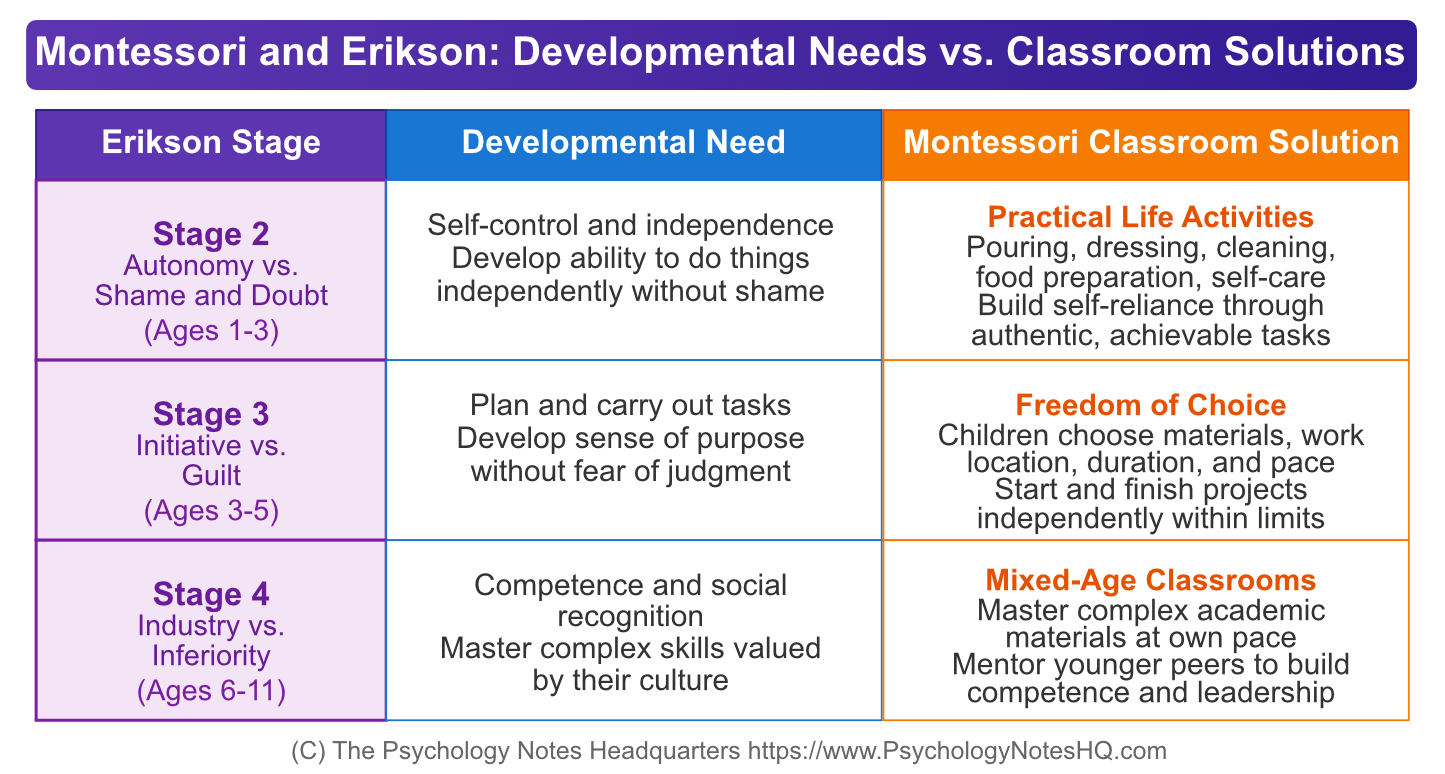
- Practical Life activities in Montessori toddler classrooms support Erikson’s Autonomy vs. Shame stage by allowing children to develop self-reliance through real, purposeful tasks.
- Freedom of choice in Montessori preschool environments supports Initiative vs. Guilt by enabling children to plan and complete projects without fear of adult judgment.
- Mixed-age Montessori classrooms support Industry vs. Inferiority by creating natural opportunities for mastery, peer mentoring, and genuine competence-building.
- Montessori teachers shift from directors to observers, designing environments where psychosocial development happens through exploration rather than instruction.
Understanding Both Frameworks
Maria Montessori and Erik Erikson approached child development from different angles but arrived at remarkably compatible conclusions. Montessori, working as an educator and physician in early 20th-century Italy, developed her philosophy through direct observation of children’s natural learning tendencies. She found that when given appropriate freedom and materials, children consistently choose activities that match their developmental needs.
Erik Erikson, building his psychosocial theory mid-20th century, identified eight stages spanning the entire lifespan, each presenting a crisis that must be resolved for healthy personality development. The first four stages occur during childhood and address fundamental questions of trust, autonomy, initiative, and competence.
Why these two theories fit together becomes clear when you look at what Montessori’s methods actually do. The Montessori environment and classroom aren’t just about academic learning — they’re structured to give children precisely the experiences Erikson argued they need at each developmental stage. Education and emotional development, in this framework, are the same project.
What Does the Montessori Prepared Environment Actually Include?
Before exploring how the prepared environment in Montessori maps onto Erikson’s stages, it helps to understand what it consists of. The montessori classroom setting is deliberately constructed around the child’s scale and independence, not the teacher’s convenience. Key elements include:
- Child-sized furniture — tables, chairs, and shelves sized for the child’s body so no adult assistance is needed to access materials
- Open, low shelves — materials are displayed visibly and accessibly, never stored in bins or cabinets out of reach
- Practical Life area — real tools and materials for pouring, dressing, food preparation, cleaning, and self-care
- Sensorial materials — manipulatives designed to isolate and refine each of the senses
- Language and mathematics materials — concrete representations of abstract concepts that children manipulate before moving to symbols
- Child-height sinks and toilets — enabling genuine physical independence in self-care routines
- Natural materials and living things — plants, wood, glass, and real objects rather than plastic toy versions
- A consistent organizational system — each material has a fixed place, giving children predictability and the ability to self-manage
This structure is what makes independence possible. Children in the montessori environment don’t wait for adult permission to begin work — the environment itself communicates what is available and how to use it.
Stage 2: Autonomy vs. Shame and Doubt (Toddlerhood)
Erikson’s second psychosocial stage occurs during toddlerhood, roughly ages 1 to 3, when children face the challenge of developing autonomy while avoiding shame and doubt. At this age, children are driven to assert independence across feeding, dressing, and movement. Developing healthy autonomy requires environments that support this drive while providing appropriate structure and limits.
Erikson’s Developmental Need: Self-Control and Independence
Toddlers need opportunities to make choices and accomplish tasks without adult intervention. When consistently prevented from trying things independently or harshly criticized for mistakes, children develop shame about their abilities and doubt about their capacity for self-direction. The challenge for caregivers and educators is balance — enough freedom to build autonomy, enough structure to prevent overwhelm.
Montessori’s Solution: Practical Life Activities
Montessori toddler classrooms emphasize Practical Life activities — real, purposeful tasks that build independence, coordination, and self-care. These are not toy versions of adult work but functional activities with actual consequences, treating children as capable of genuine contribution.
Core Practical Life activities include pouring water or dry materials between containers, using dressing frames with buttons, zippers, and snaps, preparing simple foods, sweeping, washing tables, and caring for plants. Each task is designed to be achievable for a toddler while requiring real skill and attention.
The Montessori environment prevents shame through built-in self-correction. If water spills during pouring, the child sees it immediately and can clean it up — no adult judgment required. Puzzle pieces that don’t fit show the child directly that something’s off. Mistakes become information rather than occasions for criticism, which is exactly what Erikson argued toddlers need to develop confidence rather than shame.
Teachers observe rather than direct, stepping in only when frustration tips past productive struggle. This restraint — which runs counter to most adult instincts — communicates something important: the child is trusted to figure things out.
Stage 3: Initiative vs. Guilt (Preschool)
Erikson’s third stage spans approximately ages 3 to 5, when children begin asserting power through planning, directing play, and pursuing goals. This stage builds on autonomy — children don’t just want independence, they want to initiate. When adults consistently dismiss children’s ideas or criticize their projects, children develop guilt about their natural drive to create and lead, becoming passive rather than purposeful.
Montessori’s Solution: Freedom of Choice
The cornerstone of Montessori preschool practice is freedom of choice within clear limits. Children choose which materials to work with, where to work, how long to stay with an activity, and whether to work alone or alongside others. This freedom treats children’s choices as valid and meaningful — which is precisely what initiative requires.
The choosing process itself develops initiative. Children scan the montessori environment, observe what others are doing, identify what they want to work on, and follow through. That sequence — identify, decide, act — is the psychological core of initiative, practiced dozens of times each day.
Montessori materials also emphasize complete work cycles: taking materials from the shelf, setting up a workspace, completing the activity, cleaning up, and returning everything. This full cycle gives children ownership of entire projects rather than fragments. Children learn to judge whether they have time to finish before cleanup, planning accordingly — a genuine exercise in initiative and self-regulation.
Teachers avoid the judgment that creates guilt. When a child creates something, the teacher responds with observation rather than evaluation — “I see you used many colors” rather than “that’s beautiful.” When a child repeats the same simple activity fifty times, the teacher respects it rather than redirecting. That repetition is the child following inner guidance, which is exactly the kind of self-direction Erikson’s theory values.
While Erikson focuses on the emotional dimensions of this period, Montessori materials also align with Piaget’s Preoperational Stage, using concrete, hands-on materials to bridge children’s thinking toward more structured reasoning.
Stage 4: Industry vs. Inferiority (Elementary)
Erikson’s fourth stage spans the elementary years, roughly ages 6 to 11, when children focus intensely on developing competence in skills their culture values. They compare themselves to peers, become acutely aware of relative abilities, and need environments where genuine achievement is possible. Repeated failure or excessive social comparison produces feelings of inferiority that can persist well beyond childhood.
Montessori’s Solution: Mixed-Age Classrooms
Elementary Montessori classrooms typically span three-year age ranges — either 6 to 9 or 9 to 12 — creating communities where children experience both being a beginner and being an expert. This structure directly addresses the social comparison problem Erikson identified.
Younger children see older peers’ competencies as attainable goals rather than intimidating benchmarks. Older children gain opportunities to demonstrate mastery by mentoring younger ones. Teaching reinforces the mentor’s own understanding while providing the social recognition Erikson argued is essential at this stage. Being trusted to help someone else is itself a powerful signal of competence.
The three-year cycle creates a natural arc: in the first year, children absorb the classroom culture and observe what’s possible. In the second year, they grow confident with materials and begin supporting newcomers. By the third year, they’re classroom leaders — fully competent, responsible for the community’s culture, and ready to move on. This progression maps cleanly onto what Erikson described as the development of industry.
Mastering Complex Materials
Montessori elementary materials grow genuinely complex, allowing children to develop real competence in mathematics, language, science, history, and geography. Bead chains demonstrate skip counting concretely. Geometric solids make three-dimensional properties tangible. Fraction materials make equivalence visible before it becomes abstract. Children work with these materials extensively before moving to symbolic representation, building deep understanding rather than surface-level procedural knowledge.
This approach produces the confidence that defines industry — not because children are told they’re doing well, but because they actually understand what they’re doing and can demonstrate it. The parallel with Vygotsky’s ideas is worth noting: both theorists emphasize that competence develops through well-calibrated challenge, not passive reception of information.
The Role of the Teacher
The most distinctive feature of Montessori practice — and the one that most directly supports Eriksonian development — is the transformed role of the teacher. Rather than directing children’s learning and managing their behavior, the Montessori teacher serves as guide, observer, and environmental preparer.
From Director to Observer
Traditional classroom teachers control what children learn, when they learn it, how they practice, and when they advance. This structure, however well-intentioned, limits children’s autonomy, initiative, and industry by making the adult responsible for decisions children need to make themselves.
In the Montessori classroom setting, the teacher observes. She notes each child’s interests, developmental readiness, and challenges, then prepares the environment and offers targeted lessons. But children choose when to engage with those lessons and how much to practice. The psychological effect of this shift is significant: children learn that their choices matter, that their inner guidance is trustworthy, and that adults believe in their capacity to self-direct.
This restraint supports healthy ego development across all three stages. Toddlers develop autonomy when teachers resist helping unnecessarily. Preschoolers develop initiative when teachers respect their choices rather than imposing agendas. Elementary children develop industry when teachers allow deep pursuit of interests rather than moving everyone through curriculum at the same rate.
Prepared Environment Setup and Minimal Intervention
The teacher’s primary responsibility is preparing and maintaining the environment — selecting appropriate materials, organizing them accessibly, and ensuring everything is complete and functional. This behind-the-scenes work is what makes children’s independence possible.
When a child struggles, the teacher waits before intervening. Often the child resolves the difficulty independently, building genuine problem-solving confidence. If intervention is needed, the teacher offers the smallest helpful hint rather than solving the problem outright. This minimal intervention approach — which resembles Vygotsky’s concept of scaffolding in some respects — maintains the child’s psychological ownership of the work while preventing frustration from becoming overwhelming.
How the Prepared Environment Supports All Stages
The Montessori prepared environment is a holistic system, not a collection of individual features. Its design principles work together to support psychosocial development across all the stages Erikson described for childhood.
Order and Accessibility
Every material in the montessori environment has a designated place on open shelves. Children know where to find what they need and where to return it. This consistency enables independence — children don’t need adult mediation to begin work, manage materials, or clean up. Predictability creates security, and security creates the conditions in which children can take genuine risks and try new things.
Beauty and Real Materials
Montessori classrooms use natural materials — wood, glass, metal, cloth — rather than plastic toy versions. Children use actual glass pitchers, real tools, and authentic academic content. This respect for children’s capabilities communicates that they are trusted with real things, which reinforces the sense of competence and worthiness that Erikson identified as central to healthy development at every stage.
Freedom Within Limits
The prepared environment provides genuine freedom within clear, consistent limits. Children choose activities freely but must respect materials, avoid disturbing others, and complete work cycles before moving on. These limits aren’t punitive — they’re structural. They prevent chaos while preserving the freedom essential for autonomy, initiative, and industry. The balance is what environmental theorists like Bronfenbrenner would recognize as a well-functioning microsystem: close enough to provide security, open enough to allow growth.
Age-appropriate materials across the full scope of Erikson’s childhood stages ensure the environment grows with the child. Toddler environments emphasize practical life and sensorial work. Preschool environments add language and early mathematics. Elementary environments include complex academic materials and collaborative projects. The environment evolves, but the underlying principle — freedom, trust, and genuine challenge — stays constant.
Conclusion
The Montessori and Erikson comparison reveals a deep alignment between educational method and developmental theory. The Montessori prepared environment systematically addresses the psychosocial needs Erikson identified — giving toddlers the practical tasks that build autonomy, giving preschoolers the freedom of choice that develops initiative, and giving elementary children the mixed-age communities and complex materials that produce genuine industry. By positioning teachers as guides rather than directors and designing spaces where independence is structurally possible, Montessori education demonstrates that thoughtfully built environments can support both academic achievement and psychological wellbeing at the same time.
References
- Erikson, E. H. (1963). Childhood and society (2nd ed.). W. W. Norton & Company.
- Montessori, M. (1967). The absorbent mind. Holt, Rinehart and Winston.
- Montessori, M. (1964). The Montessori method. Schocken Books.
- Lillard, A. S. (2017). Montessori: The science behind the genius (3rd ed.). Oxford University Press.
- Lillard, A. S., & Else-Quest, N. (2006). Evaluating Montessori education. Science, 313(5795), 1893-1894.
- Standing, E. M. (1998). Maria Montessori: Her life and work. Plume.
How to cite this article:
The Psychology Notes Headquarters. (2026). Montessori and Erikson: How a Prepared Environment Supports Psychosocial Growth. Retrieved from https://www.psychologynoteshq.com/montessori-erikson/