
Erikson vs Vygotsky: Key Differences and Where They Connect
A seven-year-old pushes her math worksheet away and says, “I’m just bad at math.” Is that a thinking problem or a feelings problem? The answer depends on which theorist you ask, and that’s what makes Erikson vs Vygotsky such a useful comparison.
Erik Erikson would hear a child working through industry vs. inferiority, forming a belief about her own ability. Lev Vygotsky would ask whether the task sat within what she could manage with the right help. Each theory notices something the other misses, and that worksheet moment looks very different once you see both.
Key Takeaways
- Erikson and Vygotsky both see children as social beings, but they answer different questions: one asks how kids come to feel about themselves, the other asks how they learn to think.
- Their biggest differences come down to focus, structure, and time span, and one of them trips up a lot of students on exams.
- Vygotsky described developmental crises too, a lesser-known part of his work that makes this comparison more interesting than most textbooks suggest.
- In the elementary years, the two theories meet: how well support fits a child’s current level can shape whether she ends up feeling capable or inferior.
- Knowing how to frame the comparison, and which mistakes to avoid, can make a compare-and-contrast essay noticeably stronger.
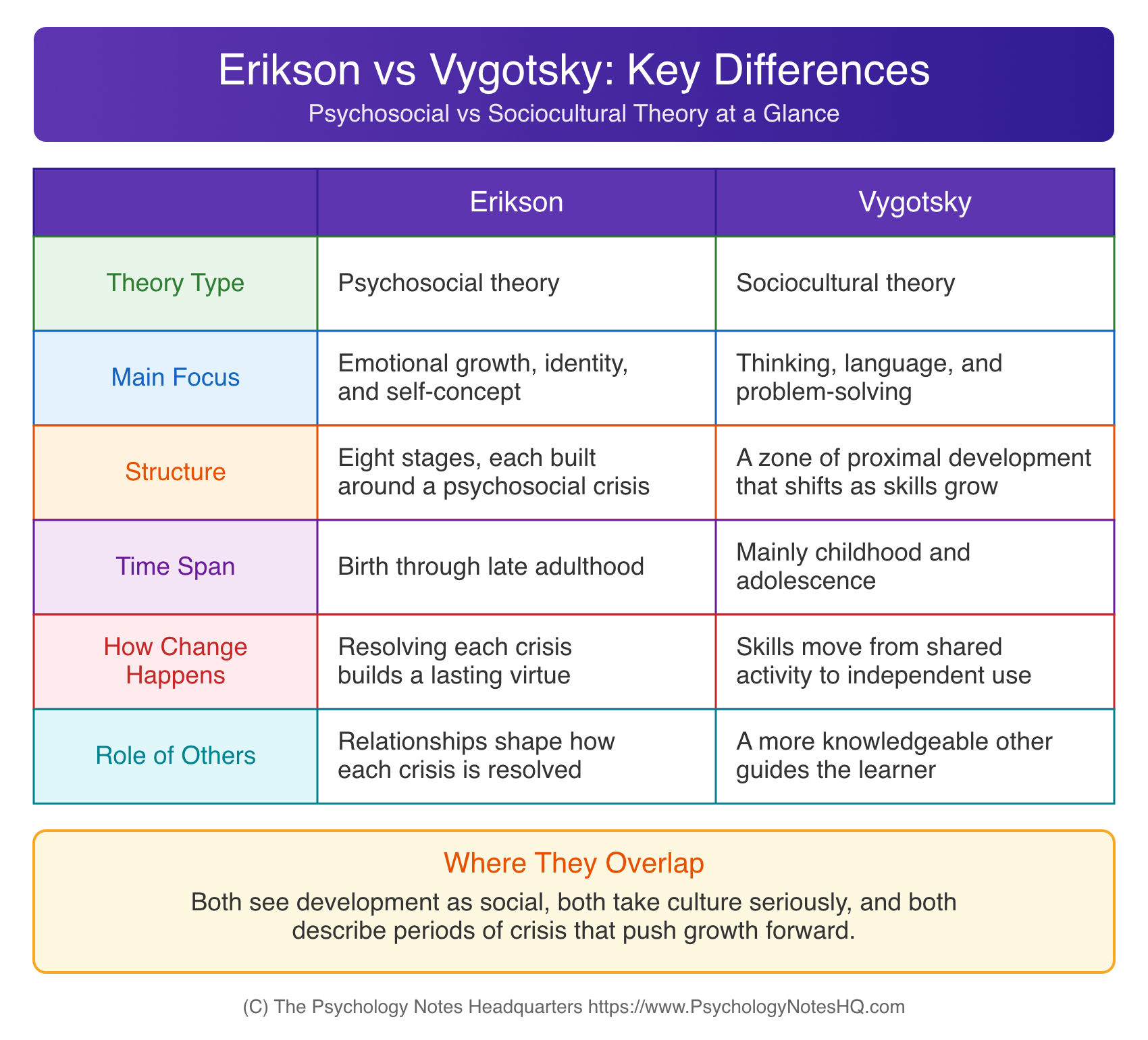
Erikson vs Vygotsky at a Glance
Before comparing the two, it helps to be clear about what each theorist was actually trying to explain. They worked in very different settings and asked very different questions about how children grow.
What Erikson Was Trying to Explain
Erik Erikson (1902 to 1994) trained in psychoanalysis in Vienna before moving to the United States. His psychosocial theory describes eight stages stretching from infancy to old age. Each stage centers on a crisis between two opposing pulls, such as trust vs. mistrust (Erikson, 1963).
Resolving a crisis in a healthy direction produces a lasting strength, or virtue, like hope, will, or competence. Erikson’s real interest was the self: how people come to feel about who they are and where they fit. You can see all eight in this overview of Erikson’s stages of development.
What Vygotsky Was Trying to Explain
Lev Vygotsky (1896 to 1934) worked in the Soviet Union and died of tuberculosis at just 37. His focus was on how higher mental functions, like reasoning, deliberate memory, and language-based thinking, develop through social interaction.
His best-known claim is that these functions appear twice: first between people, then inside the child (Vygotsky, 1978). Vygotsky’s sociocultural theory treats culture and language as the tools that make thinking possible, and it places learning in the gap between what a child can do alone and what she can do with guidance.
Key Differences Between Erikson and Vygotsky
The differences between Erikson and Vygotsky run deeper than one being “emotional” and the other “cognitive.” They disagree on how development is organized, how long it lasts, and what actually drives change.
Emotional Growth vs Cognitive Growth
Erikson’s central question is emotional and relational. How does a child come to trust others, feel capable, or know who she is? His stages track the growth of the self.
Vygotsky’s central question is cognitive. How does a child move from needing help with a problem to solving it independently, and eventually to thinking about her own thinking? His focus is the development of mental tools.
This doesn’t mean Erikson ignored thinking or Vygotsky ignored emotion. It means each put a different process at the center of his theory.
Fixed Stages vs a Moving Zone
Erikson’s theory is built on a fixed sequence. The eight stages unfold in a set order, a pattern he called the epigenetic principle, and each one is loosely tied to a period of life.
Vygotsky’s most famous idea works differently. The zone of proximal development isn’t a stage at all. It’s a moving target that shifts every time a child masters something new. What needed help last month might be easy today. In his best-known work, development looks continuous rather than stepwise.
A Whole Lifespan vs a Focus on Childhood
Erikson was one of the first theorists to argue that development doesn’t stop at adolescence. Three of his eight stages cover adulthood, ending with integrity vs. despair in late life. That lifespan view is one of his biggest contributions.
Vygotsky’s work focused on childhood and adolescence. Part of this reflects the questions he cared about, and part reflects a career cut short. He died before finishing much of what he planned, which is one reason scholars still debate how some of his ideas fit together.
Crisis Resolution vs Internalization
The deepest split in psychosocial vs sociocultural theory is the engine of change. For Erikson, growth comes from working through a tension between two opposing tendencies. The outcome is a balance, not a clean win, and healthy development keeps a little of the negative side.
For Vygotsky, growth comes from internalization. A child first solves a problem alongside a more knowledgeable other, often talking it through. Over time, that shared talk turns inward and becomes the child’s own way of thinking. The social becomes the individual.
What Counts as Healthy Development
For Erikson, success means a favorable ratio between the two poles of each crisis. A child who leaves Stage 4 with more industry than inferiority carries the virtue of competence into adolescence.
For Vygotsky, success means mastering the cultural tools of your community, such as language, writing, and counting systems, until you can use them on your own. The goal isn’t balance between opposing forces. It’s the growing ability to regulate your own thinking and behavior with tools that started out belonging to other people.
Where the Two Theories Overlap
For all their differences, the similarities between Erikson and Vygotsky are real, and textbook comparisons often underplay them. Both pushed back against the idea that development simply unfolds from inside the child.
Both Put Relationships at the Center
Neither theorist saw the child as developing alone. Erikson’s crises are resolved through relationships: with caregivers in infancy, teachers and peers in school, partners and communities in adulthood. The same crisis can turn out very differently depending on how the people around a child respond.
Vygotsky went a step further. For him, interaction isn’t just the setting for development. It’s the source. Skills begin as exchanges between people before a child can use them alone.
Both Take Culture Seriously
Erikson’s interest in culture was hands-on. In Childhood and Society, he described his fieldwork with the Sioux and Yurok and showed how each group’s child-rearing practices prepared children for the adult roles their community valued (Erikson, 1963).
Vygotsky built culture into the core of his theory. The tools a child learns to think with, from language to number systems, are cultural inventions passed down across generations. A child in one culture may develop different ways of remembering or reasoning than a child in another, simply because the tools on offer are different.
Vygotsky Had Crises Too
Here’s a detail many comparisons miss. In lectures written near the end of his life, Vygotsky proposed that childhood alternates between stable periods and critical ones. He described crises around birth, age one, age three, age seven, and age thirteen, when a child’s relationship to her social world gets reorganized (Vygotsky, 1998).
His crises aren’t the same as Erikson’s. They’re turning points in how a child relates to her environment, not conflicts between opposing traits. Still, both theorists saw development as moving through periods of upheaval, not just smooth, steady growth.
Stage 4: Where Erikson and Vygotsky Meet
The clearest place to see Erikson and Vygotsky working together is the elementary school years. Erikson explains what’s at stake emotionally during this period. Vygotsky explains how adults can tip the outcome.
Why Ages 5 to 12 Carry Emotional Weight
Erikson’s fourth stage runs from roughly age five to twelve. Children are learning to read, write, and calculate, and they’re comparing their progress with classmates. Out of those experiences, they form a working answer to a quiet question: am I capable?
These judgments get specific early. By third grade, children rate their competence separately for schoolwork, friendships, and physical skills, instead of seeing themselves as simply good or bad at everything (Harter, 1982). A child can decide she’s bad at math while still feeling fine about herself elsewhere.
The ZPD as the Place Competence Gets Built
A real sense of competence in children comes from succeeding at something that was actually hard. That’s where Vygotsky becomes essential. Tasks inside the zone of proximal development are difficult enough to matter and achievable enough to finish with support.
When a child completes that kind of task, she gets the experience Erikson’s theory says she needs: honest evidence that effort pays off. She can say “I did that,” not “someone did it for me” or “I couldn’t.” Repeated often enough, those moments add up to industry.
When Support Misses the Mark
Support can fail in two directions. Tasks pitched above a child’s zone without enough help lead to repeated failure, and she may read that failure as proof she’s just not capable. That’s the road to inferiority.
Too much help causes a different problem. If adults do most of the work, the child succeeds without mastering anything. Among college students, over-controlling parenting has been linked to lower well-being, largely through weaker feelings of autonomy and competence (Schiffrin et al., 2014). Both extremes cut off the productive struggle that builds real skill.
Scaffolding as the Bridge
Scaffolding is how adults keep a child inside her zone. The idea comes from Wood et al. (1976), who described how a tutor can handle the parts of a task a child can’t yet manage so she can focus on the parts she can.
Good scaffolding responds to what the child is doing in the moment, fades as skill grows, and hands responsibility back to the learner (van de Pol et al., 2010). That last step is where scaffolding and competence connect. Industry grows from what the child eventually does on her own.
A Tale of Two Readers
Picture two children tackling their first chapter books. Both find it hard. One has an adult who reads alongside her, asks questions about the story, and slowly hands over more of the reading as her confidence grows. The other is told to keep trying with books well beyond her level.
Both struggle. But the first child builds a trail of progress, from supported reading to independent reading. The second builds a trail of failure. Same difficulty, very different lessons about what kind of learner each child is.
What This Means for Teachers and Parents
Putting the two theories together changes how adults might think about everyday help with schoolwork.
Assess Before You Assign
If the zone of proximal development is where competence grows, then knowing a child’s current level comes first. A quick check of what she can do alone, and what she can do with a hint, shows where to pitch the next task.
This matters more in the elementary years than it might later. An adult with years of success behind them can shrug off a failed task. A seven-year-old is still gathering the evidence she’ll use to decide whether she’s capable, so a string of mismatched tasks can carry more weight than it seems.
Fade Support on Purpose
The goal isn’t to make every task easy. It’s to make hard tasks doable, then step back. Adults can shift from showing, to prompting, to simply watching as a child gains skill.
Pulling support away all at once can undo progress. Never pulling it away can leave a child dependent. The sweet spot is gradual fading, timed to what the child is actually showing she can handle. Support builds real skill, and real skill builds belief in yourself.
Using Erikson vs Vygotsky in Essays and Exams
Erikson vs Vygotsky is a classic compare-and-contrast question in developmental psychology courses. A few habits can make your answer stand out.
How to Frame a Compare-and-Contrast Answer
Start by naming what each theory is trying to explain, then organize your answer around shared dimensions: focus, structure, time span, and mechanism of change. Framing it as psychosocial vs sociocultural theory gives your reader a clear anchor from the first paragraph.
Then show where the theories connect. A strong answer goes beyond listing differences, and the Stage 4 example works well because it shows each theory doing a different job in the same situation. The same approach helps when comparing Vygotsky and Piaget or Erikson and Piaget.
A Sample Thesis Statement
If you’re stuck on how to open, here’s one way to set up the argument:
“Erikson and Vygotsky both see development as deeply social, but Erikson explains how relationships shape a child’s sense of self, while Vygotsky explains how relationships build the tools a child thinks with. During the school years, these two processes work together.”
From there, each paragraph can take one dimension and show how the two theories answer it differently.
Common Mistakes to Avoid
A few errors show up again and again. One is saying Vygotsky ignored emotion. In his later work, he wrote about how a child’s emotional experience of a situation shapes its effect on development, a concept known as perezhivanie.
Another is treating Erikson’s stages as one-time checkpoints. He saw crises as open to revisiting later in life. A third is claiming Vygotsky proposed no stages at all. His age periods are less famous than the zone of proximal development, but they’re part of his theory.
Conclusion
Erikson vs Vygotsky isn’t really a contest. Erikson tells us what’s at stake when a child faces a hard task: her developing belief about whether she’s capable. Vygotsky tells us how that task can be set up so she succeeds for real.
One theory maps the emotional terrain, and the other offers a route through it. Read together, they turn the moment a child says “I’m just bad at math” into something adults can actually do something about.
References
- Erikson, E. H. (1963). Childhood and society (2nd ed.). W. W. Norton.
- Harter, S. (1982). The Perceived Competence Scale for Children. Child Development, 53(1), 87–97.
- Schiffrin, H. H., Liss, M., Miles-McLean, H., Geary, K. A., Erchull, M. J., & Tashner, T. (2014). Helping or hovering? The effects of helicopter parenting on college students’ well-being. Journal of Child and Family Studies, 23(3), 548–557.
- van de Pol, J., Volman, M., & Beishuizen, J. (2010). Scaffolding in teacher–student interaction: A decade of research. Educational Psychology Review, 22(3), 271–296.
- Vygotsky, L. S. (1978). Mind in society: The development of higher psychological processes (M. Cole, V. John-Steiner, S. Scribner, & E. Souberman, Eds.). Harvard University Press.
- Vygotsky, L. S. (1998). The problem of age. In R. W. Rieber (Ed.), The collected works of L. S. Vygotsky: Vol. 5. Child psychology (pp. 187–205). Plenum Press.
- Wood, D., Bruner, J. S., & Ross, G. (1976). The role of tutoring in problem solving. Journal of Child Psychology and Psychiatry, 17(2), 89–100.
How to cite this article:
The Psychology Notes Headquarters. (2026). Erikson vs Vygotsky: Key Differences and Where They Connect. Retrieved from https://www.psychologynoteshq.com/vygotsky-and-erikson/