
Productive Struggle: How Over- and Under-Scaffolding Backfire
A student stares at a math problem for ten seconds, and the teacher steps in with the next step. Another student stares at a problem for ten minutes, and nobody steps in at all. Both teachers believe they are helping, and both have misjudged the student’s Zone of Proximal Development.The difference comes down to productive struggle, the effortful middle ground where students are stretched but still supported. Over-scaffolding removes that struggle, and under-scaffolding turns it into overload. Knowing which mistake you are more likely to make, and what it costs your students, is the first step toward fixing it.
Key Takeaways
- Teachers rarely misjudge the ZPD out of carelessness. The two errors look like opposites, yet both quietly take productive struggle away from students.
- One kind of help feels supportive in the moment but can teach students that their own effort does not matter. The effect on motivation may surprise you.
- The other kind looks like high expectations, yet it can leave students overwhelmed and doubting their ability. The students who lose the most are not always the ones you would guess.
- Class size, testing pressure, and a teacher’s own beliefs about intelligence all push support off target, often without anyone noticing.
- A handful of classroom signals and assessment habits reveal which way your support is leaning, and they are easier to use than you might expect.
Where Productive Struggle Lives in the ZPD
Vygotsky (1978) defined the Zone of Proximal Development as the gap between what a learner can do alone and what they can do with help from a More Knowledgeable Other. Learning happens most effectively inside that gap, where tasks are hard but still reachable. Skills a student has already mastered sit below it, and tasks that stay out of reach even with help sit above it.
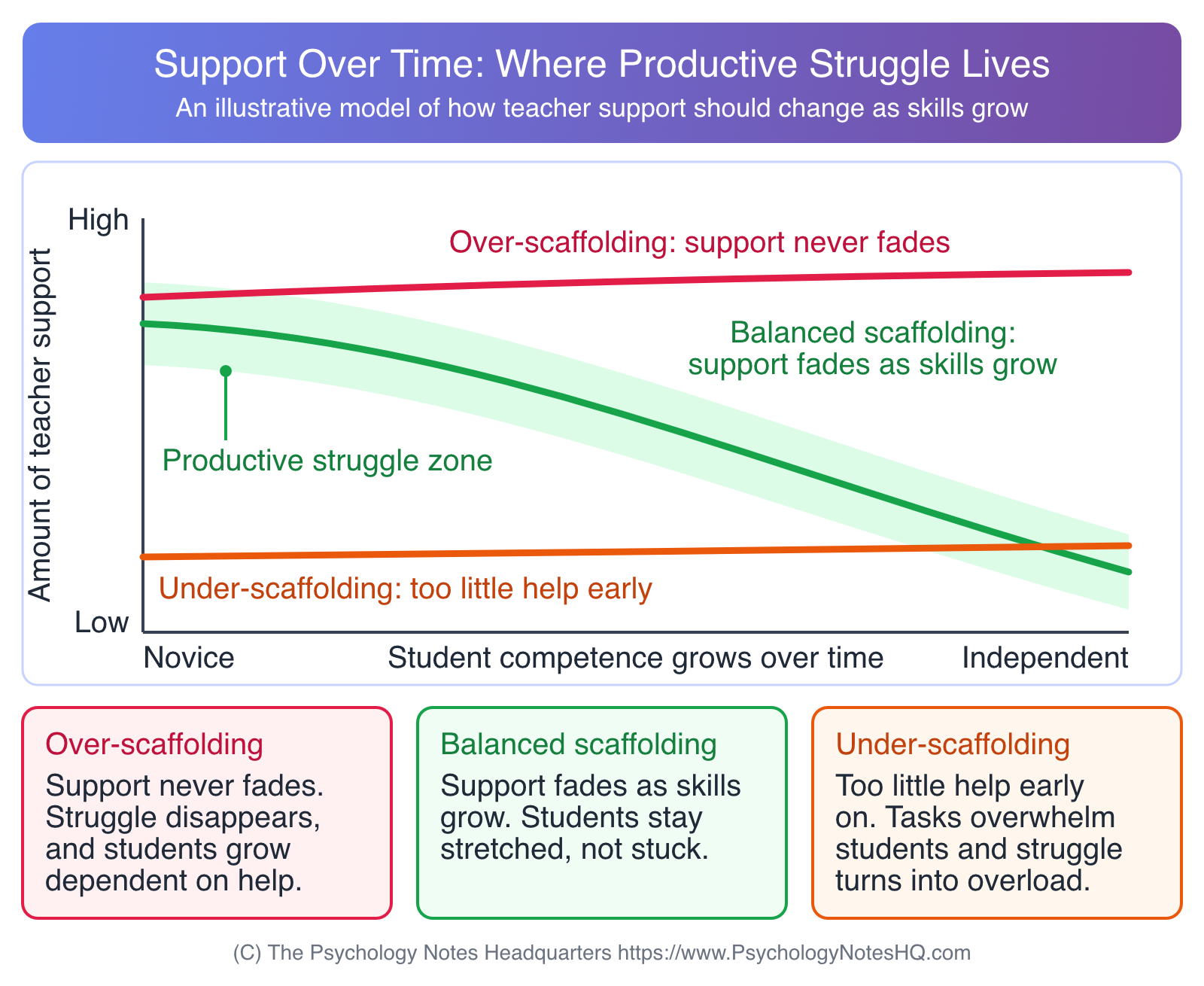
Scaffolding, introduced by Wood, Bruner, and Ross (1976), describes the temporary support teachers provide inside that zone, and it is meant to fade as competence grows. Productive struggle is the effort students invest while that support is in place. Get the amount of support right and the struggle stays productive. Get it wrong in either direction and the struggle disappears or turns harmful.
What Is Teacher Misjudgment of the ZPD?
Teacher misjudgment occurs when educators inaccurately assess where a student’s ZPD begins and ends. This miscalibration takes two primary forms: over-scaffolding, where teachers underestimate student capability and provide excessive support, and under-scaffolding, where teachers overestimate readiness and offer insufficient guidance. Both errors disrupt productive struggle in the classroom, the very process that scaffolding is designed to protect.
Misjudgment rarely stems from incompetence or lack of caring. More often, it reflects the complex challenges teachers face when calibrating support across diverse learners in dynamic classroom environments. A teacher might over-scaffold out of genuine concern for preventing student frustration, while under-scaffolding might result from time constraints or misinterpreting student independence. Understanding these patterns helps educators recognize and correct misjudgment before it significantly impacts learning outcomes.
The consequences of misjudgment extend beyond immediate task performance. Repeated over-scaffolding shapes students’ beliefs about their capabilities, fostering dependency and undermining confidence. Persistent under-scaffolding creates patterns of avoidance and anxiety around challenging material. Both trajectories move students away from the goal of becoming self-regulated, confident learners capable of tackling novel problems independently.
Over-Scaffolding: When Excessive Help Becomes Harmful
Over-scaffolding occurs when teachers provide more assistance than students need to succeed within their ZPD. Too much scaffolding might involve breaking tasks into overly small steps, providing answers before students have time to think, constantly hovering to prevent any struggle, or removing all challenge from activities. While these interventions stem from supportive intentions, they paradoxically undermine the learning process.
The most significant consequence of over-scaffolding is learned helplessness, a phenomenon where repeated experiences with uncontrollable outcomes lead individuals to stop attempting to influence their environment (Seligman, 1975). In educational contexts, students who consistently receive immediate assistance learn that their own efforts are unnecessary. They develop the expectation that the teacher will always provide solutions, reducing their initiative to engage with problems independently. Over time, these students may refuse to attempt tasks without teacher presence, signaling complete dependence on external support.
Over-scaffolding also undermines the development of autonomy and self-regulation. When teachers constantly direct every aspect of learning, students miss opportunities to make decisions, monitor their progress, evaluate their strategies, and adjust their approaches. These metacognitive skills develop through practice, and over-scaffolded environments eliminate the practice space. Students become skilled at following directions but struggle when asked to plan their own approach to problems or work independently.
According to self-determination theory, autonomy represents a fundamental psychological need essential for intrinsic motivation (Deci & Ryan, 2000). When teachers remove student choice and control through excessive scaffolding, they transform learning into a passive experience. Students complete tasks to satisfy teacher requirements rather than from genuine curiosity or desire for mastery. The shift from internal to external locus of control diminishes engagement and reduces the likelihood that students will pursue learning beyond required assignments.
Over-scaffolding also prevents the productive struggle essential for deep learning. When teachers protect students from experiencing confusion, making errors, or facing temporary setbacks, they eliminate opportunities for students to develop persistence, problem-solving strategies, and resilience. Hammond and Gibbons (2005) emphasize that learners need space to grapple with ideas, make mistakes, and construct understanding through effort. Over-scaffolded classrooms produce surface-level compliance but fail to develop the critical thinking and creative problem-solving that characterize true intellectual growth.
Real classroom examples of over-scaffolding include providing step-by-step instructions for every science experiment rather than teaching the scientific method, immediately jumping in when students look confused without giving them time to think, pre-solving math problems and asking students only to fill in blanks, creating templates that leave no room for original thinking, or hovering constantly and narrating every action students should take. These practices create efficiency in the moment but dependency over time.
Under-Scaffolding: When Insufficient Support Derails Learning
Under-scaffolding represents the opposite error: providing inadequate guidance when students genuinely need support to progress. This occurs when teachers overestimate student readiness, assign complex tasks without necessary modeling or instruction, offer minimal feedback during skill development, or leave struggling students to work independently for extended periods. The assumption that students will “figure it out” often proves incorrect when foundational skills or knowledge are missing.
The primary cognitive consequence of under-scaffolding is cognitive overload. When task demands exceed a learner’s processing capacity, working memory becomes overwhelmed and learning breaks down (Sweller, 1988). Students cannot simultaneously process new information, connect it to existing knowledge, and generate responses when the challenge level far exceeds their current capability. The result is confusion, frustration, and often complete abandonment of the task. Unlike productive struggle within the ZPD, cognitive overload produces no learning, only stress.
Under-scaffolding also generates feelings of incompetence that damage academic self-concept. When students struggle repeatedly without support, they often attribute their difficulty to low ability rather than insufficient guidance. This misattribution, studied extensively in attribution theory, has long-term implications for motivation and persistence (Weiner, 1985). Students who conclude “I’m just not good at this” avoid similar challenges in the future, creating a self-fulfilling prophecy where lack of practice further widens the gap between their skills and grade-level expectations.
Educational equity concerns arise when examining under-scaffolding patterns. Students who enter classrooms with more prior knowledge, stronger self-regulation skills, or greater confidence often succeed despite minimal guidance. These students can bridge gaps independently, seek resources proactively, and persist through confusion. However, students with fewer academic resources fall further behind when teachers under-scaffold. The achievement gap widens not because of inherent ability differences but because of differential access to the support necessary for success within each student’s ZPD.
Under-scaffolding appears in classrooms when teachers assign research projects without teaching information evaluation skills, expect students to write essays without modeling the writing process, leave students to solve complex problems without demonstrating problem-solving strategies, provide minimal feedback that doesn’t identify specific areas for improvement, or interpret student confusion as a need for more independent practice rather than more explicit instruction. These approaches assume readiness that may not exist.
Cultural factors sometimes contribute to under-scaffolding. In educational contexts emphasizing self-reliance and independence, teachers may treat the opposite of scaffolding, minimal guidance, as a sign of high expectations. However, this perspective conflates the goal (independence) with the path (supported practice). Vygotsky’s framework emphasizes that independence develops through socially mediated learning, not by withholding support. Students need guided participation in communities of practice before they can perform independently.
Factors Contributing to ZPD Misjudgment
Multiple factors influence whether teachers accurately assess and respond to students’ ZPDs. Teacher beliefs about learning and intelligence play significant roles. Educators holding fixed mindset beliefs may underestimate student capacity for growth, leading to over-scaffolding that limits challenge. Conversely, those with overly optimistic views of student self-direction may under-scaffold, assuming students possess skills they haven’t yet developed (Dweck, 2006).
Assessment challenges create substantial obstacles to accurate ZPD calibration. In diverse classrooms, students simultaneously occupy different points on learning continuums, making whole-class instruction difficult to pitch optimally for everyone. Teachers lack reliable, efficient tools for continuously gauging individual ZPDs across multiple content areas. Standardized assessments provide snapshots of current independent performance but reveal little about what students could achieve with support, which is the defining characteristic of the ZPD.
Systemic and contextual factors constrain teachers’ ability to provide appropriately calibrated scaffolding. Large student-to-teacher ratios limit opportunities for the individualized assessment and responsive support that accurate scaffolding requires. Rigid curricular pacing mandates pressure teachers to move forward regardless of whether students have mastered foundational concepts. Standardized testing emphasis creates incentives for over-scaffolding to ensure visible short-term success rather than developing long-term independence. These structural realities often force teachers into misjudgment despite their professional expertise.
Time represents a critical constraint. Effective scaffolding requires observation, reflection, and adjustment, processes that take time teachers often don’t have. Planning periods filled with administrative tasks leave little space for analyzing student work patterns or designing differentiated supports. During instruction, managing behavioral issues and addressing immediate needs prevents the careful monitoring necessary for detecting when scaffolding should be adjusted.
Recognizing the Signs of Misjudgment
Teachers can learn to identify misjudgment through attention to specific student behaviors. Over-scaffolding reveals itself when students consistently wait for teacher direction before starting tasks, rarely ask questions or show curiosity beyond assignment requirements, immediately request help without attempting problems independently, demonstrate surface-level engagement focused on task completion rather than understanding, or fail to transfer learned skills to new contexts. These patterns indicate that excessive support has created dependency.
Under-scaffolding becomes apparent through different signals. High frustration levels and increasing off-task behavior suggest tasks exceed current capability. Lack of progress despite genuine effort indicates missing foundational knowledge or skills. Growing avoidance of challenging work and statements like “I can’t do this” or “I’m not smart enough” reveal damaged confidence from repeated failure experiences without adequate support. Widening performance gaps over time show that some students advance while others fall further behind.
Strategies for Accurate ZPD Assessment and Balanced Scaffolding
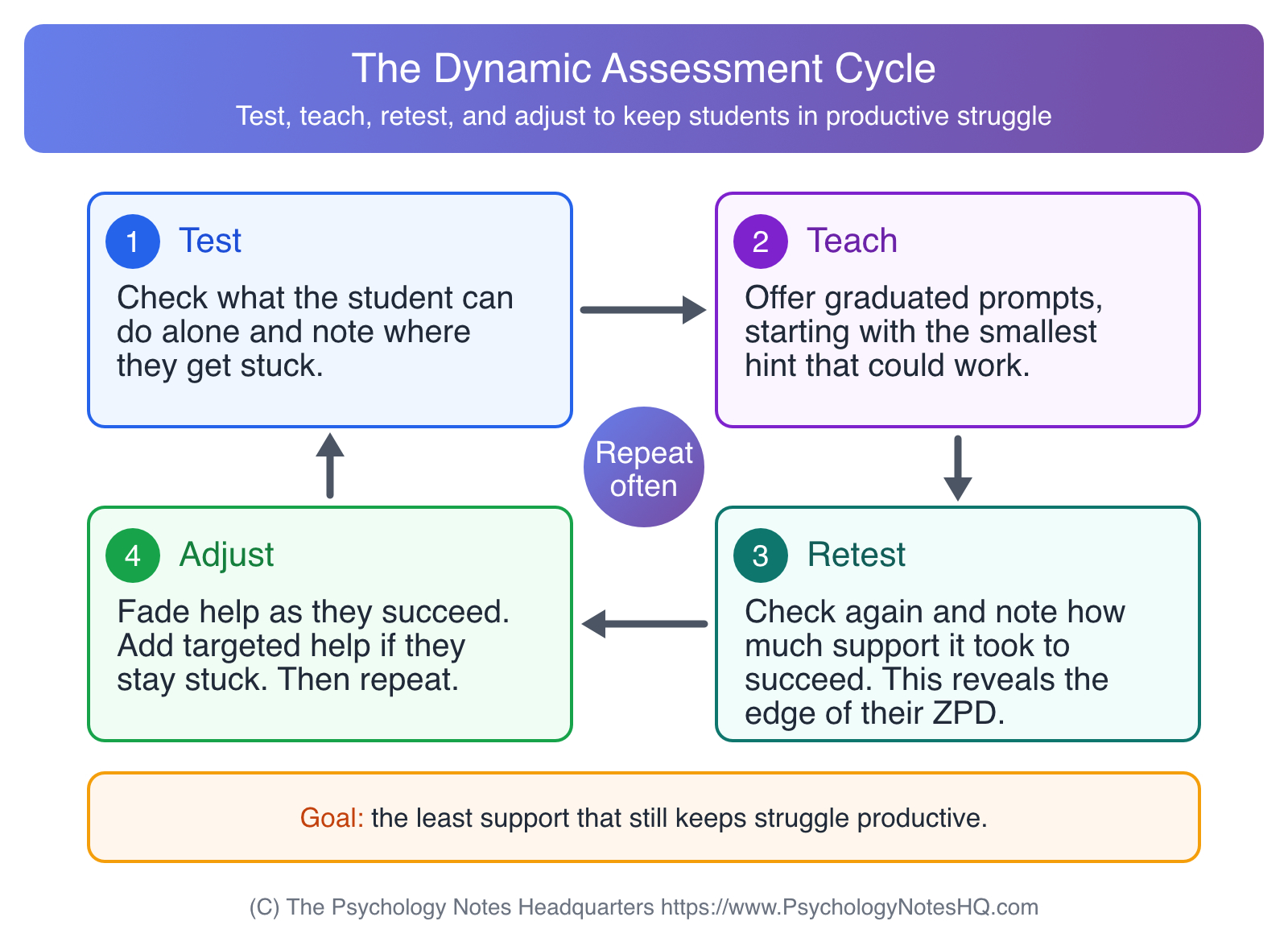
Dynamic assessment provides powerful tools for gauging students’ ZPDs accurately. This approach involves test-teach-retest sequences where teachers assess initial performance, provide graduated prompts or instruction, then reassess to determine how much and what type of support enables success. Observing how students respond to different levels of assistance reveals the boundaries of their ZPD more accurately than static testing of independent performance alone.
Formative assessment techniques including exit tickets, think-alouds, error pattern analysis, and student conferences provide ongoing data about understanding and readiness. These strategies make student thinking visible, enabling teachers to identify misconceptions, recognize when concepts have been mastered, and determine what comes next developmentally. Continuous monitoring replaces one-time judgments with responsive adjustment based on current student needs.
Effective scaffolding follows principles that maintain appropriate challenge while providing necessary support. Teachers should begin with observation and assessment before intervening, provide the minimal support necessary for students to progress rather than removing all difficulty, use strategic questioning that guides thinking rather than providing answers, gradually fade assistance as competence increases, and adjust support in real-time based on student responses. The goal is supporting growth without eliminating productive struggle in the classroom.
Building student metacognition reduces future scaffolding needs. When teachers explicitly teach self-monitoring strategies, encourage reflection on learning processes, develop error-detection skills, and foster productive struggle mindsets, they help students become more independent learners. Students who can assess their own understanding, identify when they need help, and persist through appropriate challenges require less external scaffolding over time.
Conclusion
ZPD misjudgment through over-scaffolding or under-scaffolding represents a common challenge in education with significant consequences for learning, motivation, and independence. Over-scaffolding creates dependency and undermines autonomy, while under-scaffolding produces overwhelm and feelings of incompetence. Thoughtful, responsive teaching that continuously assesses and adjusts support maintains the delicate balance necessary for optimal learning. By recognizing misjudgment patterns and implementing strategies for accurate ZPD assessment, teachers help students develop the independence and confidence that represents the ultimate goal of scaffolded instruction.
References
- Deci, E. L., & Ryan, R. M. (2000). The what and why of goal pursuits: Human needs and the self-determination of behavior. Psychological Inquiry, 11(4), 227-268.
- Dweck, C. S. (2006). Mindset: The new psychology of success. Random House.
- Hammond, J., & Gibbons, P. (2005). Putting scaffolding to work: The contribution of scaffolding in articulating ESL education. Prospect, 20(1), 6-30.
- Seligman, M. E. (1975). Helplessness: On depression, development, and death. W. H. Freeman.
- Sweller, J. (1988). Cognitive load during problem solving: Effects on learning. Cognitive Science, 12(2), 257-285.
- Vygotsky, L. S. (1978). Mind in society: The development of higher psychological processes. Harvard University Press.
- Weiner, B. (1985). An attributional theory of achievement motivation and emotion. Psychological Review, 92(4), 548-573.
- Wood, D., Bruner, J. S., & Ross, G. (1976). The role of tutoring in problem solving. Journal of Child Psychology and Psychiatry, 17(2), 89-100.
How to cite this article:
The Psychology Notes Headquarters. (2026). Productive Struggle: How Over- and Under-Scaffolding Backfire. Retrieved from https://www.psychologynoteshq.com/misjudgment-zone-of-proximal-development/