
Self-Determination Theory: Deci and Ryan’s Motivation Spectrum
Two students spend the same six hours in the library before an exam. One is there because a scholarship depends on it. The other is there because the material genuinely pulls them in. Self-determination theory explains why those identical hours can lead to very different outcomes for learning, persistence, and well-being. Developed by Edward Deci and Richard Ryan, it argues that the source of your motivation matters as much as how much of it you have.
Key Takeaways
- Lasting motivation depends on a small set of psychological needs, and the theory is most striking about what happens when those needs are actively blocked, not just ignored.
- Motivation is not an on or off switch. The theory maps a spectrum that runs from complete disengagement to genuine, self-driven interest.
- Six connected mini-theories cover everything from rewards and personality to close relationships and life goals.
- Classrooms, clinics, offices, and family homes all show why a pressuring style often backfires, even when the intention is good.
- Some critics question whether the theory’s view of autonomy fits every culture. That debate is worth knowing before you cite it.
What Is Self-Determination Theory?
Self-determination theory (SDT) is a psychological framework that explains motivation through three core psychological needs: autonomy, competence, and relatedness. First formally outlined in the 1980s, it proposes that people are most engaged, productive, and psychologically healthy when those needs are genuinely satisfied.
Edward Deci and Richard Ryan developed the theory at the University of Rochester, building on a finding from Deci’s early laboratory work in the 1970s that surprised researchers at the time: external rewards could undermine motivation rather than strengthen it. When people were paid to do a puzzle they already enjoyed, they became less interested in it afterward. That result became the seed of a research program that has now run for decades.
At its core, the self-determination theory of motivation is organismic. It views people as naturally growth-oriented, with an inherent tendency to seek out challenges, integrate new experiences, and build connections with others. The theory doesn’t treat motivation as something to install from the outside. It assumes the drive is already there, and asks whether a person’s environment supports that natural orientation or steadily erodes it.
This sets SDT apart from earlier frameworks. Drive reduction theory treated motivation as a biological tension-reduction system, and the incentive theory of motivation placed nearly all its explanatory weight on external rewards and punishments. Both missed something important: the source and quality of motivation matter, not just the amount. Two people can put in the same number of hours on a task and have completely different motivational experiences, and that difference predicts outcomes like learning, creativity, and well-being.
The Three Basic Psychological Needs
The three basic psychological needs sit at the center of SDT. According to Deci and Ryan (2000), they are universal, present across cultures, developmental stages, and life domains, even if the specific ways people satisfy them look different from one context to another.
Autonomy is the experience of acting with a genuine sense of volition and personal endorsement. This is frequently misunderstood as meaning “doing whatever you want,” but that’s not what the theory specifies. Autonomy is about whether your actions feel self-directed rather than coerced. Even actions that follow rules or expectations can feel autonomous if you’ve genuinely internalized the reason behind them. A medical student studying anatomy at midnight can feel highly autonomous if they’re doing it because they care about becoming a good doctor, even though the requirement comes from the curriculum.
Competence is the need to feel effective and capable in the things you pursue. It’s not about being objectively the best performer in a field. It’s the ongoing experience of growth, mastery, and successful engagement with meaningful challenges. This connects closely to Bandura’s work on self-efficacy, the belief that you can carry out a specific task successfully. Both constructs point to the same basic insight: when people feel capable, they lean into challenges. When they don’t, they avoid them.
Relatedness is the need to feel meaningfully connected to others: to care about people and to feel cared for in return. Unlike autonomy and competence, which carry a more individual flavor, relatedness anchors the inherently social dimension of human motivation. A person can be highly autonomous and genuinely competent and still feel isolated in ways that drain motivation and well-being. All three needs operate together, and the absence of any one of them creates a real psychological cost.
When Psychological Needs Are Frustrated
There’s an important distinction in SDT research between need dissatisfaction and need frustration. Dissatisfaction simply means the needs aren’t being met to a high degree, so the environment is neutral or indifferent. Frustration is more active. It involves environments, relationships, or circumstances that directly block need satisfaction, undermine autonomy, convey incompetence, or reject connection.
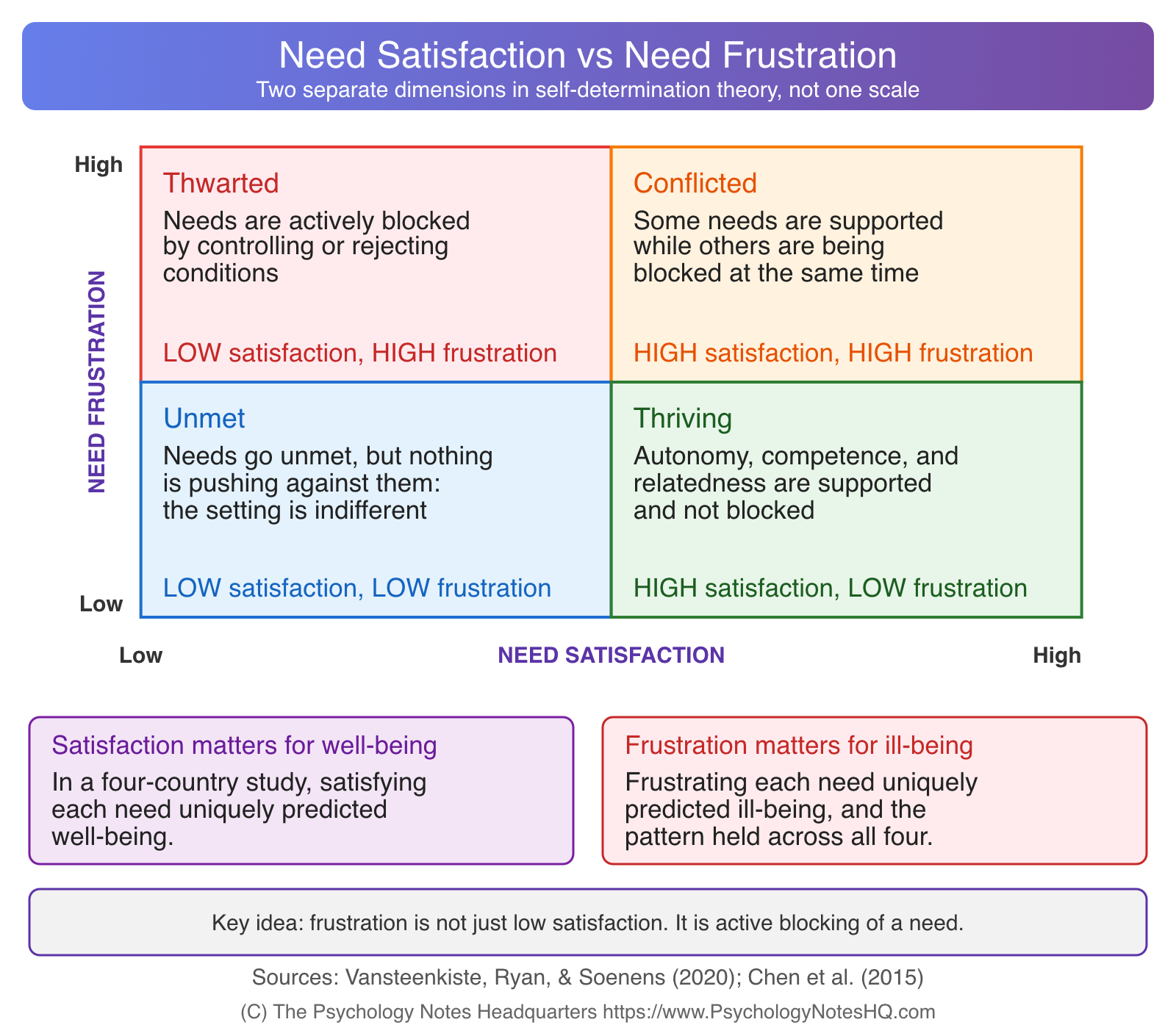
Basic psychological needs theory treats satisfaction and frustration as separate dimensions rather than opposite ends of one scale (Vansteenkiste et al., 2020). In a study across four culturally diverse countries, satisfaction of each of the three basic psychological needs uniquely predicted well-being, while frustration of each uniquely predicted ill-being, and the pattern was equivalent across all four countries (Chen et al., 2015).
In practice, students in controlling classrooms often show signs of disengagement, anxiety, and avoidance that go beyond what you’d expect from a merely uninspiring environment. The same pattern appears in workplaces where micromanagement is the norm, or in healthcare settings where providers use fear-based messaging.
This is conceptually adjacent to learned helplessness, the motivational and cognitive deterioration that sets in when people repeatedly experience lack of control. Both frameworks converge on the insight that perceived agency isn’t a luxury in human psychology. It’s a core requirement.
The Motivation Spectrum: From Amotivation to Intrinsic Motivation
One of the most practically useful things SDT has contributed is a detailed map of motivation. Rather than a binary intrinsic/extrinsic split, the motivation spectrum, often called the self-determination continuum, is organized by how self-determined the motivation is (Ryan & Deci, 2000).
At the low end sits amotivation: no intention to act, no perceived value in the outcome, and no sense of agency. The person has essentially checked out.
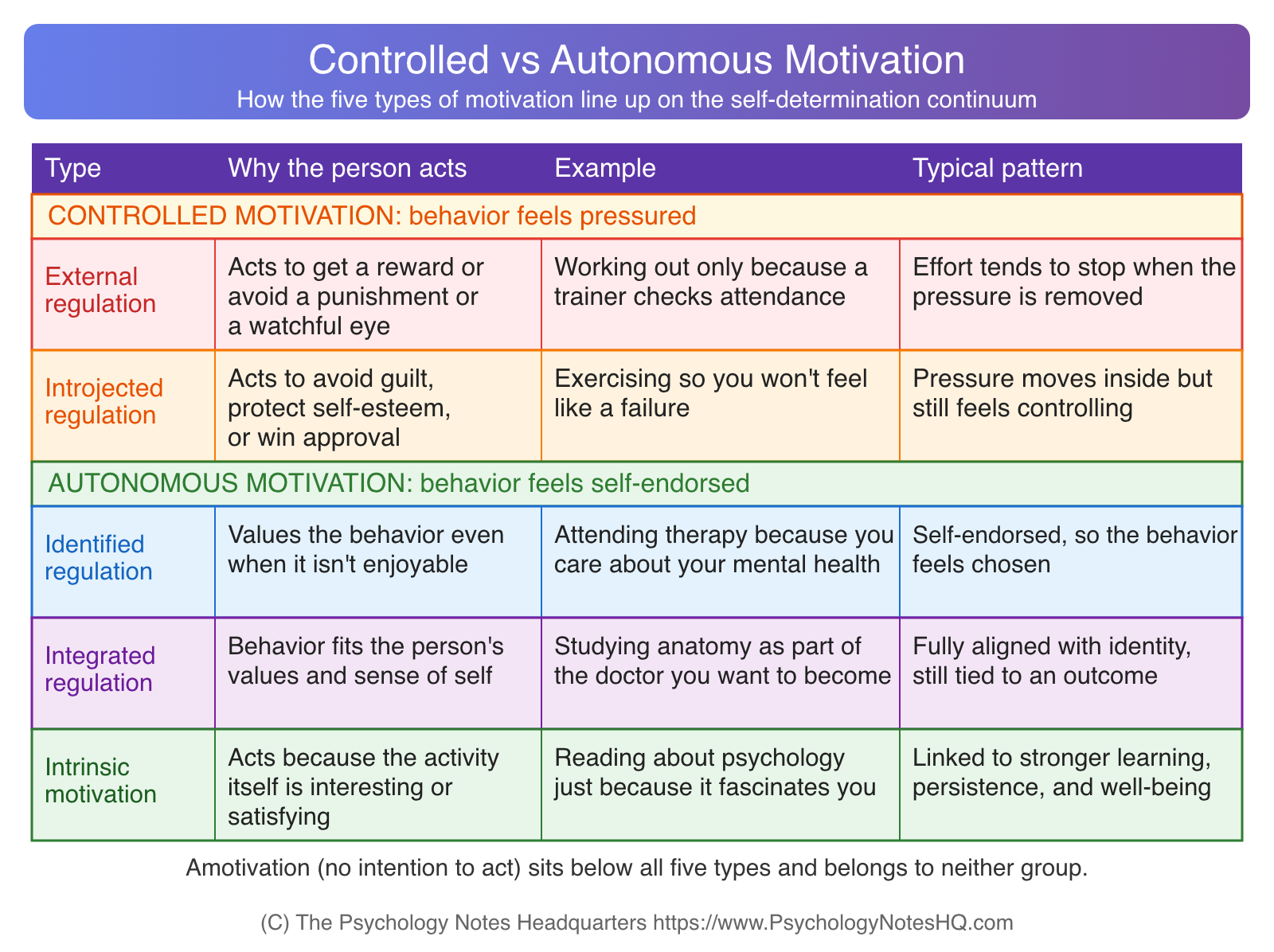
External regulation is the least autonomous form of extrinsic motivation. Behavior is driven entirely by external contingencies like rewards, punishments, or surveillance. The moment the external pressure is removed, the behavior tends to disappear with it.
Introjected regulation moves the pressure inward, but without genuine acceptance. The person acts to avoid guilt, protect self-esteem, or seek approval. “I need to exercise so I won’t feel like a failure” is introjection in action. It comes from inside, but it still feels controlling.
Identified regulation involves personally valuing a behavior even when it isn’t enjoyable in itself. Someone who attends therapy not because they enjoy it but because they genuinely care about their mental health is operating here. The behavior is self-endorsed.
Integrated regulation is the most autonomous form of extrinsic motivation. The goal is fully aligned with the person’s values and sense of self. What distinguishes it from intrinsic motivation is that the behavior is still linked to an outcome rather than enjoyed purely for what it is.
Finally, intrinsic motivation, acting because the activity itself is interesting, enjoyable, or satisfying, sits at the self-determined end of the spectrum. A large body of research links intrinsic motivation with better learning outcomes, higher creativity, greater persistence, and stronger well-being compared to more controlled forms (Ryan & Deci, 2000).
Controlled Motivation vs Autonomous Motivation
The spectrum splits into two broad groups. Controlled motivation covers external and introjected regulation, where behavior feels pressured, whether by outside forces or inner guilt. Autonomous motivation covers identified and integrated regulation plus intrinsic motivation, where behavior feels self-endorsed. Autonomous motivation is not the same as intrinsic motivation, because identified and integrated regulation are autonomous even when the task itself isn’t fun. The table below lines the types up side by side.
The Six Mini-Theories of SDT
SDT isn’t a single proposition. It’s a macro-theory structured around six sub-theories, each addressing a specific aspect of motivation and human functioning (Deci & Ryan, 2008).
Cognitive Evaluation Theory (CET) was the original mini-theory, developed to explain how external events affect intrinsic motivation. CET proposes that events perceived as controlling (such as contingent rewards or surveillance) undermine intrinsic motivation by shifting the perceived locus of causality from internal to external. Events that support competence and autonomy, however, can enhance it. Meta-analytic evidence shows that tangible rewards tend to undermine intrinsic motivation (Deci et al., 1999), and this is the theoretical basis of the overjustification effect.
Organismic Integration Theory (OIT) describes the internalization process: how people gradually take in external regulations and make them progressively their own. It maps directly onto the motivation spectrum above.
Causality Orientations Theory (COT) addresses individual differences. Some people habitually orient toward autonomous regulation, others toward controlled regulation, and others toward amotivation. These orientations are relatively stable personality tendencies rather than situational states.
Basic Psychological Needs Theory (BPNT) formalizes the three needs and, critically, establishes that need satisfaction and need frustration are separate dimensions, not simply high and low ends of the same scale.
Relationships Motivation Theory (RMT) extends SDT into close personal relationships, arguing that need satisfaction within a relationship, especially mutual autonomy support, predicts relationship quality and durability.
Goal Contents Theory (GCT) distinguishes between intrinsic goals (personal growth, community contribution, meaningful relationships, physical health) and extrinsic goals (wealth, fame, physical attractiveness). Research links placing high importance on extrinsic goals with lower well-being (Deci & Ryan, 2000). This aligns with the broader cognitive perspective on motivation that emphasizes the role of goal meaning in shaping behavior.
Self-Determination Theory Examples in Real Life
Examples turn up across virtually every domain where human motivation matters, which is part of why the theory has attracted such an extensive body of applied research.
In education, the most studied examples center on teacher behavior. Autonomy-supportive teachers, those who offer genuine choice, explain the relevance of tasks, acknowledge student perspectives, and avoid controlling language, tend to produce students who show higher intrinsic motivation, better conceptual understanding, and greater persistence compared to students in controlling classrooms (Ryan & Deci, 2000). The contrast shows up even when both types of teachers are equally warm and well-intentioned. It’s the structure of the interaction, not just the relationship quality, that makes the difference.
In the workplace, SDT has influenced how organizational psychology thinks about employee engagement. Workers whose managers explain the rationale behind decisions, invite input, and minimize surveillance-style oversight tend to report greater satisfaction and engagement. The theory also predicts, and research on rewards supports, that performance-contingent bonuses can erode the intrinsic motivation of employees who were already engaged in their work (Deci et al., 1999). That has significant implications for how organizations structure rewards.
In healthcare, patient adherence to treatment and healthy routines is one of the most practically important applications. A systematic review of 66 studies by Teixeira et al. (2012) found consistent support for a positive relation between autonomous forms of motivation and exercise, with intrinsic motivation the stronger predictor of long-term adherence. The implication is that providers who frame recommendations in autonomy-supportive ways, by explaining why, offering options, and acknowledging patient preferences, are working with patients’ motivation rather than against it.
In parenting, autonomy-supportive parenting during childhood is generally linked to better self-regulation, academic engagement, and psychological well-being later on. Baumrind’s parenting style research maps onto SDT’s framework neatly: authoritative parenting, which combines warmth with reasonable structure and autonomy support, is generally associated with healthier motivational profiles. Controlling or psychologically pressuring parenting, even when motivated by genuine care, tends to go with higher anxiety and lower intrinsic motivation over time.
SDT and Well-Being: What the Research Shows
The link between basic need satisfaction and psychological well-being is one of the most studied findings in the SDT literature. The four-country study described earlier found that need satisfaction predicted well-being equivalently across very different cultural settings (Chen et al., 2015). That cross-cultural evidence matters because it supports SDT’s central claim: these are genuine psychological necessities, not culturally constructed preferences.
The research also says something about goals. People who pursue intrinsically oriented goals, such as meaningful relationships, personal growth, and contributing to others, tend to report better well-being than those who prioritize extrinsic goals like money or fame (Deci & Ryan, 2000). The theory’s explanation is that intrinsic goals feed the basic needs more directly than extrinsic ones do.
Maslow’s humanistic framework anticipated some of this, arguing that higher-order needs for esteem and self-actualization only become salient once more basic needs are met. SDT differs in that it doesn’t strictly hierarchize the three needs. Autonomy, competence, and relatedness are all simultaneously important. But both theories share the fundamental premise that human beings are not simply reward-seeking machines. What we pursue, and why we pursue it, determines a great deal about how we feel.
Criticisms and Limitations
Self-determination theory has accumulated a large empirical base, but it has also attracted substantive critiques that are worth taking seriously.
The most persistent methodological concern involves measurement. Autonomy, competence, and relatedness are psychologically rich constructs that are genuinely difficult to operationalize with precision. Much of the research relies on self-report scales, which carry well-documented limitations around social desirability, retrospective bias, and response style. Experimental manipulation of the three needs in controlled settings is more convincing, but harder to do outside the laboratory.
The cultural challenge is perhaps the most theoretically interesting. While cross-cultural research broadly supports the universality of the three needs, scholars working in collectivist contexts have questioned whether SDT’s framing of autonomy reflects Western, individualist assumptions. In some cultural settings, behaviors that SDT would classify as externally regulated, like deferring to family expectations or following community obligations, carry genuine personal meaning that doesn’t map neatly onto the controlled-to-autonomous spectrum. Deci and Ryan and their colleagues have responded by distinguishing between the needs themselves (universal) and the behaviors that satisfy them (culturally variable), but the debate continues.
There is also the boundary question: how does SDT’s explanatory territory relate to neighboring frameworks? Its overlap with Bandura’s social learning theory, with Maslow’s hierarchy, and with goal-setting theory is real, and distinguishing SDT’s unique contribution from these adjacent frameworks isn’t always straightforward. None of this diminishes the theory’s practical value, but it does mean SDT is best understood as one powerful lens among several, not a complete account of human motivation on its own.
Conclusion
Self-determination theory offers something many motivation frameworks don’t: a coherent account of why motivation quality matters as much as motivation quantity. By identifying autonomy, competence, and relatedness as universal psychological needs, Deci and Ryan gave researchers and practitioners a framework that is both theoretically rigorous and directly applicable. Whether you’re thinking about how to structure a classroom, lead a team, or simply make sense of your own motivational patterns, SDT provides a vocabulary and an evidence base worth knowing.
References
- Chen, B., Vansteenkiste, M., Beyers, W., Boone, L., Deci, E. L., Van der Kaap-Deeder, J., Duriez, B., Lens, W., Matos, L., Mouratidis, A., Ryan, R. M., Sheldon, K. M., Soenens, B., Van Petegem, S., & Verstuyf, J. (2015). Basic psychological need satisfaction, need frustration, and need strength across four cultures. Motivation and Emotion, 39(2), 216-236.
- Deci, E. L., Koestner, R., & Ryan, R. M. (1999). A meta-analytic review of experiments examining the effects of extrinsic rewards on intrinsic motivation. Psychological Bulletin, 125(6), 627-668.
- Deci, E. L., & Ryan, R. M. (2000). The “what” and “why” of goal pursuits: Human needs and the self-determination of behavior. Psychological Inquiry, 11(4), 227-268.
- Deci, E. L., & Ryan, R. M. (2008). Self-determination theory: A macrotheory of human motivation, development, and health. Canadian Psychology/Psychologie Canadienne, 49(3), 182-185.
- Ryan, R. M., & Deci, E. L. (2000). Self-determination theory and the facilitation of intrinsic motivation, social development, and well-being. American Psychologist, 55(1), 68-78.
- Teixeira, P. J., Carraça, E. V., Markland, D., Silva, M. N., & Ryan, R. M. (2012). Exercise, physical activity, and self-determination theory: A systematic review. International Journal of Behavioral Nutrition and Physical Activity, 9, Article 78.
- Vansteenkiste, M., Ryan, R. M., & Soenens, B. (2020). Basic psychological need theory: Advancements, critical themes, and future directions. Motivation and Emotion, 44, 1-31.
How to cite this article:
The Psychology Notes Headquarters. (2026). Self-Determination Theory: Deci and Ryan’s Motivation Spectrum. Retrieved from https://www.psychologynoteshq.com/self-determination-theory/