
The Overjustification Effect: Why Rewards Can Backfire on Motivation
The overjustification effect occurs when offering an external reward for an activity someone already enjoys causes their intrinsic motivation to decline — sometimes called the undermining effect for exactly this reason. First demonstrated in Deci’s early laboratory work and later confirmed in Lepper, Greene, and Nisbett’s landmark 1973 study, overjustification effect psychology reveals a counterintuitive truth: adding a reward doesn’t always add motivation. Sometimes it quietly destroys the motivation that was already there.
Key Takeaways
- The overjustification effect occurs when external rewards undermine pre-existing intrinsic interest in an activity
- Lepper et al.’s 1973 “marker study” with preschoolers is the most cited demonstration of the effect
- Self-perception theory and cognitive evaluation theory each offer a different explanation for why it happens
- The effect is strongest for expected, tangible rewards — unexpected or verbal rewards cause considerably less damage
- Teachers, parents, and managers can reduce the risk by timing rewards carefully and preserving autonomy
What Is the Overjustification Effect?
The overjustification effect describes what happens when an external reward is introduced for an activity a person was already doing out of genuine interest — and that interest subsequently drops. The name comes from the idea that the reward “overjustifies” the behavior: it provides a salient external reason for doing something the person already had an internal reason to do. When the external reason becomes the most obvious explanation, the internal one tends to fade.
This runs counter to the intuitive assumption that layering extrinsic rewards and intrinsic rewards simply produces more motivation. In reality, the two can work against each other. The undermining effect, as it is sometimes called in the research literature, suggests that the relationship between rewards and motivation is far more complex than a simple addition. The presence of a reward changes not just what people do, but how they think about why they’re doing it — and that cognitive shift is where the damage occurs.
The Classic Marker Study: Lepper, Greene & Nisbett (1973)
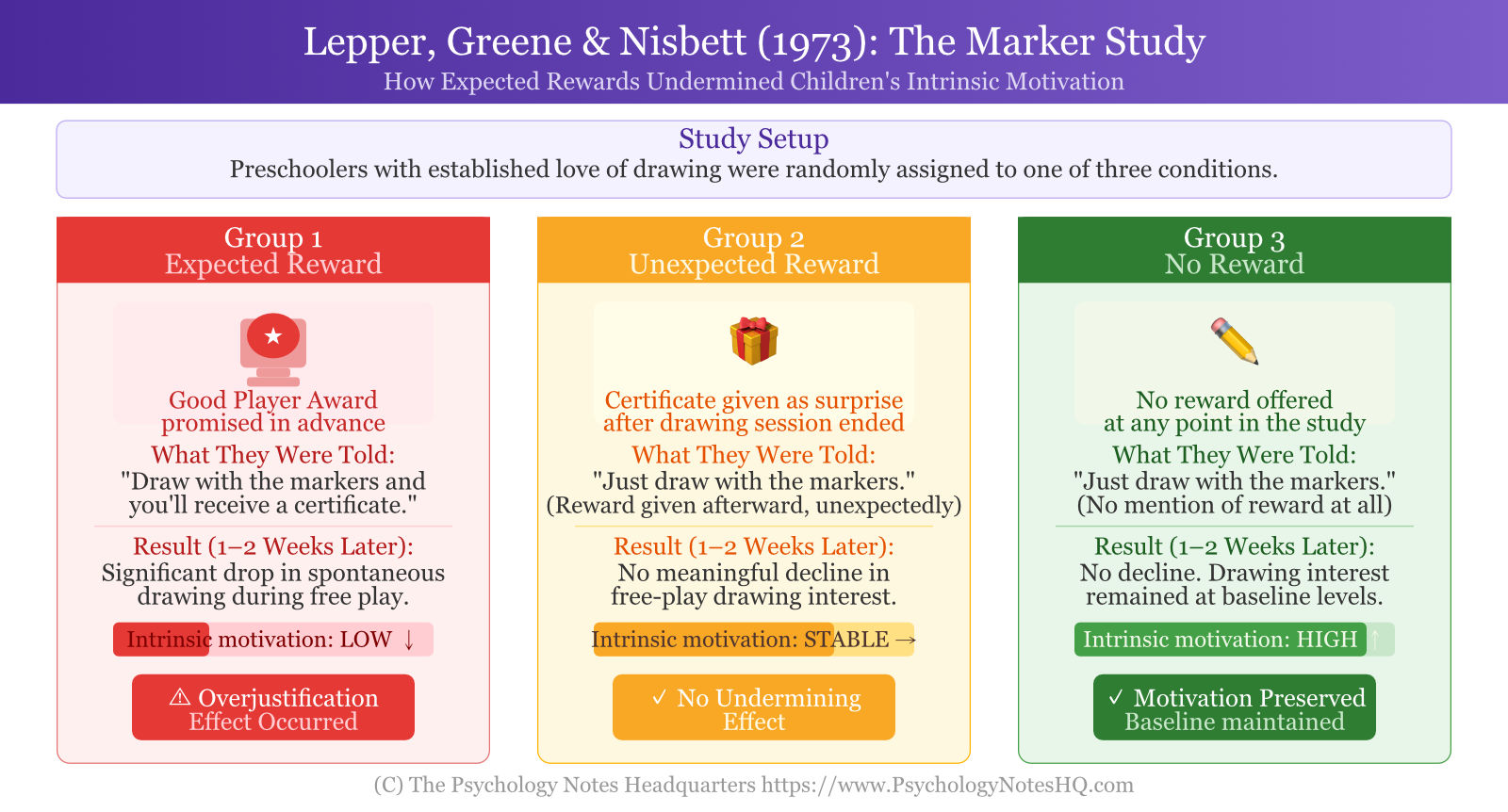
The most frequently cited overjustification effect example in psychology comes from a deceptively simple experiment with preschool children. Mark Lepper, David Greene, and Richard Nisbett recruited children who had already shown a strong natural preference for drawing with markers during free play — meaning intrinsic interest was established before anything else happened.
The children were divided into three groups. The first group was told in advance they would receive a “Good Player Award” certificate for drawing — an expected, tangible reward. The second group received the same certificate but without any prior announcement — an unexpected reward. The third group drew without any reward at all.
One to two weeks later, the researchers observed the children again during free play with markers available. The expected-reward group showed a significant drop in spontaneous drawing compared to both the unexpected-reward and no-reward groups. The children who had been promised a certificate in advance were now noticeably less interested in the activity that had absorbed them before the experiment began.
The unexpected-reward group showed no such decline. This distinction became central to everything that followed: it wasn’t rewards per se that caused the problem — it was rewards that were anticipated, promised, and thus experienced as the reason for doing the activity.
Deci’s Earlier Puzzle Experiments (1971)
Lepper et al.’s study built on work Edward Deci had published two years earlier. In his original experiments, Deci had college students work on Soma puzzles — an intrinsically engaging spatial task — across three sessions. In the experimental condition, participants were paid for each puzzle they solved during the second session. In the control condition, no payment was offered at any point.
What Deci measured was what participants chose to do during a brief free-time period when the experimenter left the room. Students who had been paid during the second session spent significantly less time with the puzzles during subsequent free time compared to those who had never been paid. The reward had shifted something about how they experienced the activity itself.
These findings laid the groundwork for what would eventually become self-determination theory. Deci’s interpretation was that rewards and intrinsic motivation interact in ways that earlier behavioral models had completely missed — and that the interaction often runs in the wrong direction.
Why Does It Happen? Two Explanations
Two theoretical frameworks have been most influential in explaining the overjustification effect, and they approach the problem from different angles.
The first is Daryl Bem’s self-perception theory. Bem argued that people infer their own internal states — including their motivation — partly from observing their own behavior and its context, much as they might infer the motivations of a stranger. When a salient external reward is present, the most available explanation for why someone is doing an activity is the reward itself. The person essentially reasons: “I’m doing this because they’re paying me.” The original internal interest gets attributed away, and with it, so does the motivation that drove it.
The second explanation comes from cognitive evaluation theory, developed by Deci and Ryan as part of self-determination theory. Cognitive evaluation theory proposes that external events — including rewards — can either support or undermine intrinsic motivation depending on how they affect two fundamental psychological needs: autonomy and competence. Rewards that feel controlling shift the perceived locus of causality from internal to external, directly undermining the sense of self-direction that intrinsic motivation depends on.
A useful cognitive evaluation theory example: a student who voluntarily reads scientific articles out of genuine curiosity. Introduce a teacher who begins grading those readings and offering bonus points for completion, and the student may gradually stop reading unless the grade is attached. The activity hasn’t changed. The external structure has changed how the student interprets their own engagement with it.
When Rewards Don’t Backfire: Moderating Factors
The overjustification effect is real, but it isn’t universal. Research has consistently identified conditions under which extrinsic rewards and intrinsic rewards coexist without the undermining effect occurring — and understanding these moderators is just as important as understanding the effect itself.
The most robust moderator is whether a reward is expected or unexpected. As Lepper et al.’s own data showed, unexpected rewards don’t produce the same motivational drop. If someone doesn’t know a reward is coming, they can’t attribute their behavior to it in advance — so the self-perception mechanism doesn’t engage in the same way.
The nature of the reward also matters. Verbal praise and informational feedback tend to support intrinsic motivation rather than undermine it, because they convey competence rather than control. Tangible, performance-contingent rewards are the most reliably problematic. Cameron and Pierce’s 1994 meta-analysis generated significant debate when it suggested the effect was smaller and more specific than widely assumed — primarily occurring when expected, tangible rewards were given for tasks people already found interesting. Eisenberger and colleagues similarly argued that rewards framed around high performance could actually enhance intrinsic motivation by conveying that the person is genuinely capable.
The level of initial intrinsic interest also plays a role. For tasks people find dull or have no interest in at the outset, external rewards carry much less risk — there’s no intrinsic motivation to undermine. The danger is most acute precisely when a person already cares about what they’re doing.
The Overjustification Effect in the Classroom
The classroom is where overjustification effect examples are probably most familiar and most consequential. Sticker charts for reading, pizza parties tied to book counts, and grade-contingent praise are all forms of expected, tangible rewards applied to activities that many children are already curious about.
The research suggests these programs can backfire in exactly the population they’re intended to help. Children who were already enthusiastic readers before a reading incentive program began may become less likely to read voluntarily once the program ends — or even while it’s running, if the extrinsic reason crowds out the intrinsic one. The child who once read because stories were absorbing now reads to fill in a chart. When the chart goes away, so does the reading.
Intrinsic rewards — the satisfaction of understanding something new, the pleasure of losing track of time in a good book, the quiet pride of mastering a difficult concept — are fragile in reward-heavy environments. This connects to a broader pattern observed in learned helplessness research: when people repeatedly experience their behavior as controlled by external contingencies rather than their own agency, motivational deterioration tends to follow.
The Overjustification Effect at Work
Workplace motivation is where the overjustification effect meets the most money and the most resistance. Performance bonuses, employee recognition programs, sales contests, and KPI-linked incentives are standard management tools — and they often work in the short term. The problem emerges when intrinsic rewards for employees, such as pride in craft, creative engagement, and sense of purpose, are gradually replaced by a purely transactional relationship with work.
Research on creativity is particularly striking here. Studies consistently show that people working under contingent reward conditions produce less creative output than those given more autonomy. When employees know their work is being evaluated for a bonus, they tend toward safe, conventional solutions rather than novel ones — a direct consequence of the shift from internal to external perceived locus of causality that cognitive evaluation theory predicts.
Self-efficacy — the belief in one’s own capacity to succeed — is also relevant here. Reward systems that emphasize performance outcomes over mastery and growth can erode self-efficacy over time, particularly when rewards are withheld after a difficult period. The employee stops asking “am I getting better at this?” and starts asking “am I hitting my number?” — a different psychological orientation with meaningfully different consequences.
The Overjustification Effect in Parenting
Parents encounter the overjustification effect most often in the form of well-intentioned incentive systems: allowances tied to chores, treats for finishing homework, or prizes for reading books. The challenge is that many of the activities parents want to reinforce — curiosity, creativity, kindness — are precisely the ones most vulnerable to the undermining effect, because children often engage in them spontaneously before any reward system is introduced.
The research on praise is instructive. Carol Dweck’s work on fixed versus growth mindsets shows that praise focused on ability (“you’re so smart”) can undermine persistence in the face of difficulty — a close cousin of the overjustification dynamic. Praise focused on effort and process, by contrast, tends to strengthen intrinsic motivation rather than displace it. The difference is whether the feedback conveys external evaluation of a fixed quality or information about something the child can build on.
When extrinsic rewards and intrinsic rewards collide in parenting contexts, the question to ask is whether the reward is teaching the child that the activity is valuable in itself, or teaching them that the activity is a means to get something else.
How to Avoid the Overjustification Effect
The practical takeaway from decades of research on rewards and intrinsic motivation is not that rewards are always harmful — it’s that their design and timing matter enormously. Several evidence-based guidelines help reduce the risk.
Use unexpected rewards rather than pre-announced ones. Telling someone in advance they’ll receive a reward for doing something changes how they interpret their own motivation from the moment they start. A spontaneous expression of appreciation after the fact carries far less risk.
Frame rewards as informational rather than controlling. Feedback that says “you handled that really well” emphasizes competence and supports autonomy. Feedback that says “here’s your bonus for meeting the target” emphasizes external control. The content may be similar; the psychological impact is quite different.
Preserve choice and autonomy wherever possible. Allowing people to decide how they approach a task — not just whether to do it — maintains the internal locus of causality that intrinsic motivation depends on. The cognitive theories of motivation literature consistently finds that perceived autonomy is one of the strongest predictors of sustained engagement.
Reserve tangible, contingent rewards for tasks that carry low intrinsic interest to begin with. The undermining effect requires intrinsic motivation to undermine. For genuinely boring or aversive tasks, external incentives do their job without the side effect.
Conclusion
The overjustification effect doesn’t argue against motivation — it argues for paying attention to where motivation comes from. When people engage in activities because they find them genuinely absorbing, meaningful, or satisfying, that engagement tends to be durable, creative, and self-sustaining. External rewards don’t have to threaten that. But when they’re designed carelessly — announced in advance, tied to performance, framed as the point of the exercise — they can quietly communicate that the activity itself wasn’t worth doing in the first place. Protecting intrinsic rewards means designing reward systems that inform and affirm rather than control and replace.
References
- Lepper, M. R., Greene, D., & Nisbett, R. E. (1973). Undermining children’s intrinsic interest with extrinsic reward: A test of the “overjustification” hypothesis. Journal of Personality and Social Psychology, 28(1), 129–137.
- Deci, E. L. (1971). Effects of externally mediated rewards on intrinsic motivation. Journal of Personality and Social Psychology, 18(1), 105–115.
- Deci, E. L., & Ryan, R. M. (1985). Intrinsic motivation and self-determination in human behavior. Plenum Press.
- Ryan, R. M., & Deci, E. L. (2000). Self-determination theory and the facilitation of intrinsic motivation, social development, and well-being. American Psychologist, 55(1), 68–78.
- Cameron, J., & Pierce, W. D. (1994). Reinforcement, reward, and intrinsic motivation: A meta-analysis. Review of Educational Research, 64(3), 363–423.
- Deci, E. L., Koestner, R., & Ryan, R. M. (1999). A meta-analytic review of experiments examining the effects of extrinsic rewards on intrinsic motivation. Psychological Bulletin, 125(6), 627–668.
- Bem, D. J. (1972). Self-perception theory. Advances in Experimental Social Psychology, 6, 1–62.
- Eisenberger, R., & Cameron, J. (1996). Detrimental effects of reward: Reality or myth? American Psychologist, 51(11), 1153–1166.
How to cite this article:
The Psychology Notes Headquarters. (2026). The Overjustification Effect: Why Rewards Can Backfire on Motivation. Retrieved from https://www.psychologynoteshq.com/overjustification-effect/