
Social Loafing: Why 8 People Pull Like 4 (and How to Stop It)
You’re in a five-person group project. The deadline is Friday, the group chat has gone quiet, and somehow you’re the one rebuilding the entire slide deck at midnight. Psychologists have a name for what’s happening: social loafing, the drop in individual effort that shows up when people work together instead of alone. It isn’t simple laziness, and it isn’t inevitable. More than a century of research points to a few specific triggers, and once you can spot them, you can set up group work that doesn’t collapse onto one person.
Key Takeaways
- A French engineer’s rope experiments in the 1880s showed that eight people pulling together produced about the force of four. Explaining why took almost a century.
- Social loafing isn’t just laziness. Three separate psychological forces push effort down in groups, and one of them hits the hardest workers most.
- The Collective Effort Model predicts when people will and won’t try hard in a team, based on a chain of three beliefs.
- Culture, friendship, and task meaning can shrink the effect dramatically. Under the right conditions, people even work harder for a group.
- The fixes that work best target the cause of loafing, not the people doing it.
The Ringelmann Effect: Where the Evidence Begins
In the 1880s, French agricultural engineer Max Ringelmann had men pull on a rope, sometimes alone and sometimes in groups, while a gauge measured their force. Groups always pulled harder in total than individuals did. But each person’s share kept shrinking as the group grew.
Treat a solo puller as 100%. In pairs, each person pulled at about 93% of that. In groups of three, the figure fell to 85%. In groups of eight, each person pulled at just 49% (Kravitz & Martin, 1986).
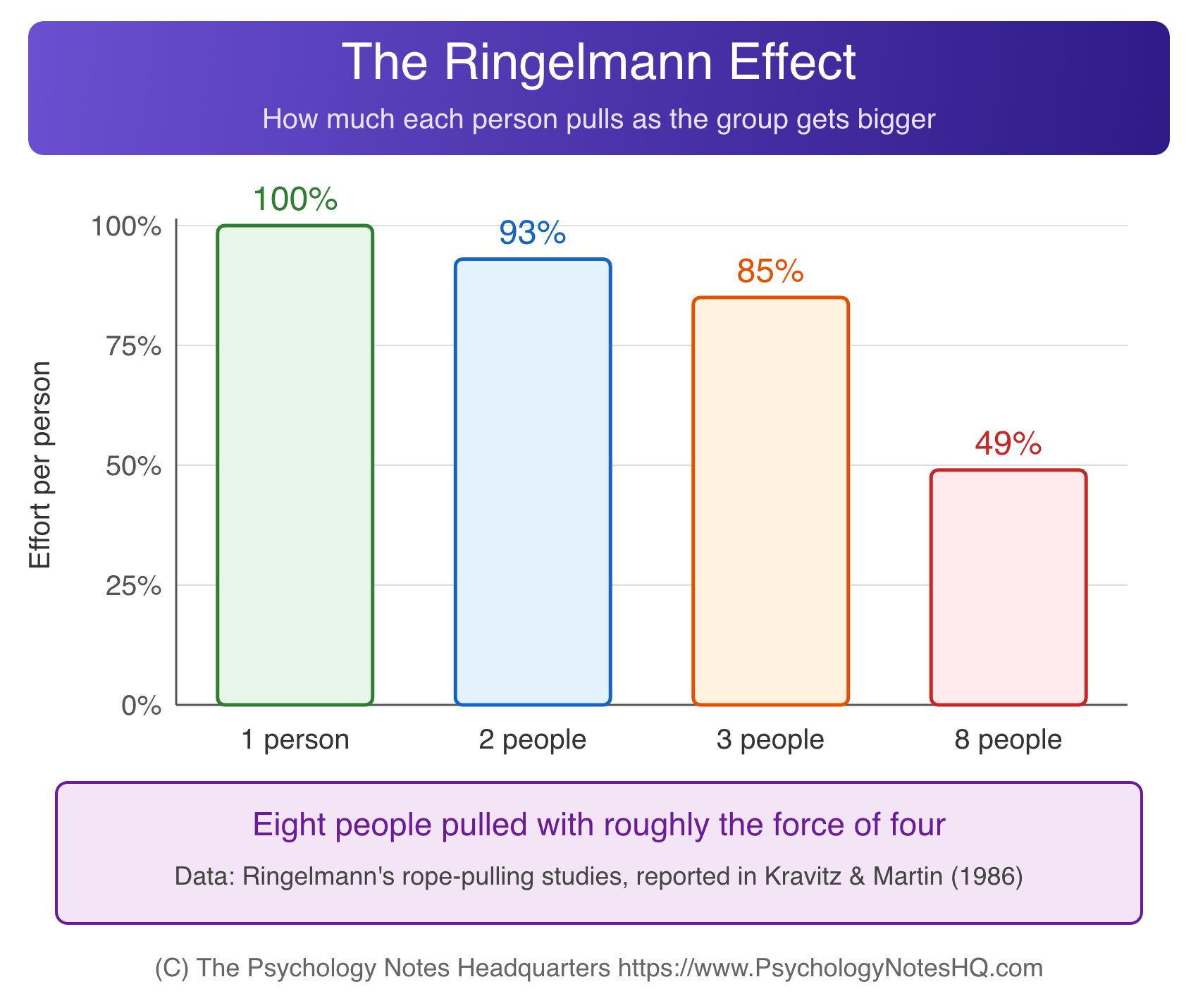
Ringelmann published this work in 1913, and it sat mostly unnoticed for decades. Kravitz and Martin (1986) later tracked down his original article and confirmed that the experiments were run in the 1880s, which makes them some of the earliest social psychology experiments on record.
Coordination Problem or Motivation Problem?
Ringelmann’s data had two possible explanations. Maybe people pulled at slightly different times and got in each other’s way. Or maybe they simply tried less hard.
Ingham and colleagues (1974) separated the two with a clever trick. Blindfolded participants were told others were pulling behind them, but they were actually pulling alone. With no real teammates, there was nothing to coordinate. Participants still pulled noticeably harder when they knew they were alone. The problem was motivation.
Naming the Effect
Latané, Williams, and Harkins (1979) gave the phenomenon its name. They asked students to clap and shout as loudly as possible, alone or in groups. Two-person groups produced only 71% of their combined individual capacity, and six-person groups only 40%.
Some of that gap was coordination loss. So the team ran pseudo-groups, where blindfolded participants wearing headphones only believed others were shouting with them. Effort still dropped to 82% with one imagined partner and 74% with five.
Why Social Loafing Happens: Three Mechanisms
Social loafing in psychology isn’t one single process. It comes from at least three overlapping forces that tend to operate together whenever effort gets pooled.
Diffusion of Responsibility
When a task belongs to everyone, it psychologically belongs to no one. Each person quietly assumes someone else will cover the gap.
This diffusion of responsibility is the same dynamic behind the bystander effect, where people are less likely to help in an emergency when others are around. In both cases, shared responsibility turns into diluted responsibility.
Reduced Evaluation Apprehension
Work alone and your output is visible and clearly yours. Work in a group and individual contributions blur into one shared result.
That anonymity removes much of the social pressure that normally keeps effort high. People ease off, often without realizing it, when nobody can tell exactly what they did. Interestingly, participants in the clapping studies generally didn’t see themselves as loafing at all.
The Sucker Effect
Kerr (1983) identified a third mechanism, the sucker effect. When capable teammates seem to be coasting, continuing to work hard starts to feel unfair.
Nobody wants to be the one carrying everyone else. So even motivated people cut back to match what they see around them. This is why loafing can spread through a group: one coaster can pull down the effort of the hardest worker.
The Collective Effort Model
The mechanisms above describe what’s going on. The Collective Effort Model, proposed by Karau and Williams (1993) in their meta-analysis of 78 studies, explains when it will happen.
The model’s core claim is simple. People will work hard on a group task only to the extent that they expect their effort to lead to outcomes they personally value.
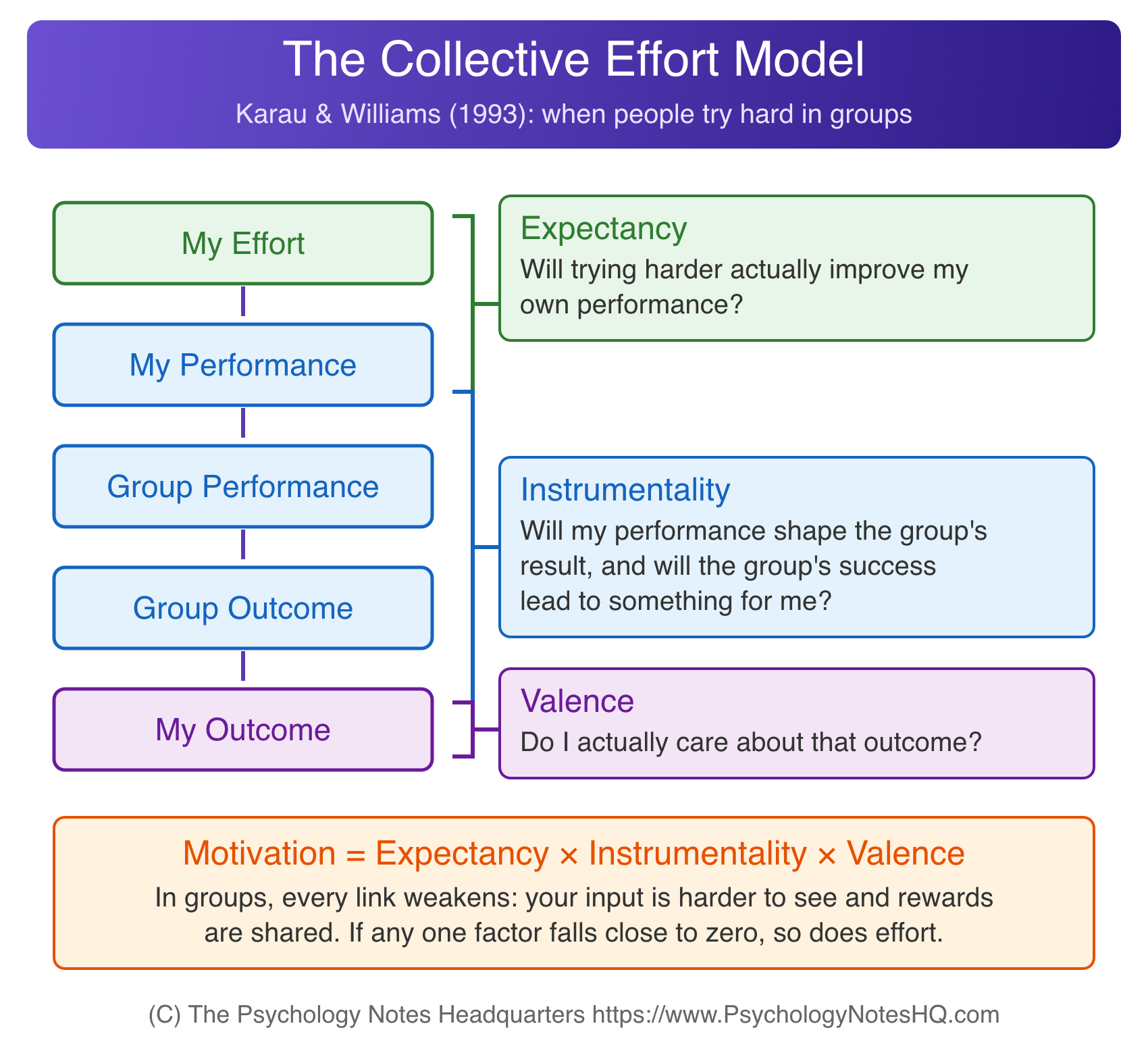
That expectation depends on a chain of three beliefs. Expectancy is the belief that more effort will improve your own performance. Instrumentality is the belief that your performance will affect the group’s result, and that the group’s success will lead to something for you. Valence is how much you actually care about that final outcome.
Motivation works like multiplication. If any one of the three falls close to zero, effort collapses.
Why Groups Weaken the Chain
Working alone, the links are tight. Your effort shapes your performance, and your performance determines your outcome.
In a group, every link loosens. Your contribution is harder to see, other people’s work also shapes the result, and rewards get split. The Collective Effort Model predicts that loafing shrinks whenever those links are restored, which is exactly what most of the research on moderators shows.
Social Loafing Examples in Real Life
Social loafing examples show up anywhere effort is pooled and individual contributions are hard to track. These four settings are where students and professionals meet it most often.
Group Projects
The classic case is the student group project. When five people share one grade, the incentive to carry a full load shrinks, especially if you believe someone else will pick up the slack.
The result is usually predictable. One or two people do most of the work, the rest contribute a little, and everyone gets the same mark. The structure of the assignment creates the problem.
Social Loafing in the Workplace
Social loafing in the workplace appears wherever accountability is spread thin. Shared project trackers, team targets that don’t separate individual contributions, and large meetings all create room for effort to fade.
Brainstorming groups are a well-known case. Groups that brainstorm together often generate fewer ideas than the same number of people working separately and pooling their lists afterward. Loafing is one contributor, alongside simply having to wait your turn to speak.
Sports Teams
Sport offers some of the cleanest tests. Williams et al. (1989) studied college swimmers in individual and relay events while varying whether each swimmer’s lap time was announced.
Relay swimmers slowed down mainly when their individual times stayed anonymous. When everyone’s time was identifiable, the slowdown disappeared. Team events don’t automatically cause loafing. Hidden individual performance does.
Online Collaboration
Remote work and shared documents make contributions even harder to trace than face-to-face teamwork does. When a message thread goes unanswered or a shared file sits untouched, it’s rarely clear whose job it was.
That ambiguity lets social proof work in reverse. If nobody else seems to be responding, silence starts to look like the normal thing to do.
Social Loafing vs Related Group Effects
Several related effects are easy to confuse with social loafing on exams, and they don’t all push effort down. The table below compares them side by side.
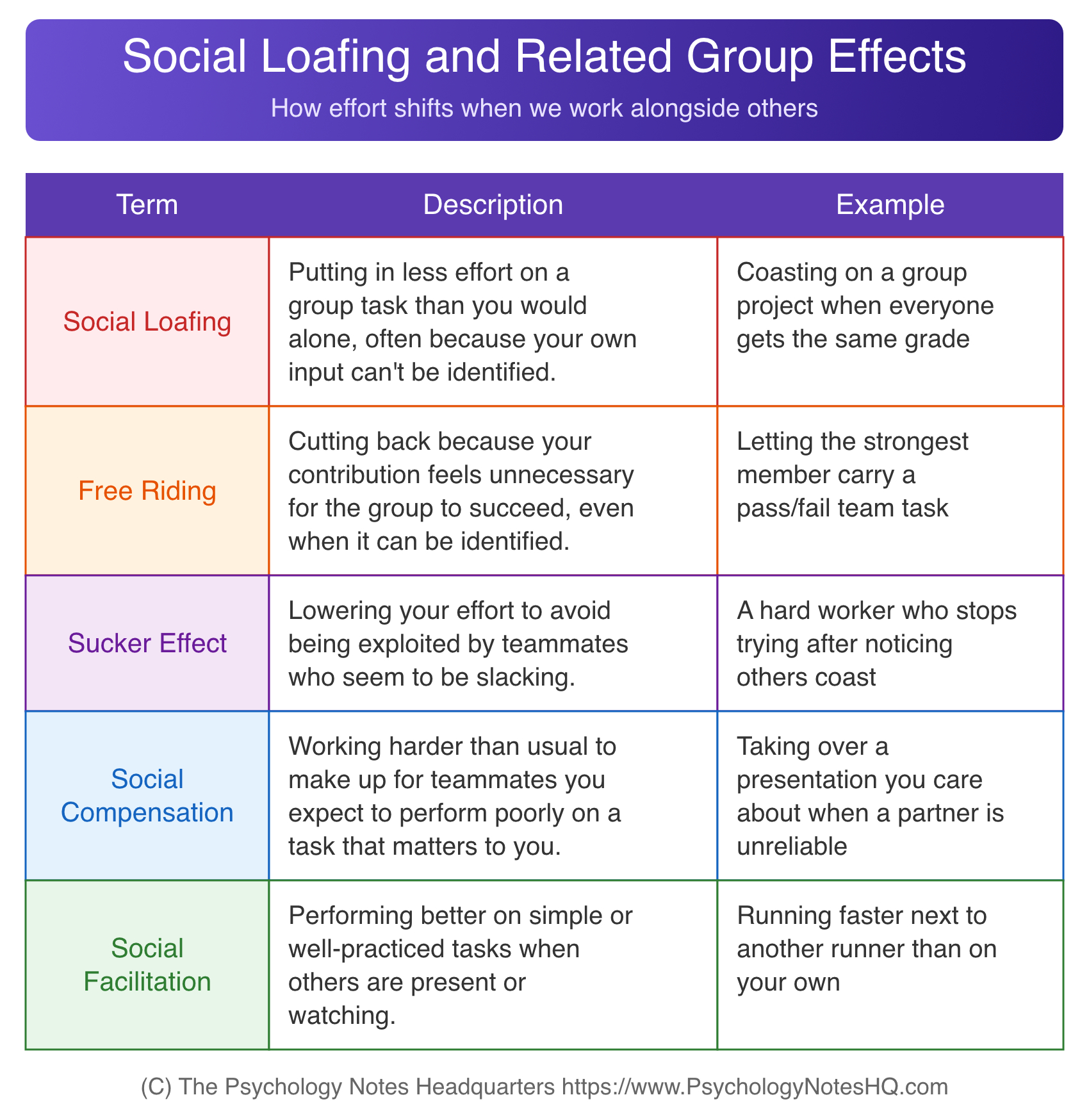
Free riding is the closest cousin. Kerr (1983) treated social loafing and free riding as separate group motivation losses. Free riders cut back because their effort feels unnecessary for the group to succeed, even when their contribution can be identified.
Social compensation runs the opposite way. Williams and Karau (1991) found that people worked harder collectively than alone when they expected teammates to perform poorly on a task they found meaningful. When the task wasn’t meaningful, the extra effort disappeared.
Social facilitation is the other direction again. The presence of others tends to improve performance on simple or well-practiced tasks, largely because individual performance stays visible.
The same audience can backfire on hard or unfamiliar tasks, where an onlooker’s presence tends to make performance worse. The key difference from loafing is that in social facilitation, each person remains fully identifiable.
When Social Loafing Gets Worse and When It Doesn’t
The idea that groups reduce effort is real, but it’s far from universal. Several moderators change the picture, and knowing them separates a surface-level grasp of group dynamics from a solid one.
Group Size
Size matters, but not in a straight line. In the clapping and shouting studies, the steepest per-person drop came with the first few added members (Latané et al., 1979). Adding more people keeps effort low, but each extra person changes things less.
Task Meaningfulness
People loaf far less on tasks they find important or interesting. A student who genuinely cares about the project topic will usually outwork one who doesn’t, even with a shared grade.
This fits self-determination theory, which holds that intrinsic motivation drives sustained effort. Group structures can either protect that motivation or wear it down, depending on how the work is designed.
Identifiability
Identifiability is one of the most dependable moderators. When individual contributions can be measured and traced to specific people, loafing drops sharply (Karau & Williams, 1993). The swimming study showed the same thing: visibility restores accountability.
Group Cohesion
Friends and close-knit teams tend to loaf less than groups of strangers, partly because caring about the group raises the value of its success.
Cohesion isn’t automatically a good thing, though. In groupthink, strong cohesion suppresses dissent, while in productive teams the same closeness boosts effort. Related effects like group polarization also grow out of the mix of cohesion, anonymity, and shared decision-making.
Culture Changes the Equation
Most early social loafing studies used Western, individualist participants, and that shaped the picture researchers drew.
Earley (1989) compared managerial trainees from the United States and the People’s Republic of China working under different conditions of accountability and shared responsibility. The American trainees showed the familiar loafing pattern. The Chinese trainees, whose beliefs were more collectivist, did not.
Karau and Williams’ (1993) meta-analysis backed this up. Social loafing was smaller in Eastern, more collectivist cultures than in Western ones.
The Collective Effort Model helps explain why. When contributing to the group is itself a source of meaning, the group’s success carries real personal value. That’s the same kind of investment social identity theory describes, and it’s closely tied to how people treat their in-groups versus out-groups.
The practical takeaway: fixes built for individualist workplaces, like individual metrics and competition, may matter less in close-knit, collectivist teams.
How to Reduce Social Loafing
Because social loafing grows out of identifiable conditions, those conditions can be changed. The most effective strategies each repair a specific broken link.
Make Individual Contributions Visible
This is the single most reliable lever. When people know their own output will be seen and evaluated by an instructor, a manager, or their peers, the anonymity that enables loafing disappears. Peer evaluation rubrics, individual check-ins, and output tracking all do this job.
Keep Groups Small
Smaller groups keep responsibility personal. As groups grow, diffusion of responsibility intensifies and the sucker effect becomes harder to counter.
Assign Specific Roles
When each person owns a defined piece of the task, there’s no confusion about who is responsible for what. That removes the easy escape route shared ownership provides, and it strengthens instrumentality, because each person’s piece clearly matters to the final result.
Make the Task Meaningful
People loaf less when they care about the outcome. Linking work to real-world uses, allowing some choice of topic, or explaining why the task matters can all raise valence. High personal investment also makes it easier to resist conformity to a low-effort group norm.
Build Cohesion Early
A short team-building activity, shared goal-setting, or simply time to get to know each other turns group identity into an active motivator. Social learning theory adds that high-effort members within a close group raise the perceived standard, which makes coasting feel less comfortable.
Build In Self and Peer Evaluation
Regular feedback lets group members compare their own contribution with everyone else’s. Even the expectation of being evaluated can reduce loafing, because it restores the visibility that groups take away. The goal isn’t punishment. It’s making sure individual effort doesn’t vanish into the collective result.
Conclusion
Social loafing feels obvious once you’ve lived through a lopsided group project, but the research behind it is more interesting than “people are lazy.” Effort drops when individual work disappears into the group, when outcomes feel disconnected from what you do, and when you suspect others are coasting. Fix those conditions and the effect shrinks, or even flips into social compensation. The goal isn’t to avoid groups. It’s to design them so that effort stays visible, meaningful, and personally owned.
References
- Earley, P. C. (1989). Social loafing and collectivism: A comparison of the United States and the People’s Republic of China. Administrative Science Quarterly, 34(4), 565–581.
- Ingham, A. G., Levinger, G., Graves, J., & Peckham, V. (1974). The Ringelmann effect: Studies of group size and group performance. Journal of Experimental Social Psychology, 10(4), 371–384.
- Karau, S. J., & Williams, K. D. (1993). Social loafing: A meta-analytic review and theoretical integration. Journal of Personality and Social Psychology, 65(4), 681–706.
- Kerr, N. L. (1983). Motivation losses in small groups: A social dilemma analysis. Journal of Personality and Social Psychology, 45(4), 819–828.
- Kravitz, D. A., & Martin, B. (1986). Ringelmann rediscovered: The original article. Journal of Personality and Social Psychology, 50(5), 936–941.
- Latané, B., Williams, K., & Harkins, S. (1979). Many hands make light the work: The causes and consequences of social loafing. Journal of Personality and Social Psychology, 37(6), 822–832.
- Williams, K. D., & Karau, S. J. (1991). Social loafing and social compensation: The effects of expectations of co-worker performance. Journal of Personality and Social Psychology, 61(4), 570–581.
- Williams, K. D., Nida, S. A., Baca, L. D., & Latané, B. (1989). Social loafing and swimming: Effects of identifiability on individual and relay performance of intercollegiate swimmers. Basic and Applied Social Psychology, 10(1), 73–81.
How to cite this article:
The Psychology Notes Headquarters. (2026). Social Loafing: Why 8 People Pull Like 4 (and How to Stop It). Retrieved from https://www.psychologynoteshq.com/social-loafing/