
Null Hypothesis Examples: 7 Real Studies That Show How It Actually Works
A null hypothesis is the default claim that nothing interesting is happening: no difference between groups, no relationship between variables, no effect of a treatment. Researchers do not set out to prove it. They set it up specifically so their data can argue against it. Working through actual null hypothesis examples from published psychology research makes this logic click far faster than memorizing a textbook definition ever will.
Key Takeaways
- A null hypothesis always predicts no effect, no difference, or no relationship, even in studies designed to find something interesting.
- Null hypothesis examples from real psychology research show researchers testing whether their treatment beats doing nothing at all.
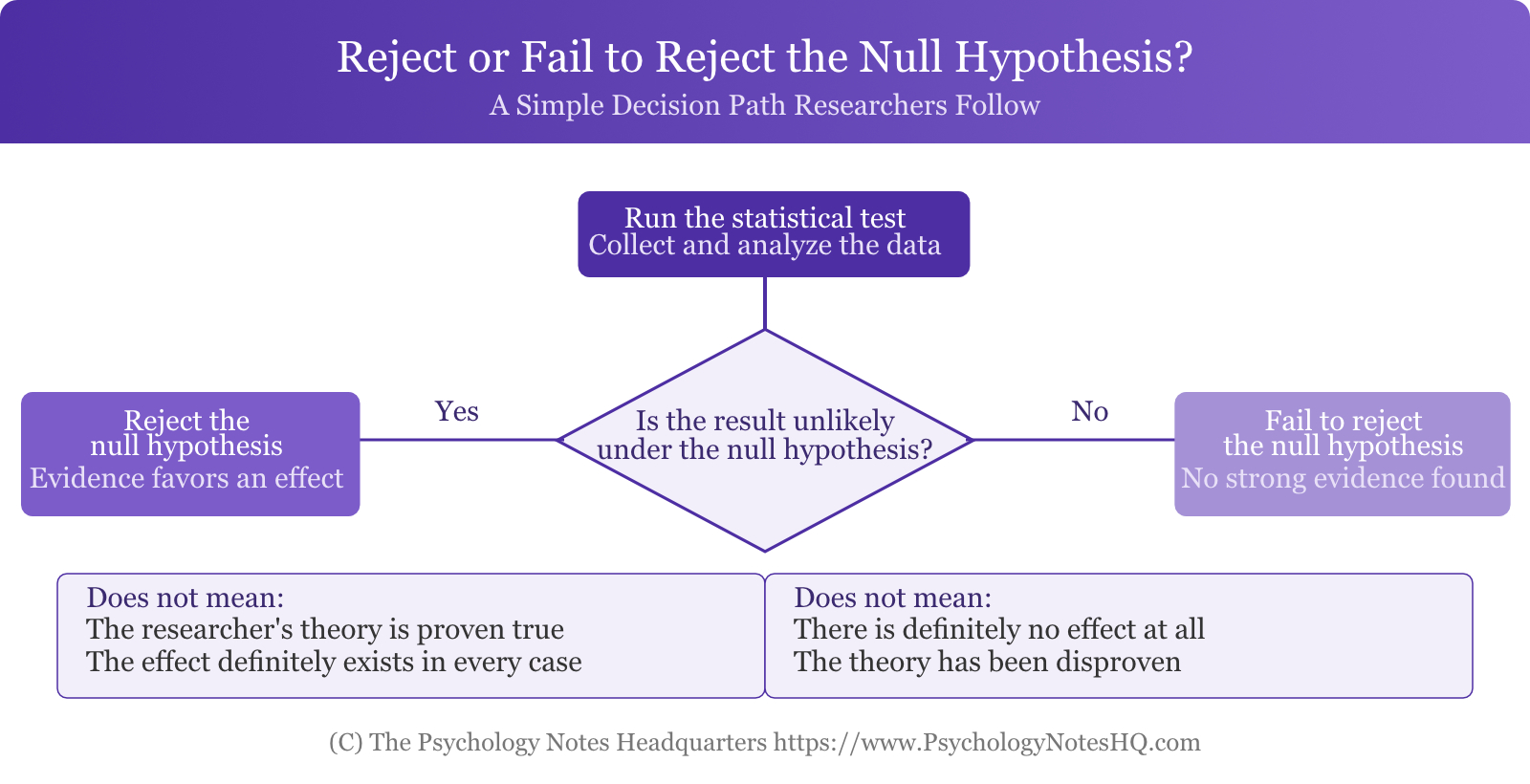
- Rejecting the null hypothesis does not prove a theory correct; it only means the results were unlikely under “no effect.”
- Failing to reject the null hypothesis does not mean an effect definitely does not exist, just that this study did not detect one.
- Confusing statistical significance with real-world importance is one of the most common mistakes students make when reading psychology studies.
What the Null Hypothesis Actually Claims
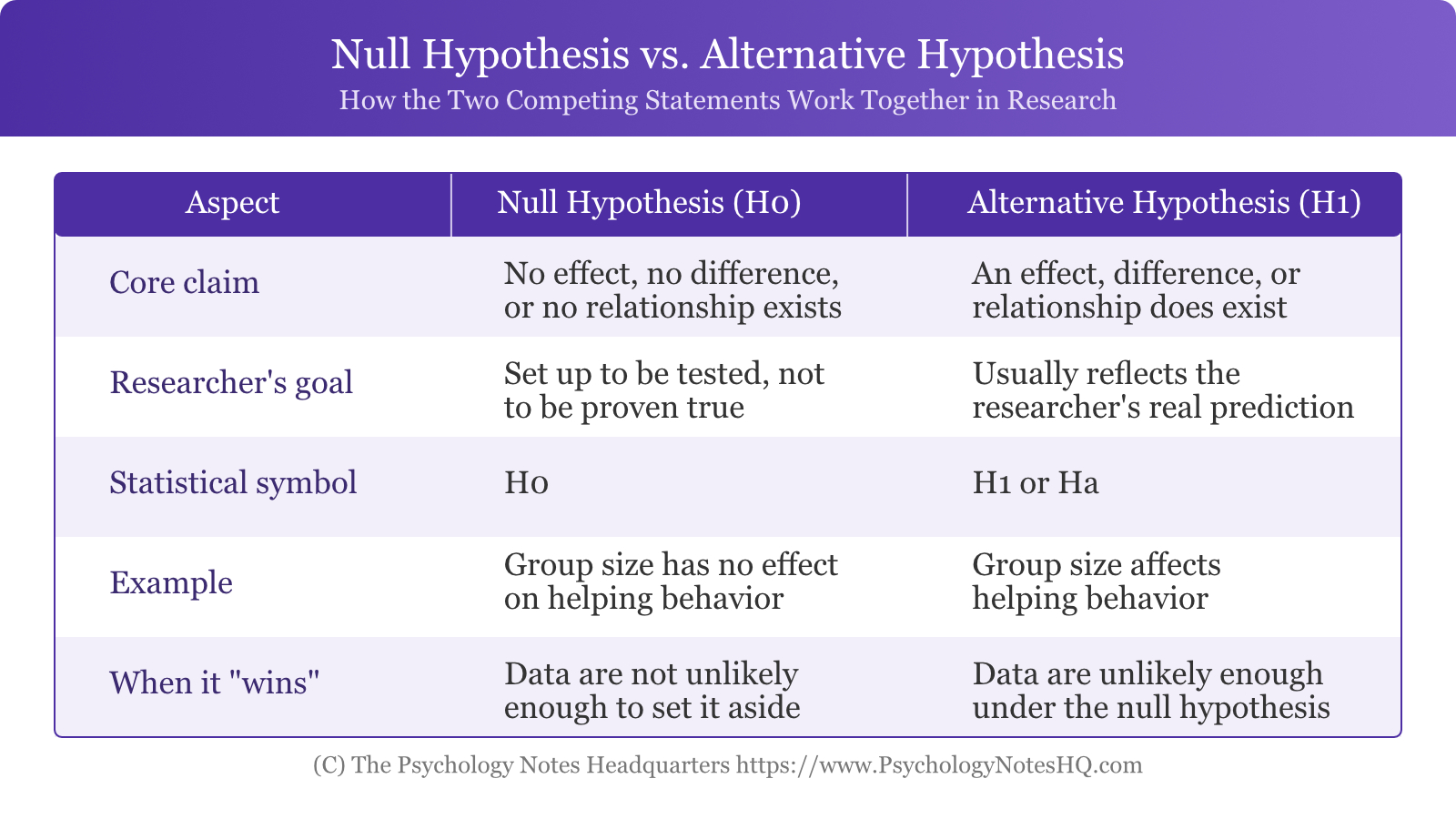
Every hypothesis test starts with two competing statements. The null hypothesis says the pattern researchers are looking for does not exist in the population, only random noise does. The alternative hypothesis says it does. A study is built to see whether the collected data make the null claim look implausible enough to set aside.
This setup matters because science is built to be skeptical of itself. Instead of trying to confirm a favorite theory, researchers try to rule out the boring explanation first. If the boring explanation survives, the theory has not earned support yet.
Null Hypothesis Examples From Real Psychology Studies
Abstract definitions rarely stick. Seeing how researchers actually phrased their null hypotheses, and what happened when they tested them, makes the concept concrete.
1. Bystander Intervention
Early bystander research set out to test whether group size affects helping behavior. The null hypothesis: the number of witnesses present has no effect on whether a person in distress receives help. Data from the bystander effect studies rejected that null hypothesis. Help became slower and less likely as more witnesses were added, which is why the effect carries its name today.
2. Obedience to Authority
Stanley Milgram’s research on obedience effectively tested whether ordinary participants would refuse to administer what they believed were harmful shocks once an authority figure instructed them to continue. The null hypothesis predicted no meaningful difference in obedience rates driven by the presence of an authority figure. The results, described in detail in coverage of the Milgram obedience experiment, rejected that null hypothesis at levels that startled even Milgram himself.
3. Situational Power in Institutions
The Stanford Prison Experiment examined whether assigned roles, guard or prisoner, would shift behavior independent of individual personality. Its null hypothesis held that role assignment would produce no meaningful behavioral difference between participants. Findings summarized in the Stanford Prison Experiment pushed researchers to reject that null hypothesis, though later critiques have raised serious questions about how the study was run.
4. Self-Efficacy and Performance
Research building on Albert Bandura’s work on self-efficacy often tests a null hypothesis stating that a person’s belief in their own competence has no relationship to their actual performance or persistence on a task. Across many studies, that null hypothesis has been rejected consistently enough that self-efficacy is now treated as a reliable predictor rather than a coincidence.
5. Group Effort and Social Loafing
Studies on social loafing test whether individual effort changes when people work in groups versus alone. The null hypothesis states that group size has no effect on per-person effort. Researchers have repeatedly rejected this null hypothesis, finding that effort tends to drop as group size increases, particularly when individual contributions are hard to track.
6. Memory Distortion After Misinformation
Work on the misinformation effect tests whether exposure to misleading details after an event changes what people later report remembering. The null hypothesis predicts no difference in recall accuracy between people exposed to misinformation and those who were not. That null hypothesis has been rejected across decades of replication, which is part of why eyewitness testimony research carries so much weight in legal settings.
7. A Non-Significant Result: Frustration and Aggression
Not every test rejects the null hypothesis, and that matters just as much. Some studies examining the frustration-aggression hypothesis in narrowly defined conditions have failed to reject the null, finding no reliable increase in aggression under specific blocked-goal scenarios. That does not disprove the broader theory. It signals that the relationship may depend on variables the study did not account for, such as how the frustration was caused or who caused it.
Why “Failing to Reject” Isn’t the Same as “Proving Nothing”
This is where most confusion sets in. Rejecting the null hypothesis does not prove a researcher’s theory is true. It only means the observed data would be unlikely if nothing were going on. Likewise, failing to reject the null hypothesis does not prove an effect is absent. It may simply mean the sample was too small, the measurement too noisy, or the effect too subtle for that particular study to catch.
Statisticians have pushed back for decades against treating a single test as a verdict (Cohen, 1994). A null hypothesis is a working assumption to be weighed against evidence, not a fact to be confirmed or a fact to be disproven once and for all.
Common Mistakes Students Make With the Null Hypothesis
A few errors show up constantly in undergraduate research papers and class discussions.
Treating a non-significant result as proof that “there is no effect” is one of the most frequent. Absence of evidence is not evidence of absence, especially with small samples. Another common mistake is confusing the null hypothesis with the researcher’s actual prediction; the null is almost always the opposite of what a researcher hopes to find. Students also sometimes assume a very small p-value means an effect is large or important, when it may just mean the sample was large enough to detect a tiny, practically meaningless difference.
How Null Hypothesis Testing Shows Up Outside the Classroom
Null hypothesis psychology research is not just a classroom exercise. Clinical trials use the same logic to test whether a new therapy outperforms a placebo. Product and UX teams use it to test whether a design change actually improves user behavior instead of matching normal daily fluctuation. Even A/B tested marketing emails rely on the same basic structure: assume no difference exists, then see whether the data disagree.
Understanding null hypothesis psychology applications this way makes the concept feel less like a statistics requirement and more like a habit of thinking. Good researchers, and good consumers of research, default to skepticism before they default to belief.
The Bigger Picture
A null hypothesis is not an obstacle standing between researchers and their real findings. It is the built-in skepticism that keeps a field honest. Every example above, from bystander behavior to memory distortion, started with the same humble assumption: maybe nothing is happening here. The studies that rejected that assumption did so with evidence strong enough to earn attention. The ones that did not still taught researchers something about where their theory’s limits might be.
References
- Cohen, J. (1994). The earth is round (p < .05). American Psychologist, 49(12), 997-1003.
- Cumming, G. (2014). The new statistics: Why and how. Psychological Science, 25(1), 7-29.
- Fisher, R. A. (1925). Statistical methods for research workers. Oliver and Boyd.
- Gigerenzer, G. (2004). Mindless statistics. The Journal of Socio-Economics, 33(5), 587-606.
- Neyman, J., & Pearson, E. S. (1933). On the problem of the most efficient tests of statistical hypotheses. Philosophical Transactions of the Royal Society A, 231, 289-337.
- Wasserstein, R. L., & Lazar, N. A. (2016). The ASA statement on p-values: Context, process, and purpose. The American Statistician, 70(2), 129-133.
How to cite this article:
The Psychology Notes Headquarters. (2026). Null Hypothesis Examples: 7 Real Studies That Show How It Actually Works. Retrieved from https://www.psychologynoteshq.com/null-hypothesis-examples/