
Independent vs Dependent Variables: How to Spot Them in Real Psychology Studies
You are halfway through a psychology exam, and the question describes a study where children watch an adult attack an inflatable doll and are then left alone with it. Which part did the researcher control, and which part was simply counted? Independent and dependent variables in psychology sound easy until a study summary scrambles the wording. Five famous experiments, a repeatable sorting method and the mistakes that cost students the most points make the next study description feel familiar instead of tricky.
Key Takeaways
- One simple question sorts the two variables in almost any study description.
- Five classic experiments show the same logic playing out in very different settings.
- A common slip involves counting the versions of a variable as separate variables.
- Some variables sit quietly in the background and can undermine a study’s conclusions.
- Not every study can assign the variable it cares about, which changes what the results can claim.
What the Two Variables Actually Do in a Study
The Variable the Researcher Changes
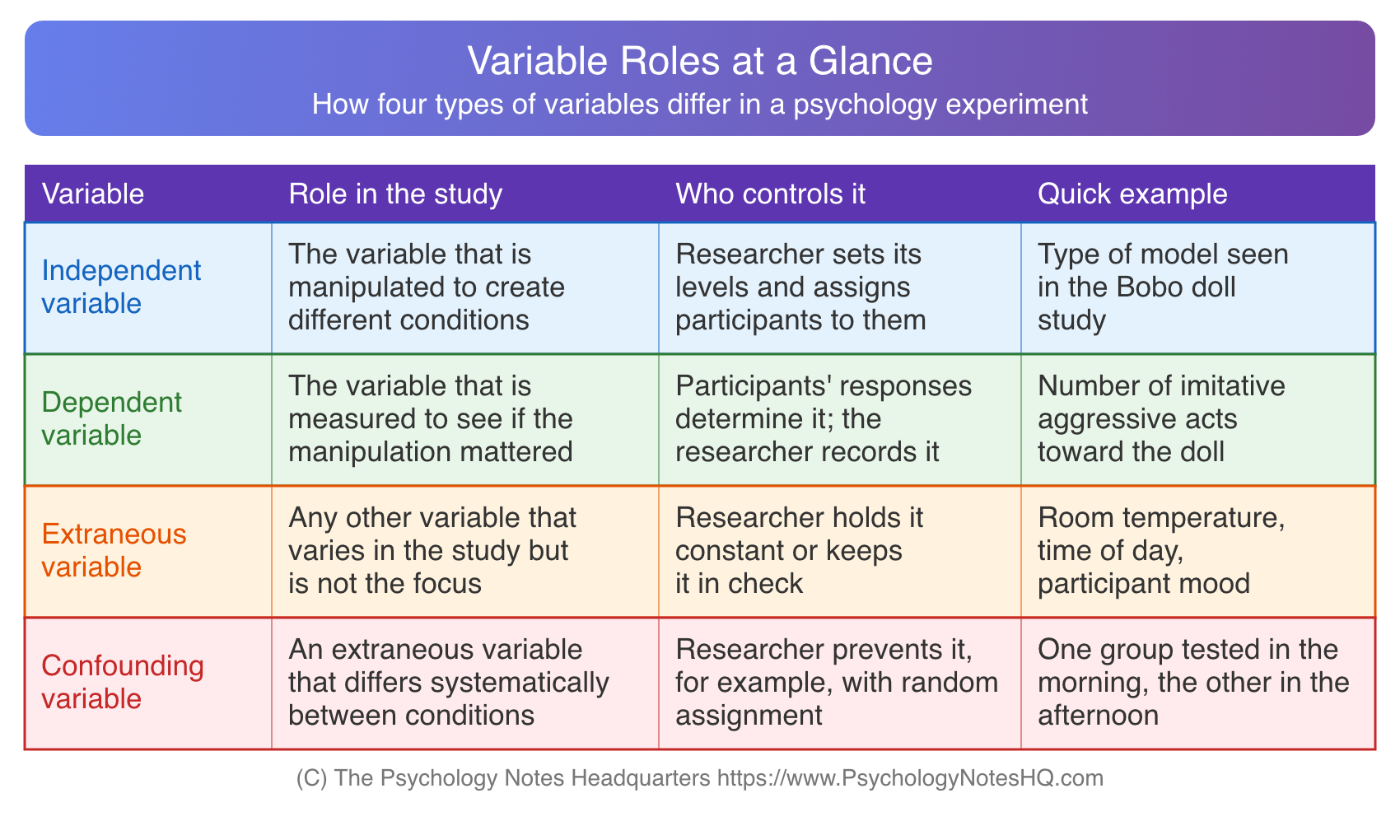
In an experiment, the researcher deliberately alters one thing to see what happens. That is the independent variable, sometimes called the manipulated variable. The researcher creates different versions of it, known as conditions or levels, and each participant experiences one of them.
The key idea is that the researcher, not the participant, decides who gets which version. If participants arrive already sorted, the variable has not truly been manipulated (Jhangiani et al., 2019).
The Variable the Researcher Records
The dependent variable is the outcome, sometimes called the measured variable. It is whatever the researcher counts, times or scores to find out whether the manipulation made a difference.
It is called dependent because its value is expected to depend on which condition a participant experienced. A test score, a reaction time, the number of aggressive acts or the minutes spent drawing can all play this role.
One Question That Sorts Them
Ask what the researcher changed and what they measured afterward. The first answer is the independent variable, and the second is the dependent variable.
A handy template is “the effect of [independent variable] on [dependent variable].” If the sentence sounds backward when you read it aloud, you have probably swapped the two.
Independent and Dependent Variables in Famous Psychology Studies
Bandura’s Bobo Doll Study
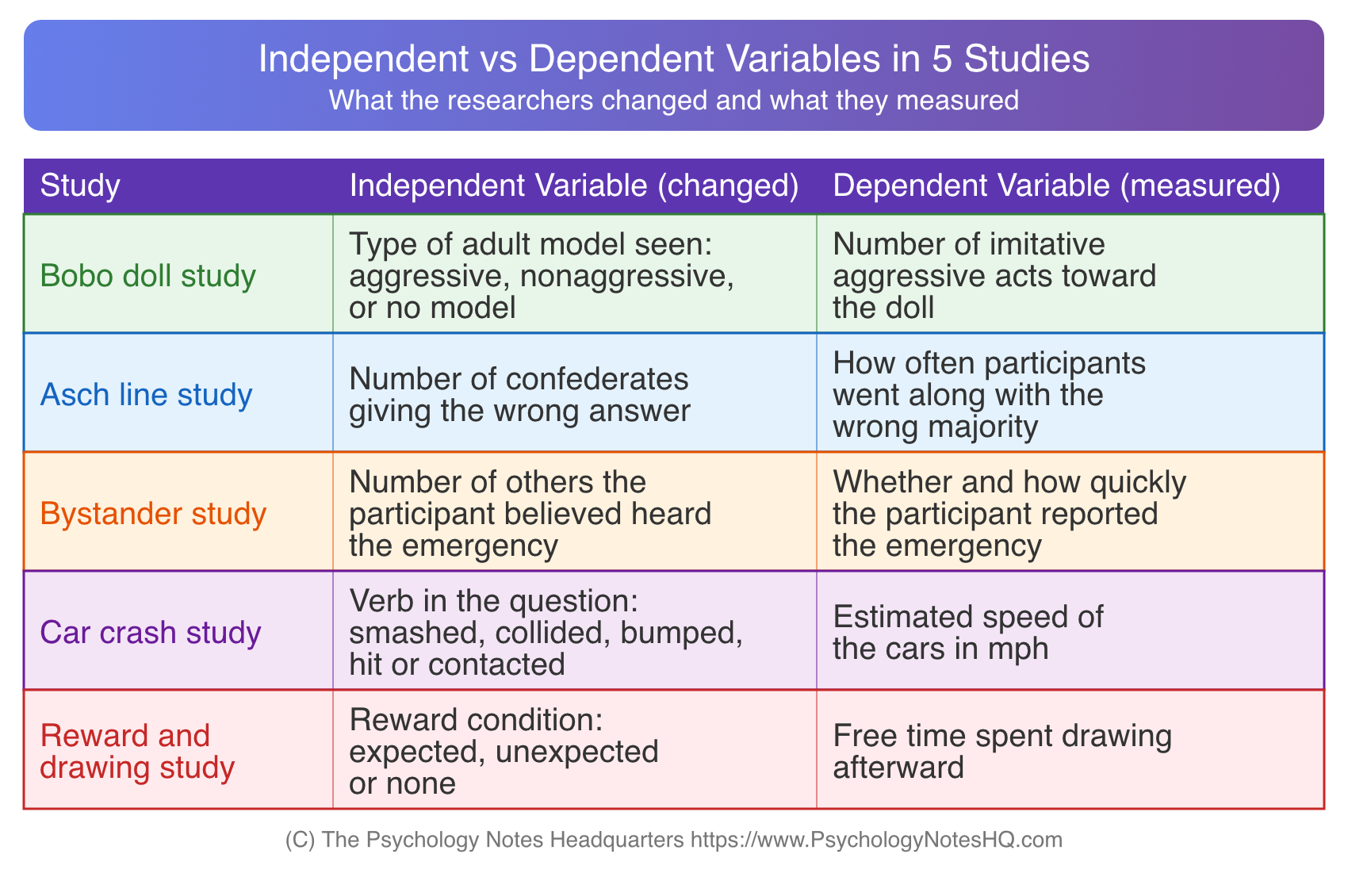
In Bandura’s classic experiment, 72 preschool children watched an adult act aggressively toward an inflatable Bobo doll, watched an adult play calmly, or saw no model at all (Bandura et al., 1961). The independent variable was the type of model. The dependent variable was how many imitative aggressive acts the children showed when later left with the doll.
The study became a cornerstone of social learning theory, and it shows how behavior can be learned by simply watching someone else.
Asch’s Line Judgment Experiments
Asch asked participants to match the length of a line while a group of confederates deliberately gave wrong answers. In some variations, he changed how many confederates gave the wrong answer, so the independent variable was the size of the unanimous majority.
The dependent variable was how often participants went along with the incorrect answer. Across the critical trials of the basic setup, roughly a third of judgments matched the wrong majority (Asch, 1956). These results fed a much larger body of conformity research.
Darley and Latané’s Bystander Study
Participants sat in separate booths, talked over an intercom, and then overheard what sounded like another student having a seizure. The independent variable was how many other people participants believed could also hear the emergency.
The dependent variable was whether, and how quickly, they reported it. Believing more bystanders were present slowed people down (Darley & Latané, 1968), a pattern now known as the bystander effect.
Loftus and Palmer’s Car Crash Study
Students watched films of traffic accidents and were then asked how fast the cars were going when they hit each other. The critical verb changed by group: smashed, collided, bumped, hit or contacted.
So the independent variable was one word in a question, and the dependent variable was the estimated speed. Smashed produced an average near 41 mph, while contacted produced about 32 mph (Loftus & Palmer, 1974). The work became foundational to research on the misinformation effect.
Lepper’s Drawing and Rewards Study
Preschoolers who enjoyed drawing were told they would get a certificate for drawing, received one unexpectedly, or received none. The independent variable was the reward condition. The dependent variable was how much free time the children later spent drawing.
Children who had expected a reward drew less afterward (Lepper et al., 1973), an early demonstration of the overjustification effect.
How to Identify the Variables in Any Study Description
Start With the Research Question
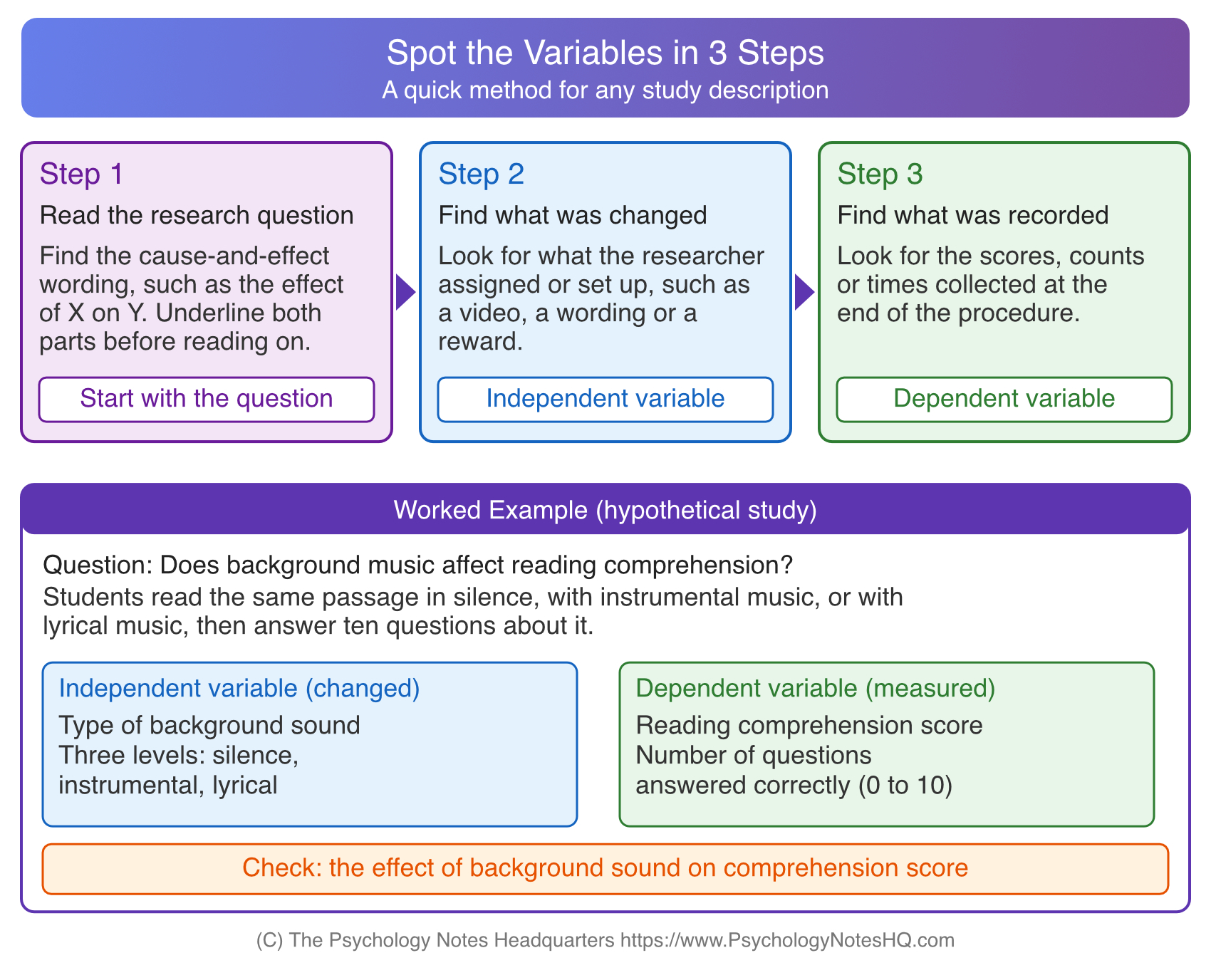
Most study summaries open with a question, such as whether sleep affects memory. The word after “affects” or “influences” usually points to the dependent variable, and the presumed cause comes first.
Underline both parts before reading anything else. This one habit removes most of the confusion, because the rest of the summary is just detail about how each idea was set up or measured.
Look for What Was Assigned
Next, scan for the moment participants were divided into groups. Anything the researcher assigned, such as a video, a wording, a reward or a group size, is a candidate for the independent variable.
Anything participants produced afterward, such as scores, counts, times or ratings, is a candidate for the dependent variable. When you are learning how to identify the dependent variable, look for the thing written down at the end of the procedure.
Watch for Different Ways of Measuring
Dependent variables show up in several forms. A frequency count, such as the number of aggressive acts, is common. Time is another, such as how long participants took to report an emergency. Researchers also use rating scales, accuracy percentages and yes or no answers, like whether participants said they saw broken glass.
The form of the measurement does not change the rule. Whatever was recorded after the manipulation is the dependent variable.
Try a Worked Example
Suppose a researcher wants to know whether background music affects reading comprehension. Students read the same passage in silence, with instrumental music, or with lyrical music, then answer ten questions.
The independent variable is the type of background sound, with three levels. The dependent variable is the comprehension score out of ten. The passage, the room and the time allowed are held constant, and those quiet background details deserve their own attention.
Why Study Summaries Hide the Variables
Summaries rarely announce their variables. They may use passive phrasing, such as scores were compared across three groups, or describe the procedure in a different order than the logic. Names also vary, and the independent variable is sometimes called the treatment or the factor.
Translate the description into your own sentence using the “effect of X on Y” template, then check each half against the procedure. Doing this a few times builds speed for exam day.
Operational Definitions Turn Ideas Into Measurable Variables
Why Concepts Need Measuring Rules
Aggression, stress and motivation cannot be measured directly. A researcher must decide how each will be observed in a specific study, and that decision is the operational definition.
In the Bobo doll study, aggression was defined through observable acts such as hitting the doll with a mallet, not through an impression that a child seemed angry. Clear operational definitions also let other labs repeat the study, which is central to the replication crisis in psychology.
Strong and Weak Definitions
Imagine defining the dependent variable in a memory study. A weak version says participants remembered well. A strong version says the number of words correctly recalled from a 20 word list after five minutes.
The strong version can be counted, checked and repeated. It also makes it easier to judge whether a measure is consistent and accurate, the ideas behind reliability and validity.
Levels, Conditions and More Than One Variable
Levels of the Independent Variable
One independent variable can have several levels. In Loftus and Palmer’s study, the verb was a single independent variable with five levels. In the bystander study, the number of bystanders was one variable with three levels.
A common slip is counting each level as its own variable. Research methods textbooks flag exactly this confusion (Jhangiani et al., 2019). Count the ideas, not the versions.
Experimental and Control Conditions
Many studies include a control condition, where participants receive no manipulation or a neutral version of it. The no-model group in the Bobo doll study is an example.
The control group gives researchers a baseline. Any difference in the dependent variable can then be linked to the manipulation instead of to the setting or the passing of time.
Studies With Two or More Independent Variables
Some designs manipulate two independent variables at once, known as factorial designs. Bandura’s study also varied the sex of the model, which let the researchers ask whether children copied same-sex models more.
Each independent variable still has its own effect on the dependent variable, and researchers can also check whether the variables work together.
Extraneous and Confounding Variables
Variables Outside the Spotlight
An extraneous variable is anything that varies in a study other than the independent and dependent variables. Room temperature, time of day and participants’ mood are common examples.
Researchers try to hold these constant, because they add noise that hides the real effect (Jhangiani et al., 2019). The verbs matter here: researchers manipulate the independent variable but control extraneous variables.
When Extraneous Becomes Confounding
Confounding variables are extraneous variables that differ systematically between conditions. Imagine testing everyone in the reward condition in the morning and everyone in the no-reward condition in the afternoon.
If drawing time differs, was it the reward or the time of day? Confounding variables supply exactly this kind of alternative explanation, which is why they threaten a study’s internal validity.
How Researchers Keep Them in Check
Random assignment is the most general tool, because it spreads differences among participants roughly evenly across conditions. Identical instructions and a standard setting help too.
Who takes part matters as well. The choice of sampling methods shapes how far results generalize, while random assignment protects the comparison between groups inside the study.
Common Mistakes Students Make
Flipping the Variables
The most common error is reversing cause and effect. If a study asks whether exercise improves mood, exercise is the independent variable and mood is the dependent variable.
When practicing how to identify the dependent variable, confirm with the procedure. Ask which item was set up in advance and which was measured at the end.
Treating Characteristics as Manipulated
Age, gender and personality cannot be assigned by a researcher. A study comparing extroverts with introverts does not manipulate extraversion, so it is not a true experiment on that variable.
Participants arrived with those characteristics already, and groups that differ from the start are likely to differ in other ways too (Jhangiani et al., 2019).
Skipping the Operational Definition
Writing “aggression” as the dependent variable often earns partial credit at best. Add how it was measured, such as the number of imitative aggressive acts during a set observation period.
Exams tend to reward specificity, and a specific answer shows you understand what the researcher actually did.
What Changes When You Cannot Manipulate the Variable
Quasi-Experiments and Natural Groups
Sometimes the independent variable cannot be assigned for practical or ethical reasons. Researchers cannot randomly place children in different families or give people early illnesses.
They study existing groups instead, using nonexperimental or quasi-experimental designs. The vocabulary of variables may stay similar, but confidence about cause and effect drops.
Why Causation Gets Weaker
Without random assignment, groups can differ in many ways beyond the variable of interest. That gap sits at the heart of correlation vs causation.
It also explains why well-controlled experiments remain the strongest tool for testing whether one variable causes change in another.
Why This Skill Matters Beyond the Exam
Reading research critically starts with asking what was changed and what was measured. Headlines often claim that one thing causes another, while the study behind them may only have measured both.
Once you can name the variables, you can also ask whether the measure made sense, whether confounds were controlled, and whether other labs found the same pattern. Understanding independent and dependent variables in psychology makes every later course easier to follow.
Conclusion
The core idea behind independent and dependent variables in psychology is simple: researchers change one thing and measure another. Bobo dolls, line cards, intercoms, car crash films and drawing markers all follow the same logic.
Practice by summarizing any study in one sentence using the “effect of X on Y” format, then check for levels, operational definitions and confounds. With a few examples behind you, the exam question becomes a routine check instead of a puzzle.
References
- Asch, S. E. (1956). Studies of independence and conformity: I. A minority of one against a unanimous majority. Psychological Monographs: General and Applied, 70(9), 1-70.
- Bandura, A., Ross, D., & Ross, S. A. (1961). Transmission of aggression through imitation of aggressive models. Journal of Abnormal and Social Psychology, 63(3), 575-582.
- Darley, J. M., & Latané, B. (1968). Bystander intervention in emergencies: Diffusion of responsibility. Journal of Personality and Social Psychology, 8(4), 377-383.
- Jhangiani, R. S., Chiang, I. A., Cuttler, C., & Leighton, D. C. (2019). Experiment basics. In H. Harton & A. M. H. Gruber (Adapt.), Research methods in psychology (UNI ed., 2026). Manifold.
- Lepper, M. R., Greene, D., & Nisbett, R. E. (1973). Undermining children’s intrinsic interest with extrinsic reward: A test of the “overjustification” hypothesis. Journal of Personality and Social Psychology, 28(1), 129-137.
- Loftus, E. F., & Palmer, J. C. (1974). Reconstruction of automobile destruction: An example of the interaction between language and memory. Journal of Verbal Learning and Verbal Behavior, 13(5), 585-589.
How to cite this article:
The Psychology Notes Headquarters. (2026). Independent vs Dependent Variables: How to Spot Them in Real Psychology Studies. Retrieved from https://www.psychologynoteshq.com/independent-vs-dependent-variables/