
Reliability vs Validity in Psychology: Why a Test Can Be Consistent But Still Wrong
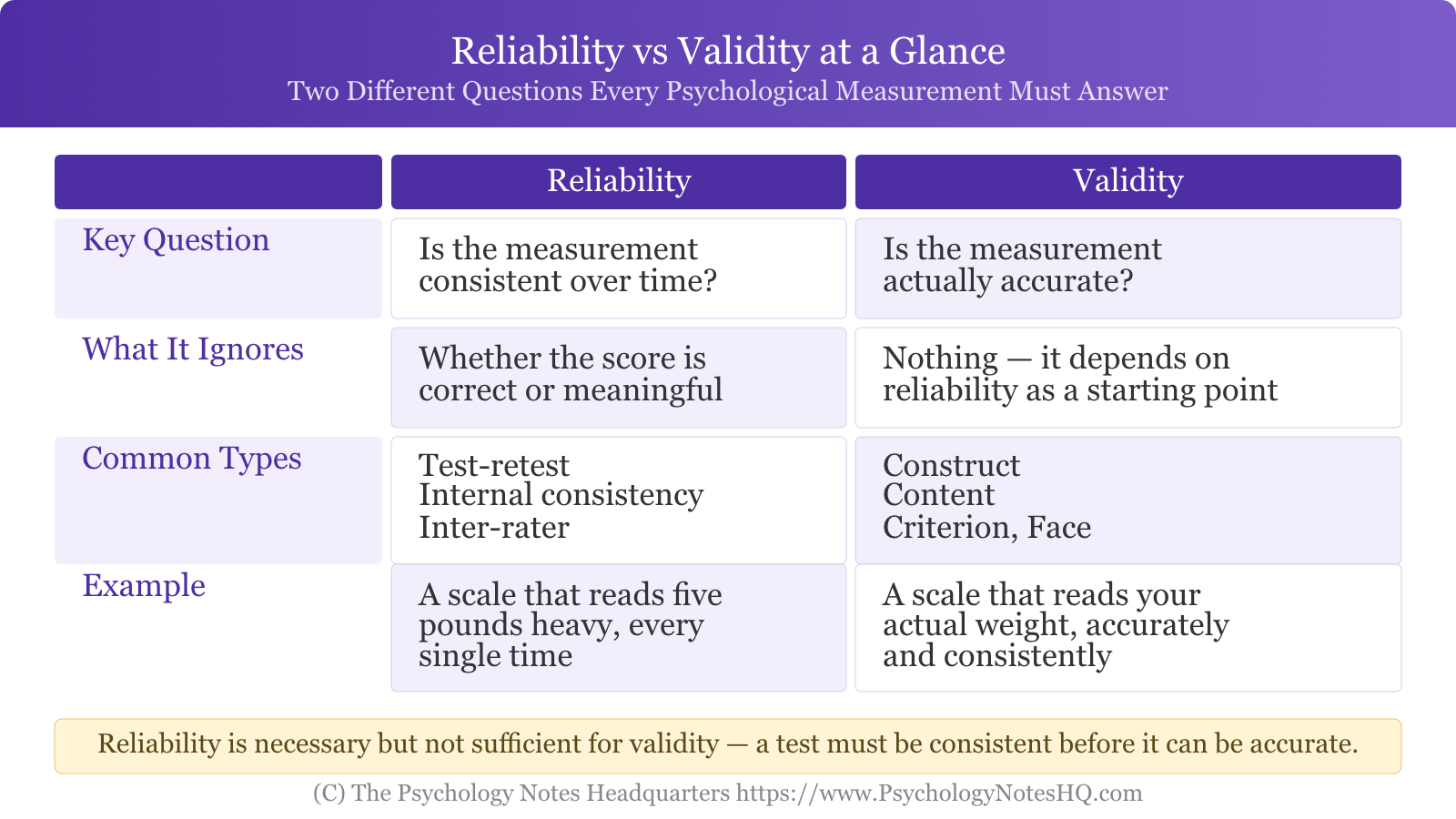
A test can give you the exact same score every single time and still be measuring the wrong thing entirely. That’s the core tension between reliability and validity in psychology: reliability asks whether a measurement is consistent, while validity asks whether it’s actually accurate. A bathroom scale that reads five pounds heavy every time is perfectly reliable — it’s just not valid. Understanding the difference matters for anyone designing, critiquing, or just trying to make sense of psychological research.
Key Takeaways
- Reliability measures consistency; validity measures accuracy — a test can have one without the other
- A simple scale analogy makes the distinction click faster than any textbook definition
- Several distinct types of validity each answer a different question about accuracy
- High reliability never guarantees high validity, but low reliability makes validity impossible
- Real research examples show how flawed measurement quietly skews entire studies
What Reliability Actually Measures
Reliability is about consistency, not correctness. If a measurement tool produces similar results under similar conditions, it’s reliable, regardless of whether those results are actually accurate.
Psychologists typically assess reliability in a few ways. Test-retest reliability checks whether the same person gets a similar score when they take the same test at two different points in time. Internal consistency reliability looks at whether different items on the same test, meant to measure the same construct, produce related results. Inter-rater reliability checks whether different observers scoring the same behavior arrive at similar conclusions.
None of these methods ask whether the test is measuring the right thing. They only ask whether it’s measuring something the same way, repeatedly.
What Validity Actually Measures
Validity asks a different question: does this test actually measure what it claims to measure? A reliable test can be wildly off-target and still produce consistent numbers.
This is where a lot of research goes wrong. A poorly designed anxiety questionnaire might reliably produce the same score for a person every time they take it, yet still be capturing something closer to general negative mood than anxiety specifically. Consistency alone tells you nothing about whether the underlying construct is being captured correctly.
Types of Validity in Research
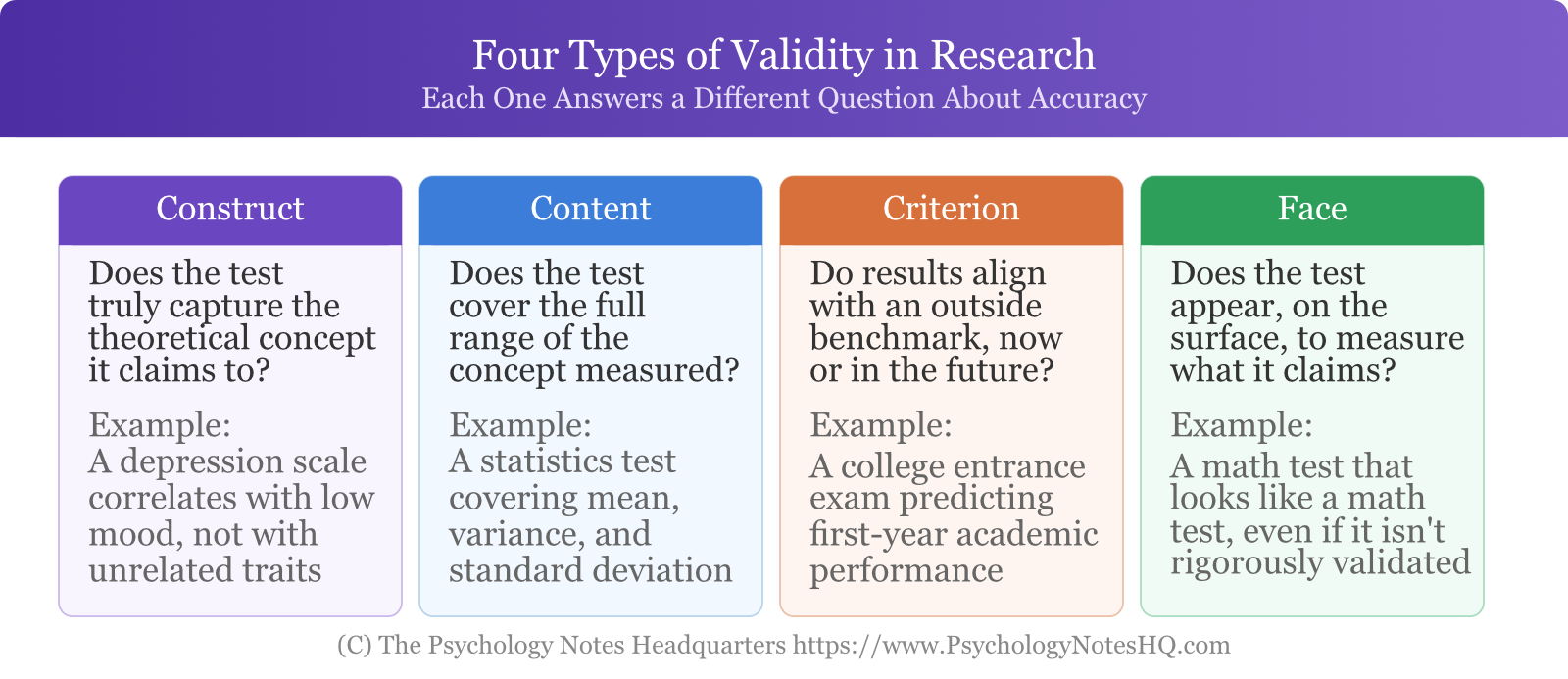
Researchers don’t just ask “is this valid” as a yes-or-no question. There are several types of validity in research, each addressing accuracy from a different angle.
Construct validity asks whether a test truly captures the theoretical concept it claims to measure. A depression scale should correlate with related constructs like low mood and correlate less with unrelated ones like extraversion.
Content validity asks whether a test covers the full range of the concept being measured. A test of statistics knowledge that only includes questions about the mean, and nothing about variance or standard deviation, has weak content validity.
Criterion validity compares test results against an outside benchmark. This splits into predictive validity, which checks whether scores forecast future outcomes, and concurrent validity, which checks whether scores align with a related measure taken at the same time.
Face validity is the weakest form: does the test appear, on the surface, to measure what it claims to measure? A test can have strong face validity and still be scientifically weak, or vice versa.
Together, these types of validity in research give psychologists a more complete picture than any single check could provide on its own.
The Scale Analogy: Why Reliable Doesn’t Mean Valid
Go back to the bathroom scale. If it reads the same weight every morning, it’s reliable. If it consistently reads five pounds heavier than your actual weight, it’s reliable but not valid.
Now imagine a scale that gives a different random number every time you step on it. That scale isn’t reliable, and because of that, it can’t be valid either. Inconsistent measurement can never accurately reflect the truth, since accuracy requires some baseline of stability to compare against.
This is why reliability is often described as a necessary, but not sufficient, condition for validity. A test needs to be consistent before it even has a chance of being accurate, but consistency by itself guarantees nothing about accuracy.
Can a Test Be Valid but Not Reliable?
Not really, and this is a common point of confusion. Because validity depends on accurate, meaningful scores, and meaningful scores require some level of consistency, a test that produces wildly different results under the same conditions cannot be considered valid.
This is the relationship in a nutshell: reliability sets the ceiling for how valid a measurement can be. A test can be reliable without being valid, but it cannot be valid without also being reasonably reliable.
Real-World Examples From Psychological Research
Reliability and validity in psychology show up constantly in research design decisions, often in ways students don’t notice until something goes wrong.
Standardized intelligence tests, for example, are built with heavy emphasis on both test-retest reliability and construct validity, since scores are used to make real decisions about educational placement. If an IQ test produced different scores each time a person took it, or measured something closer to test-taking speed than reasoning ability, its usefulness would collapse.
Self-report personality measures face a different challenge. They tend to have strong internal consistency, since items are written to correlate with each other, but validity concerns arise when people answer in socially desirable ways rather than honestly, which can distort what the test is actually capturing.
Clinical diagnostic tools carry the highest stakes. A screening measure for depression needs strong criterion validity against clinical diagnosis, because a measurement error here doesn’t just skew a research finding, it can affect whether someone receives treatment.
Why This Distinction Matters Beyond the Classroom
Reliability and validity aren’t just concepts to memorize for an exam. They shape whether research findings can be trusted, whether clinical tools make accurate decisions, and whether the conclusions drawn from a study reflect reality or just noise. The same logical care used to separate reliability from validity also matters when researchers try to separate a correlation from an actual causal relationship — both distinctions guard against mistaking a pattern in the data for something it isn’t.
Anyone reading psychological research, not just those conducting it, benefits from asking both questions before trusting a result: was this measured consistently, and was it measuring the right thing in the first place?
References
- American Educational Research Association, American Psychological Association, & National Council on Measurement in Education. (2014). Standards for educational and psychological testing. American Educational Research Association.
- Cronbach, L. J., & Meehl, P. E. (1955). Construct validity in psychological tests. Psychological Bulletin, 52(4), 281–302.
- American Psychological Association. (n.d.). Reliability. APA Dictionary of Psychology.
- American Psychological Association. (n.d.). Validity. APA Dictionary of Psychology.
How to cite this article:
The Psychology Notes Headquarters. (2026). Reliability vs Validity in Psychology: Why a Test Can Be Consistent But Still Wrong. Retrieved from https://www.psychologynoteshq.com/reliability-vs-validity/