
How Good People Justify Bad Acts: Bandura’s Moral Disengagement Theory
Most people like to think they’d never quietly go along with cruelty. Yet history and everyday life keep showing the opposite. Psychologist Albert Bandura’s moral disengagement theory explains this uncomfortable pattern: how ordinary, otherwise decent people carry out or ignore harmful acts without feeling the guilt you’d expect. The theory doesn’t argue these people lack a conscience. It argues their conscience got quietly switched off.
Key Takeaways
- Bandura identified eight specific mental shortcuts people use to deactivate guilt before, during, or after harmful behavior.
- The mechanisms cluster around reframing the act itself, blurring who’s responsible, and reframing the victim.
- Moral disengagement shows up in workplaces, social media, war, and everyday small compromises, not just extreme cases.
- It connects to social learning theory and Bandura’s broader social cognitive framework.
- Understanding the mechanisms is the first step toward interrupting them in institutions and individuals alike.
A Cognitive Process, Not a Character Flaw
Bandura built moral disengagement on a simple observation: most people hold themselves to internal moral standards, and violating those standards usually produces self-condemnation. That self-monitoring system generally keeps behavior in check without anyone needing to watch over us. The interesting question Bandura pursued was what happens when that internal check fails to activate, even though the standards are still there.
His answer grew out of his broader social cognitive theory, the same framework behind Bandura’s work on observational learning. Moral agency, in his view, isn’t fixed. It’s something people exercise selectively, and that selectivity is where disengagement mechanisms do their work. The self-regulatory system doesn’t disappear during unethical acts. It gets temporarily disconnected from the specific behavior in question.
The Eight Mechanisms of Moral Disengagement
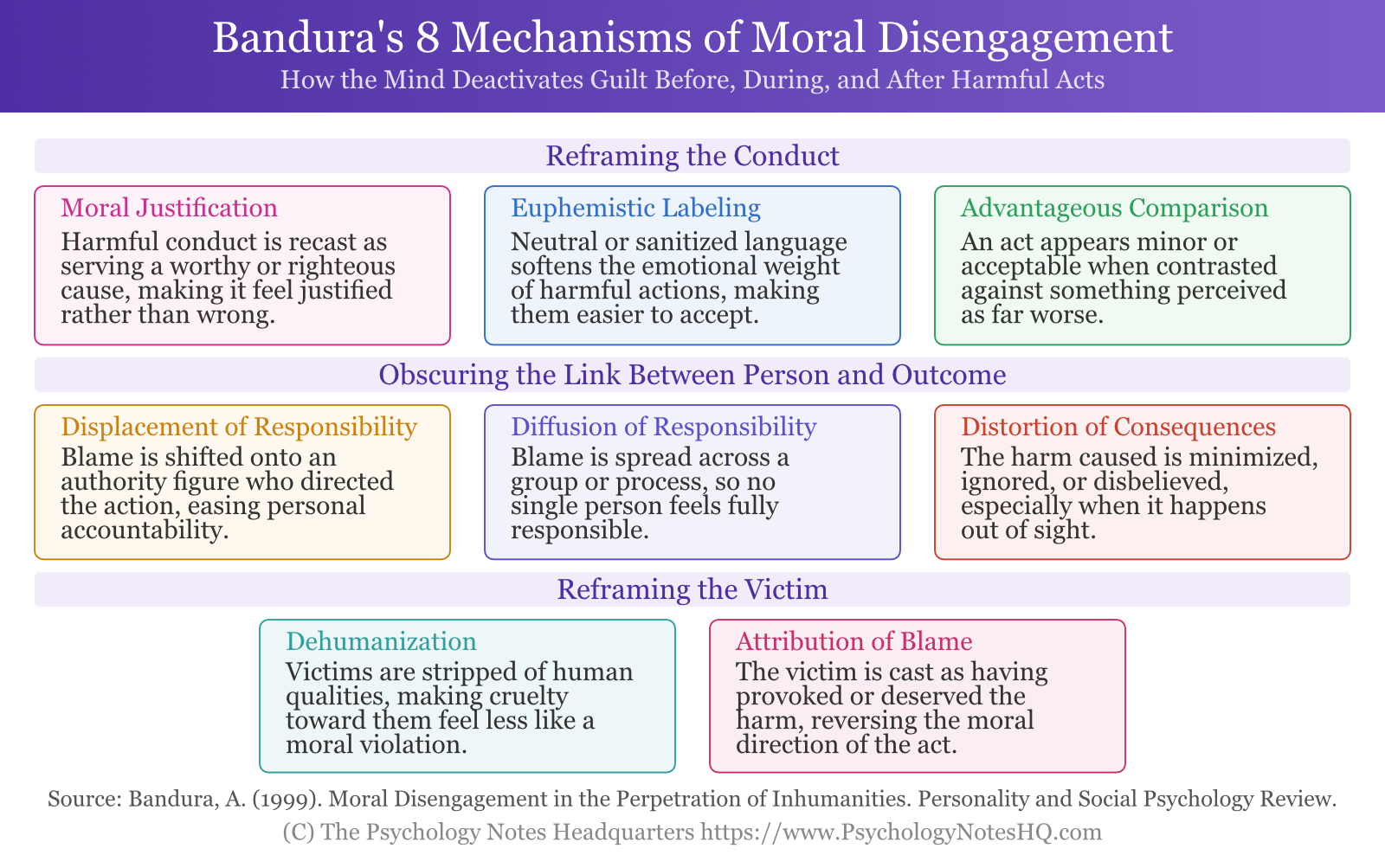
Bandura grouped these mechanisms by where in the chain of moral reasoning they intervene: reframing the conduct itself, obscuring the link between the person and the harmful outcome, or reframing how the victim is perceived.
Reframing the Conduct
Moral justification recasts harmful behavior as serving a higher purpose. A soldier or activist may come to see violence as necessary and even righteous once it’s tied to a cause. Euphemistic labeling works through language rather than logic. Calling civilian casualties collateral damage or layoffs rightsizing softens the emotional weight of what’s actually happening. Advantageous comparison works by contrast. An act looks minor when placed beside something worse. Cheating on a test feels forgivable next to plagiarizing an entire paper.
Obscuring the Link Between Person and Outcome
Displacement of responsibility shifts moral ownership onto an authority figure. This mechanism helped explain the disturbing compliance seen in the Milgram obedience experiments, where participants administered what they believed were painful shocks while attributing responsibility to the experimenter. Diffusion of responsibility spreads blame across a group, so no single person feels fully accountable. This is common in bureaucracies and committees where a harmful decision passes through many hands. Distortion of consequences involves minimizing, ignoring, or disbelieving the actual harm caused, which is easier when the harm happens somewhere out of sight.
Reframing the Victim
Dehumanization strips victims of human qualities, making cruelty toward them feel less like a moral violation. This mechanism appeared in Bandura’s own early research on aggression, and later work extended it to describe wartime propaganda and hate speech. Attribution of blame flips the moral direction entirely, casting the victim as the one who provoked or deserved the harm. Both mechanisms make empathy, the usual brake on cruelty, harder to access.
Moral Disengagement Examples Across Everyday Life
These mechanisms rarely appear in isolation, and they show up far more often in mundane settings than extreme ones. Corporate scandals frequently involve euphemistic labeling and diffusion of responsibility, where a decision that harms customers or employees gets described in neutral, technical language and spread across so many approvals that no one person feels like the one who caused it.
Online platforms have become a rich source of moral disengagement examples as well. Anonymity and distance from the target make dehumanization and attribution of blame easier, which partly explains why people say things online they’d never say face to face. Workplace misconduct often relies on advantageous comparison, where an employee rationalizes a minor ethical shortcut by comparing it to worse behavior they’ve seen colleagues get away with.
Even historical atrocities, which Bandura studied directly, show these same everyday mechanisms operating at scale rather than some unique form of evil. The mechanisms are the same; only the stakes differ.
Why This Matters for Moral Agency
Bandura connected moral disengagement to his concept of self-efficacy, the belief in one’s capacity to exercise control over outcomes. When disengagement mechanisms activate, they don’t just quiet guilt. They interfere with a person’s sense of moral agency itself, making it feel like the outcome was inevitable or out of their hands. Readers curious about how self-belief shapes behavior more broadly can look at Bandura’s work on self-efficacy, which describes the flip side of this same regulatory system.
This is part of why moral disengagement theory has proven useful well beyond its original context. Researchers have applied it to organizational ethics, sports misconduct, cyberbullying, and political violence, largely because the underlying mechanism, not the specific behavior, is what the theory targets.
Related Research on Situational Pressure and Morality
Moral disengagement theory pairs naturally with earlier social psychology research on how situations override individual character. The Stanford Prison Experiment demonstrated how quickly ordinary people could adopt cruel roles under situational pressure, though it left open the question of the internal cognitive process involved. Bandura’s mechanisms help answer that question directly, describing not just that situations can produce cruelty, but how the mind justifies going along with it.
Reducing Moral Disengagement
Because moral disengagement operates through specific, nameable mechanisms, it can be interrupted at those same points. Organizations that use precise, human language instead of euphemisms tend to see less rationalized misconduct. Clear individual accountability, rather than diffuse committee decisions, reduces the room for diffusion of responsibility. Humanizing language about affected people, rather than abstract statistics, works against dehumanization directly. None of these fixes are dramatic, but they target the exact mental shortcuts Bandura identified.
The Bigger Picture
Moral disengagement theory reframes a disturbing pattern of human behavior as something explainable rather than mysterious. People aren’t simply good or bad. They have functioning moral standards that can be selectively deactivated through identifiable mental processes. Recognizing those processes, in institutions and in ourselves, is the first real step toward keeping them in check.
References
- Bandura, A. (1986). Social foundations of thought and action: A social cognitive theory. Prentice-Hall.
- Bandura, A. (1999). Moral disengagement in the perpetration of inhumanities. Personality and Social Psychology Review, 3, 193-209.
- Bandura, A., Barbaranelli, C., Caprara, G. V., & Pastorelli, C. (1996). Mechanisms of moral disengagement in the exercise of moral agency. Journal of Personality and Social Psychology, 71, 364-374.
- Bandura, A., Underwood, B., & Fromson, M. E. (1975). Disinhibition of aggression through diffusion of responsibility and dehumanization of victims. Journal of Research in Personality, 9, 253-269.
- Detert, J. R., Trevino, L. K., & Sweitzer, V. L. (2008). Moral disengagement in ethical decision making: A study of antecedents and outcomes. Journal of Applied Psychology, 93(2), 374-391.
- Moore, C. (2015). Moral disengagement. Current Opinion in Psychology, 6, 199-204.
- White, J., Bandura, A., & Bero, L. A. (2009). Moral disengagement in the corporate world. Accountability in Research, 16(1), 41-74.
How to cite this article:
The Psychology Notes Headquarters. (2026). How Good People Justify Bad Acts: Bandura’s Moral Disengagement Theory. Retrieved from https://www.psychologynoteshq.com/moral-disengagement/