
Milgram’s Obedience Experiment: The Shocking 65% Result and the Ethical Issues Behind It
The ethical issues in the Milgram experiment center on three problems: deception that removed any chance of informed consent, psychological harm severe enough to cause visible distress, and a right to withdraw that existed on paper but rarely in practice. In 1961, Stanley Milgram’s study at Yale University found that 65% of ordinary participants delivered a maximum 450-volt shock to a stranger simply because a man in a lab coat told them to continue. The finding shocked researchers as much as the public, and more than sixty years later, psychologists still debate whether the study’s scientific value could ever justify what it put participants through.
Key Takeaways
- Milgram’s obedience to authority experiment found that 65% of participants delivered a 450-volt shock simply because an authority figure told them to continue.
- The ethical issues in the Milgram experiment include deception, psychological harm, and a right to withdraw that broke down under pressure.
- Follow-up debriefing found most participants glad they took part, but critics question whether that self-report can be trusted.
- The study’s ethical fallout helped push the field toward Institutional Review Boards and modern informed consent standards.
- Milgram’s experiment could not be run today in its original form under current ethical guidelines.
Background and Context
The Milgram experiment emerged from profound questions raised by World War II and the Holocaust. As Nazi officials faced trial at Nuremberg, their defense often centered on obedience: they were “just following orders.” This raised unsettling questions about human nature and moral responsibility. Could ordinary people—not monsters or psychopaths, but regular citizens—commit horrific acts simply because authority figures commanded them?
Philosopher Hannah Arendt coined the phrase “banality of evil” after observing Adolf Eichmann’s trial, noting that those who perpetrated the Holocaust weren’t sadistic monsters but often bland bureaucrats following orders. This observation challenged comfortable assumptions that only deeply disturbed individuals could participate in atrocities. If Eichmann represented the banality of evil, perhaps the capacity for destructive obedience lurked in everyone.
Stanley Milgram, a young psychologist at Yale University, designed an obedience to authority experiment to investigate this disturbing possibility scientifically. His research question was deceptively simple: Would ordinary Americans obey orders to harm an innocent person? Milgram hypothesized that people would resist harming others despite authority pressure, believing that only a tiny fraction would continue to maximum shock levels.
In 1961, Milgram began his experiments at Yale’s prestigious psychology department. The institutional setting mattered—Yale’s reputation lent scientific legitimacy to the proceedings. Milgram recruited participants through newspaper advertisements, seeking a cross-section of ordinary people. What he discovered would fundamentally challenge assumptions about human nature, authority, and individual moral agency.
The expectations proved dramatically wrong. Milgram, along with psychiatrists and colleagues he consulted beforehand, predicted that virtually no participants would administer the highest shock levels. They estimated perhaps one or two percent might continue to 450 volts. The actual results revealed something far more disturbing about human obedience.

Download this overview in PDF format
The Method: How the Experiment Worked
For a full summary of the Milgram experiment’s design, it helps to break the procedure down into its core parts: recruitment, roles, escalation, and the authority figure’s scripted pressure.
The Setup
Milgram recruited participants through newspaper advertisements requesting volunteers for “a study of memory and learning” at Yale University. Participants received $4.50 for their time—equivalent to about $40 today—regardless of what happened during the experiment. This payment created a sense of obligation while appearing as compensation for time rather than incentive for behavior.
The initial study involved 40 male volunteers ranging from ages 20 to 50, representing diverse occupations including teachers, salesmen, engineers, and laborers. This demographic variety ensured results wouldn’t reflect peculiarities of a specific group. The Yale University laboratory setting conveyed scientific legitimacy and authority.
The Roles
Each experimental session involved three people playing distinct roles. The “Teacher” was the real participant—the person whose behavior Milgram actually studied. The “Learner” was a confederate named Mr. Wallace, a mild-mannered accountant who was actually an actor working with Milgram. The “Experimenter” served as the authority figure, wearing a gray lab coat and maintaining a stern, professional demeanor throughout.
Upon arrival, the participant and confederate received an explanation that the study examined punishment’s effects on learning. They drew slips of paper from a hat to determine roles. This drawing was rigged—both slips said “teacher”—ensuring the real participant always became the teacher while the confederate always played the learner.
The Procedure
The learner was strapped into a chair with electrodes attached to his wrists, with electrode paste “to prevent blisters and burns.” The teacher watched this process, seeing the learner secured and hearing him mention having “a slight heart condition.” This setup established reality—participants saw an ordinary person in a potentially dangerous situation.
The teacher then moved to an adjacent room containing an intimidating shock generator with 30 switches ranging from 15 volts to 450 volts in 15-volt increments. Labels beneath the switches indicated shock intensity: “Slight Shock,” “Moderate Shock,” “Strong Shock,” “Very Strong Shock,” “Intense Shock,” “Extreme Intensity Shock,” “Danger: Severe Shock,” and finally two switches ominously labeled “XXX.” The generator looked authentic, with voltage meters, warning lights, and official labeling.
The teacher’s task seemed straightforward: read word pairs to the learner through an intercom, then test the learner’s memory. For each incorrect answer, the teacher administered an electric shock, increasing the voltage with each mistake. The experimenter sat nearby with a clipboard, monitoring and issuing instructions.
The Learner’s Scripted Responses
No actual shocks occurred—Mr. Wallace acted out responses to convey increasing suffering. His performance was carefully calibrated to provoke moral concern in the teacher. At 75 volts, he grunted. At 120 volts, he complained that shocks were becoming painful. At 150 volts—a critical threshold—he demanded to be released, saying “Get me out of here! I refuse to go on!”
The intensity escalated. At 180 volts, he cried that he couldn’t stand the pain. At 300 volts, he screamed, refused to provide answers, and demanded the experiment end. At 315 volts and beyond, only silence came from the learner’s room—he appeared to have collapsed or worse. Teachers faced the horrifying possibility they had seriously harmed or killed someone.
The Authority’s Prods
When teachers hesitated or protested, the experimenter responded with standardized prods, delivered in calm, firm tones:
- “Please continue” or “Please go on”
- “The experiment requires that you continue”
- “It is absolutely essential that you continue”
- “You have no other choice, you must go on”
If teachers asked about the learner’s wellbeing, the experimenter assured them the shocks caused “no permanent tissue damage.” If teachers expressed concern about responsibility, the experimenter stated, “I’m responsible for anything that happens here.” These responses transferred moral responsibility from teacher to authority, a key psychological mechanism enabling continued obedience.
The Results: What Milgram Discovered
The milgram shock experiment produced results that shocked researchers, participants, and eventually the world, revealing uncomfortable truths about human obedience.
Quantitative Findings
A staggering 65% of participants—26 out of 40—administered the full 450-volt shock, continuing to the end despite believing they might have killed someone. All participants continued to at least 300 volts, the point where the learner pounded on the wall and then fell silent. These numbers defied predictions. Psychiatrists Milgram consulted beforehand estimated that less than 1% would go to 450 volts.
The average maximum shock delivered was well into the “danger” range. Even participants who eventually refused continued far beyond what most would consider acceptable. Nobody stopped before 300 volts, suggesting situational forces overwhelmed individual moral judgment until extreme distress from the victim forced confrontation with the reality of harm.
Behavioral Observations
Despite continuing, participants showed intense emotional distress. They sweated profusely, trembled, stuttered, bit their lips, and dug fingernails into their flesh. Some burst into nervous laughter—not from amusement but from severe anxiety. Observers described participants as showing signs of nervous breakdown, with several experiencing seizure-like responses.
Teachers questioned the experimenter, expressing concerns about the learner. They asked if the shocks were dangerous, whether they should stop, if the learner was alright. They stated they didn’t want to continue, that they felt uncomfortable, that this seemed wrong. Yet these verbal objections rarely translated into actual disobedience. The tension between conscience and compliance became viscerally visible.
This revealed a disturbing pattern: participants experienced genuine moral conflict and distress yet continued shocking. They weren’t sadists enjoying causing pain. They were ordinary people suffering intensely while following orders, demonstrating that moral awareness doesn’t necessarily produce moral action when confronted with authority.
Variations of the Experiment
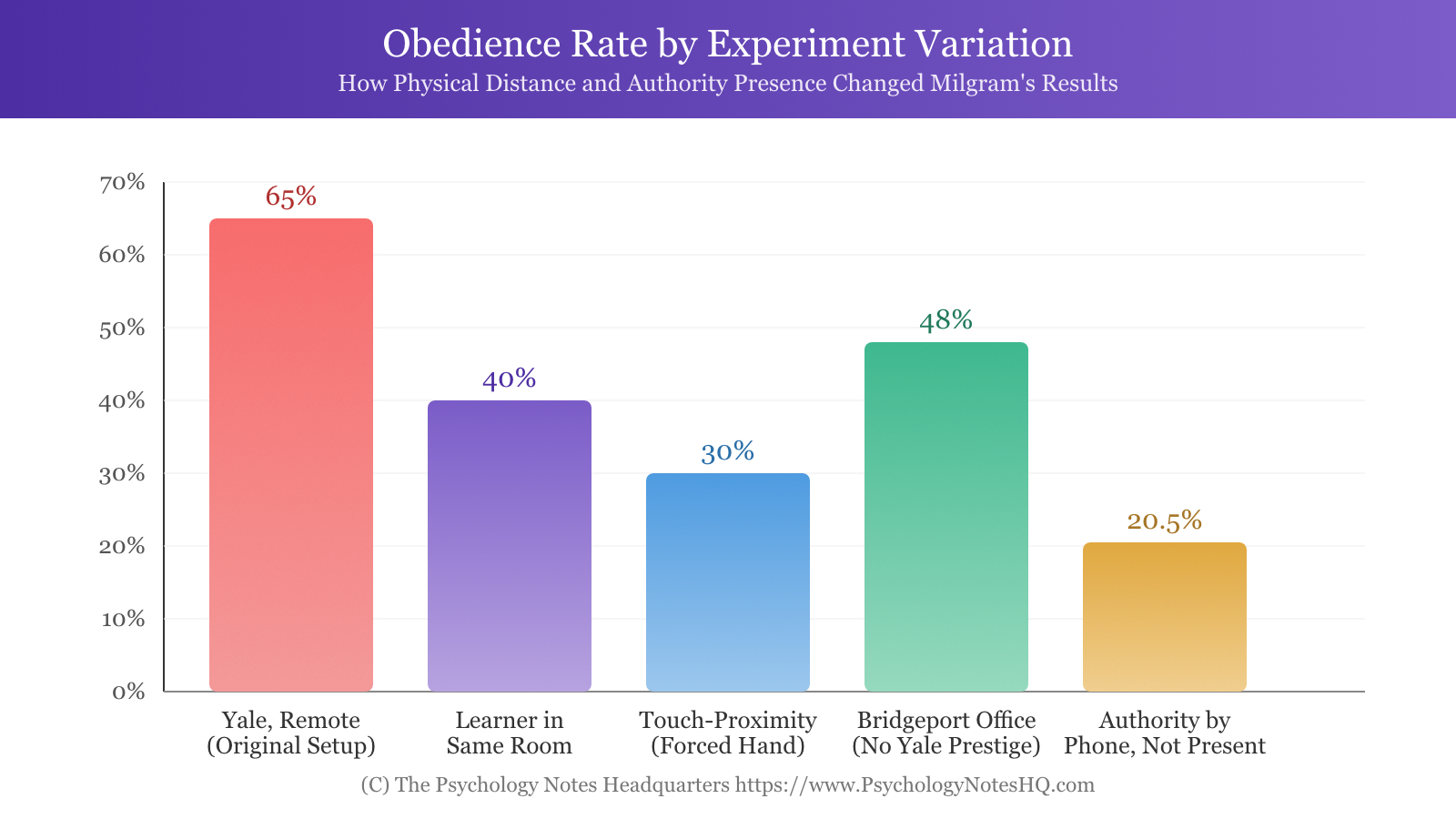
Milgram conducted 18 variations testing different conditions to understand factors affecting obedience. These variations revealed which situational elements increased or decreased compliance.
Proximity variations manipulated physical distance between teacher and learner. In the remote condition (original setup), 65% continued to maximum shock. When the learner was in the same room, obedience dropped to 40%. When teachers had to physically force the learner’s hand onto a shock plate, only 30% fully complied. Physical closeness made harm more real, harder to deny or dissociate from.
Authority variations tested the experimenter’s presence and legitimacy. When the experimenter left and gave orders by telephone, obedience plummeted to 20.5%. Some participants even lied, claiming they administered shocks when they hadn’t. Without direct authority presence, people more easily resisted.
Location variations moved the experiment from Yale to a run-down office building in Bridgeport, Connecticut, eliminating prestigious institutional backing. Obedience decreased to 48%—still disturbingly high but notably lower than at Yale. Institutional prestige mattered, though not as much as anticipated.
Key Findings
Several crucial patterns emerged. Obedience decreased dramatically with physical proximity to the victim—seeing and hearing suffering made compliance harder. Obedience plummeted when authority was distant or absent—direct supervision maintained compliance. Institutional prestige influenced obedience but couldn’t fully explain it—even in a shabby office, nearly half continued.
Most importantly, ordinary people proved capable of harmful acts under authority. Participants weren’t specially selected for cruelty or obedience. They represented a cross-section of society, yet most followed destructive orders despite personal distress.
What the Results Revealed
Milgram’s findings demonstrated the overwhelming power of situational forces over individual morality. People who considered themselves decent and moral administered what they believed were dangerous, potentially lethal shocks to an innocent person simply because an authority figure insisted.
The experiment revealed the agentic state—a psychological condition where individuals see themselves as agents executing another’s will rather than autonomous actors responsible for their choices. In this state, people transfer moral responsibility to the authority, following orders without feeling personally accountable for outcomes.
Authority’s influence proved profound and disturbing. A lab coat, institutional setting, and calm insistence could override deeply held values against harming others. The gradual escalation—starting with harmless 15-volt shocks—created incremental commitment making each step harder to refuse. Once participants delivered 300 volts, refusing at 315 volts meant admitting previous shocks were wrong.
Explanations: Why Did They Obey?
Milgram’s obedience to authority experiment is often explained through several psychological mechanisms operating simultaneously, rather than any single cause.
Milgram’s Theoretical Explanations
Milgram proposed the agentic state as central to obedience. In autonomous state, people view themselves as responsible agents controlling their actions. In agentic state, they see themselves as instruments executing authority’s wishes. This shift transfers perceived responsibility from individual to authority, making destructive obedience psychologically possible.
Diffusion of responsibility occurred through the experimenter’s statements like “I’m responsible for anything that happens.” This explicit assumption of responsibility relieved participants’ sense of accountability. They could continue shocking while telling themselves they weren’t really responsible—the scientist was.
Authority legitimacy stemmed from multiple sources: Yale University’s prestige, scientific credentials, professional appearance, and confident demeanor. These markers signaled that the authority knew what they were doing and had the right to issue commands. People learn from childhood to obey legitimate authorities—parents, teachers, police, doctors—creating ingrained obedience patterns.
Gradual commitment trapped participants through the foot-in-the-door effect. Delivering 15 volts seemed harmless. Having done that, refusing at 30 volts meant admitting 15 was wrong. Each step made the next easier to justify through consistency, while each continuation made stopping harder. By the time shocks became clearly dangerous, participants were deeply committed.
The absence of a clear stopping point created ambiguity. Unlike situations with obvious boundaries, the experiment provided no explicit moment where continuing became unacceptable. The experimenter’s prods suggested each shock was necessary, removing clarity about when refusal was justified.
Psychological Mechanisms
Social norms and socialization created expectations about obeying authority. From childhood, people learn that cooperation with legitimate authority produces social order. Scientific settings particularly evoke compliance—scientists presumably understand what they’re doing and wouldn’t request harmful actions.
The scientific context reduced perceived personal responsibility. Science serves important societal goals, suggesting that temporary discomfort might be justified for advancing knowledge. Participants could frame their participation as contributing to science rather than simply harming someone.
Incremental escalation prevented clear decision points. Rather than facing one choice to shock someone at 450 volts, participants made 30 small decisions, each seemingly minor continuation of previous actions. This gradualism prevented confronting the full implication of choices until deeply committed.
Conflicting values created internal tension. Participants valued both obedience to legitimate authority and avoiding harm to others. When these values clashed, situational pressures favoring obedience often prevailed despite intense distress. The conflict wasn’t resolved—participants suffered precisely because they recognized the moral problem but felt unable to act on that recognition.
Situational Factors
Physical distance from the victim allowed psychological distancing. Hearing suffering through walls proved easier to tolerate than witnessing it directly. Distance enabled dissociation, letting participants avoid fully confronting harm they inflicted.
Institutional prestige provided cover. Yale’s reputation suggested that harmful procedures wouldn’t occur in such respected settings. This assumption proved tragically mistaken but powerfully influenced behavior.
The authority figure’s presence created surveillance and social pressure. The experimenter’s watchful eye made disobedience feel like confrontation or failure. People find direct defiance of authority difficult, especially when authority appears calm and certain.
The lack of a clear exit strategy trapped participants. They weren’t explicitly told they could leave freely. The payment might have created obligation. The situation’s ambiguity made asserting autonomy feel illegitimate or rude. Participants needed to actively reject authority rather than simply declining participation.
While Milgram proved that we obey authority figures, the Stanford Prison Experiment demonstrated how quickly we adapt to social roles and power dynamics even without a direct order.
Ethical Implications and Controversies
Milgram’s experiment generated immediate and lasting ethical controversy, fundamentally changing how psychological research is conducted.
What Are the Ethical Issues in the Milgram Experiment?
At its core, the ethical issues in the Milgram experiment come down to four problems that would stop the study from getting approved today:
- Deception: participants believed they were in a memory study, not an obedience experiment, and never knew the shocks or the learner’s suffering were fake.
- Psychological harm: many participants showed visible signs of extreme stress, including trembling, sweating, and nervous laughter.
- Compromised right to withdraw: the experimenter’s scripted prods pressured participants to continue even after they asked to stop.
- Limited debriefing safeguards: post-study debriefing addressed the deception, but critics question whether it could fully undo the psychological impact.
Each of these issues is explored in more detail below, along with how the field responded to them.
Major Ethical Concerns
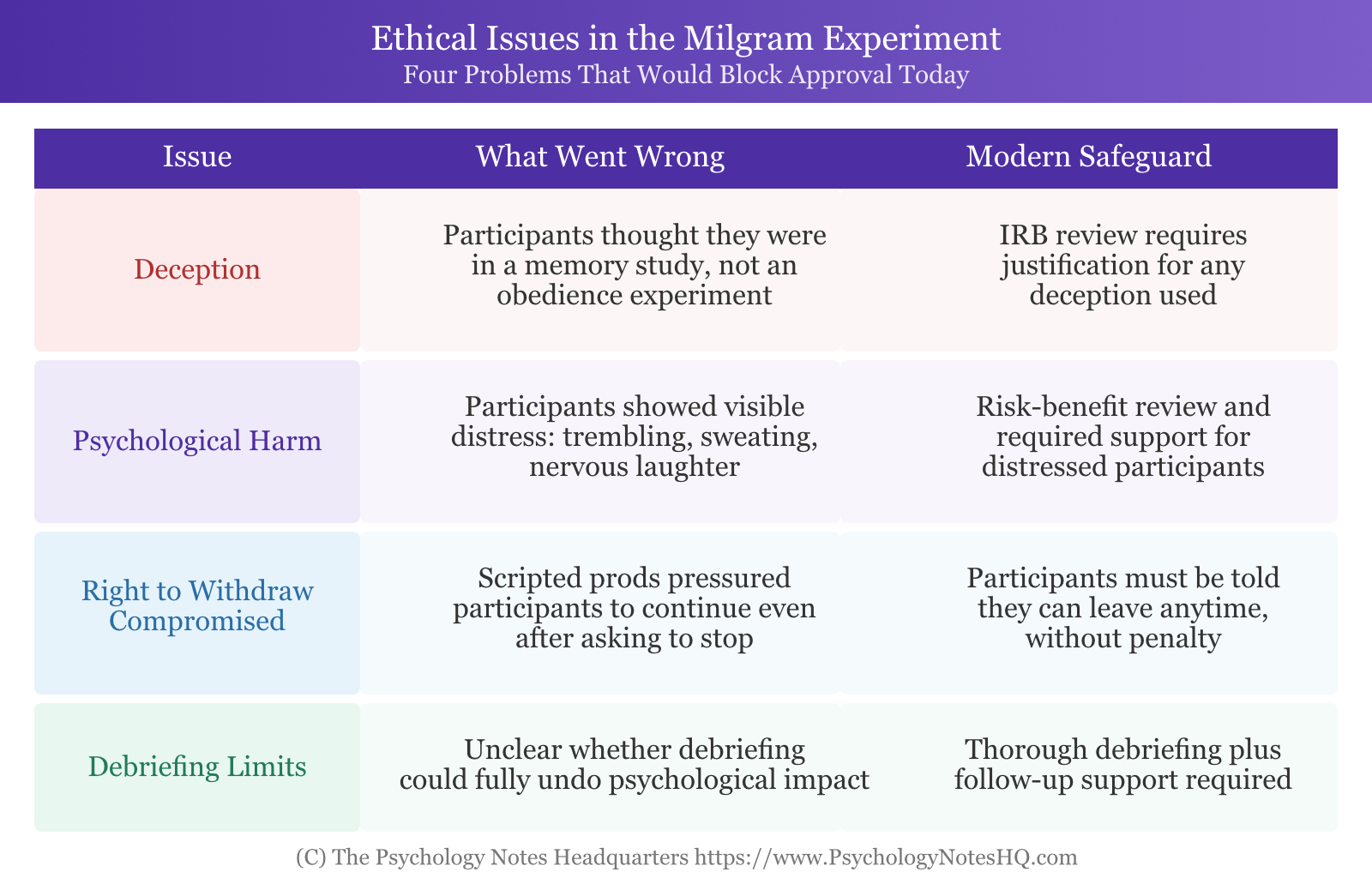
Deception formed the experiment’s foundation. Participants believed they were in a memory study but actually participated in an obedience experiment. They thought they administered real shocks to a real participant who suffered genuine agony. The entire scenario was fabricated—the learner was an actor, shocks were fake, the drawing was rigged. This extensive deception violated informed consent, preventing participants from making truly informed decisions about participation.
The deception’s scope was total. Participants couldn’t consent to the actual study because revealing its true nature would invalidate the research. This created an impossible ethical bind: the study couldn’t both maintain scientific validity and obtain genuine informed consent.
Psychological harm represents perhaps the most serious ethical concern. Participants experienced extreme stress—sweating, trembling, anxiety, nervous breakdowns. The experience forced confrontation with disturbing truths about themselves: that they could harm innocent people when ordered. Some observers described participants as suffering psychological seizures.
The long-term effects remained unclear. Learning you’re capable of potentially lethal obedience could produce lasting psychological damage—guilt, shame, disturbed self-image, trauma. Even if debriefing explained that no harm occurred, participants still learned they obeyed orders to harm someone, a revelation difficult to unlearn or forget.
Right to withdraw proved compromised. Ethical research requires that participants can leave at any time without consequence. However, the experimenter’s verbal prods—”You have no other choice, you must go on”—directly contradicted this right. Participants felt unable to stop, pressured to continue despite wanting to quit.
The situation created coercion through authority manipulation. While participants theoretically could leave, situational forces made withdrawal psychologically difficult. The experimenter never physically restrained anyone, but psychological restraint proved remarkably effective. Some argue this violated voluntary participation principles.
Debriefing issues raised questions about whether post-experiment procedures could undo harm. Milgram provided extensive debriefing, reuniting teachers and learners, explaining the deception, and discussing the experiment’s purpose. But could debriefing truly reverse psychological trauma? Once participants learned they were capable of harmful obedience, that knowledge couldn’t be erased.
Learning disturbing self-knowledge poses unique problems. Even understanding that shocks were fake, participants still knew they believed they were harming someone and continued anyway. This self-knowledge—that under authority pressure, you might do terrible things—could prove deeply unsettling.
Milgram’s Defense
Milgram defended his research on several grounds. Follow-up surveys found 84% of participants reported being glad they participated, while only 1% expressed regret. These statistics suggested most participants valued the experience and learning despite the distress.
Extensive debriefing occurred immediately after experiments. Participants met the unharmed learner, learned about the deception, and discussed the psychological mechanisms involved. Follow-up questionnaires and psychiatric evaluations found no evidence of long-term psychological harm. One psychiatrist interviewed participants a year later, finding no lasting negative effects.
Milgram argued the scientific value justified the methods. The findings revealed crucial insights about human nature, authority, and obedience with profound implications for understanding historical atrocities and preventing future ones. Knowledge this important, he contended, warranted temporary participant discomfort, especially given the apparent lack of lasting harm.
Counterarguments
Critics challenged these defenses on multiple grounds. Self-report bias might inflate positive responses—participants who invested time and experienced distress might rationalize participation as worthwhile to reduce cognitive dissonance. Admitting regret means admitting you suffered for nothing, a psychologically uncomfortable position.
Participants might rationalize their participation and responses to maintain a positive self-image. The 84% glad figure might reflect psychological defense mechanisms rather than genuine satisfaction. People who discovered disturbing truths about themselves might reframe the experience positively to cope with that knowledge.
Unknown long-term psychological effects remain possible. One-year follow-ups might miss delayed consequences. Some participants might have experienced guilt, shame, or psychological struggles that evaluations didn’t detect or that emerged later.
The ends-don’t-justify-means argument asserts that scientific value doesn’t excuse ethical violations. Valuable knowledge can be ill-gotten. Nazi doctors gained medical knowledge through horrific experiments, but that knowledge is considered tainted and unusable. While Milgram’s research wasn’t comparable in severity, the principle remains: importance doesn’t automatically justify methods.
Impact on Research Ethics
The Milgram experiments, along with other controversial studies like the Stanford Prison Experiment and the Tuskegee Syphilis Study, catalyzed major changes in research ethics. Universities established Institutional Review Boards (IRBs) to evaluate research proposals before studies proceed. These boards assess potential risks, ensure informed consent, and require that benefits outweigh harms.
Emphasis on informed consent became paramount. Participants must understand what they’re agreeing to, including risks, procedures, and their right to withdraw. While some deception remains permissible in psychology, it’s carefully regulated and requires compelling justification.
Limits on deception protect participants from excessive manipulation. Researchers must demonstrate that deception is necessary, that less deceptive alternatives don’t exist, and that debriefing will occur. Extensive deception like Milgram’s faces much higher scrutiny today.
Protection of participants from harm—physical and psychological—became central. IRBs carefully evaluate stress-inducing procedures. Risk-benefit analyses weigh potential scientific gains against participant welfare. When doubt exists, participant welfare takes precedence.
Modern Ethical Standards
Milgram’s experiment couldn’t be replicated today as originally designed. Current ethical guidelines would prohibit such extensive deception, psychological stress, and compromised right to withdraw. Any similar study would require substantial modifications reducing ecological validity.
Modern ethical standards require explicit informed consent about general procedures and risks, even if specific hypotheses aren’t revealed. Participants must clearly understand they can leave anytime without penalty. Researchers must minimize distress and provide immediate support if participants become upset. Debriefing must thoroughly explain deception and ensure participants aren’t harmed.
These protections reflect hard-won wisdom about balancing scientific inquiry with human dignity. The Milgram experiments taught psychology about authority and obedience, but also about ethics and researcher responsibility. Both lessons remain vital.
Criticisms and Alternative Interpretations
Beyond ethical concerns, methodological criticisms and alternative interpretations challenge Milgram’s original conclusions.
Methodological concerns include sample bias—volunteers may differ from the general population in obedience tendencies. The initial study used only males, though later variations included women with similar results. Participants who answered newspaper ads for psychology experiments might be more compliant or authority-trusting than average.
Demand characteristics suggest participants might have suspected deception. Some critics argue participants knew shocks were fake but played along to avoid ruining the experiment or appearing foolish. However, participants’ extreme visible distress seems inconsistent with consciously faking responses.
Recent reanalyses examined Milgram’s archived data, finding more complexity than original reports suggested. Some participants actively resisted, requiring multiple prods. The standard four prods weren’t always sufficient—experimenters sometimes improvised additional pressure. This suggests obedience was more contested than typically portrayed.
Alternative explanations challenge Milgram’s authority-obedience interpretation. The “engaged followership” theory proposes participants identified with scientific goals rather than simply obeying. They saw themselves as collaborators helping science progress, not mindless followers. This reframe suggests partnership rather than domination.
Cultural and historical context matters. The experiment occurred in 1960s America during the Cold War, with strong respect for scientific authority and institutions. Would results replicate across cultures or time periods? Cross-cultural studies show variation, though disturbingly high obedience appears across societies.
These criticisms don’t negate the findings but add nuance. Even if some participants suspected deception, most showed genuine distress. Even if obedience rates varied with methodology, they remained far higher than predicted. The core finding—that situational forces can override individual morality—withstands scrutiny even as details are debated.
Conclusion
The ethical issues in the Milgram experiment—deception, psychological harm, and a right to withdraw that broke down under pressure—remain as debated today as the 65% obedience rate itself. The study revealed disturbing truths about human obedience to authority, showing that ordinary people can perform harmful acts when ordered by a legitimate authority figure. It also came at a real ethical cost, one that reshaped how psychology approaches research on human subjects. Milgram’s findings still remind us to question authority and examine the situational forces shaping our behavior.
References
- Blass, T. (2004). The man who shocked the world: The life and legacy of Stanley Milgram. Basic Books.
- Burger, J. M. (2009). Replicating Milgram: Would people still obey today? American Psychologist, 64(1), 1-11.
- Haslam, S. A., & Reicher, S. D. (2012). Contesting the “nature” of conformity: What Milgram and Zimbardo’s studies really show. PLoS Biology, 10(11), e1001426.
- Milgram, S. (1963). Behavioral study of obedience. Journal of Abnormal and Social Psychology, 67(4), 371-378.
- Milgram, S. (1974). Obedience to authority: An experimental view. Harper & Row.
- Perry, G. (2013). Behind the shock machine: The untold story of the notorious Milgram psychology experiments. The New Press.
How to cite this article:
The Psychology Notes Headquarters. (2026). Milgram’s Obedience Experiment: The Shocking 65% Result and the Ethical Issues Behind It. Retrieved from https://www.psychologynoteshq.com/psychological-studies-stanley-milgram-experiment/