
Stanford Prison Experiment: What Zimbardo’s Study Really Proved (and Got Wrong)
The stanford prison experiment is a 1971 psychological study led by Philip Zimbardo that randomly assigned college students to roles of guards and prisoners inside a simulated prison at Stanford University, testing whether abusive behavior comes from personality or from the power of a situation. Planned to run two weeks, it was shut down after just six days once guards’ treatment of prisoners turned abusive. Decades later, the study remains one of psychology’s most cited experiments and one of its most disputed.
Key Takeaways
- Zimbardo’s 1971 study randomly assigned Stanford students to play guards or prisoners in a mock prison to test situational power over behavior
- The planned two-week study ended after only six days once guard behavior turned abusive and prisoners showed signs of breakdown
- Zimbardo argued the results proved that institutional roles, not personality, drive cruelty and submission
- Serious stanford prison experiment ethical issues, including lack of informed consent and Zimbardo’s dual role as researcher and superintendent, still shape how psychology teaches research ethics
- Recent archival research has reopened the debate over whether the zimbardo experiment showed spontaneous behavior or behavior that was coached

Download this overview in PDF format
Background and Context
In August 1971, Philip Zimbardo, a psychology professor at Stanford University, set out to answer a question that had divided prison reformers for years: does the brutality inside prisons come from the personalities of the guards and prisoners themselves, or from the prison environment they’re placed in?
The timing mattered. American prisons in the early 1970s were dealing with unrest and violence, and the Attica Prison riot broke out just weeks after Zimbardo’s study ended. Some researchers argued that violence in prisons reflected inherently cruel guards and inherently difficult prisoners — a dispositional explanation. Others, including Zimbardo, argued that ordinary, healthy people would behave abusively if placed into a system that gave them unchecked power over other people — a situational explanation.
Zimbardo believed strongly in the second view. He wanted to show that psychologically healthy volunteers, given nothing more than a coin-flip assignment to a role, would begin acting like authentic guards or authentic prisoners within days. This idea connects to a broader thread in social psychology about how far ordinary people will go once placed inside a role or hierarchy. Stanley Milgram’s obedience research had already shown that people would follow direct orders to harm others; Zimbardo wanted to see whether a role alone, without anyone issuing explicit commands, could produce similarly troubling behavior.
How the Experiment Was Conducted
Zimbardo advertised for male volunteers for “a psychological study of prison life,” offering $15 a day. Around 75 men responded, mostly college students looking for summer income. After psychological screening, background checks, and interviews, Zimbardo selected 24 participants who were healthy, stable, and had no criminal history — ordinary young men, deliberately chosen so that any bad behavior couldn’t be blamed on pre-existing personality problems.
Roles were assigned by coin flip: twelve became guards, twelve became prisoners. This random assignment meant that any behavioral differences that later emerged couldn’t be explained by who the participants were before the study began — only by the roles they were given.
Zimbardo converted the basement of Stanford’s psychology building into a makeshift prison, complete with barren cells, a solitary confinement closet nicknamed “the hole,” and an exercise yard. Guards wore khaki uniforms, carried billy clubs, and wore mirrored sunglasses that hid their eyes from prisoners. Prisoners were “arrested” at home by real Palo Alto police, fingerprinted, stripped, deloused, and given smocks and identification numbers in place of their names — an intake process designed to strip away individual identity from the very first moment.
Guards received almost no instruction beyond keeping order and avoiding physical violence, leaving them to improvise how they’d exercise control. That freedom turned out to matter a great deal.
Guards worked eight-hour rotating shifts, which meant prisoners encountered a rotating cast of personalities and approaches to authority. Some shifts were relatively calm; others, particularly overnight when direct observation was minimal, grew far harsher. The prison ran on a strict daily schedule of “counts,” where prisoners lined up to be counted and recite their numbers, sometimes for hours at a stretch as guards demanded perfect posture and recitation. These counts occurred at unpredictable hours, including the middle of the night, which meant guards effectively controlled prisoners’ sleep as well as their movement.
Even basic needs became privileges guards could grant or withhold. Bathroom access required permission. Meals could be denied as punishment. Work assignments were often deliberately pointless, designed less to accomplish anything than to reinforce who held control. None of this was scripted in detail beforehand — it emerged from guards testing what they could get away with inside a system that gave them almost total authority and almost no accountability.
What Happened: Day by Day
On the first day, both prisoners and guards seemed unsure of themselves. Prisoners treated the setup almost like a game; guards issued orders tentatively, uncertain how much authority they really held.
By day two, prisoners rebelled — tearing off their numbers and barricading cells with their beds. Guards responded by calling in reinforcements, using fire extinguishers to force prisoners back, and introducing a “privilege cell” that sowed distrust among prisoners by rewarding those who hadn’t joined the rebellion. This single tactic marked a shift from simple rule enforcement to deliberate psychological manipulation.
Over the following days, guard behavior grew more inventive and more severe. Counts that should have taken minutes stretched for hours. Bathroom privileges were denied. Prisoners were made to do push-ups, clean toilets with bare hands, and endure degrading tasks and language. Roughly a third of guards showed clearly sadistic behavior, a third were firm but not cruel, and a third were quietly kind to prisoners — yet none of the “good guards” ever stepped in to stop the abuse happening around them.
Prisoners’ psychological state deteriorated quickly. Several had emotional breakdowns; one, known as Prisoner #8612, was released within 36 hours after showing symptoms Zimbardo described as approaching a nervous breakdown. Four more prisoners were released early for similar reasons, meaning five of the twelve original prisoners couldn’t complete even this shortened version of the study. Prisoners who remained stopped resisting almost entirely. Where they had once mocked and defied guards, they became passive, depressed, and compliant, internalizing their assigned identity to the point that some began requesting “parole” rather than simply asking to leave — a telling sign of how completely they had absorbed the logic of the simulated institution around them.
Guard behavior, meanwhile, kept escalating rather than leveling off. Sexual humiliation appeared in some interactions, along with increasingly creative forms of degradation that seemed to spread as guards observed and copied each other’s tactics. Zimbardo himself, immersed in his role as “prison superintendent,” later admitted he had stopped thinking like a research psychologist and started thinking like someone responsible for maintaining institutional order.
By day six, Christina Maslach — a recent Stanford psychology PhD who was dating Zimbardo at the time — visited the study, was horrified by what she saw, and confronted Zimbardo directly, reportedly telling him, “What you are doing to these boys is terrible.” She was the first of roughly fifty outside visitors, including parents and a former prison chaplain, to seriously object to what was happening. Her objection ended the experiment that night, eight days short of its planned two-week run, and was followed by extensive debriefing sessions meant to help participants process the experience and reunite guards and prisoners as equals.
What Zimbardo Claimed the Study Proved
Zimbardo’s central conclusion was that ordinary, psychologically healthy people can be transformed by powerful situations, regardless of their personality. Guards weren’t chosen because they were cruel; prisoners weren’t chosen because they were passive. Random assignment ruled that out. Yet within days, clear behavioral differences emerged that Zimbardo attributed entirely to the roles participants were given.
He pointed to several mechanisms behind this shift. Deindividuation — the loss of personal identity through uniforms, sunglasses, and numbers — made it easier for guards to treat prisoners as objects rather than people. Role conformity happened quickly, with participants beginning to think and feel like guards or prisoners rather than simply acting the part. And what Zimbardo called learned helplessness explained why prisoners largely stopped resisting after their initial rebellion failed, instead requesting “parole” rather than simply asking to leave.
Zimbardo later argued these dynamics helps explain real institutional abuse, including the Abu Ghraib prisoner scandal during the Iraq War, where he served as an expert witness arguing that situational pressures made abusive behavior close to inevitable given the circumstances.
Stanford Prison Experiment Ethical Issues
The stanford prison experiment ethical issues are inseparable from how the study is taught today, and they go well beyond the discomfort of a difficult psychology lesson.
Participants could not give truly informed consent, since nobody could have anticipated the humiliation, stress, and psychological harm that followed. The surprise arrests removed any chance to mentally prepare. Five prisoners were released early due to severe emotional distress, and the debriefing that followed, while extensive, could not undo experiences that some participants described as traumatic.
Perhaps the most serious of the stanford prison experiment ethical issues was Zimbardo’s own dual role. He acted as both the lead researcher responsible for participant welfare and the prison’s “superintendent,” a role he leaned into so fully that he began evaluating prisoners’ requests to leave as parole decisions rather than as a scientist protecting research subjects. He denied several early requests to leave, including from Prisoner #8612, despite visible distress. No independent oversight board monitored the study as it unfolded — a gap that would not be permitted under today’s institutional review board standards.
There’s also the question of a right to withdraw, which is a basic protection in modern research ethics. Because prisoners were treated as though they were genuinely incarcerated rather than voluntary participants, asking to leave meant navigating a “parole” process rather than simply exercising a right they should have held from the start. That blurring of experiment and reality is itself one of the clearest stanford prison experiment ethical issues that modern textbooks now flag when teaching the study, since it shows how easily a research design can erode the very protections it’s supposed to guarantee participants.
Taken together, these problems are part of why the study is now taught as much as a cautionary tale about research ethics as it is a demonstration of situational power. College courses often use it specifically to illustrate what informed consent, the right to withdraw, and independent oversight are meant to prevent.
The Zimbardo Experiment Under Scrutiny
For decades, the zimbardo experiment was taught as clean evidence that situations override personality. That narrative has been seriously challenged by more recent scholarship.
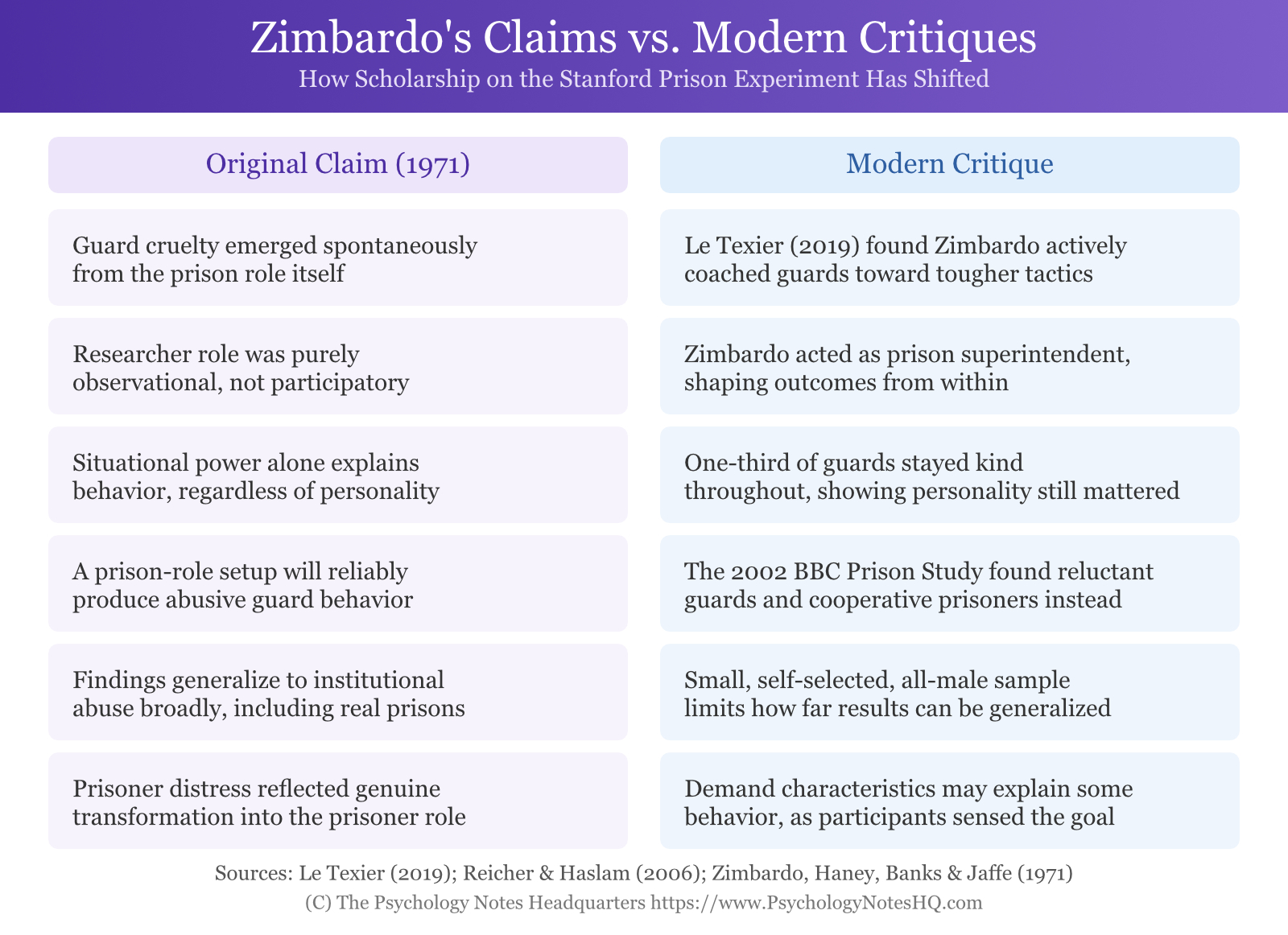
Psychologist Thibault Le Texier spent years combing through Zimbardo’s original archives and interviewing surviving participants. His 2019 analysis in American Psychologist found that guards weren’t left to improvise as freely as originally described — Zimbardo, acting as superintendent, coached them toward tougher behavior and modeled authoritarian conduct himself (Le Texier, 2019). This raises the question of demand characteristics: participants may have behaved abusively not because the situation spontaneously demanded it, but because they sensed what the researcher wanted to see.
A separate challenge to the zimbardo experiment came from the 2002 BBC Prison Study, conducted by Stephen Reicher and Alexander Haslam, which used a similar mock-prison design but without a researcher directing guard behavior from within. Their guards did not spontaneously turn abusive; instead, they were reluctant to assert authority, and prisoners eventually built a more cooperative social system before that too broke down (Reicher & Haslam, 2006). The differing outcome suggests that leadership and group identification, not just institutional roles, shape how power gets used.
Other criticisms point to the small, self-selected, all-male sample, which limits how far the findings generalize, and to the fact that not all guards behaved cruelly — a third were notably kind — undercutting the idea that the situation alone fully determined behavior. If a role alone were powerful enough to override personality, that variation among guards shouldn’t have existed at all.
There’s also the matter of demand characteristics more broadly. Participants in the zimbardo experiment knew they were part of a study specifically about prison behavior, which means some may have shaped their conduct around what they assumed researchers wanted to observe, rather than reacting purely to the situation itself. Combined with evidence that Zimbardo actively coached guards rather than simply observing them, this has led a growing number of researchers to treat the original findings as a demonstration of directed behavior under researcher influence, not spontaneous role adoption. That doesn’t erase the study’s historical importance, but it does mean the tidy conclusion many textbooks repeat deserves far more scrutiny than it traditionally received.
Why It Still Matters
Even with its flaws exposed, the study’s core questions about power, identity, and institutional authority remain relevant to how psychology thinks about group behavior, a theme that connects to research on how strongly people identify with assigned groups and to classic findings on why people conform to group pressure. Dr. Zimbardo’s own later writing, including his book The Lucifer Effect, argued that understanding these dynamics is essential for preventing institutional abuse, not just explaining it after the fact. Modern research ethics boards, informed consent requirements, and participant welfare protections all trace part of their justification back to studies like this one, where the pursuit of a compelling result outpaced protection of the people involved.
Conclusion
The stanford prison experiment endures not because it settled the debate between situational and dispositional explanations of behavior, but because it forces a harder look at how easily compelling research narratives can outrun rigorous evidence. Studying it seriously means holding both truths at once: it shaped how generations think about institutional power, and it should never have been run the way it was.
References
- Haney, C., Banks, C., & Zimbardo, P. (1973). Interpersonal dynamics in a simulated prison. International Journal of Criminology & Penology, 1(1), 69-97.
- Le Texier, T. (2019). Debunking the Stanford Prison Experiment. American Psychologist, 74(7), 823-839.
- Reicher, S., & Haslam, S. A. (2006). Rethinking the psychology of tyranny: The BBC prison study. British Journal of Social Psychology, 45(1), 1-40.
- Zimbardo, P. G. (2007). The Lucifer effect: Understanding how good people turn evil. Random House.
- Zimbardo, P. G., Haney, C., Banks, W. C., & Jaffe, D. (1971). The Stanford Prison Experiment: A simulation study of the psychology of imprisonment. Stanford University.
How to cite this article:
The Psychology Notes Headquarters. (2026). Stanford Prison Experiment: What Zimbardo’s Study Really Proved (and Got Wrong). Retrieved from https://www.psychologynoteshq.com/psychological-studies-stanford-prison-experiment/