
Sampling Methods in Psychology: Which One Would You Actually Use?
Picture a researcher who wants to study test anxiety across a university of 15,000 students. She cannot test everyone, so she has to pick a smaller group that still represents the whole population fairly. That single decision, how she picks her participants, will shape whether her results mean anything at all. This is where the types of sampling methods in psychology come in, and each one handles that decision in a completely different way, with different trade-offs in cost, time, and accuracy.
Key Takeaways
- Four sampling methods dominate psychology research: random, systematic, stratified, and convenience, each suited to different research constraints.
- Random sampling vs systematic sampling comes down to a trade-off between statistical purity and practical ease of execution.
- Stratified sampling protects smaller subgroups from being underrepresented, which matters a lot in diverse populations.
- Convenience sampling is common in undergraduate research despite weaker generalizability, mostly because of access and budget limits.
- The right method depends less on which is “best” and more on what data the researcher actually has access to.
Why Sampling Decisions Matter More Than They Seem
A sample is only useful if it reflects the population a researcher is trying to understand. Pick the wrong group, or pick it the wrong way, and the results can look statistically solid while still being misleading. This is closely tied to how a study can be consistent but still not measure what it claims to measure, since a biased sample can quietly distort validity even when every other part of the study is done carefully. That is why the method of selection is treated as a foundational decision, not an afterthought.
Random Sampling
Random sampling means every individual in the population has an equal, known chance of being selected. In practice, this often means assigning each person a number and using a random number generator to pull the sample, rather than trusting human judgment to “randomly” pick names, which tends to introduce unconscious bias.
The strength of random sampling is that it minimizes selection bias almost entirely. If done correctly, the sample should statistically resemble the population on both measured and unmeasured traits. The catch is that it requires a complete list of the population, called a sampling frame, and for large populations that list is not always easy to obtain.
Systematic Sampling
Systematic sampling selects participants at fixed intervals from a list. A researcher calculates a sampling interval by dividing the population size by the desired sample size, picks a random starting point, and then selects every nth person from there. For a population of 1,000 and a target sample of 100, that means selecting every 10th person after a randomly chosen start between 1 and 10.
This method is faster to execute than pure random sampling because it does not require pulling individual random numbers for every selection. The main risk is periodicity: if there is a hidden pattern in how the list is organized that happens to line up with the sampling interval, the sample can end up skewed without the researcher realizing it.
Random Sampling vs Systematic Sampling
Random sampling vs systematic sampling is one of the more common points of confusion in intro-level research methods courses, mostly because both rely on a defined population list rather than opportunistic recruitment. The practical difference is effort versus purity. Random sampling gives a slightly stronger statistical guarantee against bias, but systematic sampling is quicker to carry out, especially by hand, which is why it shows up often in field research and smaller academic studies.
Neither approach is inherently better. A researcher choosing between random sampling vs systematic sampling is usually weighing how much time they have to execute the sampling process against how much protection they need from subtle, list-based bias.
Stratified Sampling
Stratified sampling divides the population into subgroups, or strata, based on a shared characteristic such as age, year in school, or diagnosis status, and then samples proportionally from each subgroup. If 20 percent of a university’s population is graduate students, a properly stratified sample will also be about 20 percent graduate students.
This method is especially useful when a subgroup is small relative to the overall population and might get missed or underrepresented through simple random selection. Clinical research often relies on stratified sampling for exactly this reason, since rare conditions or minority subgroups can otherwise end up statistically invisible in the final sample.
Convenience Sampling
Convenience sampling selects participants based on who is easiest to access, such as students in an intro psychology class completing a study for course credit. It is by far the most common method in undergraduate and early-career research, mainly because it is fast, inexpensive, and does not require a full population list.
The trade-off is generalizability. A sample of psychology undergraduates does not necessarily represent the broader population a researcher may want to make claims about, which is a common critique raised against studies relying heavily on convenience samples, including some of psychology’s most famous experiments.
Choosing the Right Method for Your Study
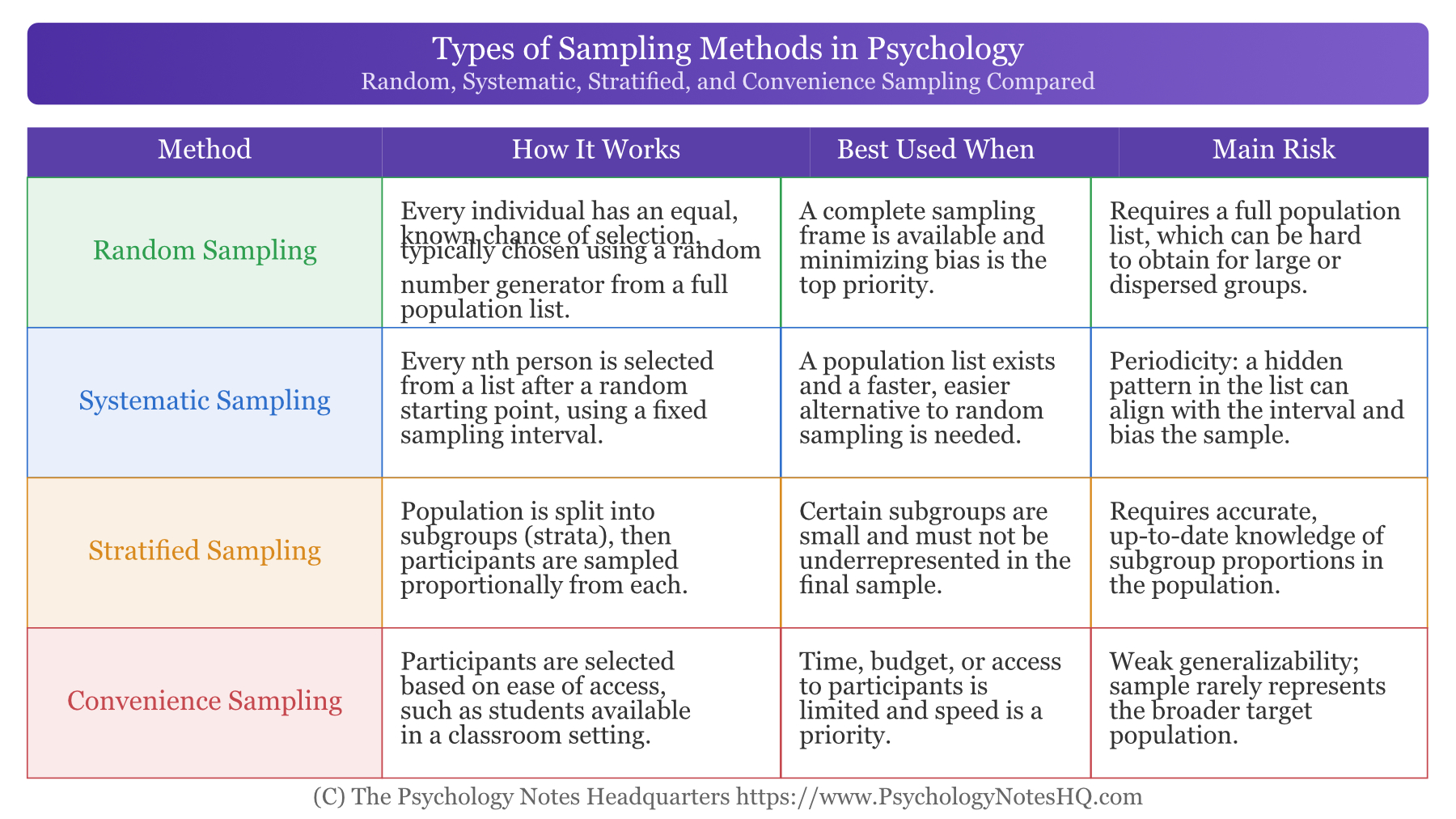
In practice, the decision usually comes down to what resources are available rather than which method is theoretically ideal. A complete population list points toward random or systematic sampling. A population with meaningful subgroups points toward stratified sampling. Limited time, budget, or access points toward convenience sampling, with the understanding that generalizability will be limited as a result. Strong research design means matching the method to the constraints honestly, rather than defaulting to whichever is easiest and ignoring the trade-off.
Sampling method is not just a methodology checkbox. It is one of the first decisions that determines whether a study’s conclusions can be trusted beyond the specific group tested.
References
- Etikan, I., and Bala, K. (2017). Sampling and sampling methods. Biometrics and Biostatistics International Journal, 5(6), 215-217.
- Henrich, J., Heine, S. J., and Norenzayan, A. (2010). The weirdest people in the world? Behavioral and Brain Sciences, 33(2-3), 61-83.
- Pollet, T. V., et al. (2024). WEIRD but also inconsistent: An analysis of the reporting practices of participant samples across five areas of psychology.
- Stroebe, W., Gadenne, V., and Nijstad, B. A. (2018). Do our psychological laws apply only to college students? External validity revisited. Basic and Applied Social Psychology, 40(6), 384-395.
How to cite this article:
The Psychology Notes Headquarters. (2026). Sampling Methods in Psychology: Which One Would You Actually Use?. Retrieved from https://www.psychologynoteshq.com/sampling-methods-in-psychology/