
Between Subjects vs Within Subjects: Why People Rated 9 Bigger Than 221
Imagine asking one group of people how big the number 9 is, and a different group how big 221 is. In a real study, the group judging 9 gave it the higher rating (Birnbaum, 1999). Nobody forgot how numbers work. The result came from the experimental design.
The choice between subjects vs within subjects decides whether each participant experiences one condition or all of them. That single decision shapes what your data can and cannot tell you. Pick the wrong one, and your results can look solid while answering a different question than you asked.
Key Takeaways
- Between-subjects designs give each person one condition, while within-subjects designs put everyone through every condition. That one choice affects sample size, noise, and bias.
- Within-subjects designs need fewer participants, but practice, fatigue, and carryover effects can sneak into the results.
- Counterbalancing can fix many order effects, but not all of them. Some conditions simply can’t be “undone.”
- The design itself can change the answer, which is how people ended up rating 9 as bigger than 221.
- A few quick questions about your study can tell you which design fits, and help you avoid common lab report mistakes.
What Makes an Experiment Between Subjects or Within Subjects
Every experiment manipulates something. Researchers change one thing and watch what happens to a measured outcome, the classic setup of independent and dependent variables.
Once you know what you’re manipulating, you face a second decision that students often rush past: who gets which condition?
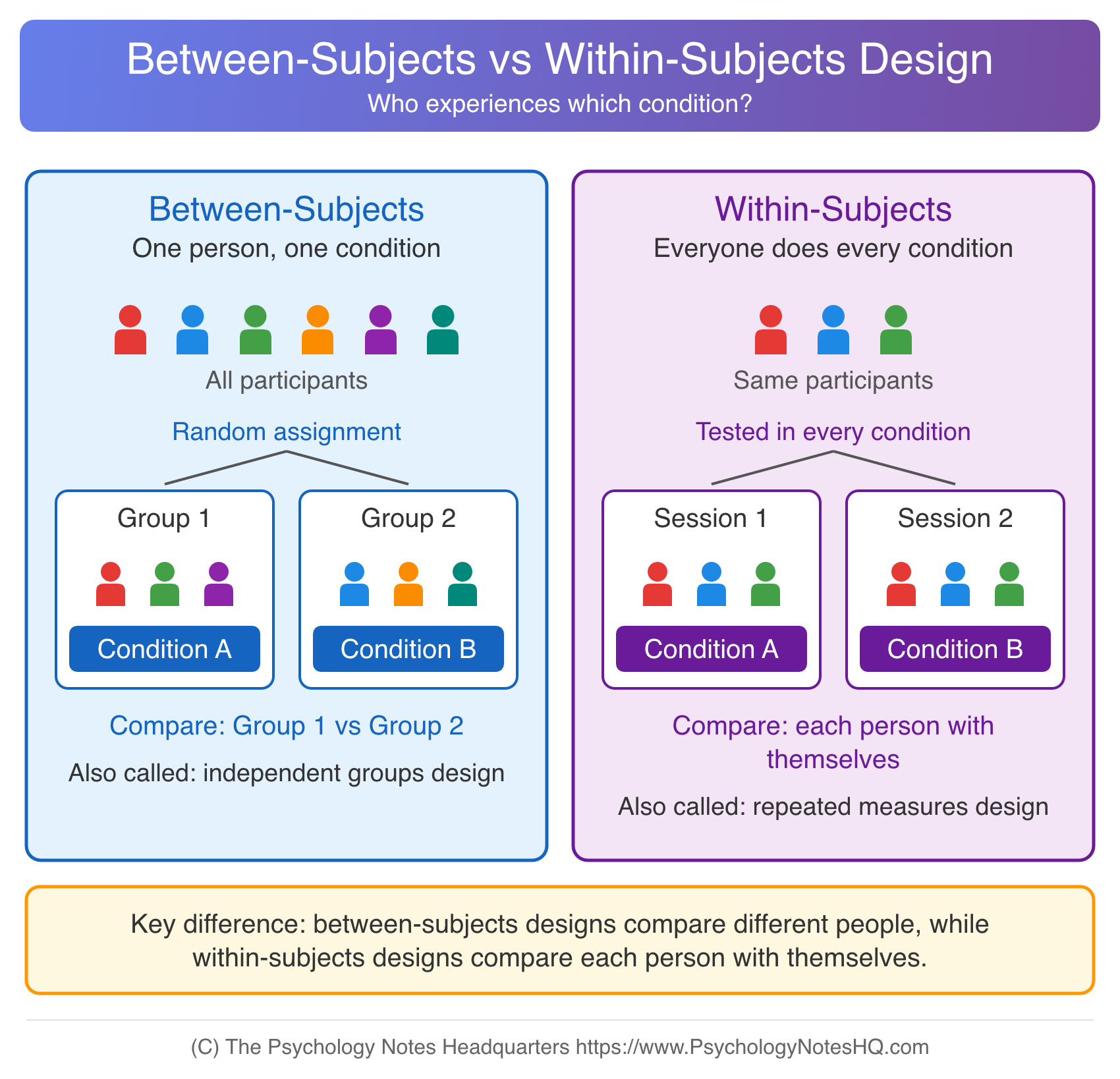
You can give each participant one level of your manipulation, or you can give every participant all of them. That’s the whole split. Almost everything else in this article follows from that one choice.
Between-Subjects Design: One Person, One Condition
In a between-subjects design, participants are split into separate groups, and each group experiences only one condition. You then compare the groups’ average scores.
If you’re reading UK or A-level materials, you’ll see this called an independent groups design. Same thing, different label.
The big safeguard here is random assignment. When people are randomly placed into groups, differences in personality, mood, and prior knowledge should spread out roughly evenly, so the groups start out comparable (Jhangiani et al., 2019).
Within-Subjects Design: Everyone Does Everything
In a within-subjects design, the same participants complete every condition. Instead of comparing different groups, you compare each person’s performance across conditions with their own performance.
You’ll often see this called a repeated measures design, because each participant is measured repeatedly, once per condition. In experimental psychology the two names mean the same thing, and you’ll meet the second one again in statistics class when you run a repeated measures ANOVA.
Two Classic Studies, Two Different Designs
Textbook definitions make more sense once you see them in real research. These two well-known memory studies happen to sit on opposite sides of the split, and each one shows why its researchers chose the design they did.
Loftus and Palmer (1974): Five Verbs, Five Groups
In their eyewitness memory study, Loftus and Palmer (1974) showed 45 students film clips of car accidents. They then asked how fast the cars were going when they “smashed,” “collided,” “bumped,” “hit,” or “contacted” each other.
Each participant heard only one verb, so this was a between-subjects experiment. The “smashed” group gave the highest average estimate (40.8 mph) and the “contacted” group gave the lowest (31.8 mph).
Why not let everyone hear all five verbs? They’d quickly notice the wording changes and guess the point of the study.
Godden and Baddeley (1975): Divers on Land and Underwater
Godden and Baddeley (1975) had 18 scuba divers learn word lists either on land or underwater, then recall them either on land or underwater.
Every diver took part in all four combinations across separate sessions, which made it a within-subjects study. Recall was better when the learning and recall environments matched, a classic example of context shaping episodic memory.
Here’s a twist: a 2021 replication using the same within-subjects setup didn’t find the effect (Murre, 2021). A sound design doesn’t guarantee a result that holds up.
Why Between-Subjects Designs Need More Participants
People are different. Some read faster, some have sharper memories, and some slept badly. In a between-subjects design, all of those individual differences become noise in your comparison, because different people sit in different conditions.
Random assignment keeps that noise from favoring one group, but it doesn’t make the noise disappear. To see a real effect through it, you usually need more participants.
Don’t confuse this with random sampling, which is about who gets into your study in the first place and is one of several sampling methods in psychology.
The Power Advantage of Within-Subjects Designs
Within-subjects designs remove much of that noise because each person serves as their own comparison. Greenwald (1976) pointed to this statistical efficiency as the main argument in their favor.
In practice, a within-subjects study can often detect the same effect with far fewer people. A between-subjects study with too few participants has low statistical power, which makes it harder to reject the null hypothesis even when a real effect exists.
The Hidden Problem With Within-Subjects Designs: Order Effects
If within-subjects designs are so efficient, why doesn’t everyone use them?
Because doing one condition can change how people perform in the next. These order effects can masquerade as the effect of your manipulation. Greenwald (1976) grouped the main culprits as practice, sensitization, and carryover.
Practice Effects
Participants often improve simply because they’ve done the task before. They learn the instructions, discover shortcuts, and feel more relaxed. If condition B always comes second, it gets an unfair boost from practice alone.
Fatigue and Boredom Effects
The opposite can happen, too. In a long session, people get tired, bored, or careless. If condition B always comes last, its scores may drop for reasons that have nothing to do with condition B itself.
Carryover and Sensitization
Sometimes a condition leaves something behind. A drug might still be active, a mood might linger, or a strategy learned in one condition might get used in the next.
Seeing every condition can also tip participants off about what you’re testing. Once they guess the hypothesis, they may act the way they think you want. Charness et al. (2012) note that these demand effects are likely to be stronger in within-subjects designs.
How Counterbalancing Fixes Order Effects
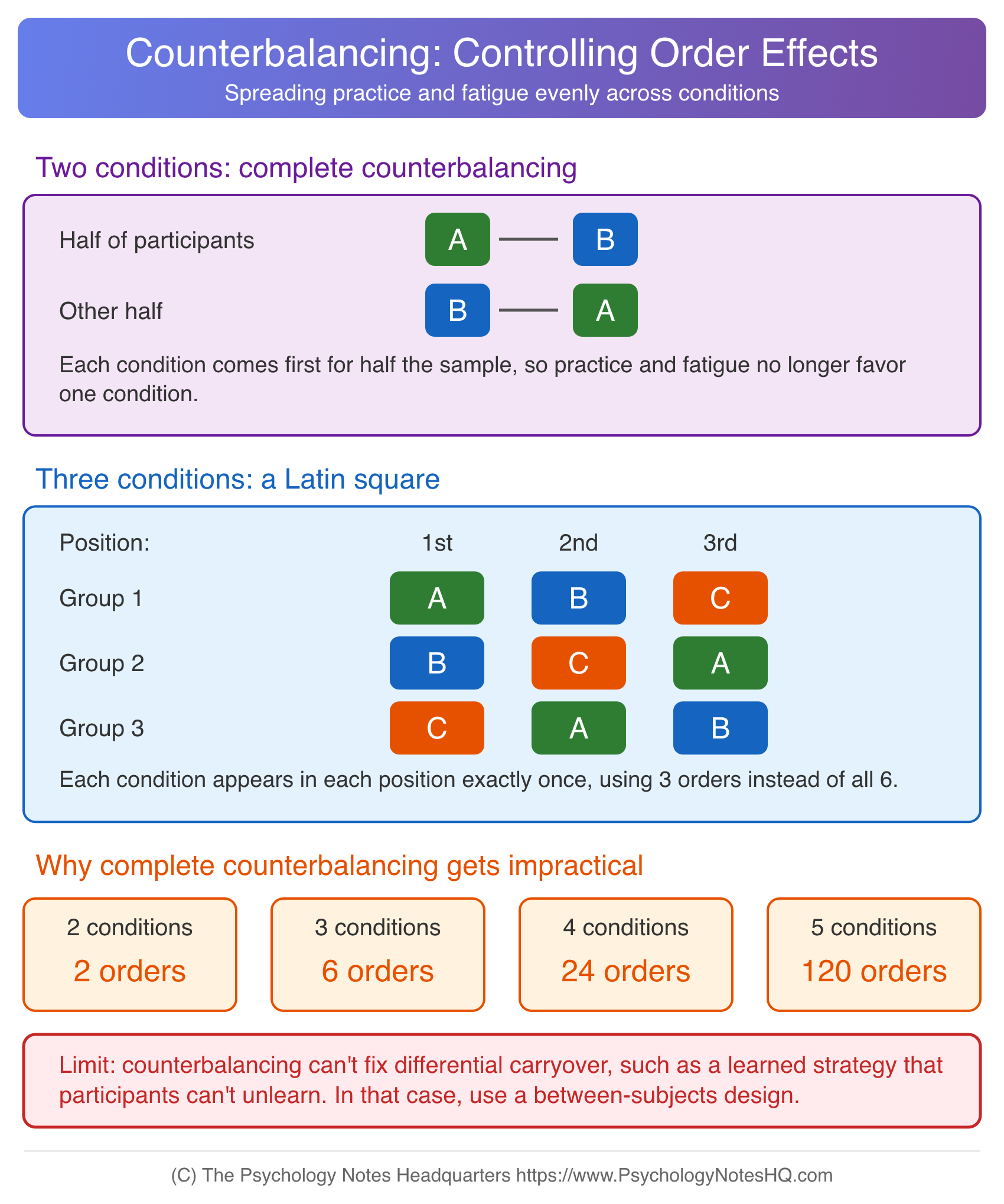
The standard fix is counterbalancing, which means testing different participants in different orders so that order effects are spread evenly across conditions (Jhangiani et al., 2019).
Order still affects individual scores. It just no longer favors one condition over another, so any difference between conditions can’t be blamed on order alone.
Complete Counterbalancing
With two conditions, this is easy. Half your participants do A then B, and the other half do B then A.
The trouble is that the number of possible orders grows fast. Three conditions give you 6 orders, four give you 24, and five give you 120. Complete counterbalancing means using every order equally often, which quickly becomes impractical.
Latin Square Designs
A Latin square is the practical shortcut. Instead of using every possible order, you use a smaller set in which each condition appears in each position exactly once.
With three conditions, that might be ABC, BCA, and CAB. Every condition gets a turn at being first, second, and third, so practice and fatigue are balanced across conditions without needing all six orders.
When Counterbalancing Can’t Help
Counterbalancing assumes order effects work the same in both directions. Sometimes they don’t.
Say you’re testing whether a memory strategy improves recall. If participants learn the strategy in condition A, they can’t simply forget it before condition B. Doing A first changes B, but doing B first doesn’t change A in the same way.
This is called differential (or asymmetric) carryover, and no ordering scheme can cancel it out. Here, a between-subjects design is usually the safer choice.
The 9 vs 221 Problem: When the Design Changes the Answer
Back to the study from the introduction. Birnbaum (1999) asked one group of participants to rate how large the number 9 is, and a different group to rate the number 221, on a scale from 1 (very very small) to 10 (very very large).
The 9 group gave a mean rating of 5.13. The 221 group gave a mean rating of 3.10. In a between-subjects design, 9 “beat” 221.
Why It Happened
Birnbaum’s explanation is that people judging a single number quietly supply their own comparison. The 9 group compared it with other single-digit numbers, where 9 is pretty big. The 221 group compared it with other three-digit numbers, where 221 is fairly small.
So the two groups weren’t using the same yardstick. The stimulus changed, but so did the context. If the same people had rated both numbers, nobody would have said 9 was bigger.
The Bigger Lesson
Greenwald (1976) made a related point decades earlier: between-subjects designs aren’t free of context effects. Each single condition creates its own context.
That means the two designs can answer different questions. Between-subjects results tell you how people judge something on its own. Within-subjects results tell you how people judge things side by side. Charness et al. (2012) add that when people in real life usually face only one option, a between-subjects design may better reflect that situation.
Matched Pairs Design: A Middle Ground
What if you need separate groups but worry about individual differences? A matched pairs design offers a compromise.
First, you measure participants on something relevant to your study, such as a pretest score or reading ability. Then you pair people with similar scores and randomly assign one member of each pair to each condition.
You get two comparable groups without any order effects. The catch is that matching takes extra time, and you can only match on variables you thought to measure.
Between Subjects vs Within Subjects: Side-by-Side Comparison
Here’s how the two designs stack up. It’s a handy reference when you need to justify your design in a lab report or weigh between subjects vs within subjects strengths and weaknesses in an exam answer.
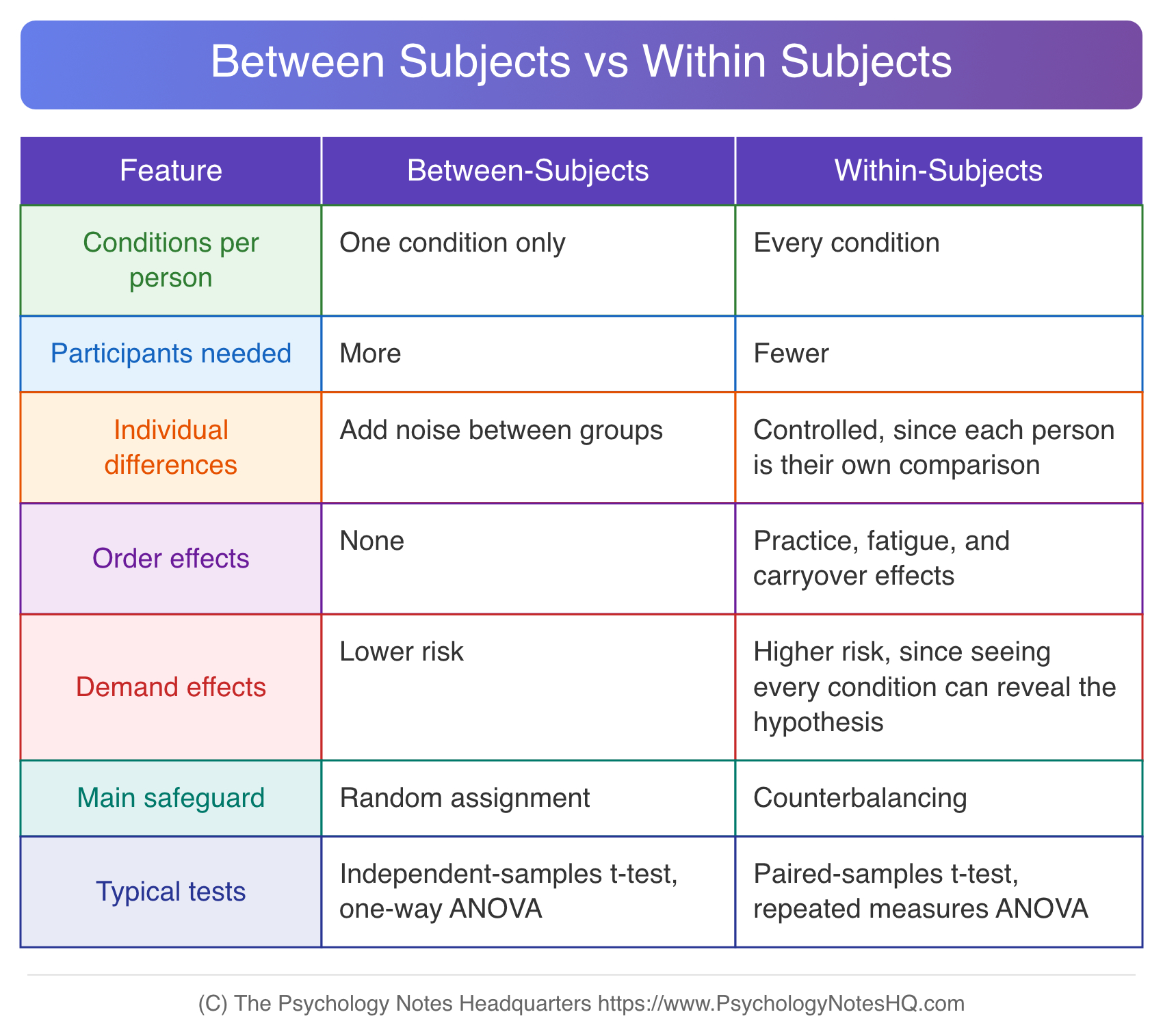
The short version: between-subjects designs need more people but avoid order effects, while within-subjects designs need fewer people but must manage them. The analysis differs too. Separate groups are usually compared with an independent-samples t-test or one-way ANOVA, while a repeated measures design calls for a paired-samples t-test or repeated measures ANOVA.
How to Choose the Right Design for Your Study
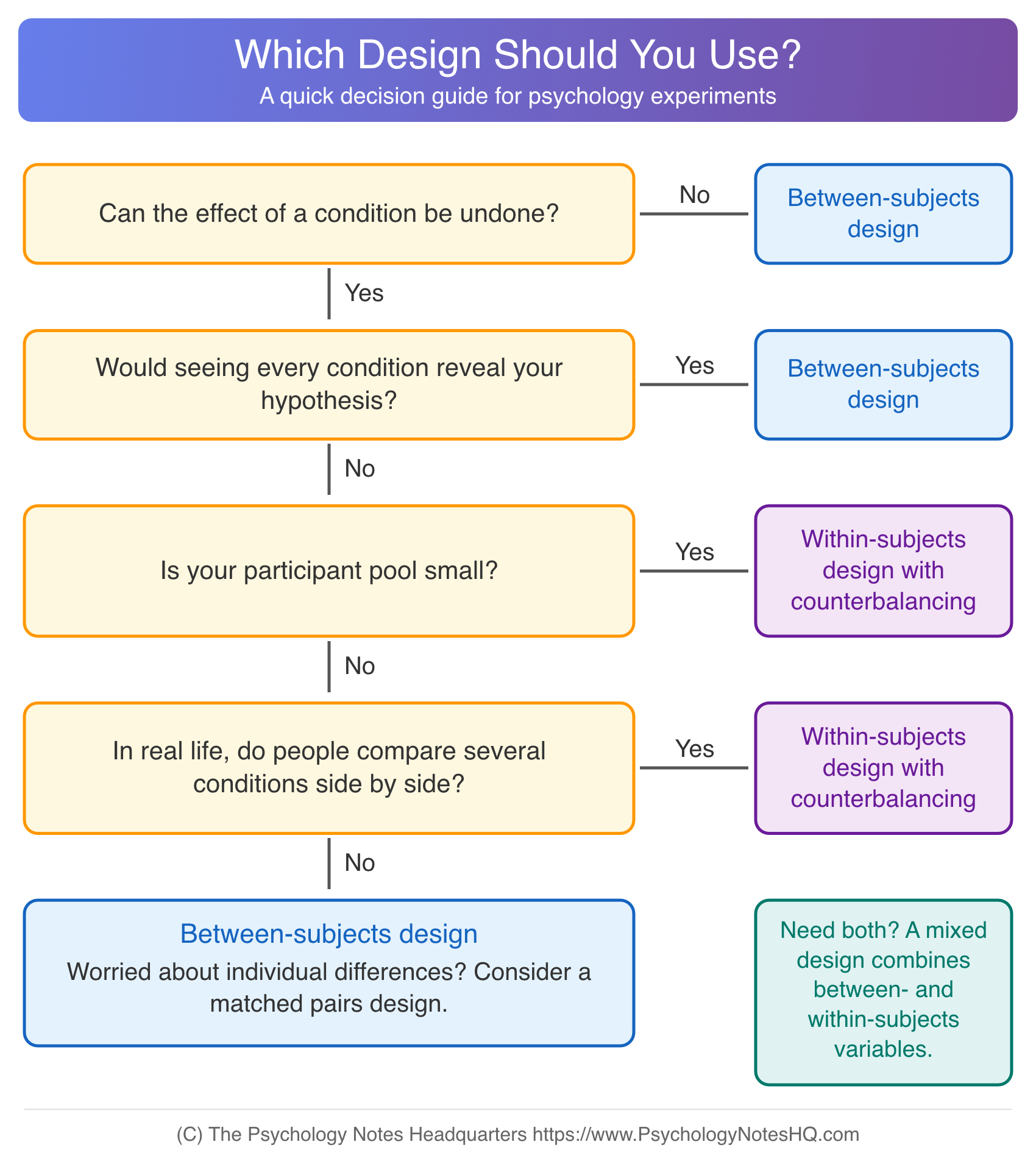
When you’re planning your own experiment, work through these questions:
- Can the effect of a condition be undone? If not, use a between-subjects design.
- Would seeing every condition reveal your hypothesis? If so, lean toward between-subjects.
- Is your participant pool small? If so, lean toward within-subjects.
- In real life, do people experience one condition or compare several? Match your design to that.
A Quick Example
Say you want to know whether background music hurts reading comprehension. Music doesn’t leave a lasting change, and your class only has 30 volunteers, so a within-subjects design makes sense. Everyone reads one passage with music and one in silence.
Two details matter. Half the group should do music first and half silence first. And the two passages need to be equally difficult, or the passage, not the music, could explain any difference.
What If the Answers Point Both Ways?
You don’t always have to pick just one. A mixed design includes at least one between-subjects variable and at least one within-subjects variable. For example, two groups might get different instructions (between), while everyone completes the same task at several time points (within).
Whichever route you take, explain why. Whether you settle on a between subjects vs within subjects setup or a repeated measures design with counterbalancing, your methods section should spell out exactly what you did and why it fits your question.
Common Mistakes Students Make in Lab Reports and Exams
These slip-ups show up again and again in student work. Most come from mixing up related concepts or leaving out details your reader needs to judge the design.
Mixing Up Design Concepts
- Confusing random assignment with random sampling. Assignment decides who goes into which condition. Sampling decides who is in the study at all.
- Calling a single-group before-and-after study a true experiment. Without a comparison condition, a change over time could come from many things besides your manipulation, the same trap behind confusing correlation vs causation.
Overlooking Order and Confounds
- Forgetting to report counterbalancing. If you used a within-subjects design, say exactly how you ordered the conditions.
- Ignoring confounds. If anything other than your manipulation differs between conditions, your conclusions lose validity, no matter how consistent the scores look.
Treating One Design as Always Better
It’s tempting to write that within-subjects designs are simply better because they need fewer people. Examiners usually want to see the trade-off instead. Statistical power is only one consideration. Carryover, demand effects, and the 9 vs 221 context problem all pull in different directions, so name the trade-off rather than declaring a winner.
The Design Is Part of the Answer
The 9 vs 221 result isn’t a quirky exception. It’s a reminder that your design decides which question your data can answer.
Between-subjects designs keep conditions clean but need more people and leave participants to supply their own context. Within-subjects designs are efficient but need careful counterbalancing. Choose deliberately, explain your reasoning, and your results will mean what you say they mean.
References
- Birnbaum, M. H. (1999). How to show that 9 > 221: Collect judgments in a between-subjects design. Psychological Methods, 4(3), 243–249.
- Charness, G., Gneezy, U., & Kuhn, M. A. (2012). Experimental methods: Between-subject and within-subject design. Journal of Economic Behavior & Organization, 81(1), 1–8.
- Godden, D. R., & Baddeley, A. D. (1975). Context-dependent memory in two natural environments: On land and underwater. British Journal of Psychology, 66(3), 325–331.
- Greenwald, A. G. (1976). Within-subjects designs: To use or not to use? Psychological Bulletin, 83(2), 314–320.
- Jhangiani, R. S., Chiang, I. A., Cuttler, C., & Leighton, D. C. (2019). Research methods in psychology (4th ed.). Kwantlen Polytechnic University.
- Loftus, E. F., & Palmer, J. C. (1974). Reconstruction of automobile destruction: An example of the interaction between language and memory. Journal of Verbal Learning and Verbal Behavior, 13(5), 585–589.
- Murre, J. M. J. (2021). The Godden and Baddeley (1975) experiment on context-dependent memory on land and underwater: A replication. Royal Society Open Science, 8(11), Article 200724.
How to cite this article:
The Psychology Notes Headquarters. (2026). Between Subjects vs Within Subjects: Why People Rated 9 Bigger Than 221. Retrieved from https://www.psychologynoteshq.com/between-subjects-vs-within-subjects/