
The Formal Operational Stage: Why Teens Argue Like Lawyers
A ninth grader insists a school rule is unjust, not just inconvenient, and backs it up with a principled argument that holds up even when a teacher pushes back. Two years earlier, the same kid could only say the rule was unfair because it got in their way. Something shifts in how adolescents think, and psychologist Jean Piaget called it the formal operational stage.
Key Takeaways
- Something changes in how adolescents reason starting around age 11, and it is not simply “getting smarter.” See what actually shifts.
- Teens develop a way of testing ideas that looks a lot like scientific method. One classic task makes this very easy to spot.
- A specific mental habit, distinct from intelligence, is one of the strongest predictors of academic success. Most students never get taught it directly.
- Adolescent idealism, constant self-consciousness, and arguing with parents trace back to the same underlying cognitive shift.
- Not every adult reaches this stage in every area of life. What actually determines who gets there, and where, might surprise you.
Where It Fits in Piaget’s Four Stages

Piaget’s theory describes cognitive development as a sequence of four stages, each building on the last. The sensorimotor stage (birth to 2 years) is where infants learn by physically interacting with their environment. The preoperational stage (ages 2 to 7) introduces language and symbolic thinking, though reasoning remains intuitive and egocentric. The concrete operational stage (ages 7 to 11) brings logical thinking, but only when applied to tangible, observable objects and events.
The formal operational stage represents the final leap in this sequence. “Formal” refers to reasoning about the logical form of arguments, independent of their actual content. “Operational” points to reversible mental transformations that allow systematic manipulation of ideas. Together, they describe a thinker who can reason about abstract structures, possibilities, and hypotheticals that may never exist in the physical world. This marks a fundamental shift in the nature of thought, not just its content (Inhelder & Piaget, 1958).
When Does the Formal Operational Stage Begin?
Piaget placed the onset at approximately 11 to 12 years old, with most individuals achieving it by mid-adolescence. He originally believed the stage was near-universal, something virtually all cognitively healthy individuals would reach given normal development. Subsequent research has complicated that picture significantly, as discussed later in this article.
What’s worth noting early is that this stage has no clear endpoint. This timeline for the formal operational stage of cognitive development extends through adulthood, and the depth of formal operational reasoning tends to grow with education and experience. Onset also varies considerably: some adolescents show signs of abstract reasoning as early as 10, while others don’t demonstrate it reliably until their late teens.
It’s also important to understand that reaching this stage doesn’t mean a person always thinks formally. Even adults default to more concrete reasoning when under stress, fatigued, or dealing with unfamiliar domains (Bjorklund, 2012). The formal operational stage describes a cognitive capacity, not a permanent mode of thinking.
Abstract Thinking: Reasoning Beyond the Concrete
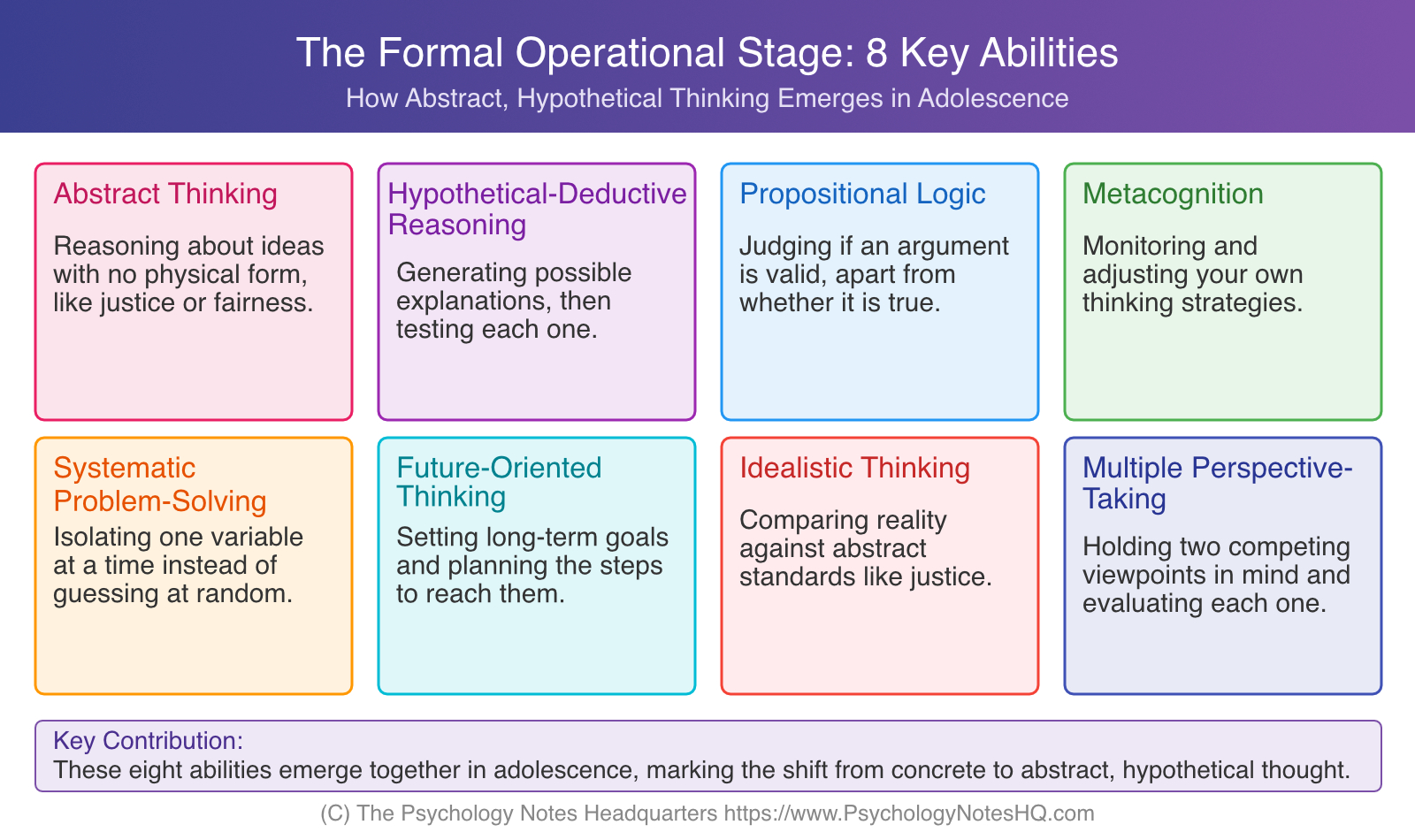
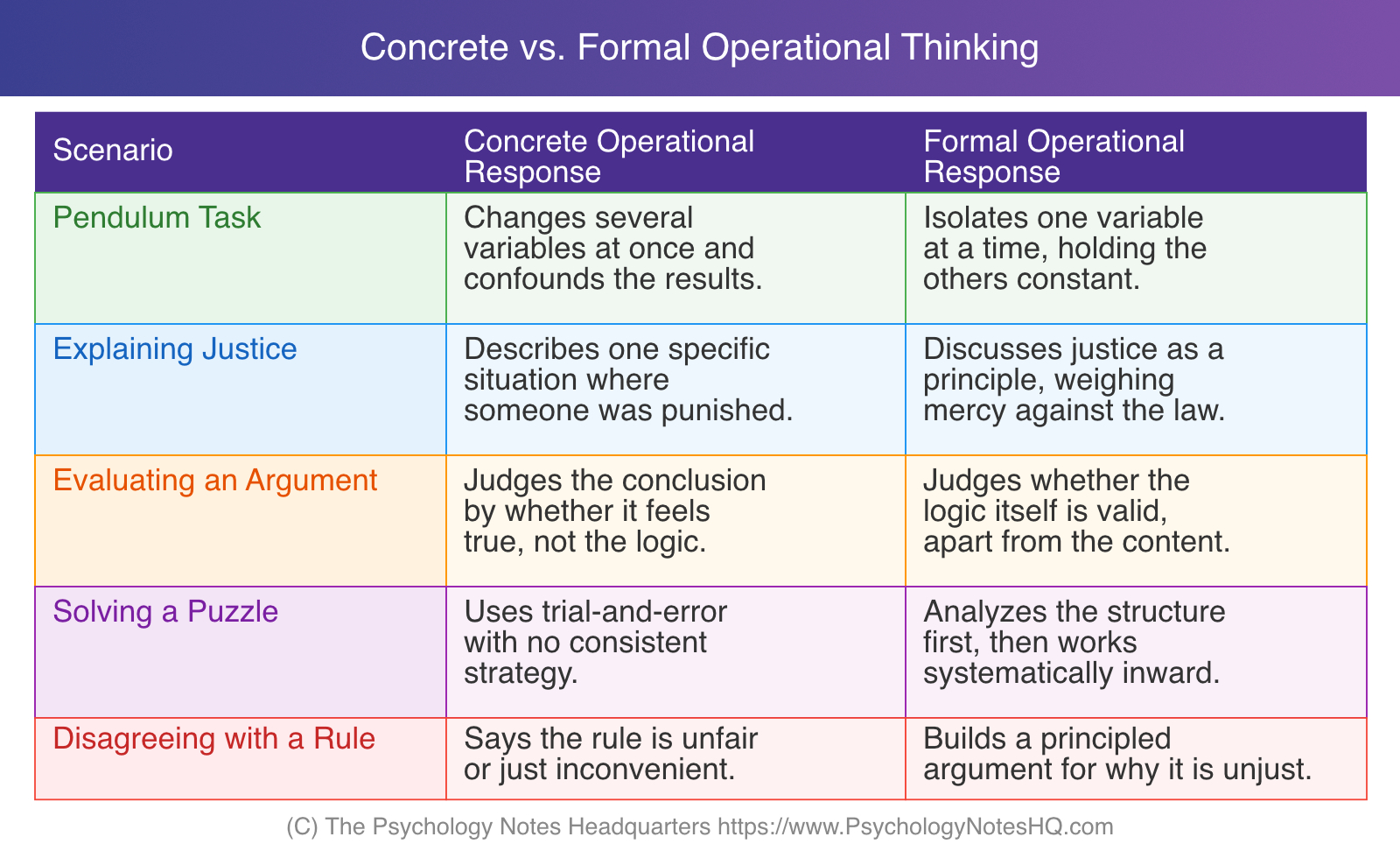
Abstract thinking is the most immediately visible feature of formal operations, the ability to reason about concepts with no physical referent. Ask a 9-year-old to explain justice and they’ll describe a specific situation where someone got punished fairly. Ask a 15-year-old and they can discuss justice as a principle: whether it’s compatible with mercy, whether a law can be legal but unjust, or whether equality of opportunity differs from equality of outcome.
This shift matters enormously in academic settings. Algebra requires reasoning about variables as symbols standing in for unknown quantities. Physics asks students to reason about forces and fields that can’t be seen. Literature analysis moves beyond plot summary into themes, symbolism, and authorial intent. None of these are accessible without abstract thinking.
Understanding how adolescents integrate new abstract concepts into existing knowledge structures, the process of assimilation and accommodation, helps explain why some learners grasp abstract material quickly while others need additional scaffolding (Piaget & Inhelder, 1969). Real-world abstract thinking shows up constantly: teenagers debating political ideologies, wrestling with questions about identity and meaning, or reasoning through ethical dilemmas with no clear right answer.
Hypothetical-Deductive Reasoning: The Scientific Mind in Action
If there is one ability that best characterizes formal operations, it is hypothetical-deductive reasoning: the capacity to generate possible explanations for a problem, then systematically test each one. Rather than relying on trial-and-error, formal operational thinkers approach problems the way scientists do, forming hypotheses first, then deducing how to test them.
Piaget and Inhelder’s Pendulum Task illustrates this perfectly. Participants are given a string, a set of weights, and a simple question: what determines how fast the pendulum swings? Four variables are in play: string length, weight, release height, and the force of the initial push.
A concrete operational child typically changes multiple variables at once and draws conclusions from the outcome, without realizing they have confounded their results. A formal operational thinker does something different: before touching anything, they mentally identify all four variables, then test each one independently while holding the others constant. The correct answer, that only string length matters, can only be reached through this systematic, one-at-a-time approach.
The same reasoning shows up outside the lab: a student troubleshooting a failed experiment, a teenager working out why a friendship deteriorated, or a young adult evaluating job offers based on long-term career logic rather than immediate appeal.
Propositional Logic: Reasoning from Words Alone
Propositional logic refers to the ability to evaluate arguments based on their logical structure, independent of whether the content is actually true. A formal operational thinker can assess “If all gronks are flurbs, and this is a gronk, then this must be a flurb” as logically valid, without knowing what gronks or flurbs are.
This is a meaningful cognitive shift. Concrete operational children tend to accept or reject arguments based on whether the conclusion feels true, not whether the reasoning is sound. Formal operational thinkers learn to separate those two questions: is this logically valid, and is the conclusion actually true?
Conditional if-then reasoning becomes reliable at this stage, along with understanding the contrapositive: if the ground is not wet, it cannot have rained. Combinatorial reasoning also develops: given a set of elements, a formal operational thinker systematically generates all possible combinations rather than guessing at random.
These abilities extend well beyond the classroom. Geometry proofs require deriving conclusions from axioms by logical necessity. Legal reasoning depends on evaluating whether conclusions follow from statutes and precedents. Computer programming runs almost entirely on boolean logic and conditional statements. This same logical foundation directly supports postconventional moral reasoning, where abstract principles take precedence over concrete social rules.
Metacognition: Thinking About Your Own Thinking
Metacognition, the ability to monitor and regulate one’s own cognitive processes, emerges as a defining feature of formal operational thinking. It isn’t just self-awareness in a broad sense. It is the specific capacity to step back from a task, observe how you’re reasoning, and ask: is this approach actually working?
Flavell (1979) defined metacognition as both awareness of and control over one’s own cognitive activity. In practice, this means a student noticing they have read three paragraphs without retaining anything and consciously choosing a different strategy. It means recognizing the difference between genuinely understanding a concept and merely being able to repeat a definition, what researchers call the “illusion of understanding.”
Research consistently shows that students who monitor their comprehension and adjust their strategies outperform those who simply work harder without reflection. The development of these self-regulatory thinking skills is closely connected to the quality of social learning environments: Vygotsky argued that the kind of coached dialogue students have with teachers and peers eventually gets internalized as self-directed inner speech.
For students, building metacognitive habits is one of the most reliable predictors of long-term academic success. It is not just about studying harder, it is about studying with deliberate awareness of how learning is or is not happening.
Systematic Problem-Solving and Future-Oriented Thinking
Formal operational thinkers approach problems more strategically than their concrete operational counterparts. Where a younger child solves a puzzle through random trial-and-error, an adolescent analyzes the structure first: sorting by color, completing the border, working systematically inward. This shift from reactive to deliberate strategy generalizes across virtually every domain.
The scientific expression of this is variable isolation, testing one factor at a time while holding others constant, the same logic underlying the Pendulum Task. Applied to everyday life, it is the student who adjusts one study habit at a time to identify what actually improves performance, or the athlete who changes only their pre-game warm-up to isolate its effect.
Future-oriented thinking develops alongside this strategic capacity. Adolescents begin setting goals that extend months or years ahead, thinking through the steps required and anticipating potential obstacles. A student choosing course electives with college admissions in mind, or weighing part-time work against study time, is engaging in exactly this kind of forward-looking planning.
Both abilities reinforce each other: systematic thinking makes future goals actionable rather than wishful. This is also when adolescents begin forming a clearer sense of personal and occupational identity, a process central to the challenges of Erikson’s identity vs. role confusion stage, which unfolds alongside these cognitive developments (Bjorklund, 2012).
Idealistic Thinking and Multiple Perspective-Taking
One of the most socially visible consequences of formal operational development is idealistic thinking, the ability to imagine how things ought to be, not just how they are. Adolescents who can now reason abstractly about justice and equality begin measuring reality against those standards. The result is the characteristic teenage frustration with institutions that fall short of their stated ideals, with adults who say one thing and do another, and with rules that seem arbitrary rather than principled.
This is not simply rebellion, it is cognition. For the first time, adolescents can hold an abstract ideal in mind and compare it systematically against observable reality. That capacity drives youth activism and the kind of passionate moral engagement that often shapes lifelong values.
Multiple perspective-taking develops in parallel. Formal operational thinkers can hold two competing viewpoints simultaneously, evaluate the internal logic of each, and understand how someone reasoning from a different framework could arrive at a different but coherent conclusion. This is exactly what both Piaget and Kohlberg’s frameworks identify as necessary for higher moral reasoning, recognizing that moral development requires principled reasoning from multiple angles, not just rule-following.
A student who argues both sides of a policy debate before forming a position, or a teenager who disagrees with a parent but can articulate why the parent’s reasoning is internally consistent, is demonstrating exactly this.
Formal Operational Stage Examples in Real Life
Seeing formal operational stage examples in everyday contexts is the clearest way to recognize this type of thinking in practice. Here are five scenarios that illustrate what it actually looks like.
A high school student argues that a disciplinary rule is unjust, not just inconvenient, by constructing a principled argument about fairness and applying it consistently across different groups. That is abstract thinking and propositional logic working together.
A teenager decides to find out whether changing their practice schedule actually affects their athletic performance. They keep every other variable in their routine constant and track results over several weeks. That is hypothetical-deductive reasoning applied outside the lab.
A student realizes mid-exam that a memorization strategy is not helping them answer application questions, and consciously switches approaches in real time. That is metacognition at work.
A 16-year-old enrolls in a demanding course they find difficult, reasoning it will strengthen their academic record for college applications two years ahead. That is future-oriented, systematic planning.
Two friends disagree on a moral question. One says, “I understand why you see it that way, but here is where I think that reasoning breaks down.” Holding another person’s logic in mind while evaluating it critically is multiple perspective-taking in action.
These formal operational stage examples share a common thread: reasoning that extends beyond what is immediately visible, tangible, or personally experienced.
Adolescent Egocentrism: The Imaginary Audience and Personal Fable
David Elkind observed that the very cognitive advances enabling abstract thought also produce a new form of egocentrism specific to adolescence. Formal operational thinkers can now imagine what others are thinking, but they make a characteristic error: they assume others are thinking about them.
The imaginary audience is the belief that one is constantly being observed and evaluated. A minor embarrassment, stumbling in the hallway, saying something awkward in class, feels catastrophic because the adolescent assumes everyone noticed and will remember it. This heightened self-consciousness typically peaks around age 15 and fades as real-world experience reveals that other people are far less focused on us than we imagine.
The personal fable is the complementary belief in one’s own uniqueness and invulnerability. The adolescent’s emotional experiences feel so intense and unprecedented that they conclude no one else could fully understand them, and that the consequences affecting other people simply will not apply to them. This “it can’t happen to me” thinking underlies a significant portion of adolescent risk-taking behavior.
Both are developmental phenomena, not character flaws. They represent the leading edge of a perspective-taking ability that has not yet been calibrated by sufficient real-world feedback. With experience, most adolescents replace these distortions with more accurate social judgment (Elkind, 1967).
Does Everyone Reach Formal Operations?
Piaget originally assumed formal operations were a near-universal achievement by mid-adolescence. Research since then has told a more complicated story. Studies consistently find that a substantial portion of adults, when given formal operational tasks, respond at a concrete operational level, particularly in domains outside their expertise (Kuhn, 2008).
Cultural context plays a meaningful role. Piaget’s tasks reflect priorities embedded in Western, school-based education: abstract problem-solving, systematic experimentation, and logic independent of content. Individuals educated within different cultural frameworks often demonstrate sophisticated reasoning through other means without performing well on these specific tasks, raising genuine questions about whether formal operations represent a universal cognitive milestone or a culturally-specific form of reasoning (Cole, 1996).
Domain specificity further complicates the stage model. A skilled carpenter may reason formally about structural problems but concretely when discussing policy. A philosopher may think abstractly about ethics but troubleshoot everyday technology through trial-and-error. Formal reasoning may develop unevenly across domains depending on experience, interest, and depth of knowledge rather than as a single, sweeping cognitive upgrade.
For educators, this has practical consequences. Many curricula assume formal operational thinking in their design and assessment methods. Students who reason concretely, or only formally in specific domains, can be significantly disadvantaged by that assumption. Vygotsky’s sociocultural perspective offers a useful counterpoint here, emphasizing that higher cognitive functions are actively shaped by the social and educational environments in which learning takes place.
Criticisms and Limitations
The formal operational stage has shaped developmental psychology for decades, but it has attracted consistent and well-founded criticism. Four issues stand out.
First, Piaget overestimated how broadly adolescents achieve formal operations. His theory suggested most teenagers would reliably demonstrate abstract reasoning by mid-adolescence. The evidence does not support that. Many adolescents and adults struggle with formal operational tasks, particularly when problems are framed abstractly or fall outside familiar territory.
Second, cultural bias in assessment tasks is a genuine concern. The Pendulum Task and similar measures reflect priorities specific to Western, school-based education. Performance varies considerably across cultures, making universal developmental conclusions difficult to sustain.
Third, domain specificity undermines the idea of a uniform cognitive stage. Evidence increasingly suggests formal reasoning develops selectively, in areas where individuals have accumulated deep experience, rather than as a general cognitive upgrade applied across all domains of thinking.
Fourth, some theorists argue that development does not stop at formal operations. Post-formal thinking, which involves integrating logic with context, contradiction, uncertainty, and pragmatic judgment, has been proposed as a continuation of cognitive development into adulthood, suggesting Piaget’s final stage may not be the final word (Bjorklund, 2012).
Conclusion
The formal operational stage marks the most sophisticated level of cognitive development in Piaget’s framework, and the most debated. Its core insight holds: adolescence brings a genuine qualitative shift in thinking, from concrete to abstract, from reactive to systematic, from self-centered to perspective-aware. When it emerges, who achieves it, and whether it represents a universal final stage remain productive areas of inquiry, and understanding them matters for anyone working with or alongside adolescents.
References
- Bjorklund, D. F. (2012). Children’s thinking: Cognitive development and individual differences (5th ed.). Wadsworth Cengage Learning.
- Cole, M. (1996). Cultural psychology: A once and future discipline. Harvard University Press.
- Elkind, D. (1967). Egocentrism in adolescence. Child Development, 38(4), 1025-1034.
- Flavell, J. H. (1979). Metacognition and cognitive monitoring: A new area of cognitive-developmental inquiry. American Psychologist, 34(10), 906-911.
- Inhelder, B., & Piaget, J. (1958). The growth of logical thinking from childhood to adolescence. Basic Books.
- Kuhn, D. (2008). Formal operations from a twenty-first century perspective. Human Development, 51(1), 48-55.
- Piaget, J., & Inhelder, B. (1969). The psychology of the child. Basic Books.
How to cite this article:
The Psychology Notes Headquarters. (2026). The Formal Operational Stage: Why Teens Argue Like Lawyers. Retrieved from https://www.psychologynoteshq.com/formal-operational-stage/