
Psychological Changes in Adolescence: What’s Normal and Why
A 13-year-old argues about climate policy at dinner with the skill of a debate captain, then spends the rest of the night crushed by one unanswered text. Parents call it moodiness. Teachers call it attitude.
Psychologists see something more interesting. Psychological changes in adolescence rarely arrive one at a time, because the brain, the body, and the social world are all shifting on different schedules. Once you know which of those shifts are normal and why they happen, the teenage years start to make a lot more sense.
Key Takeaways
- Adolescence unfolds in three overlapping stages, and the psychological agenda of a 12-year-old looks very different from that of a 19-year-old.
- The teenage brain is not broken. Two key systems simply mature on different timetables, and that gap explains a surprising amount of teen behavior.
- Self-esteem tends to dip during adolescence, and the drop is steeper for one group than the other.
- In a classic driving experiment, simply having friends in the room changed how teens played far more than it changed how adults played.
- The famous “storm and stress” view of adolescence is only partly right, and knowing where it goes wrong helps separate normal turbulence from real warning signs.
The Three Stages of Adolescence
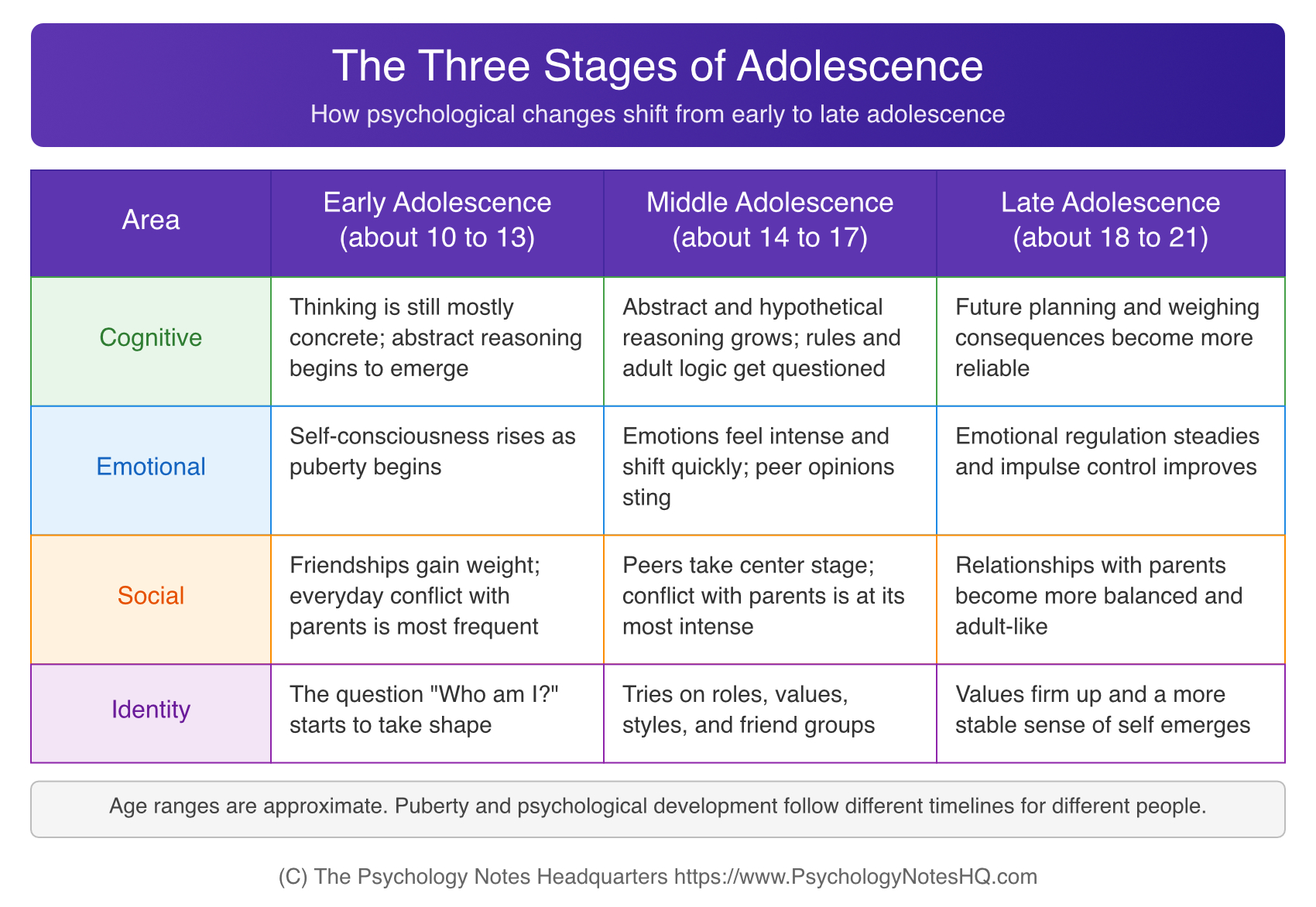
Adolescence is not one long, uniform stretch. Pediatricians commonly divide it into three stages of adolescence: early (about 10 to 13), middle (about 14 to 17), and late (about 18 to 21). The age bands are approximate, since puberty starts at different times for different people, but each stage has a recognizable psychological agenda.
Early adolescence is dominated by puberty and a sudden rise in self-consciousness, while thinking is still fairly concrete. Middle adolescence brings a surge in peer focus, abstract reasoning, and pushback against family rules. Late adolescence is when impulse control, future planning, and a steadier sense of identity usually begin to settle in.
Seeing the stages side by side is useful because many psychological changes during adolescence peak at different points. Conflict with parents is not spread evenly across the teenage years, for example, and the appetite for risk shows up well before the ability to manage it.
Where adolescence ends is still debated. Because brain maturation continues past 21, some researchers stretch late adolescence into the early or mid-twenties. For many college students, that means several of the changes described here are not distant history but still in progress.
What’s Happening in the Adolescent Brain
Much of what looks erratic in teenage behavior traces back to the timing of brain development. Regions tied to emotion and reward become highly responsive early in adolescence, while the prefrontal systems that support planning and impulse control mature more gradually (Casey et al., 2008). The result is a brain that feels intensely before it regulates reliably.
Two processes drive this restructuring. Synaptic pruning trims neural connections that go unused and strengthens the ones that get regular use. Myelination insulates connections so signals travel faster, and it moves slowly through the frontal regions.
Some of this refinement continues into the twenties, which is one reason researchers now treat emerging adulthood as a developmental period of its own.
Because pruning follows use, adolescence is also a window of opportunity. Skills, habits, and coping strategies practiced during these years tend to become deeply wired, so this stage is as much about building capacity as it is about managing risk.
Emotional Changes in Adolescence: Why Moods Feel Bigger
The “raging hormones” explanation oversimplifies what is going on. Hormonal shifts do raise emotional intensity, but how that intensity plays out depends heavily on sleep, stress, and relationships at home and at school. Teens tend to feel emotions more sharply, and switch between them faster, than children or adults do.
It helps to separate two skills that often get lumped together. Emotional reactivity is how strongly a feeling hits. Emotional regulation is how well that feeling gets managed once it arrives. Adolescence tends to amplify the first while the second is still under construction, which creates the look of moodiness even when nothing is actually wrong.
Sleep makes this harder. Puberty pushes the body clock later, but school schedules rarely move with it. Many teens build up chronic sleep debt even though their need for sleep has not declined (Carskadon, 2011). A tired brain is a more reactive brain, so ordinary frustrations start to feel much larger.
Emotional intensity also has a social side. Adolescents are especially responsive to social and emotional contexts (Casey et al., 2008), so a message left on read or an inside joke they missed can register as a genuine emotional event rather than a minor slight.
These psychological changes in adolescence are not a sign of permanent instability. Emotional swings tend to ease as the connections between emotional and regulatory brain regions strengthen through the late teens and early twenties.
Cognitive Shifts: Abstract Thought and Self-Consciousness
Adolescence is also when thinking changes shape. Teens move from concrete, rule-bound reasoning toward hypothetical and abstract thought, the shift Piaget described as the formal operational stage. Suddenly they can debate justice, spot contradictions in adult rules, and imagine several possible futures for themselves.
That same capacity opens the door to more sophisticated moral reasoning. Many teens start weighing rules against broader principles, a progression mapped out in Kohlberg’s stages of moral development.
It also fuels a spike in self-consciousness known as adolescent egocentrism. The imaginary audience is the feeling of being constantly watched and judged, which drives embarrassment. The personal fable is the sense that one’s experiences are unique, which can make consequences feel like something that happens to other people. Both usually fade by the late teens.
Self-Concept, Self-Esteem, and Body Image
How teens see themselves goes through its own turbulence. Research on self-esteem across the lifespan shows that it is relatively high in childhood, drops during adolescence, especially for girls, and then rises gradually through adulthood (Robins & Trzesniewski, 2005).
Several forces converge here. Abstract thinking lets teens judge themselves more critically, puberty changes how their bodies look and feel, and the peer group becomes the main yardstick. Social comparison becomes almost constant, and social media supplies an endless stream of curated peers to measure against.
Body image is often where this shows up first. Puberty changes height, weight, skin, and shape on a schedule no one chooses, and those changes are visible to peers at exactly the age when being noticed feels most intense. That combination helps explain why appearance becomes such a loaded topic in early adolescence.
The dip is an average, not a destiny. Plenty of teens hold steady, and those who lose confidence often regain it as their identity firms up and their comparison group widens beyond the school hallway.
Identity Exploration
Adolescence is when the question “Who am I?” becomes urgent. Erik Erikson framed this as the identity vs. role confusion stage, when teens try out roles, values, and group memberships before committing to a more stable sense of self.
Teens move through this exploration at very different speeds. Some adopt their family’s values without much questioning, while others spend years actively trying things on. What that exploration looks like day to day, from sudden friend group changes to questioning family beliefs, becomes easier to read once you know the common signs of an identity crisis.
This identity work also overlaps with the practical milestones in Havighurst’s developmental tasks of adolescence, such as forming mature relationships with peers and preparing for greater independence.
Social Changes: Peers, Parents, and Independence
Social life reorganizes during adolescence. Friends take up more time and carry more emotional weight, and approval from peers can start to matter more than approval from parents. This is a normal part of building independence, not a rejection of family.
Peer influence is real, but it works mostly through the desire to belong rather than through direct pressure. The pull toward conformity tends to be strongest when a teen feels unsure of where they fit in.
Relationships with parents change too. A meta-analysis found that parent-adolescent conflict is most frequent in early adolescence and most intense in middle adolescence (Laursen et al., 1998, as cited in Arnett, 1999). Much of this friction reflects a renegotiation of autonomy rather than a breakdown of the relationship.
Risk-Taking and the Peer Effect
Risk-taking peaks in adolescence, and the dual systems model offers the leading explanation. A socioemotional system that drives reward-seeking ramps up early, while a cognitive control system that restrains impulses keeps developing into the early twenties (Shulman et al., 2016). For a stretch of years, the accelerator is stronger than the brakes.
The gap matters most in social settings. In a classic experiment, adolescents, young adults, and adults played a computerized driving game either alone or with same-age peers present. Participants took more risks in groups overall, but the peer effect was much stronger for adolescents and young adults than for adults (Gardner & Steinberg, 2005).
That finding reframes many psychological changes during adolescence. Teens usually know that risks exist. What changes is how loudly the anticipated reward, especially peer approval, speaks in the moment. It helps explain why warnings alone often fall flat: the knowledge is there, but the social payoff feels bigger.
Not all risk-taking is harmful, either. The same drive for novelty and reward pushes teens to audition for a play, try out for a team, speak up for a cause, or take on a job. These positive risks build confidence and independence in ways that playing it safe cannot.
Effects of Early Puberty (and Late Puberty)
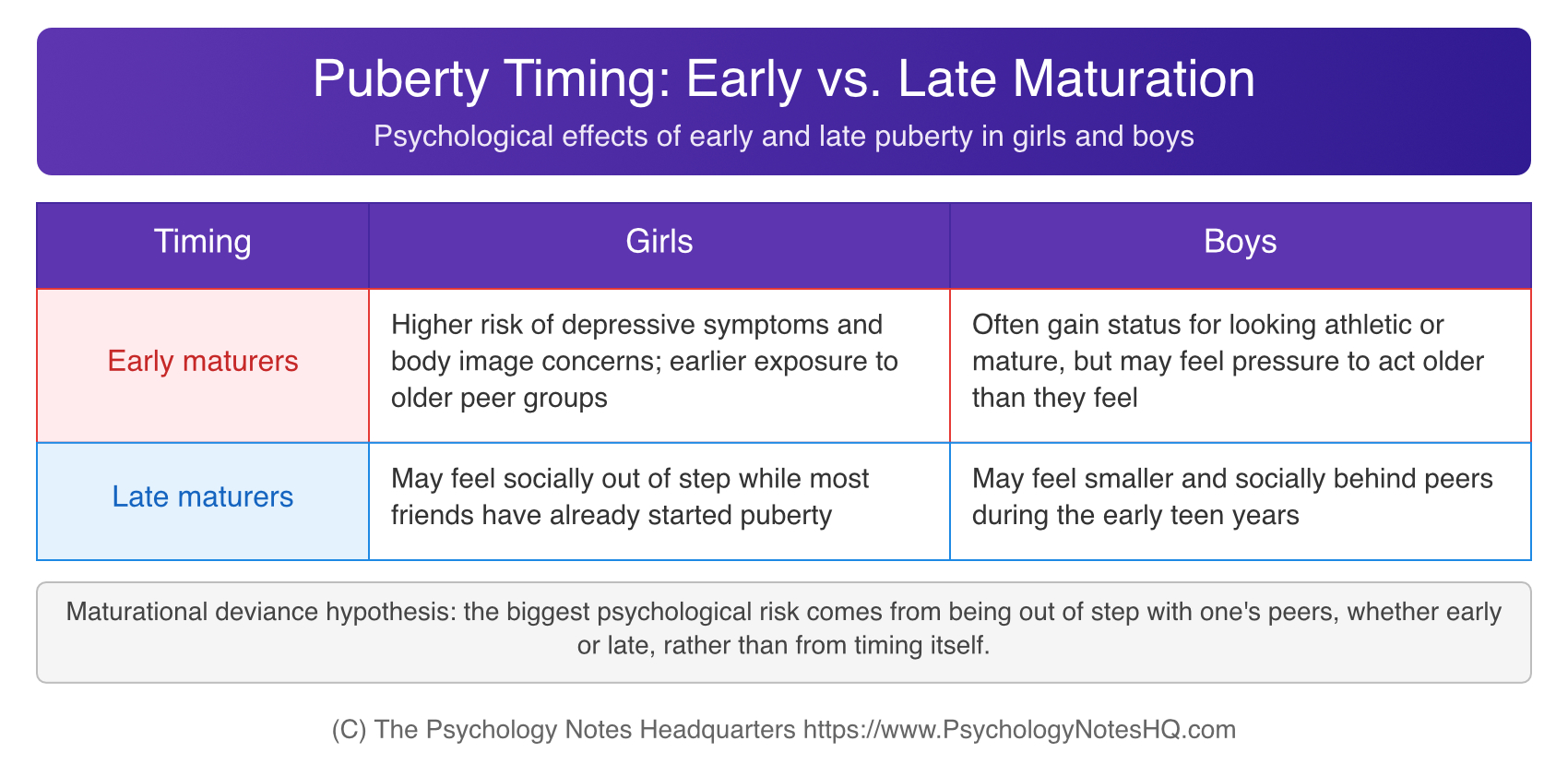
Puberty timing carries its own psychological consequences. Among the most studied effects of early puberty is the elevated risk early-maturing girls face, including higher rates of depressive symptoms and other negative outcomes compared with on-time or later-maturing peers (Mendle et al., 2007).
For boys, early maturation was long seen as an advantage that brings athletic status and a more mature image. The picture is more mixed than that, since early-maturing boys can also feel pressure to act older than they are. Late maturers of either gender may feel socially behind at a time when fitting in matters intensely.
The maturational deviance hypothesis helps explain these patterns. It proposes that the real risk comes from being out of step with one’s peers, early or late, rather than from timing in any absolute sense. A girl who develops early alongside friends on a similar timeline usually has an easier experience than one who develops well ahead of everyone around her.
Is Adolescence Really “Storm and Stress”?
The idea that adolescence is inherently turbulent goes back to G. Stanley Hall, who in 1904 described it as a period of “storm and stress.” The phrase stuck, and it still shapes how many adults think about teenagers today.
Arnett (1999) put this view to the test by reviewing research on three areas: conflict with parents, mood disruptions, and risk behavior. In all three, the evidence supported only a modified version of Hall’s idea. Not every adolescent experiences storm and stress, but it is more likely during adolescence than at other ages, and it varies with individual differences and culture.
Arnett also pointed out that storm and stress tends to be lower in traditional cultures than in Western ones. That pattern is a reminder that culture, not biology alone, shapes how turbulent these years feel.
This modified view is the most useful lens for understanding psychological changes in adolescence. Turbulence is common enough to be expected, but not so universal that it should be brushed off as “just a phase” when it becomes severe or long-lasting.
Normal Changes vs. Signs Worth a Closer Look
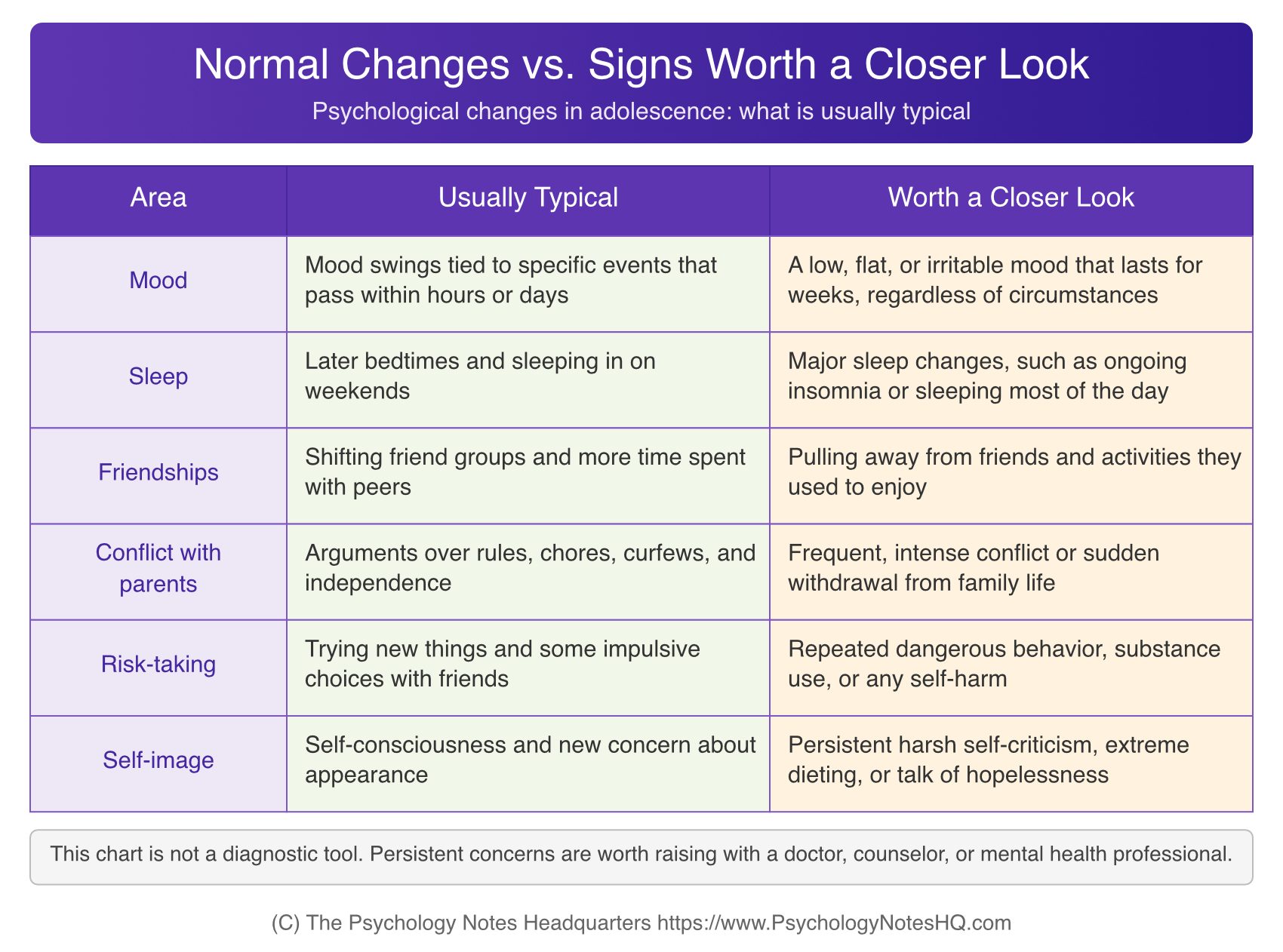
Because so much teenage turbulence is normal, genuine problems can be easy to miss. That matters, since half of all lifetime cases of mental disorders begin by age 14 (Kessler et al., 2005).
A useful rule of thumb is to look at duration, intensity, and impact. A bad mood tied to a specific trigger, such as a disappointing grade or a fight with a friend, usually passes. A low or flat mood that lasts for weeks, shows up regardless of circumstances, or pulls a teen away from friends, school, and activities they used to enjoy deserves attention from a doctor, counselor, or mental health professional.
It also helps to watch for clusters. A shift in sleep, appetite, or grades on its own is common, but several of these changes arriving together, especially alongside withdrawal from friends, are a stronger signal that something more than ordinary adolescence is going on.
Supporting Healthy Adolescent Development
Treating these changes as development rather than misbehavior shifts how parents, teachers, and teens themselves respond. Protecting sleep, keeping communication open, and offering real choices within clear limits all help channel the drive for independence into safer territory.
Structured challenges, like a demanding class, a new sport, or a leadership role, can satisfy the appetite for novelty at lower stakes. Talking decisions through out loud, rather than simply handing down rules, gives the still-developing prefrontal system practice at the reasoning it will eventually handle on its own.
Adolescence is less a phase of chaos than a period of recalibration. The brain, body, and social world are all changing at once, and not always in sync, which produces some predictable turbulence. Knowing which shifts are typical, which are timing-related, and which deserve a closer look turns a confusing stage into one that makes a lot more sense.
References
- Arnett, J. J. (1999). Adolescent storm and stress, reconsidered. American Psychologist, 54(5), 317-326.
- Carskadon, M. A. (2011). Sleep in adolescents: The perfect storm. Pediatric Clinics of North America, 58(3), 637-647.
- Casey, B. J., Jones, R. M., & Hare, T. A. (2008). The adolescent brain. Annals of the New York Academy of Sciences, 1124, 111-126.
- Gardner, M., & Steinberg, L. (2005). Peer influence on risk taking, risk preference, and risky decision making in adolescence and adulthood: An experimental study. Developmental Psychology, 41(4), 625-635.
- Kessler, R. C., Berglund, P., Demler, O., Jin, R., Merikangas, K. R., & Walters, E. E. (2005). Lifetime prevalence and age-of-onset distributions of DSM-IV disorders in the National Comorbidity Survey Replication. Archives of General Psychiatry, 62(6), 593-602.
- Mendle, J., Turkheimer, E., & Emery, R. E. (2007). Detrimental psychological outcomes associated with early pubertal timing in adolescent girls. Developmental Review, 27(2), 151-171.
- Robins, R. W., & Trzesniewski, K. H. (2005). Self-esteem development across the lifespan. Current Directions in Psychological Science, 14(3), 158-162.
- Shulman, E. P., Smith, A. R., Silva, K., Icenogle, G., Duell, N., Chein, J., & Steinberg, L. (2016). The dual systems model: Review, reappraisal, and reaffirmation. Developmental Cognitive Neuroscience, 17, 103-117.
How to cite this article:
The Psychology Notes Headquarters. (2026). Psychological Changes in Adolescence: What’s Normal and Why. Retrieved from https://www.psychologynoteshq.com/psychological-changes-in-adolescence/