
Self-Handicapping Psychology: Why We Sabotage Ourselves Before We Even Try
Self handicapping psychology explains why people sometimes create their own obstacles before a big test, presentation, or performance, using those obstacles as a built-in excuse if things go wrong. It sounds counterproductive, and it is, but it also protects something people value even more than success: their sense of competence. Instead of risking a clear verdict on their ability, they muddy the water first.
Key Takeaways
- Self-handicapping behavior involves creating real or claimed obstacles to performance so failure can be blamed on something other than ability.
- The strategy protects self-esteem by making outcomes ambiguous: a loss can be blamed on the handicap, not on skill.
- Academic self-handicapping is especially common among college students facing high-stakes exams and grading pressure.
- It differs from procrastination and imposter syndrome in both motive and timing, even though the behaviors can look similar.
- Breaking the pattern usually means addressing the underlying fear of failure rather than the surface behavior itself.
What Counts as Self-Handicapping Behavior
Psychologists Steven Berglas and Edward Jones first described this pattern in a classic 1978 experiment. Participants were told they would likely succeed or struggle on an upcoming test after an initial round of problems, then given a choice between a pill that supposedly boosted performance and one that supposedly impaired it. Men who had succeeded on the first round but suspected that success was a fluke, rather than a real reflection of skill, were the ones most likely to pick the performance-inhibiting option. Choosing the impairing pill gave them a built-in excuse if the second test went badly, and made a repeat success look even more impressive if it somehow went well anyway.
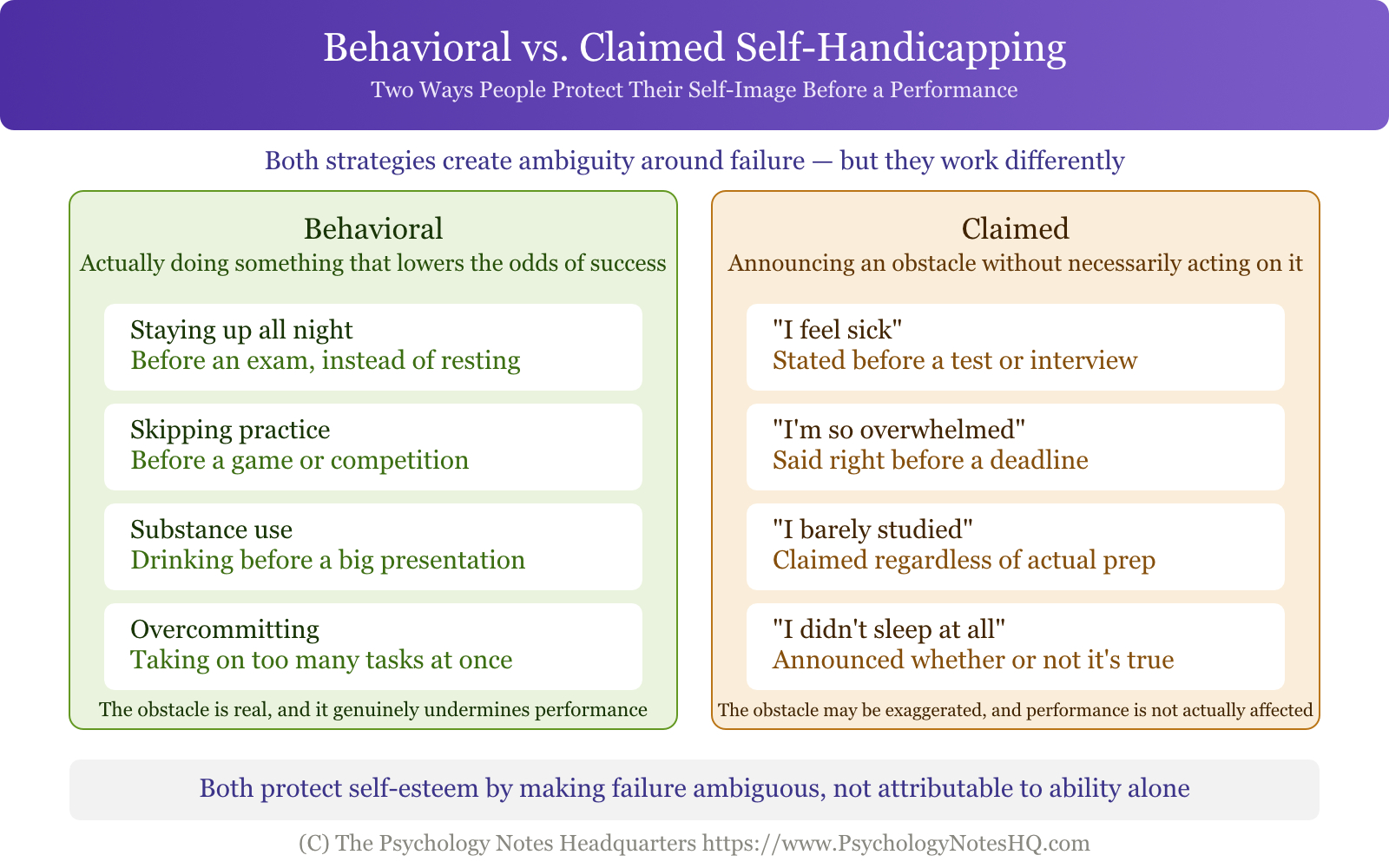
Researchers usually split self-handicapping behavior into two broad types. Behavioral self-handicapping involves actually doing something that reduces the odds of success, like staying up all night before an exam, skipping practice before a big game, or drinking heavily the night before an important presentation. Claimed self-handicapping involves simply announcing an obstacle, such as saying you feel sick, overwhelmed, or unprepared, without necessarily doing anything that actually undermines performance. Both versions serve the same underlying purpose: protecting the person from a clean, unambiguous verdict on their abilities. A poor outcome can be pinned on the obstacle instead of on a lack of talent, while a good outcome despite the obstacle makes the person look even more capable than before.
What makes this pattern tricky to spot, in yourself or in others, is that the obstacles often look like ordinary bad luck or poor planning. A roommate who always seems to get sick before finals, or a classmate who never quite finishes preparing a presentation, might simply be having a rough semester. But when the pattern repeats itself specifically before evaluative moments, and specifically among people who otherwise seem capable, self-handicapping behavior becomes the more likely explanation.
The Psychology Behind the Sabotage
At its core, this behavior is about managing how failure gets explained. This connects closely to how people assign cause to their outcomes in everyday life, since much of the discomfort around failing comes not from the failure itself but from what it seems to say about a person’s underlying ability. If someone fails after handicapping themselves, they can point to the obstacle rather than a lack of talent. If they somehow succeed despite the obstacle, their perceived ability looks even more impressive, since they managed to pull it off under a supposed handicap.
This matters most for people whose self-worth is tightly bound to performance in a specific domain, whether that is academics, athletics, or a professional skill. For these individuals, uncertainty about whether they can succeed is often more distressing than the possibility of failing outright, because an ambiguous failure leaves room for a face-saving story. A clear, effort-based failure, one where someone tried their hardest and still came up short, does not leave that same room. It risks confirming the exact fear the person is trying to avoid: that they simply are not good enough.
This is why self-handicapping so often shows up around high-stakes, identity-relevant tasks rather than low-stakes ones. Nobody typically sabotages their performance in a casual game with friends, because the outcome carries little weight for how they see themselves. But a qualifying exam, a job interview, or a competitive tryout activates the exact self-protective instinct that produces this behavior, precisely because so much of the person’s self-concept feels like it is riding on the result.
Common Self-Handicapping Strategies
Self handicapping strategies show up in fairly predictable forms across different settings, whether academic, athletic, or professional. Procrastination is probably the most familiar, delaying work until there is not enough time left to do it well, which conveniently means any resulting poor performance can be blamed on rushing rather than on skill. Reduced effort works similarly, where someone puts in a noticeably smaller amount of preparation than the task calls for, quietly lowering the bar for what counts as a reasonable outcome.
Substance use before a performance, whether alcohol the night before a presentation or simply staying up too late socializing, is another common version, one that Berglas and Jones documented directly in their original drug-choice experiments. Choosing an unnecessarily difficult or unrealistic goal is a subtler strategy, since failing at something everyone agrees was a long shot feels far less threatening than failing at something reasonable. Taking on too many commitments at once fits the same pattern, allowing someone to point to being spread too thin rather than to a gap in ability.
Each of these strategies creates a plausible alternative explanation for a poor outcome, one that has nothing to do with actual competence. They tend to cluster together in people with high trait anxiety or a strong fear of failure, since the underlying motive, protecting self-image under threat, stays the same regardless of which specific behavior shows up. It is also common for someone to lean on different strategies in different contexts, procrastinating on a paper while overcommitting to extracurriculars, for example, without ever consciously connecting the two as versions of the same pattern.
Academic Self-Handicapping in College Students
Academic self handicapping shows up constantly on college campuses, and it makes sense why. Grades are public, comparative, and tied to identity in ways that make failure feel personal, especially for students who have built a significant part of their self-image around being a good student. A student who says “I barely looked at the material” before a final has already built in an excuse, whether or not that statement is entirely accurate, and whether or not they realize they are doing it.
Research on university students consistently links this behavior to test anxiety and lower self-esteem, and it often travels together with academic procrastination, to the point that the two are difficult to fully separate in practice. One large study of university students found that self-handicapping was strongly predicted by procrastination, test anxiety, and low self-esteem, together explaining well over half the variation in how much students engaged in the behavior (Barutçu Yıldırım & Demir, 2020). Students who scored higher on procrastination in particular showed the strongest link to self-handicapping, suggesting that delaying work is often doing double duty: it is both a time-management failure and a self-protective strategy operating at the same time.
Academic settings amplify this pattern in a few specific ways. Grades are assigned on a fixed schedule, which means there is no room to quietly extend a deadline the way one might in a personal project. Performance is also constantly compared against peers, through class rankings, curved grading, or simply overhearing what others scored. For students already prone to fear of failure, this creates near-constant pressure to have an excuse ready. Recognizing the behavior for what it is, a self-protective strategy rather than a character flaw or simple laziness, is usually the first step toward addressing it, both for students noticing the pattern in themselves and for instructors trying to understand why a capable student keeps turning in visibly rushed work.
Self-Handicapping vs. Related Concepts
It helps to separate self-handicapping behavior from a few concepts it gets confused with, since the surface behaviors can look nearly identical while the underlying motives differ. Plain procrastination is often about poor time management, task aversion, or difficulty regulating emotions in the moment, while self-handicapping specifically serves an excuse-making function tied to fear of evaluation. Someone can procrastinate purely because a task is boring, with no self-protective motive involved at all, which is part of why the two frequently overlap in practice without being identical.
Imposter syndrome runs in something like the opposite direction. Someone with imposter feelings has usually already succeeded but cannot internalize it, remaining convinced they are a fraud despite clear evidence otherwise, and living with a persistent fear of being exposed as less capable than others believe (Clance & Imes, 1978). Self-handicapping happens before the outcome is known, as a preemptive move designed to control how a future failure gets explained. Imposter feelings, by contrast, persist after success has already occurred, and often intensify with each additional achievement rather than fading. A student with imposter feelings might over-prepare obsessively out of fear of being caught unprepared, which is nearly the opposite behavior pattern from a student engaging in self-handicapping.
Comparing your performance to peers, a pattern well documented in social comparison research, can feed both patterns, but the core mechanisms are distinct. Frequent upward comparison, measuring yourself against people who seem more capable, can heighten fear of failure and push someone toward self-handicapping. It can also feed imposter feelings by making one’s own achievements feel smaller by comparison. Recognizing which pattern is actually driving a given behavior matters, since the two call for somewhat different responses: self-handicapping tends to respond well to clearer goals and reduced ambiguity, while imposter feelings often respond better to directly challenging the distorted belief that success was undeserved.
How to Break the Self-Handicapping Cycle
Because the behavior is rooted in fear of a clear verdict on ability, the most effective fixes target that fear directly rather than just the visible symptom. Setting specific, achievable goals instead of vague or extreme ones removes some of the ambiguity the strategy relies on, since a clear, moderate target leaves less room for the kind of face-saving excuses self-handicapping depends on. This lines up with goal-setting research showing that clear, moderately challenging targets produce better outcomes than either vague or unrealistic ones, in part because they make effort and outcome easier to connect honestly.
Building intrinsic motivation also helps, since people who engage in a task because it is meaningful to them, rather than purely to prove ability to others, have less need for a built-in excuse. This is one of the core ideas behind self-determination theory, which emphasizes competence, autonomy, and relatedness as drivers of sustainable motivation rather than external validation. When a task feels chosen and personally meaningful rather than imposed, the pressure to protect a public image around it tends to ease.
Tracking effort and preparation directly, rather than only focusing on the final outcome, can also gradually shift the internal story away from needing a ready-made excuse in the first place. Keeping a simple log of study hours or practice sessions, for instance, makes it much harder to later claim “I didn’t have time,” since the evidence contradicts the excuse before it can even form. Finally, treating an occasional underprepared performance as informative rather than threatening, something to learn from rather than something to explain away, weakens the whole incentive structure that makes self-handicapping feel necessary in the first place. None of these fixes work overnight, but each one chips away at the specific fear driving the pattern.
Conclusion
Self-handicapping behavior is not laziness or a lack of discipline. It is a self-protective strategy, often operating below conscious awareness, designed to keep failure from saying anything definitive about a person’s ability. Recognizing the pattern in academic settings, and understanding how it differs from procrastination or imposter syndrome, makes it much easier to address the root cause: fear of an unambiguous verdict on one’s own competence.
References
- Berglas, S., & Jones, E. E. (1978). Drug choice as a self-handicapping strategy in response to noncontingent success. Journal of Personality and Social Psychology, 36(4), 405-417.
- Clance, P. R., & Imes, S. A. (1978). The impostor phenomenon in high achieving women: Dynamics and therapeutic intervention. Psychotherapy: Theory, Research and Practice, 15(3), 241-247.
- Barutçu Yıldırım, F., & Demir, A. (2020). Self-handicapping among university students: The role of procrastination, test anxiety, self-esteem, and self-compassion. Psychological Reports, 123(3), 825-843.
- Zarshenas, L., Ashrafean Jahromi, L., Faseleh Jahromi, M., & Dehghan Manshadi, M. (2019). Self-handicapping among nursing students: An interventional study. BMC Medical Education, 19(1), 26.
How to cite this article:
The Psychology Notes Headquarters. (2026). Self-Handicapping Psychology: Why We Sabotage Ourselves Before We Even Try. Retrieved from https://www.psychologynoteshq.com/self-handicapping-psychology/