
Self-Serving Bias Examples That Reveal How Your Brain Protects Your Ego
You ace an exam and immediately think, “I’m just good at this.” You bomb the next one and think, “That test was written unfairly.” Same class, same effort level on paper, two completely different explanations. That flip is not a coincidence and it is not really about the test either.
It is a well-documented mental habit called the self-serving bias, and once you know what to look for, self-serving bias examples show up everywhere: in classrooms, in office meetings, and especially in close relationships. This article walks through where it comes from, how it plays out in everyday life, and what happens when it goes unchecked.
Key Takeaways
- Your brain tends to credit your own skill for wins and blame outside circumstances for losses, often without you noticing.
- This pattern shows up differently at school, at work, and in relationships, sometimes with real consequences for the people around you.
- Researchers link it to a basic need to protect self-esteem, plus a general tendency toward optimism.
- Culture matters a lot here. It is far more common in individualist societies than collectivist ones.
- Left unchecked, it can quietly wreck feedback, teamwork, and trust in a partnership.
What’s Actually Happening in Your Head
At its core, this bias is a specific pattern of explaining outcomes: internal credit for success, external blame for failure. It is a close cousin of broader attribution theory concepts, but it is narrower and more personal. Attribution theory as a whole covers how people explain any behavior, their own or someone else’s. This particular pattern is about how we explain our own outcomes specifically, and it leans in one predictable direction.
Psychologists Dale Miller and Michael Ross reviewed decades of research on this in 1975 and found something interesting. The bias was not as universal or as simple as “protect the ego at all costs.” Instead, a lot of it comes down to expectations. People generally expect good things to happen to them, so when good things do happen, it confirms what they already believed about themselves. When bad things happen, they come as a surprise, and surprises get explained away by looking outward instead of inward.
This is a meaningfully different explanation than the one most people assume. The popular version of the story is that we are all just constantly trying to look good to ourselves and others, full stop. Miller and Ross’s review complicated that picture. They found solid evidence that people take extra credit for success, but only modest evidence that people reflexively dodge blame for failure in every situation. In other words, the “self-enhancing” half of the bias, feeling good about wins, tends to be more robust than the “self-protecting” half, dodging responsibility for losses. Later researchers have continued to debate exactly how much of each ingredient is at play in any given situation, but the basic pattern Miller and Ross documented has held up well across a huge number of follow-up studies.
It also helps to separate this from simple dishonesty. Someone claiming credit for a win they did not really earn, and knowing it, is doing something different from someone who genuinely, sincerely believes their skill mattered more than it did. Self-serving bias usually falls into that second category. The explanation feels true to the person giving it. That is exactly what makes it so persistent and so hard to argue someone out of in the moment.
Self-Serving Bias Examples at School and Work
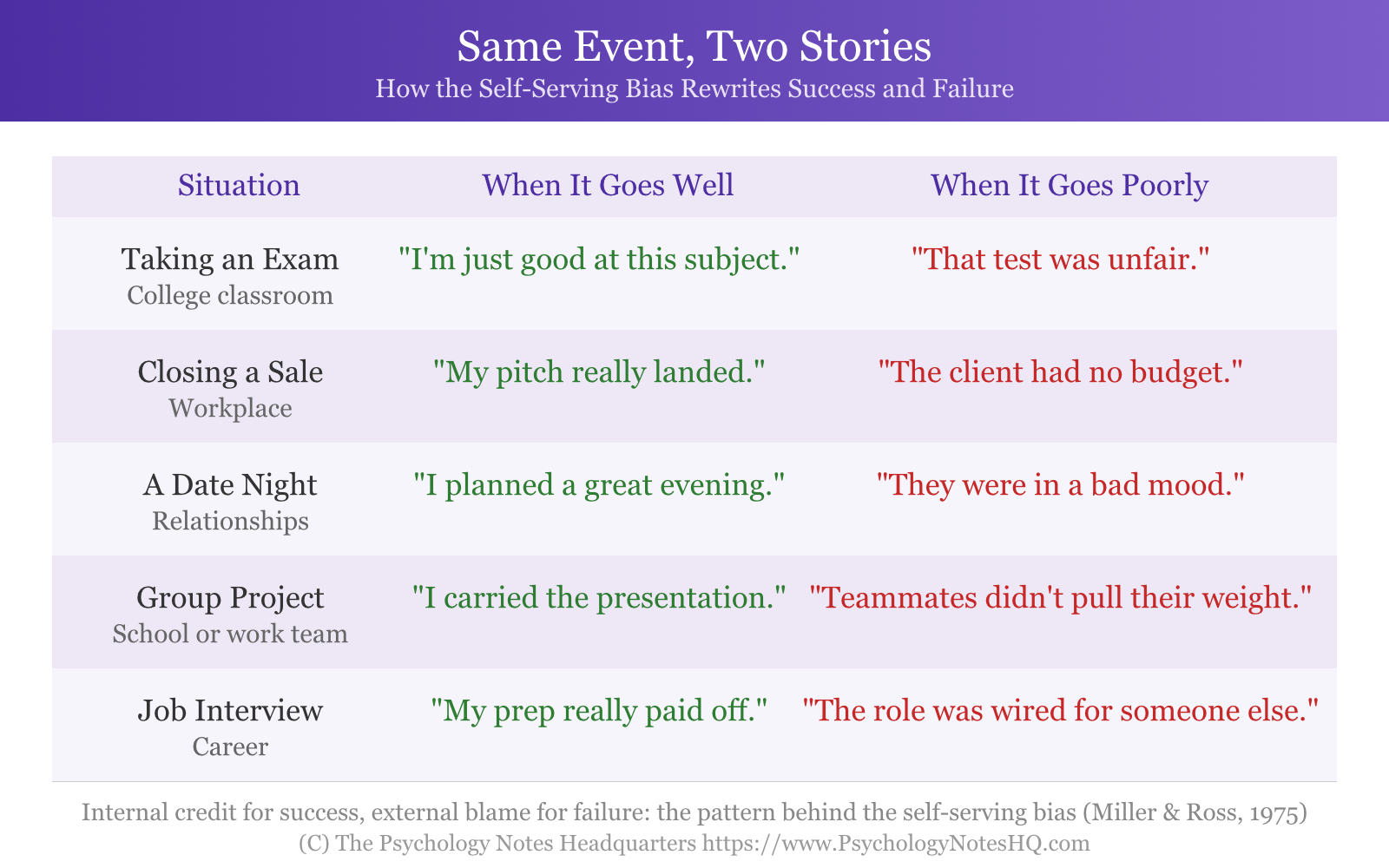
Classrooms are a goldmine for this pattern. A student who gets an A tends to point to their own intelligence or work ethic. The same student, after a D, is far more likely to mention a confusing rubric, a harsh grader, or a test that “didn’t match what we covered in class.”
Work environments run on the same script. A salesperson who closes a big deal will often describe their pitch, their relationship-building, their instincts. If the deal falls through, the explanation shifts to a stingy budget, a difficult client, or bad timing in the market. Managers do this too. A quarter of strong numbers gets attributed to leadership decisions. A rough quarter gets pinned on the economy or a competitor’s move.
None of this necessarily means people are lying or being deliberately unfair. Most of the time, the shift in explanation happens automatically, below conscious awareness. That is part of what makes self-serving bias examples so easy to spot in other people and so hard to catch in yourself.
Group projects offer a particularly clear window into this. When a team presentation goes well, it is common for several members to privately feel like they were the one who carried it, or at least contributed the most valuable piece. When it goes poorly, blame tends to scatter outward toward whoever did the least visible work, toward unclear instructions from the professor, or toward bad luck with the presentation slot. Athletic coaching shows a similar split. Coaches whose teams win often point to strategy and player development. After a loss, referees, injuries, and scheduling tend to get more airtime than coaching decisions.
Job interviews and performance reviews are another place this plays out in a fairly high-stakes way. A candidate who gets an offer will usually credit their preparation and interview skills. A candidate who gets rejected is more likely to conclude the position was already wired for an internal hire, or that the interviewer simply did not “get” them. Neither explanation is necessarily wrong in any individual case, which is part of the problem. The bias is not obviously false, which makes it easy to miss.
Self-Serving Bias in Relationships
This is where the pattern gets personal and, frankly, a little harder to admit to. Self serving bias in relationships often looks like this: a great date night gets credited to your own effort, the restaurant you picked, the conversation you steered. A date that falls flat gets blamed on your partner’s mood, their phone habit, or “they just weren’t feeling it tonight.”
The same thing plays out in ongoing conflict. Research on married couples going back to work by Frank Fincham and Thomas Bradbury found that how partners explain each other’s negative behavior is closely tied to relationship satisfaction. Distressed couples tend to see a partner’s annoying behavior as intentional and internal to who that partner is, while explaining away their own similar behavior as a one-off reaction to a bad day. That asymmetry, over time, chips away at goodwill and makes conflicts harder to resolve.
It is worth noting this connects to other biases you might already recognize, like the halo effect, where an early positive impression colors how generously we interpret a partner’s later behavior. Self-serving bias adds another layer on top of that by shaping how we interpret our own contribution to what is going right or wrong.
Household labor is another common flashpoint. Partners frequently overestimate their own share of chores, errands, or childcare relative to what they actually do, while being quick to notice and remember moments their partner fell short. This is not usually a sign that either person is keeping score maliciously. Each person simply has far more detailed memory of their own effort than of their partner’s, since they experienced their own contributions directly and only observed the other person’s from the outside. Layer a self-serving bias on top of that memory gap, and it is easy to see how two reasonable people can walk away from the same week with very different accounts of who did more.
Friendships show a milder version of the same thing. If a friend group’s weekend trip goes smoothly, the person who planned it tends to attribute that to good organization. If the trip has a rocky moment, like a canceled reservation or an awkward disagreement, it is common to hear it framed as bad luck or someone else’s miscommunication rather than a planning oversight. These moments rarely damage a friendship on their own, but they add up in relationships where trust is already fragile.
Why We Do This (The Psychology Behind It)
Two main explanations show up again and again in the research. The first is self-esteem protection. Taking credit for wins and deflecting blame for losses keeps your self-image intact, which feels good and requires very little conscious effort. The second is that optimism angle Miller and Ross pointed to. Because most people expect things to go reasonably well, failure feels like an anomaly that needs an external explanation, while success just confirms what was already expected.
Culture plays a real role too. Researchers analyzing this bias across hundreds of studies, including a widely cited 2004 meta-analysis by Amy Mezulis and colleagues, found the pattern is considerably weaker in collectivist cultures compared to individualist ones. In cultures that emphasize group harmony and interdependence over personal achievement, there is less pressure to protect an individual ego, so the bias shows up less often and less strongly.
That cultural difference tracks with a broader distinction psychologists draw between an independent sense of self and an interdependent one. In independent, individualist cultures, self-worth is closely tied to personal achievement, so protecting that achievement narrative matters a lot. In interdependent, collectivist cultures, self-worth is more closely tied to fulfilling roles and obligations within a group, so there is less individual ego riding on any single outcome. This does not mean people in collectivist cultures never protect their self-image. It means the specific “I succeeded because of me, I failed because of them” pattern shows up less consistently.
There is also a developmental angle worth mentioning briefly. Some research suggests the bias becomes more pronounced through childhood and adolescence as self-concept becomes more stable and more tied to comparison with peers, then moderates somewhat in adulthood as people develop more nuanced, situational thinking about causes and outcomes. It is also notably weaker in people experiencing depression, who tend to show the opposite pattern of taking on more personal blame for negative events than the average person does.
When It Becomes a Problem
A little self-protection is normal and even healthy in small doses. It becomes a problem when it blocks learning. If you never sit with the idea that your own choices contributed to a failure, you miss the chance to actually fix anything. In relationships, chronic external blame from one or both partners tends to erode trust and make resolving disagreements feel pointless. In workplaces, leaders who never own a bad outcome tend to lose the confidence of their teams fairly quickly.
There is also a quieter cost that shows up over time rather than all at once, which is a gradual distortion of self-knowledge. Someone who consistently externalizes every setback slowly builds an inflated, inaccurate picture of their own abilities. That inflated picture can feel good in the short term, but it tends to backfire in situations that require an honest assessment of skill, like choosing a career path, deciding whether to take on a bigger project, or evaluating whether a relationship pattern is actually the other person’s fault. Confidence built on an inaccurate foundation is more fragile than confidence built on an accurate one, since it tends to collapse hard the first time reality provides undeniable evidence to the contrary.
It can also strain how feedback lands. A student, employee, or partner who has built a habit of externalizing failure will often experience honest, constructive feedback as an attack rather than useful information, simply because it conflicts with the story they have been telling themselves. That reaction can make the people around them hesitant to give honest feedback at all, which removes one of the most useful tools anyone has for actually improving.
How to Notice It in Yourself
Catching this pattern takes a little deliberate effort since it runs mostly on autopilot. A few things help. After any setback, try listing at least one factor that was actually within your control, even a small one. Ask someone close to you how they saw the situation, since outside perspective tends to be more balanced than your own. And when you do succeed, get comfortable naming outside help or luck alongside your own effort. This does not mean beating yourself up over every failure. It just means giving your own choices a fair hearing alongside everything else.
Conclusion
That gap between “I earned this” and “that wasn’t my fault” is one of the most consistent patterns in how people think about themselves. Recognizing it will not make it disappear, but it does make it easier to give credit and blame where they actually belong, especially in the relationships and work you care most about.
References
- Bradbury, T. N., & Fincham, F. D. (1990). Attributions in marriage: Review and critique. Psychological Bulletin, 107(1), 3-33.
- Mezulis, A. H., Abramson, L. Y., Hyde, J. S., & Hankin, B. L. (2004). Is there a universal positive bias in attributions? A meta-analytic review of individual, developmental, and cultural differences in the self-serving attributional bias. Psychological Bulletin, 130(5), 711-747.
- Miller, D. T., & Ross, M. (1975). Self-serving biases in the attribution of causality: Fact or fiction? Psychological Bulletin, 82(2), 213-225.
How to cite this article:
The Psychology Notes Headquarters. (2026). Self-Serving Bias Examples That Reveal How Your Brain Protects Your Ego. Retrieved from https://www.psychologynoteshq.com/self-serving-bias/