
In-Group vs Out-Group Psychology: The Bias You Don’t Notice
Two strangers meet, discover they went to the same college, and suddenly trust each other more within thirty seconds than they trusted anyone in the room a minute earlier. Nothing about either person actually changed. What changed is a mental switch that flips the instant your brain sorts someone into “one of us.” The in group vs out group divide is one of the fastest, most automatic judgments the human mind makes, and it happens long before you’re aware you’ve made it.
Key Takeaways
- Your brain draws the line between “us” and “them” faster and with less evidence than you’d expect, sometimes based on something as trivial as a coin flip.
- The same mistake gets explained away for someone in your group and judged as character for someone outside it, often without you noticing the double standard.
- One classic camp experiment shows how quickly strangers turn hostile, and how that hostility can be reversed just as fast.
- A handful of specific conditions, not good intentions alone, are what actually reduce bias between groups.
- Recognizing the pattern is the first step, and it shows up in far more places than you’d guess.
What Are In-Groups and Out-Groups?
An in-group is any social category you identify as part of, your nationality, religion, sports team, workplace department, political party, or even a shared subculture. An out-group is simply any group you don’t identify with, at least from your current vantage point. These aren’t fixed or permanent categories; the same person can belong to your in-group in one context and your out-group in another. A fellow citizen abroad is “one of us” in a way that evaporates completely back home when you’re on opposite sides of a political debate.
What makes this framework so revealing is how little is actually required to set these dynamics in motion. Henri Tajfel’s minimal group paradigm experiments in the early 1970s showed that people will favor their own group even when the groups are formed around something entirely trivial, like whether you preferred paintings by Klee or Kandinsky. Participants had no prior relationship with their group members and no opportunity for interaction, yet they consistently allocated more rewards and points to in-group members than to out-group members.
This was a genuinely surprising result because it dismantled the assumption that in group bias requires real shared history, meaningful common ground, or genuine conflict between groups. It doesn’t. The act of categorization itself, being assigned to a group however arbitrarily, is sufficient to trigger differential treatment. That insight is the foundation of nearly everything that follows in the study of intergroup psychology.
The Psychology Behind the Divide: Social Identity Theory
To understand why in group vs out group thinking runs so deep, you need to start with social identity theory, developed by Henri Tajfel and John Turner in the late 1970s. The theory’s central argument is that your sense of self isn’t built on personal qualities alone. A significant portion of your self-concept, what Tajfel and Turner called your social identity, is derived directly from the groups you belong to.
Because group membership is tied to how you evaluate yourself, you are motivated to see your in-group favorably. A positive comparison between your group and an out-group, whether in intelligence, morality, work ethic, or cultural values, boosts your self-esteem through association. This is why sports fans feel a genuine surge of pride after a team win, even though they personally didn’t play a single minute. It’s also why criticism directed at your group can feel like a personal attack even when it isn’t aimed at you individually.
Social identity theory helps explain several patterns that are otherwise puzzling. It accounts for why conformity within groups is so powerful, since going along with group norms isn’t just about social pressure, it’s about protecting an identity that feels core to who you are. It explains why people derogate out-groups reflexively, since putting another group down is one of the fastest routes to elevating your own group in relative terms. And it explains the intense loyalty people maintain toward groups even when those groups behave badly, because leaving or criticizing the group means dismantling part of yourself.
In-Group Favoritism: We’re Not as Fair as We Think
In-group favoritism is the consistent tendency to give preferential treatment, more generous evaluations, greater trust, more benefit of the doubt, to members of your own group over out-group members, even in situations that call for objectivity. It plays out in hiring, where interviewers consistently rate candidates with similar backgrounds to themselves more favorably, even when controlling for objective qualifications. It shapes how ambiguous behavior gets interpreted: an in-group member who makes a costly mistake receives situational explanations (“she was completely overloaded that week”), while the same mistake by an out-group member gets attributed to character or group disposition (“that’s just what they’re like”).
In-group favoritism also affects resource allocation in ways that go beyond simple self-interest. In minimal group paradigm studies, participants would actually sacrifice total reward in order to maximize their group’s relative advantage over the out-group, even when that meant everyone ended up with less. The goal wasn’t to get as much as possible; it was to have more than them.
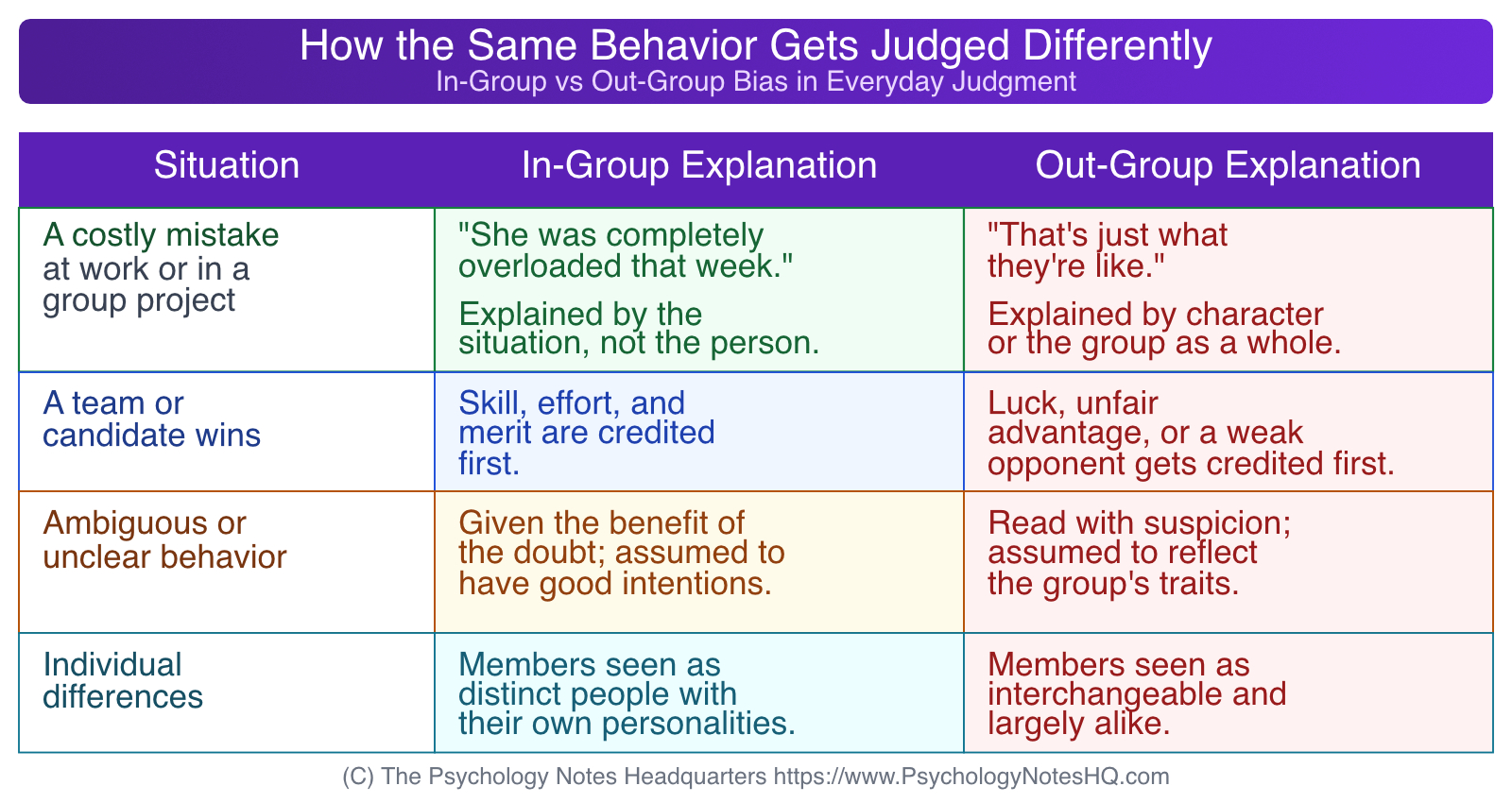
What makes in group bias especially persistent is that it frequently operates below the level of conscious awareness. Implicit association research has consistently shown that people who genuinely believe they treat everyone equally still display measurable in-group favoritism when tested. They aren’t lying about their values, the bias is simply running on a faster track than deliberate thought. Recognizing that in group bias is largely automatic is the first step toward interrupting it, because you can’t question a process you don’t know is happening.
The Out-Group Homogeneity Effect: “They’re All the Same”
One of the most reliable findings in intergroup psychology is out group homogeneity: people perceive out-group members as more similar to each other than they perceive members of their own group to be. Your own group feels richly varied, full of individuals with distinct personalities, motivations, histories, and quirks. The out-group, by contrast, gets compressed into a single mental category. “They’re all the same” captures this tendency precisely.
The effect has been documented across political groups, racial groups, age cohorts, competing fan bases, and even rival university students evaluating each other. It serves as a direct pipeline to stereotyping: if you treat an entire group as functionally interchangeable, you are essentially applying a single template to every member of that group, which is exactly what a stereotype does. Individual variation within the out-group gets erased before you’ve had a chance to notice it.
The out group homogeneity effect also shapes how we explain behavior. When an out-group member does something negative, we’re far more likely to attribute it to their character, or to the character of their group as a whole, rather than considering situational factors. This connects to broader patterns in attribution theory, where the same behavior gets judged by very different standards depending on whether the person belongs to your group or someone else’s. The practical consequence is that out-group members have a much harder time earning the benefit of the doubt that in-group members receive almost automatically.
In Group and Out Group Examples in Real Life
The best in group and out group examples are the ones hiding in plain sight in everyday life. Political polarization is arguably the most visible current case: research consistently shows that people evaluate the same policy proposal differently depending on which party advanced it, not based on what the policy actually says, but based on the group identity of its source. The content becomes secondary to the tribal signal.
Sports fandom runs on identical logic. The same aggressive tackle is “physical, competitive play” or “a dirty foul” depending on which team’s player threw it. The subjective shift happens automatically and feels completely rational from the inside. In workplaces, in-group dynamics often form around professional backgrounds, seniority levels, or shared educational pedigrees, with informal mentoring, social invitations, and visibility for promotion flowing more consistently to those perceived as insiders.
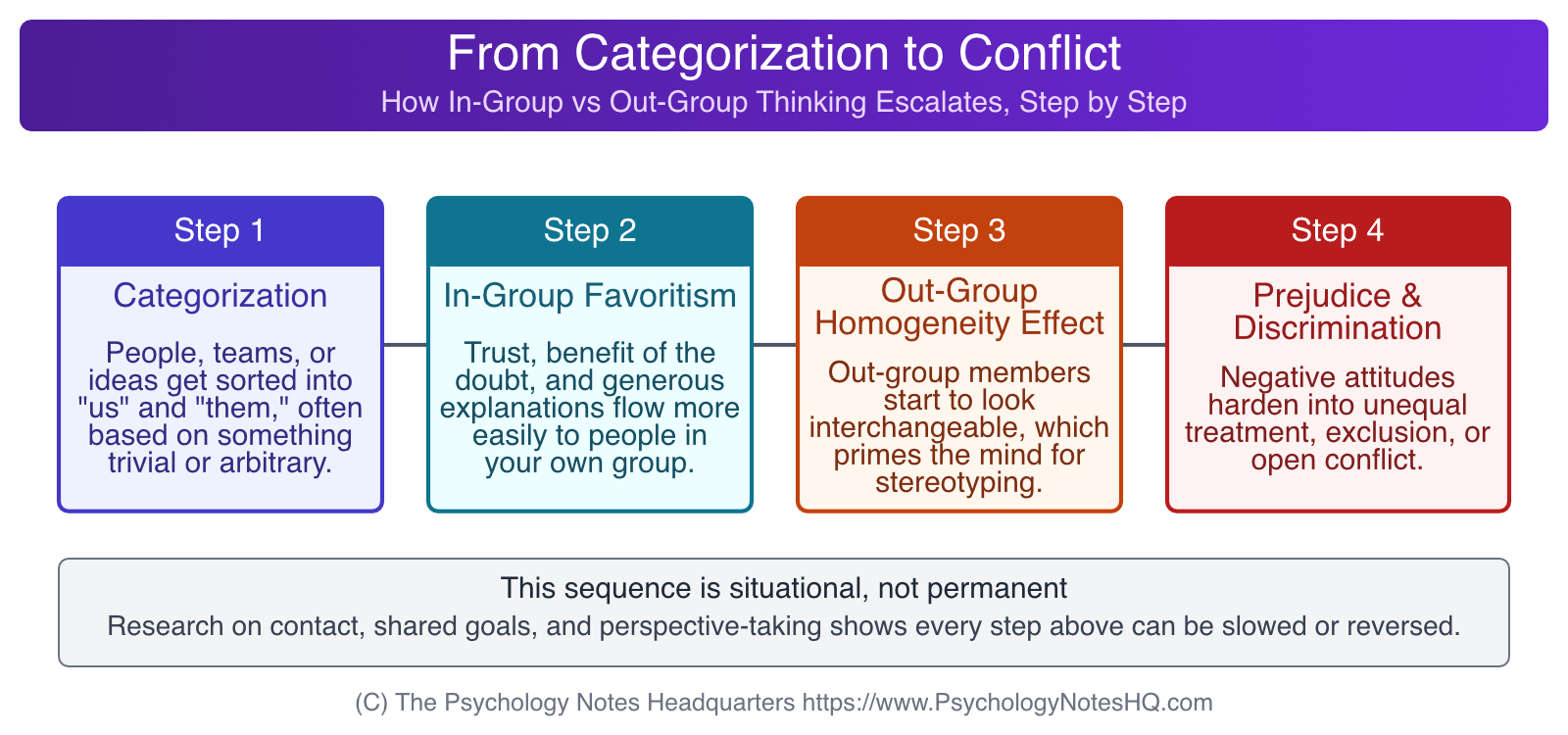
Online communities have intensified these patterns considerably. Forums, subreddits, and social media groups develop powerful in-group cultures that can turn hostile toward anyone perceived as an outsider or critic with remarkable speed, and the anonymity of online spaces makes the out group homogeneity effect even more pronounced. At a broader historical scale, ethnicity, religion, and nationality represent the highest-stakes versions of these dynamics, where in-group identity has served simultaneously as the foundation of culture and community and as the justification for exclusion, discrimination, and organized violence. What all these in group and out group examples share is the same underlying sequence: categorization produces identification, and identification produces differential treatment.
The Robbers Cave Experiment: Us vs. Them in Action
One of the most cited illustrations of in group vs out group psychology in action comes from Muzafer Sherif’s Robbers Cave Experiment, conducted in Oklahoma in 1954. Sherif recruited 22 boys for what was framed as a summer camp experience and divided them into two groups, the Eagles and the Rattlers, who were kept entirely separate during the first phase. Without any contact between the groups, each developed its own leadership structure, group norms, and collective identity, complete with a name, a flag, and a strong sense of group pride.
When Sherif introduced competitive activities in the second phase, the hostility that emerged was rapid and intense. Cabin raids, name-calling, flag-burning, and food fights broke out, and any cross-group friendships that had started to form evaporated almost immediately. Arbitrary group assignment had produced genuine intergroup conflict within days, with no prior history of animosity and no real differences between the groups to justify it.
The experiment’s third phase delivered the more optimistic lesson. When Sherif introduced superordinate goals, problems that neither group could solve on its own, such as repairing a broken water supply and pooling funds to rent a film, the hostility gradually declined. Cross-group friendships re-emerged. The study demonstrated not only how quickly us-vs-them dynamics ignite, but that they are situationally produced, which means they are also, under the right conditions, situationally reversible.
When Us vs Them Gets Dangerous
In-group and out-group dynamics don’t stay neutral for long. When group identity becomes the dominant lens for interpreting the world, mild favoritism can harden into prejudice, a negative attitude toward out-group members based purely on their group membership, and from there into active discrimination. Dehumanization, which involves treating out-group members as fundamentally less than fully human, is one of the most consistently documented psychological steps preceding organized violence and atrocity throughout history.
Even in less extreme contexts, these dynamics are quietly corrosive. Group polarization research shows that when people deliberate primarily within like-minded in-groups, their views tend to become more extreme rather than more measured, because dominant positions get amplified and dissent gets suppressed. Groupthink compounds this, where the drive for in-group cohesion overrides critical evaluation of decisions, sometimes with serious consequences.
Confirmation bias accelerates the whole process: once you hold a negative view of an out-group, you selectively notice and retain information that confirms it while discounting anything that complicates the picture. The result is a self-reinforcing loop. The more you consume information within your in-group’s media and social ecosystem, the more your negative perception of the out-group feels validated by evidence, and the harder the psychological divide becomes to bridge from the inside.
Can We Reduce In Group and Out Group Bias?
Psychology doesn’t just describe the problem, it offers evidence-based tools for reducing it. Gordon Allport’s contact hypothesis, introduced in 1954, proposed that prejudice decreases when in-group and out-group members have direct, meaningful contact under four specific conditions: equal status between the groups in the situation, shared goals, opportunities for genuine personal acquaintance, and support from relevant institutions or authorities. Decades of research have broadly confirmed this, though the quality and depth of contact matters far more than simply placing people in the same room. This is also part of what separates a real difference between in group and out group contact from a superficial one.
Superordinate goals are particularly effective because they don’t ask people to abandon their group identities; they simply introduce a higher-level identity that both groups share. When Eagles and Rattlers had to fix the water supply together, “solving the problem” became a more immediately relevant category than “our group vs. their group.” The same principle has been applied in cooperative learning structures in educational settings with consistent positive results.
Perspective-taking, actively imagining the experience and point of view of an out-group member, has been shown to reduce both explicit and implicit bias. It works because it forces individualization: you can’t maintain out group homogeneity thinking when you’re actively constructing a specific person’s inner life. At the individual level, understanding in group bias and knowing that it operates largely unconsciously creates enough reflective distance to question automatic judgments before they solidify into decisions. And cultivating prosocial behavior that crosses group lines, extending genuine help, curiosity, or trust toward out-group members, can gradually shift the psychological frame away from division and toward common ground.
Conclusion
In group vs out group dynamics are a feature of human social cognition, not a character flaw to be ashamed of. The same mental process that creates belonging, loyalty, and community also generates the conditions for bias and conflict. What psychology offers is something genuinely actionable: a clear account of how these mechanisms work and solid evidence for what can change them. The next time a snap judgment about someone “not like you” shows up, there’s a good chance you now know exactly where it came from.
References
- Tajfel, H., & Turner, J. C. (1979). An integrative theory of intergroup conflict. In W. G. Austin & S. Worchel (Eds.), The Social Psychology of Intergroup Relations (pp. 33-47). Brooks/Cole.
- Tajfel, H. (1970). Experiments in intergroup discrimination. Scientific American, 223(5), 96-102.
- Sherif, M., Harvey, O. J., White, B. J., Hood, W. R., & Sherif, C. W. (1961). Intergroup Conflict and Cooperation: The Robbers Cave Experiment. University of Oklahoma Book Exchange.
- Allport, G. W. (1954). The Nature of Prejudice. Addison-Wesley.
- Park, B., & Rothbart, M. (1982). Perception of out-group homogeneity and levels of social categorization: Memory for the subordinate attributes of in-group and out-group members. Journal of Personality and Social Psychology, 42(6), 1051-1068.
- Greenwald, A. G., & Krieger, L. H. (2006). Implicit bias: Scientific foundations. California Law Review, 94(4), 945-967.
- Pettigrew, T. F., & Tropp, L. R. (2006). A meta-analytic test of intergroup contact theory. Journal of Personality and Social Psychology, 90(5), 751-783.
- Turner, J. C. (1982). Towards a cognitive redefinition of the social group. In H. Tajfel (Ed.), Social Identity and Intergroup Relations (pp. 15-40). Cambridge University Press.
How to cite this article:
The Psychology Notes Headquarters. (2026). In-Group vs Out-Group Psychology: The Bias You Don’t Notice. Retrieved from https://www.psychologynoteshq.com/in-group-vs-out-group/