
Information Processing Theory vs Piaget: What 7-Year-Olds Prove
Many 7-year-olds can tell you that a squashed ball of clay still has the same amount of clay in it. Ask whether it still weighs the same, though, and the same child may insist it doesn’t. If children think in fixed stages, that’s surprisingly hard to explain.
Information processing theory offers a different take. It treats the mind as a system that takes in, holds and retrieves information, and it argues that children improve gradually as their memory, speed and strategies get better. That one shift changes how we read almost every classic Piaget finding.
Key Takeaways
- Information processing theory pictures the mind as a system with limited space, and that limit explains a surprising amount of “immature” thinking in children.
- Four things improve steadily with age, and none of them requires a stage change. One of them lets 10-year-olds beat adults on a memory test.
- Seven-year-olds often switch between several problem-solving strategies in a single session, which is hard to square with tidy stages.
- Piaget and information processing theorists split on one big question: does thinking change in kind, or just in efficiency?
- Neo-Piagetian researchers tried to merge both views, and their answer still shapes how children’s thinking is studied today.
What Is Information Processing Theory?
Information processing theory is an approach to cognition that describes thinking as a flow of information through a limited-capacity system. Information comes in through the senses, gets processed and stored, and is pulled back out when you need it.
The approach grew out of the cognitive revolution of the 1950s and 1960s, when psychologists moved away from behaviorism and started asking what happens inside the mind. The arrival of computers handed them a convenient metaphor.
It’s worth knowing that information processing theory in psychology isn’t a single theory. It’s a family of models built on the same basic assumptions.
The Core Assumptions Behind the Approach
Most versions of the information processing model share three ideas:
- The mind has limited capacity. You can only attend to, hold and work with so much at once.
- Thinking happens in steps. Information is encoded, transformed, stored and retrieved.
- Both the “hardware” and the “software” matter. Atkinson and Shiffrin (1968) used this computer analogy themselves, separating the fixed structure of memory from the control processes people use to run it.
For developmental psychologists, that last idea raises the key question. When children think differently from adults, is it the hardware, the software or both?
The Information Processing Model of Memory
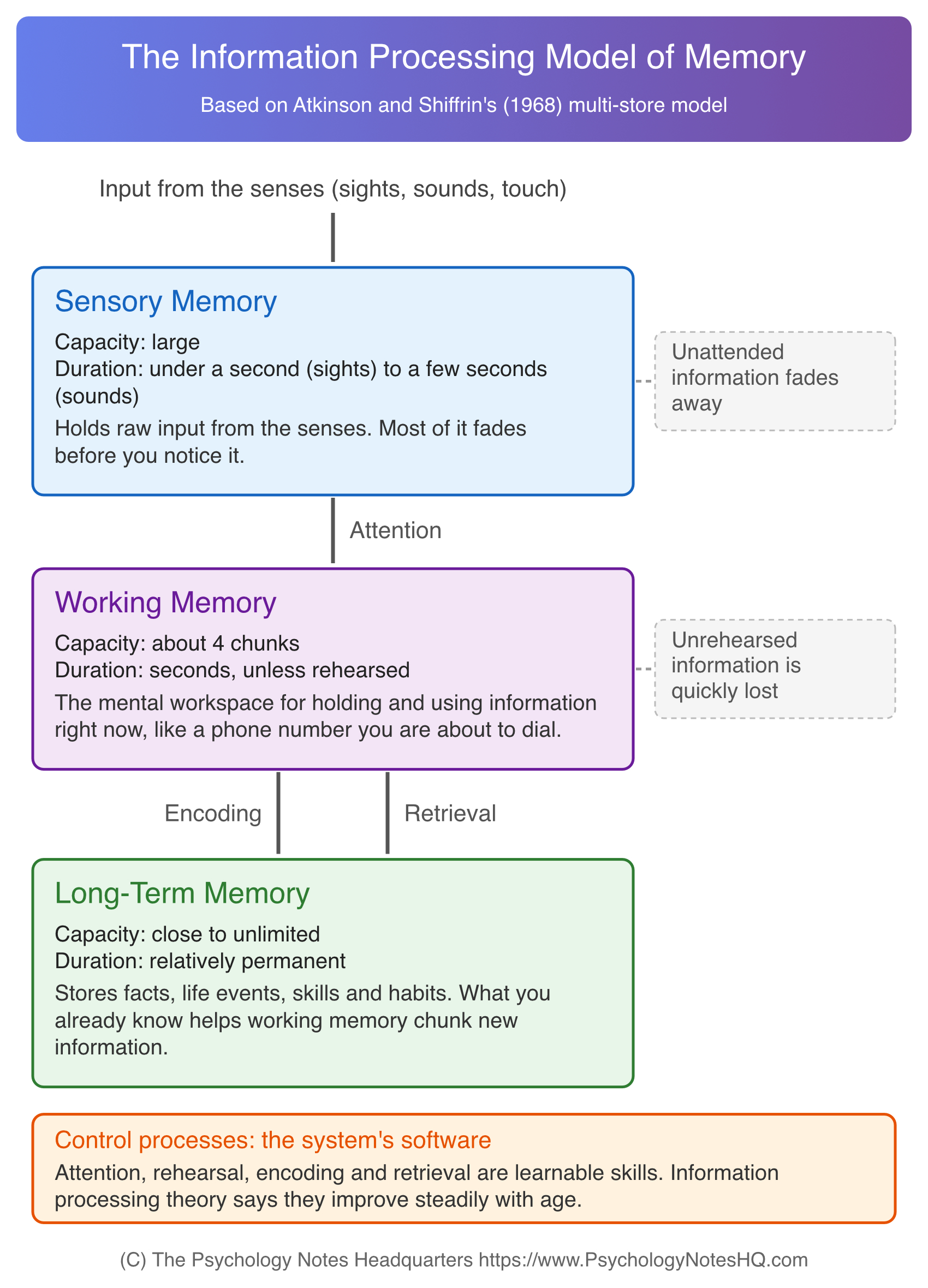
The best-known version of the approach is the multi-store model proposed by Atkinson and Shiffrin (1968), often called the modal model in textbooks. It describes the information processing model of memory as three stores, linked by processes that move information from one to the next.
Each store differs in how much it holds and how long it holds it. Attention decides what leaves sensory memory, and encoding decides what makes it into long-term storage.
Sensory Memory
Sensory memory holds a large amount of raw input for a very brief time. Visual traces fade in a fraction of a second, while sounds linger for a few seconds at most.
Most of this input disappears before you ever notice it. Only what you pay attention to moves forward. That makes attention the first gatekeeper in the system, and it explains why a distracted child may not have “forgotten” an instruction at all. The instruction may never have gotten in.
Working Memory
Working memory is the mental workspace where you hold and manipulate information in the moment, like keeping a phone number in your head while you dial it.
Its capacity is small. George Miller famously put the limit at about seven items, but later research suggests the true limit is closer to four chunks once tricks like rehearsal are taken out of the picture (Cowan, 2001).
Most developmental studies today use Baddeley and Hitch’s multi-component version, which splits working memory into verbal, visual and executive parts.
Long-Term Memory
Long-term memory is the relatively permanent store. Its capacity appears close to unlimited, and it holds everything from facts and life events to skills and habits. The distinction between episodic and semantic memory applies to this part of the system.
For development, long-term memory matters for a less obvious reason too. What you already know changes how much you can squeeze into working memory, as a group of young chess players showed.
Control Processes: Attention, Encoding and Retrieval
Control processes are the system’s software. They decide what gets attention, how information is encoded and which cues are used to retrieve it later. Rehearsing, grouping items and using memory tricks all count as control processes.
Unlike the stores themselves, these processes can be learned, practiced and improved. This is exactly where information processing theory starts to look very different from Piaget.
How Information Processing Theory Explains Cognitive Development
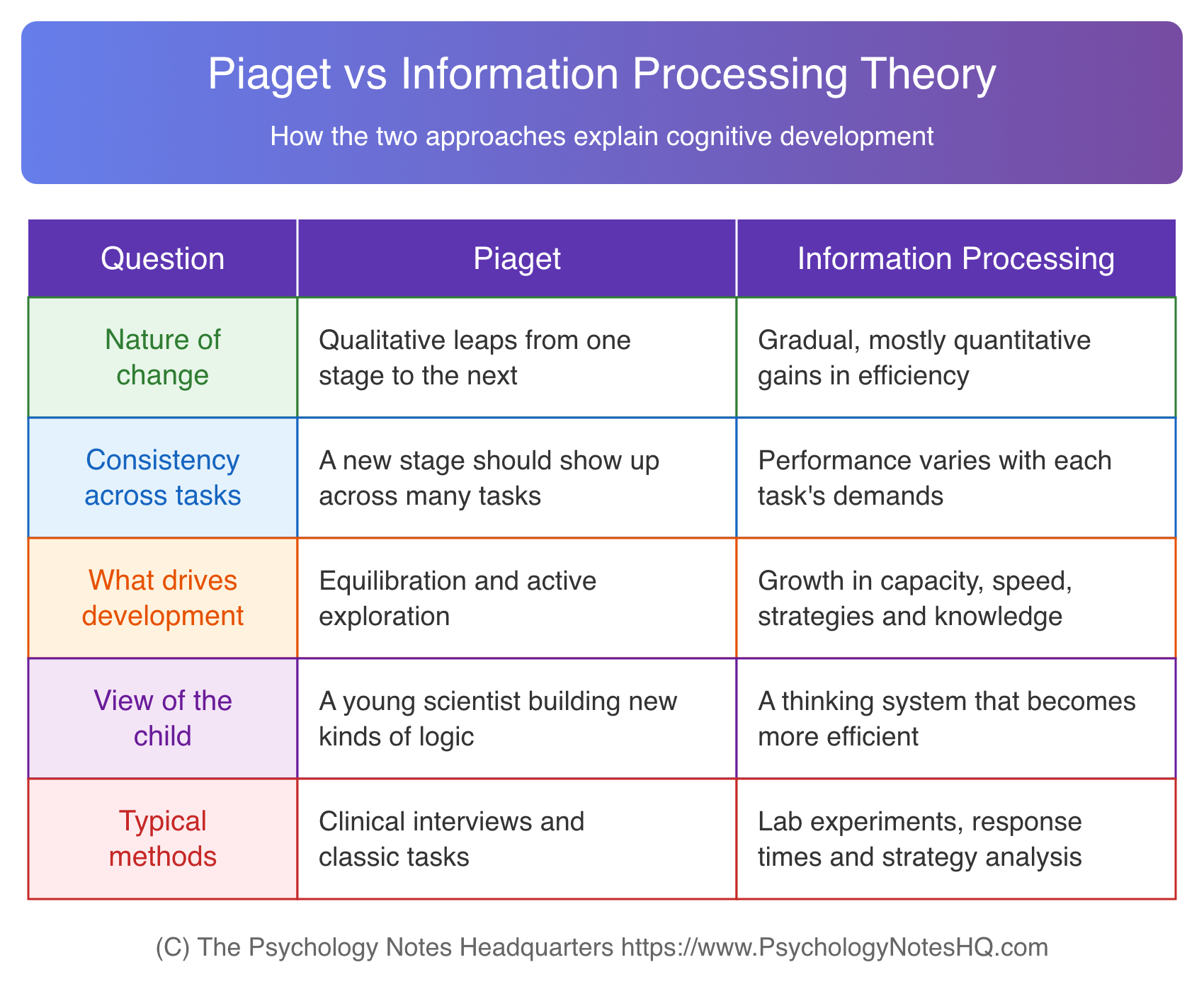
Piaget saw development as a series of qualitative leaps. Information processing theory sees something more gradual. Children don’t suddenly gain a new kind of mind. The same basic system simply becomes more efficient.
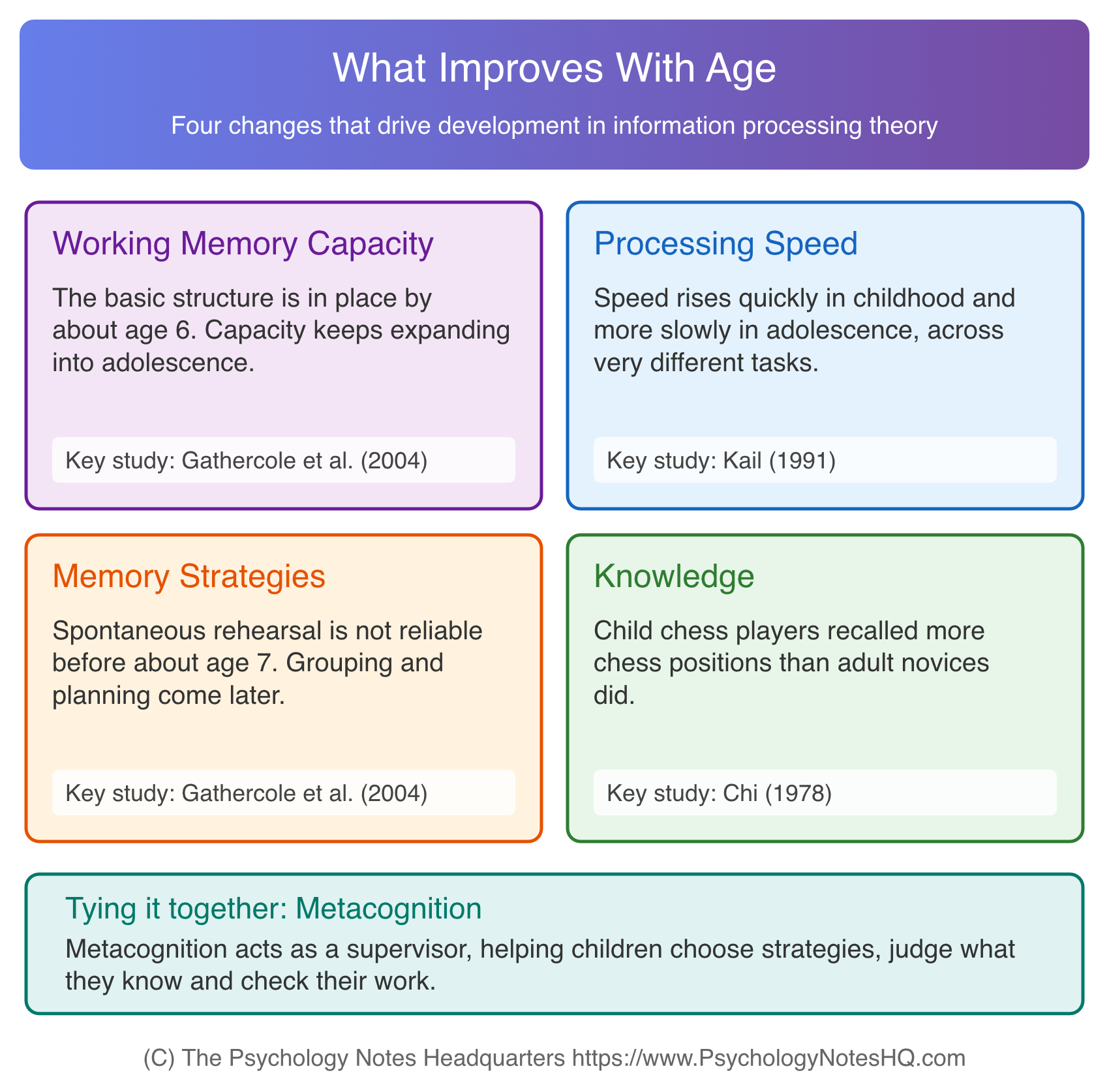
Researchers usually point to four changes that drive this growth, plus a fifth that ties them together.
Working Memory Capacity Grows
In a study of children aged 4 to 15, Gathercole et al. (2004) found that the basic structure of working memory is in place by about age 6. What changes after that is capacity. Each component expands steadily through the school years and into adolescence.
This matters for Piaget’s tasks. Many of them require a child to hold several pieces of information in mind at once. A child who fails might be short on space, not short on logic.
Processing Speed Increases
Children also get faster. Kail (1991) reviewed a large body of research and found that processing speed improves rapidly during childhood and more slowly during adolescence, following a similar curve across very different tasks.
That consistency points to a general, system-wide change rather than task-by-task learning. Faster processing also frees up working memory, because information can be used before it fades.
Memory Strategies Get Better
Young children rarely use memory strategies on their own. Before about age 7, spontaneous rehearsal doesn’t reliably occur (Gathercole et al., 2004). Older children repeat items, sort them into categories and plan how they’ll remember.
This growth isn’t a clean switch. Researchers describe a production deficiency, when a child can use a strategy but doesn’t think to, and a utilization deficiency, when a child uses a new strategy that doesn’t help yet. Both show up long before mastery.
Knowledge Changes Everything
Chi (1978) compared 10-year-old chess players with adults who knew the game but didn’t play seriously. When asked to recall chess positions, the children remembered more pieces than the adults. On a standard digit-span test, the adults came out ahead.
The lesson is simple. Memory isn’t only about age or capacity. Knowledge lets you chunk information into larger, more meaningful units, so an expert child can outperform a novice adult in their area of expertise.
Metacognition and Executive Control
The fifth change is in how children manage their own thinking. With age, they get better at judging what they know, picking strategies and checking their work.
This is metacognition, and it works like a supervisor for the whole system. It also helps explain why two children with similar memory spans can perform very differently on the same task.
Piaget vs Information Processing Theory: The Core Disagreements
Piaget’s theory of cognitive development describes four stages, each with its own kind of logic. Piagetian and information processing theories agree that children’s thinking changes dramatically between infancy and adolescence.
Where they part ways is on how and why that change happens. Three disagreements stand out.
Stages or Continuous Growth?
For Piaget, development moves through qualitatively different stages. Preoperational children don’t just know less than older children. They reason in a different way.
Information processing theorists see mostly quantitative change. A 9-year-old uses the same basic system as a 5-year-old, just with more capacity, faster speed and better strategies. What looks like a leap from one stage to the next may be many small gains adding up.
Domain-General or Domain-Specific?
Piaget expected a new stage to show up across many tasks at roughly the same time. His own data didn’t always cooperate, and he called the gaps horizontal décalage.
Conservation tasks are the classic example. Children typically conserve number around 6 or 7, substance around 7 or 8 and weight around 9 or 10. The underlying logic is the same each time, so a stage account struggles with the delay. An information processing account has a simpler answer: the tasks place different demands on attention and memory.
What Actually Drives Change?
Piaget emphasized equilibration, the process of resolving the conflict between what a child expects and what they actually observe. In his view, change comes from within, through active exploration.
Information processing theory points to mechanisms that are easier to measure: growth in capacity, speed, strategies and knowledge. Because those claims can be tested directly in the lab, the approach became hugely influential in developmental research from the 1970s onward.
The Evidence That Challenged Piaget’s Stages
Two lines of research did the most damage to the idea of clean, all-or-nothing stages. One looked at how children actually choose strategies. The other looked at what happens when you change the way a task is presented.
Siegler’s Overlapping Waves Model
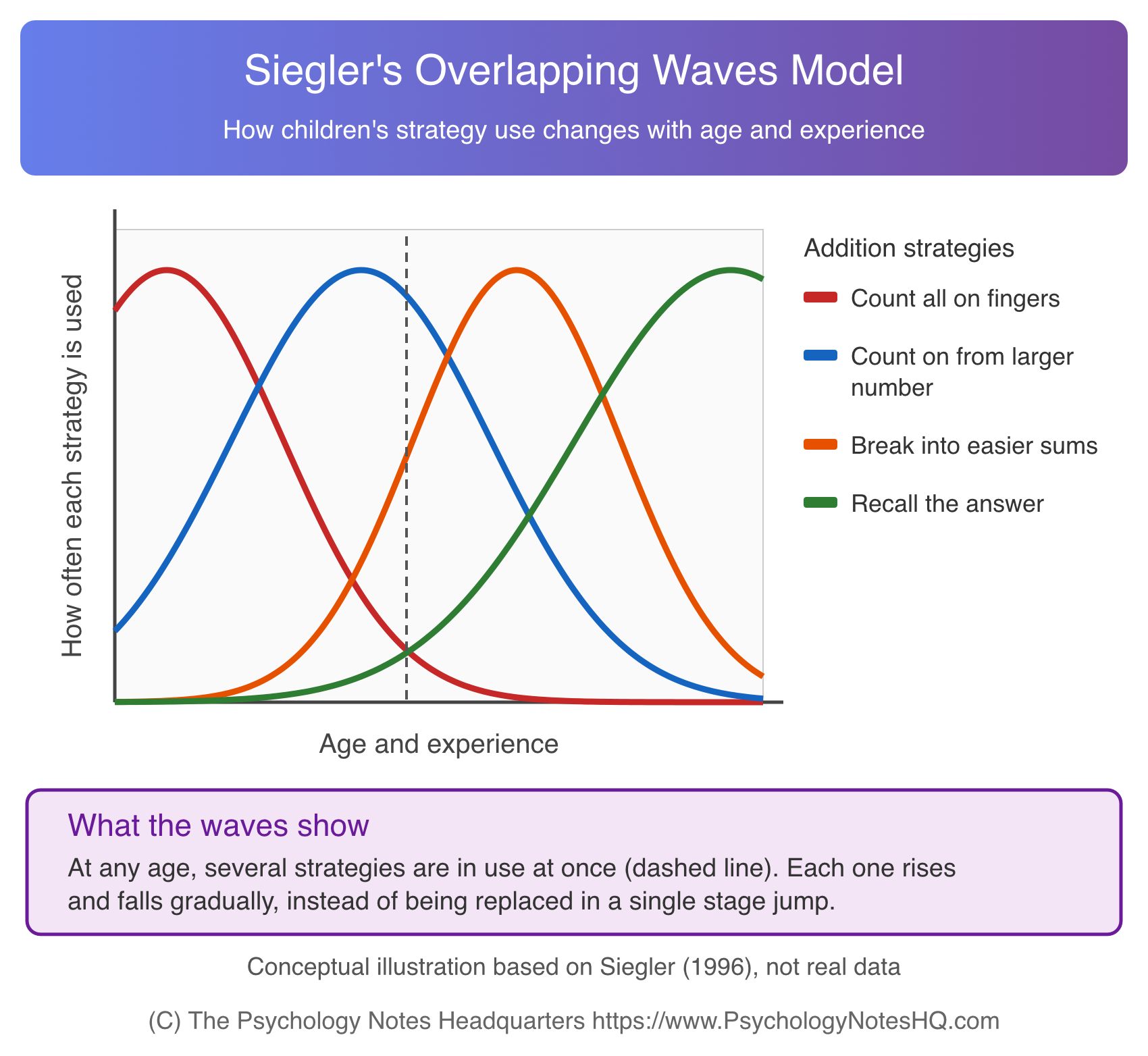
Robert Siegler watched young children solve simple addition problems and noticed something stage theory doesn’t predict. The same child might count on their fingers for one problem, count up from the larger number for the next and simply recall the answer for a third (Siegler, 1996).
Siegler described development as overlapping waves. Several strategies exist side by side, and each one gradually rises and falls in frequency. Children don’t climb a staircase. They shift the balance among options they already have.
When Tasks Change, Children Succeed Earlier
If a task’s demands hide what a child can do, simplifying the task should reveal that ability sooner. McGarrigle and Donaldson (1974) tested this with number conservation. When a “naughty teddy” messed up a row of counters by accident, far more 4- to 6-year-olds said the number stayed the same than when the experimenter changed the row on purpose.
Critics argue the teddy may have simply distracted children. Even so, studies like this suggest young children often know more than Piaget’s original tasks reveal.
What 7-Year-Olds Prove About Development
Piaget placed the start of the concrete operational stage at around age 7. Look closely at children that age, though, and the picture gets messy. Many can conserve substance but not yet weight. Most are only just starting to rehearse information on their own. In arithmetic, they often juggle several strategies in the same session.
None of this looks like a child who has crossed into one new stage. It looks like a child whose memory, speed, strategies and knowledge are all improving, each at a slightly different pace.
Neo-Piagetian Theory: Bridging the Two Approaches
Not everyone wanted to pick a side. Starting in the 1970s, a group of researchers developed neo-Piagetian theories of cognitive development. They kept Piaget’s broad stages but explained them using information processing mechanisms, especially working memory capacity.
At its core, neo-Piagetian theory asked a practical question. What if Piagetian and information processing theories describe the same development from two angles? Stages might be real, but limits on mental capacity could explain when and why each one appears.
Pascual-Leone’s M-Capacity
Juan Pascual-Leone proposed that children have a limited mental power, which he called M-capacity, that sets how many mental schemes they can coordinate at once.
M-capacity grows step by step through childhood and adolescence. Each increase lets a child handle a slightly more complex problem, and from the outside that can look like a move into a new stage.
Case’s Central Conceptual Structures
Robbie Case argued that progress within a stage depends on how efficiently children use working memory. As skills become automatic, they take up less space, which frees room for new learning.
Case and Okamoto (1996) later proposed central conceptual structures. These are networks of core knowledge in a domain, such as number, space or social stories, that children apply across many tasks in that domain. Development is still stage-like, but within domains rather than across the whole mind.
Halford and Fischer
Graeme Halford focused on relational complexity, meaning how many relations a child has to consider at once. A problem that requires linking three variables is harder than one with two, whatever its content.
Kurt Fischer’s skill theory went further. He described development as a web of skills growing in different directions, with a child’s performance rising or falling depending on how much support the situation provides.
Criticisms of Information Processing Theory
The approach has weak spots of its own. First, the computer metaphor only stretches so far. Brains work in parallel, are shaped by emotion and live inside bodies, and no simple flowchart captures all of that.
Second, it often describes change better than it explains it. Saying that capacity grows doesn’t tell us why it grows.
Third, like Piaget, it largely treats the child as a lone thinker. The objection raised in the debate between Vygotsky and Piaget, that learning is deeply social and cultural, applies here as well.
Why This Debate Still Matters in the Classroom
For teachers and psychology students, the practical message is clear. When a child struggles, “not developmentally ready” can sometimes mean “holding too much in mind at once.”
Breaking tasks into smaller steps, teaching memory strategies directly and building background knowledge can all make a real difference. This is also why information processing theory works best alongside other major child development theories rather than in place of them.
Conclusion
The 7-year-old who conserves clay but not weight isn’t confused. That child is running a system that’s still being upgraded. Information processing theory shows that much of children’s growth comes from better memory, faster processing, smarter strategies and deeper knowledge.
That doesn’t make Piaget wrong so much as incomplete. Piaget mapped what changes. Information processing helps explain how. The most useful view today borrows from both, which is exactly what the neo-Piagetians set out to do.
References
- Atkinson, R. C., & Shiffrin, R. M. (1968). Human memory: A proposed system and its control processes. In K. W. Spence & J. T. Spence (Eds.), The psychology of learning and motivation (Vol. 2, pp. 89-195). Academic Press.
- Case, R., & Okamoto, Y. (1996). The role of central conceptual structures in the development of children’s thought. Monographs of the Society for Research in Child Development, 61(1-2, Serial No. 246).
- Chi, M. T. H. (1978). Knowledge structures and memory development. In R. S. Siegler (Ed.), Children’s thinking: What develops? (pp. 73-96). Lawrence Erlbaum Associates.
- Cowan, N. (2001). The magical number 4 in short-term memory: A reconsideration of mental storage capacity. Behavioral and Brain Sciences, 24(1), 87-114.
- Gathercole, S. E., Pickering, S. J., Ambridge, B., & Wearing, H. (2004). The structure of working memory from 4 to 15 years of age. Developmental Psychology, 40(2), 177-190.
- Kail, R. (1991). Developmental change in speed of processing during childhood and adolescence. Psychological Bulletin, 109(3), 490-501.
- McGarrigle, J., & Donaldson, M. (1974). Conservation accidents. Cognition, 3(4), 341-350.
- Siegler, R. S. (1996). Emerging minds: The process of change in children’s thinking. Oxford University Press.
How to cite this article:
The Psychology Notes Headquarters. (2026). Information Processing Theory vs Piaget: What 7-Year-Olds Prove. Retrieved from https://www.psychologynoteshq.com/information-processing-theory/