
Conservation in Piaget’s Theory: 5 Tasks, Stages & Why Children Fail
Conservation in psychology is the understanding that quantity stays constant even when the appearance of an object changes. It’s one of six cognitive abilities children develop during Piaget’s concrete operational stage (ages 7–11) — the period when logical thinking first takes hold. Before conservation develops, children are routinely misled by how things look: a taller glass seems to hold more liquid, a spread-out row of coins seems to have more items. Piaget designed five classic tasks to test conservation across different properties — number, liquid, mass, area, and volume — each revealing a predictable pattern of errors that shows exactly where perception overrides logic.
Key Takeaways
- Conservation in Piaget’s theory is the understanding that quantity remains constant even when shape or arrangement changes
- Piaget identified 5 classic conservation tasks — number, liquid, mass, area, and volume — each mastered at different ages
- Children fail conservation tasks because of centration, irreversibility, and heavy reliance on visual appearances
- The ability to conserve marks the shift from the preoperational to the concrete operational stage, typically around ages 7–11
- Cross-cultural research confirms conservation is a universal developmental milestone, though timing varies with education and experience
What Is Conservation in Piaget’s Theory?
Conservation, in the context of Piaget’s theory of cognitive development, is the understanding that certain properties — number, volume, mass, area — remain unchanged even when the physical appearance of an object or arrangement is altered. When a child has developed conservation, they know that flattening a ball of clay doesn’t create more clay, that spreading out a row of coins doesn’t increase their number, and that pouring liquid into a differently shaped container doesn’t change the amount.
Piaget arrived at this concept through years of careful observation, watching children of different ages respond to simple transformation tasks. He noticed a consistent pattern: younger children trust their eyes completely, while older children apply logical reasoning that overrides what they see. He concluded that this shift represents something much deeper than learning a fact — it reflects a fundamental reorganization of how the mind processes the world.
Conservation is closely tied to how children build and revise mental schemas through assimilation and accommodation. As children encounter situations where appearances mislead them, their schemas gradually update to accommodate logical principles rather than perceptual shortcuts. Understanding this process is central to grasping why conservation develops when it does, and not before.
Why Conservation Matters for Cognitive Development
Conservation might seem like a narrow laboratory phenomenon, but its implications reach much further. The shift from failing to passing conservation tests signals a fundamental change in how children process information — from relying on immediate perceptions to applying abstract logic. That change underpins mathematical understanding, scientific reasoning, and eventually the kind of multi-step thinking that formal education demands.
Teachers and curriculum designers have long used conservation as a practical guide. Concepts like equivalent fractions, density, or chemical transformations all assume children can hold multiple dimensions in mind simultaneously and recognize that certain changes in form don’t alter underlying quantity. Introducing these ideas before conservation is established tends to produce rote memorization rather than genuine comprehension — children can recite rules without really grasping them.
In the broader context of child development theories, conservation occupies a central position. It’s one of the clearest empirical markers separating qualitatively different modes of thinking, which is why Piaget gave it such prominence in his stage framework. It’s not just a task children eventually pass — it’s a window into the architecture of thought itself.
The 5 Classic Conservation Tasks
Piaget developed a set of conservation tasks to systematically assess the emergence of logical thinking in children. Each follows the same basic structure: establish that two quantities are equal, transform the appearance of one, and ask whether equality still holds. The tasks differ in what property is being tested.

Conservation of Number
Two identical rows of coins are arranged in one-to-one correspondence. The child confirms both rows are equal. Then one row is spread out, making it visually longer. Young children almost always say the spread-out row now has more — the length of the row dominates their judgment. They can count both rows and still insist the longer one contains more items. This task illustrates how powerfully visual space distorts quantity judgments in young children, and it typically resolves around ages 6–7.
Conservation of Liquid
Equal amounts of water are poured into two identical glasses. One is then transferred into a taller, narrower container. Young children say the tall container holds more because the water level is higher — they focus entirely on height while ignoring width. This is Piaget’s most famous conservation demonstration, capturing perfectly the cognitive limitation he called centration: the tendency to lock onto one perceptual dimension while ignoring all others. It also develops around ages 6–7, alongside number conservation.
Conservation of Mass
Two equal balls of clay are presented and confirmed as equal. One is then rolled into a snake, flattened into a pancake, or broken into several pieces. Non-conserving children claim the reshaped clay now contains a different amount — the snake looks like more, the flat disk looks like less. The dramatic change in form convinces them the quantity has changed, even though nothing was added or removed. This understanding typically emerges around ages 7–8.
Conservation of Area
Two identical paper fields have the same number of small blocks placed on them in matching arrangements. Then the blocks on one field are rearranged — clustered into a corner instead of spread out. Young children often say the field with scattered blocks has less space available for grazing, not grasping that the same number of blocks covers the same total area regardless of arrangement. The visual impression of crowdedness overrides any logical reasoning about constant area.
Conservation of Volume
The most cognitively demanding of the conservation tasks, volume conservation requires predicting whether differently shaped pieces of clay would displace equal amounts of water when submerged. Because it involves reasoning about an invisible property — the volume of matter — rather than visible dimensions, it typically doesn’t emerge until ages 11–12. Mastering it signals the beginning of the transition into the formal operational stage, where truly abstract reasoning becomes possible.
Why Do Children Fail Conservation Tasks?
Piaget identified three interlocking cognitive limitations that explain why young children struggle with conservation, regardless of which task is being used.
Centration is the tendency to focus on one salient dimension while ignoring all others. In the liquid task, children lock onto water height and tune out width entirely. They can’t hold both dimensions in mind simultaneously, so the most visually striking feature wins by default. This single-focus thinking shows up across all conservation scenarios — whatever dimension stands out most becomes the basis for the child’s judgment.
Irreversibility means children can’t mentally undo a transformation. When water is poured into a tall glass, they treat this as a one-way event — they cannot mentally reverse the pour to confirm that the original equality still holds. Older children develop reversibility, the ability to trace operations backward, which enables them to reason that a reversible transformation cannot have changed the underlying quantity.
Appearance-based thinking is perhaps the most pervasive limitation. Children in the preoperational stage trust perceptions over logic, consistently and confidently. If it looks like more, it is more — full stop. Overcoming this bias is one of the defining achievements of middle childhood. It’s also closely tied to the gradual decline of egocentrism: as children grow more capable of considering multiple perspectives and properties at once, appearance-based thinking loses its grip.
Conservation and Piaget’s Stages
Conservation ability maps directly onto Piaget’s stage framework and serves as one of its most reliable diagnostic markers.
The developmental arc actually begins earlier than conservation itself. During the sensorimotor stage, infants slowly learn that objects continue to exist even when out of sight — this is object permanence, and it represents the first sign that appearances and reality can diverge. Conservation is a conceptually parallel achievement at a more abstract level: just as an object doesn’t cease to exist when hidden, a quantity doesn’t change when its form is altered.
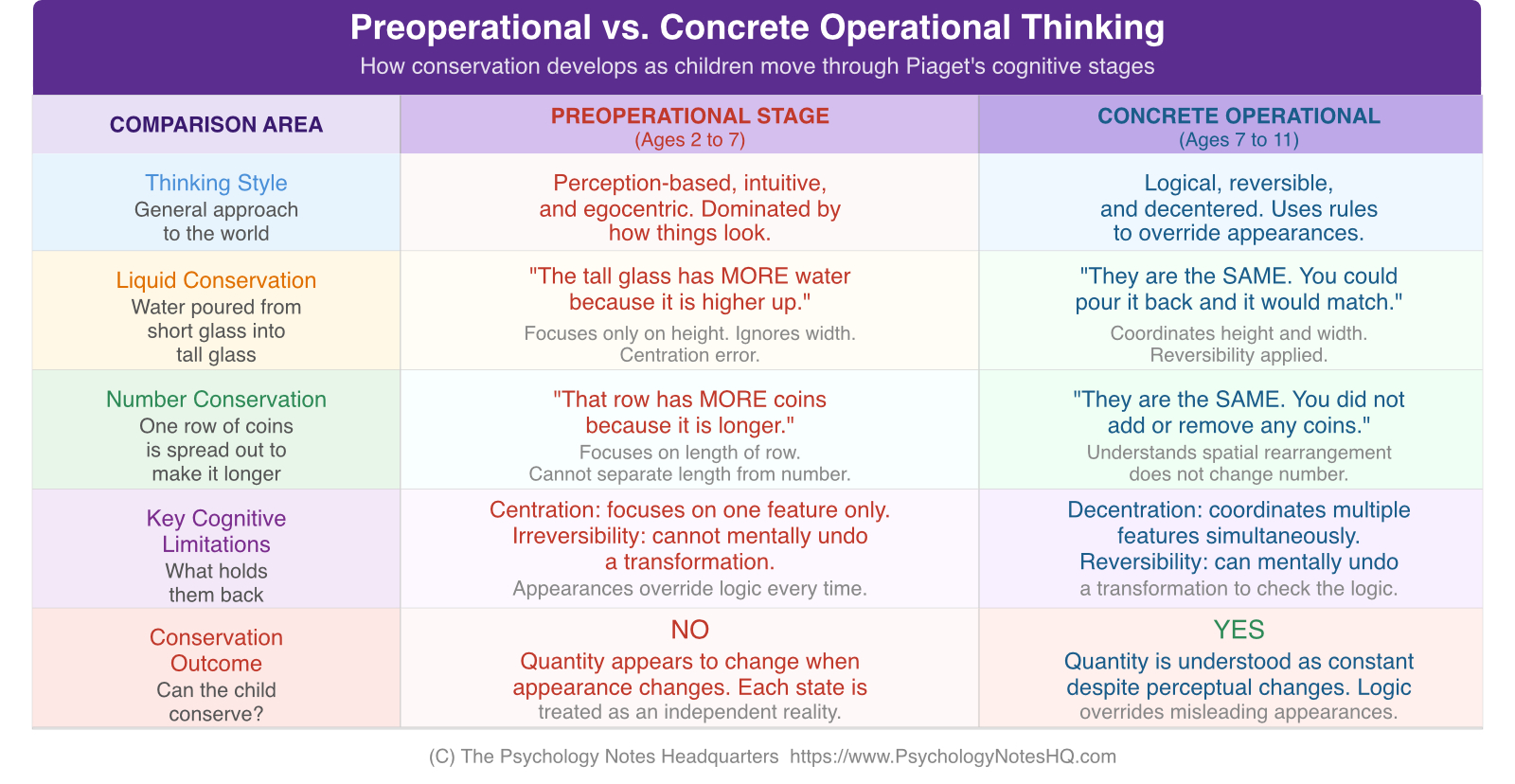
During the preoperational stage (ages 2–7), children lack conservation entirely. Their thinking is intuitive and perceptually bound. No amount of explaining will produce genuine conservation understanding at this point, because the underlying cognitive structures haven’t yet developed.
The concrete operational stage (ages 7–11) is where conservation emerges. Children develop decentration — the ability to consider multiple dimensions at once — along with reversibility and compensation (the insight that a gain in height can be offset by a loss in width). These three abilities collectively make conservation possible and mark the shift from intuitive to genuinely logical thinking.
Horizontal Décalage: Why Conservation Doesn’t Arrive All at Once
One of the more nuanced observations in Piaget’s work is that conservation doesn’t emerge uniformly. Even within the concrete operational stage, different types develop at different ages — a phenomenon Piaget called horizontal décalage, meaning that similar logical structures are applied to different content areas at different times.
Number and liquid conservation typically appear first, around ages 6–7. Mass and area follow at 7–8. Weight conservation comes around ages 9–10. Volume — the most abstract — arrives last, around ages 11–12.
This sequential pattern seems puzzling if conservation were simply a single logical structure being switched on. But applying that logic to different physical properties apparently demands different levels of abstraction and direct experience. Reasoning that rearranging coins doesn’t change their number is simply more concrete than reasoning that reshaping clay doesn’t change the volume of water it displaces. Décalage is a useful reminder that cognitive development is uneven — logical structures don’t instantly transfer across all domains once they appear in one. It’s one reason Piaget’s stage model is better understood as capturing broad developmental tendencies rather than clean, simultaneous cognitive switches.
Can Conservation Be Taught?
Whether conservation can be accelerated through instruction is one of the more contested questions that conservation research has raised, with real consequences for education.
Piaget himself was skeptical. His position was that children construct conservation understanding through active exploration of their environment — not by being told the right answer. Simply explaining to a child that the amount stays the same produces, at best, verbal learning: children repeat the correct response without genuinely grasping the logical principle behind it.
Training studies have produced mixed results. Some interventions — particularly those involving hands-on measuring, comparing, and physically reversing transformations — do improve conservation performance. But critics point out that children may learn to solve specific tasks without developing the broader operational thinking that genuine conservation requires. That distinction matters.
This is where the contrast with Vygotsky’s theory becomes instructive. Vygotsky placed far greater weight on guided social interaction and instruction as drivers of cognitive development, while Piaget emphasized individual discovery. The practical middle ground supported by most contemporary educators is this: you can’t force conservation to emerge before its time, but well-designed activities that involve manipulation, comparison, and discussion create conditions in which it develops more reliably and perhaps earlier than it might otherwise.
Cross-Cultural Research on Conservation
Conservation has been studied across dozens of cultures, and the broad conclusion is consistent: children everywhere eventually acquire it. This universality supports Piaget’s claim that conservation reflects a genuine feature of human cognitive development rather than something culturally taught.
That said, the timing varies. Children in cultures with formal schooling tend to acquire conservation earlier than those without it. Formal education, with its emphasis on abstract, decontextualized reasoning, appears to accelerate the process. Some studies found conservation appearing several years later in unschooled children from traditional societies, though those children did still develop it eventually.
Methodological concerns complicate interpretation, however. Piaget’s conservation tasks were designed in Western contexts, using materials and questioning styles that may be unfamiliar to children elsewhere. When researchers adapt tasks to use locally familiar objects and culturally appropriate language, children from non-Western backgrounds often perform considerably better than standard Piagetian testing would suggest. This implies that some apparent cross-cultural differences reflect familiarity with the testing format rather than genuine differences in cognitive development — a meaningful distinction for anyone drawing conclusions about universal versus culturally shaped aspects of development.
Criticisms and Refinements
Despite its influence, Piaget’s account of conservation has been challenged on several important fronts.
McGarrigle and Donaldson’s (1974) “naughty teddy” studies showed that when a toy accidentally spread out the coins rather than the experimenter doing it deliberately, more young children gave correct conservation answers. The implication is significant: children may have interpreted the experimenter’s deliberate action as a signal that a different answer was expected — a social communication explanation rather than a cognitive one. This connects to theory of mind development: young children’s evolving understanding of adult intent and expectation shapes how they respond to questions in testing situations.
Language and questioning format also play a role. Simplified or neutral questions consistently improve young children’s conservation performance, suggesting that some failures reflect linguistic confusion about what’s being asked rather than an absence of conservation logic.
Information-processing researchers offer a third angle: conservation failures may reflect limited working memory rather than missing logical structures. Holding height and width in mind simultaneously is a genuine cognitive load. As processing capacity expands with development, conservation performance improves — not because a new stage switches on, but because cognitive resources grow. This view connects to broader debates about whether Piaget’s stages represent truly discrete reorganizations or more gradual progressions, debates that echo in parallel work on moral development in children and in the shared assumptions explored when comparing Piaget and Kohlberg’s frameworks.
Conclusion
Conservation in Piaget’s theory remains one of developmental psychology’s most durable and empirically tested ideas. The shift from trusting appearances to applying logical rules is genuine, well-documented, and consequential. Criticisms have sharpened the picture — particularly around methodology, language, and the role of social context — but the core insight holds: children’s thinking undergoes real qualitative change, and conservation is one of the clearest observable markers of when and how that change actually happens.
References
- Dasen, P. R. (1994). Culture and cognitive development from a Piagetian perspective. In W. J. Lonner & R. S. Malpass (Eds.), Psychology and culture (pp. 145-149). Allyn & Bacon.
- Donaldson, M. (1978). Children’s minds. W. W. Norton.
- Lourenco, O., & Machado, A. (1996). In defense of Piaget’s theory: A reply to 10 common criticisms. Psychological Review, 103(1), 143-164.
- McGarrigle, J., & Donaldson, M. (1974). Conservation accidents. Cognition, 3(3), 341-350.
- Piaget, J. (1952). The child’s conception of number. Routledge & Paul.
- Piaget, J., & Inhelder, B. (1969). The psychology of the child. Basic Books.
- Siegler, R. S. (1995). How does change occur: A microgenetic study of number conservation. Cognitive Psychology, 28(3), 225-273.
- Vygotsky, L. S. (1978). Mind in society: The development of higher psychological processes. Harvard University Press.
How to cite this article:
The Psychology Notes Headquarters. (2026). Conservation in Piaget’s Theory: 5 Tasks, Stages & Why Children Fail. Retrieved from https://www.psychologynoteshq.com/conservation/