
The Sensorimotor Stage: How Babies Build Intelligence One Touch at a Time
An eight-month-old watches her mother slide a toy under a blanket. A month earlier, this would have ended the game entirely, out of sight meant gone for good. Instead, she reaches straight for the blanket and pulls it away. That shift in understanding sits at the center of the sensorimotor stage, the opening chapter of Piaget’s theory of cognitive development. Long before toddlers can talk through what they know, they are already building a working model of reality through touch, sight, sound, and movement, one small experiment at a time.
Key Takeaways
- The sensorimotor stage unfolds across six substages, each one building a new ability on top of the last. See what changes at every step and why the order matters.
- Object permanence does not appear overnight. There is a specific point where most babies still get it wrong, even after they start searching for hidden objects.
- One classic error trips up nearly every infant around eight months old. Find out what causes it and exactly when it disappears.
- Circular reactions evolve from body-focused habits into full experimentation. Discover how a toddler’s mind starts working like a scientist’s.
- Modern research has revised part of Piaget’s original picture. Learn what still holds up decades later and what does not.
What Is the Sensorimotor Stage?
The sensorimotor stage is the first period in Piaget’s theory, and it runs from birth through approximately 24 months. During this stage, infants construct their understanding of the world primarily through direct sensory experience: seeing, hearing, touching, tasting, smelling, paired with motor actions like reaching, grasping, and moving. The term “sensorimotor” reflects exactly that combination of senses and movement.
Unlike Vygotsky’s sociocultural theory, which treats social interaction as the primary engine of development, Piaget focused on how individual children actively construct knowledge through their interactions with the physical world. Babies are not passive recipients of information. They are active explorers who build increasingly sophisticated mental models through countless everyday experiences.
Sensorimotor stage age ranges vary somewhat by child. Some infants move through the substages more quickly, others more gradually, and that variation is normal rather than a red flag. What stays consistent is the sequence itself. This stage lays the foundation for everything that follows; the thinking skills that emerge during Piaget’s preoperational stage depend directly on sensorimotor achievements like object permanence and symbolic representation.
The Six Substages of Sensorimotor Development
Piaget did not treat the sensorimotor stage as one uniform period. He broke it into six distinct substages of Piaget’s sensorimotor stage, each marked by increasingly sophisticated cognitive abilities. Understanding these sensorimotor substages helps parents and educators recognize developmental milestones and support age-appropriate learning.
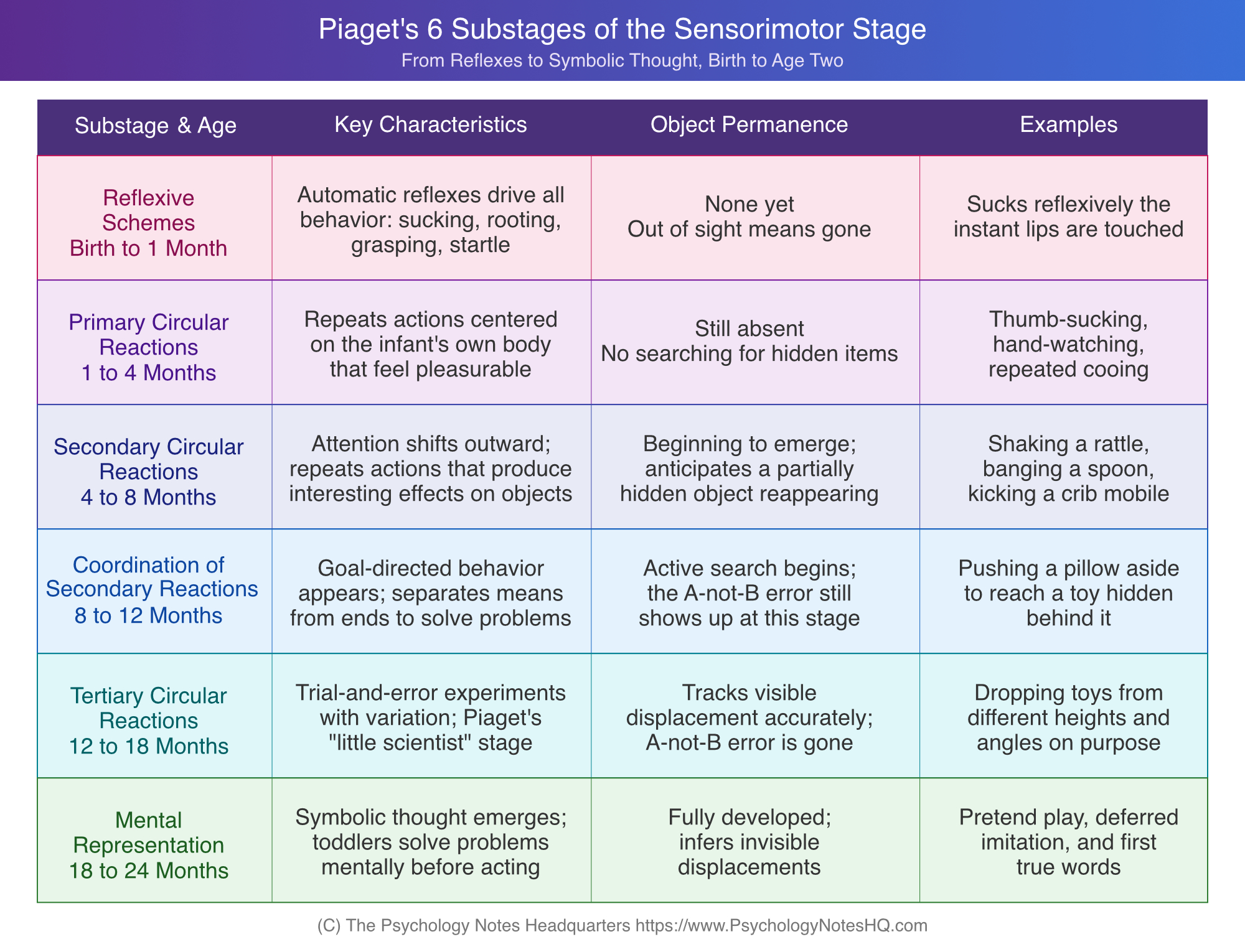
Substage 1: Reflexive Schemes (Birth to 1 Month)
Newborns enter the world equipped with automatic responses called reflexes that enable survival and provide the raw material for cognitive development. These reflexive schemes operate without thought or learning: they are hardwired biological programs activated by specific triggers.
The sucking reflex engages when anything touches a baby’s lips or mouth, triggering automatic sucking movements essential for feeding. The rooting reflex causes newborns to turn their heads toward touches on their cheeks, helping them locate food sources. The grasping reflex produces automatic hand closure when objects touch their palms. The Moro reflex triggers arm extension and retraction in response to sudden movements or loss of support.
Piaget called these automatic patterns “schemes,” organized sequences of actions the infant performs. At this earliest substage, the entire cognitive repertoire consists of these innate reflexes. When a nipple touches the baby’s lips, sucking begins without conscious intention. When you stroke a newborn’s cheek, she automatically turns toward the touch. These responses happen reflexively, representing biology’s preparation for learning rather than learning itself.
Cognitive processing during this substage is extremely limited. Newborns respond to immediate sensory input but cannot anticipate future events, remember absent objects, or coordinate different reflexes purposefully. They show no awareness that objects continue existing when out of sight.
However, even during this earliest period, subtle modifications begin. Infants quickly learn to distinguish between nipples and surrounding skin, adjusting their sucking accordingly. A newborn might suck vigorously on a milk-producing nipple but suck differently on a pacifier. These early discriminations represent the very beginning of adaptation and foreshadow the deliberate learning that characterizes later substages.
Substage 2: Primary Circular Reactions (1 to 4 Months)
Between one and four months, a significant shift occurs as infants discover that certain actions produce pleasurable sensations, leading them to repeat these actions deliberately. Piaget termed these patterns “primary circular reactions.” They are circular because they repeat, and primary because they focus on the infant’s own body rather than external objects.
The classic example involves thumb-sucking. An infant accidentally gets her thumb in her mouth while moving her arms randomly. The sucking produces pleasurable sensations, which motivates the infant to repeat the action. Unlike the reflexive sucking of substage 1, this thumb-sucking is deliberate: the baby actively tries to recreate the pleasant experience.
Hand-watching provides another common example. Infants move their hands into their visual field, discover the interesting sight of their own fingers moving, and deliberately repeat the action to continue watching. Similarly, babies at this stage produce cooing sounds, listen to these sounds with apparent interest, and deliberately coo again to hear themselves.
Coordination between different sensory systems advances significantly during this substage. Infants begin integrating visual and tactile information, watching their hands as they move and learning to coordinate hand movements with visual input. This hand-eye coordination represents an important cognitive achievement enabling more sophisticated exploration in later months.
Intentionality begins emerging, though incompletely. Infants deliberately repeat pleasurable actions, but these repetitions remain tied to actions initially performed by chance. True goal-directed behavior, where infants separate means from ends, emerges in later substages.
At this stage, infants still lack understanding that objects continue existing when out of sight. If a toy disappears behind a barrier, infants may briefly continue looking where it vanished but quickly lose interest, acting as though the disappeared object no longer exists. Object permanence, the understanding that objects maintain independent existence, has not yet developed.
Substage 3: Secondary Circular Reactions (4 to 8 Months)
Around four months, infants’ attention shifts dramatically outward from their own bodies to objects and events in the external environment. Secondary circular reactions involve repeating actions that produce interesting effects on external objects rather than just on the baby’s body.
The distinction between primary and secondary circular reactions is crucial. Primary circular reactions are body-focused: the baby sucks her thumb because sucking feels good. Secondary circular reactions are object-focused: the baby shakes a rattle because the rattle makes an interesting sound. The goal has shifted from producing sensations in the baby’s own body to producing effects in the external world.
An infant who accidentally shakes a rattle and hears an interesting sound will deliberately shake it again to reproduce the sound. This represents expanded awareness of the external world and emerging understanding that one’s actions can affect objects and events.
Real-world examples abound. Infants at this stage repeatedly hit mobiles to make them move, bang objects on highchair trays to produce sounds, splash bathwater to observe the effects, kick their legs to make crib toys jingle, or repeatedly drop objects to watch them fall. Parents often tire of these endless repetitions, but they represent important cognitive work as infants systematically investigate cause-effect relationships.
However, actions remain incompletely intentional during this substage. Infants don’t yet clearly separate means from ends. True instrumental behavior, using one action as a means toward a different end, emerges in the next substage.
Object permanence awareness begins developing during this period. Infants may reach toward locations where objects disappeared and show anticipation when partially hidden objects reappear. However, they typically don’t actively search for completely hidden objects. If you completely cover a toy with a cloth while a six-month-old watches, the baby may look puzzled but won’t remove the cloth to retrieve the toy.
Substage 4: Coordination of Secondary Circular Reactions (8 to 12 Months)
Around eight months, a crucial cognitive transformation occurs that fundamentally changes infant behavior: intentional, goal-directed behavior emerges clearly. Infants now separate means from ends, using one action as a deliberate tool to accomplish a different goal.
Consider an infant who wants a toy sitting behind a pillow. The baby will push the pillow aside (means) to obtain the toy (goal). The pillow-pushing isn’t intrinsically interesting; it serves purely as an instrumental action toward the desired end. This separation of means from ends marks a fundamental cognitive advance distinguishing true intelligence from simpler forms of learning like habit or reflex.
Understanding that objects continue existing when out of sight develops significantly during this substage. Infants actively search for hidden objects, reaching behind barriers and looking under cloths to retrieve desired toys.
This period coincides with Erikson’s trust vs. mistrust stage, where cognitive and emotional development intersect as infants develop expectations about caregiver reliability and object permanence simultaneously.
However, important limitations remain. Infants commonly commit what Piaget called the “A-not-B error” during this substage. A toy is repeatedly hidden at location A, and the infant successfully retrieves it from location A several times. Then, while the infant watches, you hide the toy at location B instead. Remarkably, most eight-to-twelve-month-olds will search at location A, where they previously found it, despite clearly seeing you hide it at location B.
This fascinating error suggests incomplete understanding of objects’ independent existence. The infant may believe the object exists because of searching actions rather than having independent existence. Either way, the A-not-B error reveals that object permanence understanding, while developing, remains incomplete during this substage.
Real-world examples of substage 4 behavior include infants removing obstacles blocking desired objects, using one toy to knock another toy within reach, pointing at desired objects to request them, crawling toward caregivers when seeking comfort, or pulling strings attached to toys to bring them closer.
Substage 5: Tertiary Circular Reactions (12 to 18 Months)
Between twelve and eighteen months, experimentation becomes the defining characteristic of infant behavior. Rather than merely repeating actions that worked previously, toddlers systematically vary their actions to discover what different variations produce. Piaget described toddlers at this stage as “little scientists” conducting experiments on their physical worlds.
The circular reactions remain “circular” because actions get repeated, but they’re “tertiary” because systematic variations introduce novelty. A toddler doesn’t just drop objects from the highchair repeatedly; she drops them from different heights, releases them with different forces, throws them onto different surfaces, and carefully observes how these variations affect outcomes.
Trial-and-error problem-solving characterizes this substage. When facing obstacles, toddlers don’t just apply familiar solutions or give up when initial strategies fail. Instead, they systematically try alternatives until finding solutions. If a toy won’t fit through a hole one way, the toddler turns it different directions, trying various orientations until discovering the one that works.
Understanding of visible displacements develops fully during this substage. Toddlers can track objects through visible movements, searching successfully in new locations after watching objects moved there. They no longer commit the A-not-B error that characterized substage 4.
Real-world examples appear constantly in toddler behavior. A toddler repeatedly pours water from cup to cup, varying the amount poured, the pouring height, and the container sizes. She climbs stairs multiple ways, crawling up, walking while holding rails, walking independently, experimenting with different techniques and their outcomes.
The experimentation extends beyond physical objects to social domains. Toddlers vary their vocalizations systematically, noting how different sounds produce different reactions from caregivers. They experiment with social strategies, trying different approaches for obtaining attention or expressing emotions.
Substage 6: Mental Representation (18 to 24 Months)
The final sensorimotor substage marks the crucial transition to symbolic thought, the capacity to form and manipulate mental representations of objects, people, and events. This symbolic capacity fundamentally transforms cognitive functioning, enabling thought about absent objects, problem-solving through mental manipulation rather than physical action, and the beginning of true imagination.
Deferred imitation provides dramatic evidence for mental representation. Toddlers observe behaviors and accurately reproduce them hours or days later, demonstrating they formed mental representations of the observed actions. A toddler watches her father shaving in the morning, then later that afternoon pretends to shave with a toy, moving it across her face just as her father did.
Problem-solving through mental representation becomes possible during this substage. Rather than relying exclusively on physical trial-and-error like substage 5 toddlers, substage 6 children can think through problems mentally before taking action. A toddler seeking a toy on a high shelf might look around, notice a nearby chair, and deliberately push the chair over before climbing.
Understanding of invisible displacements completes object permanence development during this substage. This represents the most sophisticated form of object permanence: inferring where hidden objects are even after invisible movements. An 18-24 month old will search behind a box after a toy is secretly removed from a cloth and left there, inferring that the toy must be there even though they never saw it placed there.
The emergence of symbolic thought marks the transition from sensorimotor to preoperational thinking. Toddlers begin using objects symbolically in pretend play; a block becomes a phone, a box becomes a house, a stick becomes a magic wand. The symbolic capacity emerging in late sensorimotor development supports language acquisition and egocentrism characteristic of early preoperational thought.
Language development accelerates dramatically during this substage. The vocabulary explosion beginning around 18 months reflects deepening symbolic capacity. The progression from single words to two-word combinations around age two reveals increasingly sophisticated symbolic thinking, the hallmark of the transition to preoperational thought.
Object Permanence Across the Substages
Object permanence, the understanding that objects continue to exist even when we can’t see, hear, or touch them, is arguably the signature achievement of the sensorimotor stage. It develops gradually rather than all at once: newborns show no awareness of it at all, infants around four to eight months begin anticipating a partially hidden object’s reappearance, eight to twelve month olds actively search but still fall for the A-not-B error, and by 18 to 24 months toddlers can infer even invisible displacements.
Modern research using violation-of-expectation methods suggests infants may have earlier object permanence understanding than Piaget proposed, but that motor limitations prevented them from demonstrating this knowledge through manual search. When researchers measure looking time rather than searching, younger infants show surprise at physically impossible events.
For a full breakdown of how object permanence unfolds, including the classic hiding-game tests researchers use to measure it, see our dedicated object permanence guide.
Means-End Behavior and Intentionality
One of the most significant transitions during the sensorimotor stage involves the emergence of truly intentional, goal-directed behavior. This development represents the shift from reactive to proactive cognition, from responding to immediate stimuli to actively pursuing goals.
In early substages, infant actions serve intrinsic purposes. Babies suck because sucking feels pleasurable. They shake rattles because the sound is interesting. The action itself is the goal; there is no separation between means and ends.
The critical shift occurs during substage 4 (8-12 months) when infants begin using actions instrumentally, as means toward separate ends. Pushing a pillow aside isn’t intrinsically interesting, but it becomes valuable as a means to obtain the toy behind it. Pulling a string isn’t enjoyable for its own sake, but it achieves the goal of bringing an attached toy closer.
This means-end separation requires several cognitive advances. Infants must mentally represent goals, desired states different from current states. They must recognize that current situations differ from goals and that specific actions can transform current into desired states.
Problem-solving strategies become increasingly sophisticated across subsequent substages. Eight-month-olds use simple strategies like removing single obstacles. Twelve-month-olds try multiple approaches when initial strategies fail. Eighteen-month-olds systematically vary strategies, experimenting with alternatives. Twenty-four-month-olds mentally represent problems and solutions, thinking through approaches before acting.
Modern Research and Theoretical Updates
While Piaget’s sensorimotor framework remains influential, decades of subsequent research have revealed both its limitations and its enduring insights. The most consistent finding from recent research is that Piaget underestimated infant cognitive abilities. Using methods that don’t require sophisticated motor responses, researchers have demonstrated competencies emerging earlier than Piaget proposed.
Core knowledge theory, proposed by researchers like Elizabeth Spelke, suggests infants possess innate understanding of fundamental domains like physics (object solidity, continuity), number (approximate quantities), and psychology (goal-directed action). This contrasts with Piaget’s constructivist approach, where all knowledge is built through experience.
The primary limitation in Piaget’s methods involved heavy reliance on motor responses. His tasks required infants to manually search for hidden objects, reach for toys, or manipulate objects. These motor demands may have obscured cognitive understanding in infants who comprehended more than their limited motor skills allowed them to demonstrate.
When researchers use looking-time measures, how long infants look at surprising versus expected events, younger infants reveal sophisticated understanding. Three-month-olds look longer at physically impossible events, like objects passing through solid barriers, suggesting earlier physical knowledge than Piaget proposed.
Brain imaging studies complement behavioral research, revealing neural correlates of cognitive development. The prefrontal cortex, critical for planning and working memory, undergoes dramatic maturation during the sensorimotor period. These neurological findings provide mechanistic understanding complementing Piaget’s behavioral descriptions.
Despite these revisions, much of Piaget’s framework remains valid. The progression from reflexive to intentional behavior, the development of means-end reasoning, and the transition to symbolic representation all capture genuine developmental changes. Understanding developmental tasks helps contextualize Piaget’s stages within broader frameworks of age-appropriate challenges and achievements.
Practical Applications for Parents and Caregivers
Understanding sensorimotor development helps parents and caregivers support infant learning through age-appropriate stimulation. For substages 1-2 (0-4 months), focus on rich sensory experiences: visual stimulation through high-contrast patterns and mobiles, varied tactile experiences, and auditory richness through talking and singing.
For substage 3 (4-8 months), emphasize cause-effect relationships with sensorimotor stage toy examples like rattles that make sounds when shaken, activity gyms with elements that move when touched, and bath toys that pour or squirt water.
For substage 4 (8-12 months), support problem-solving through peek-a-boo and hiding games that encourage object permanence, along with simple obstacles for babies to overcome.
For substage 5 (12-18 months), encourage systematic experimentation with materials that support variation: water and various containers, balls of different sizes, and blocks for stacking and knocking down.
For substage 6 (18-24 months), support emerging symbolic capacity with pretend play materials, books, and conversations that encourage deferred imitation and language development.
General principles apply across all substages: follow the child’s lead, provide responsive interaction, ensure safety while maximizing exploration, and respect individual differences in developmental timing.
Conclusion
The sensorimotor stage chronicles infancy’s remarkable cognitive transformation from reflexive newborns to symbolic thinkers capable of mental representation. Through six progressive substages, infants master increasingly sophisticated capabilities, moving from automatic reflexes to deliberate exploration, from accidental discoveries to intentional experimentation, from action-based to thought-based problem-solving. While modern research reveals earlier competencies than Piaget initially proposed, his framework remains foundational for understanding how infants actively construct knowledge through sensory experiences and motor actions.
References
- Baillargeon, R. (1987). Object permanence in 3½- and 4½-month-old infants. Developmental Psychology, 23(5), 655-664.
- Bjorklund, D. F. (2012). Children’s thinking: Cognitive development and individual differences (5th ed.). Wadsworth Cengage Learning.
- Piaget, J. (1952). The origins of intelligence in children. International Universities Press.
- Piaget, J. (1954). The construction of reality in the child. Basic Books.
- Spelke, E. S., & Kinzler, K. D. (2007). Core knowledge. Developmental Science, 10(1), 89-96.
- Wadsworth, B. J. (2004). Piaget’s theory of cognitive and affective development: Foundations of constructivism (5th ed.). Pearson Education.
How to cite this article:
The Psychology Notes Headquarters. (2026). The Sensorimotor Stage: How Babies Build Intelligence One Touch at a Time. Retrieved from https://www.psychologynoteshq.com/sensorimotor-stage/