
Separation Anxiety in Infants and Stranger Anxiety: What’s Normal and Why It Happens
Separation anxiety in infants is the distress babies show when separated from a primary caregiver, typically emerging between 8 and 14 months of age. It often develops alongside infant stranger anxiety — a related but distinct response to unfamiliar faces that appears a little earlier, around 6 to 8 months. Both are signs of healthy cognitive and emotional development, not behavioral problems to be fixed.
Key Takeaways
- Separation anxiety in infants typically peaks between 10 and 18 months and fades naturally as toddlers develop confidence and broader social experience.
- Infant stranger anxiety usually appears earlier — around 6 to 8 months — when babies first begin distinguishing familiar faces from unfamiliar ones.
- Both responses are linked to the formation of secure attachment: a baby who protests your absence has bonded meaningfully with you.
- Object permanence plays a central role — once babies understand that people still exist when out of sight, absence becomes something to grieve.
- Temperament, prior social exposure, and attachment quality all shape how intensely a baby experiences these anxieties.
What Is Separation Anxiety in Infants?
Separation anxiety in infants refers to the distress a baby experiences when separated — even briefly — from a primary caregiver. The most familiar separation anxiety examples include crying at daycare drop-off, clinging at bedtime, or dissolving into tears the moment a parent steps out of the room. Onset typically falls between 8 and 14 months, with intensity peaking around 10 to 18 months. Most children show a noticeable reduction by age 2 to 3, as their sense of security and independence grows.
One key feature of this response is that it follows a predictable pattern: protest when the caregiver leaves, continued distress during the absence, and rapid relief when the caregiver returns. That return-and-recover arc is actually a reassuring sign — it means the baby has formed a meaningful bond with a specific person, which is exactly what healthy development looks like at this age.
What Is Infant Stranger Anxiety?
In developmental psychology, stranger anxiety refers to the wariness or distress an infant shows in response to unfamiliar people. It tends to emerge slightly earlier than separation anxiety — typically around 6 to 8 months — which is why parents sometimes notice it first. A baby who happily smiled at everyone at 3 months may suddenly burst into tears when a well-meaning grandparent reaches out to hold them at 7 months. That shift can feel abrupt, but it marks a genuine cognitive milestone.
The signs of stranger anxiety in infants include crying or whimpering at an unfamiliar face, turning away or burying their head in a caregiver’s shoulder, and a general wariness or “freeze” response before distress sets in. The intensity varies considerably across children and across cultures — in societies where infants have more frequent contact with extended family networks and community members, stranger anxiety tends to be less pronounced (Kagan et al., 1978).
How They’re Related — and How They Differ
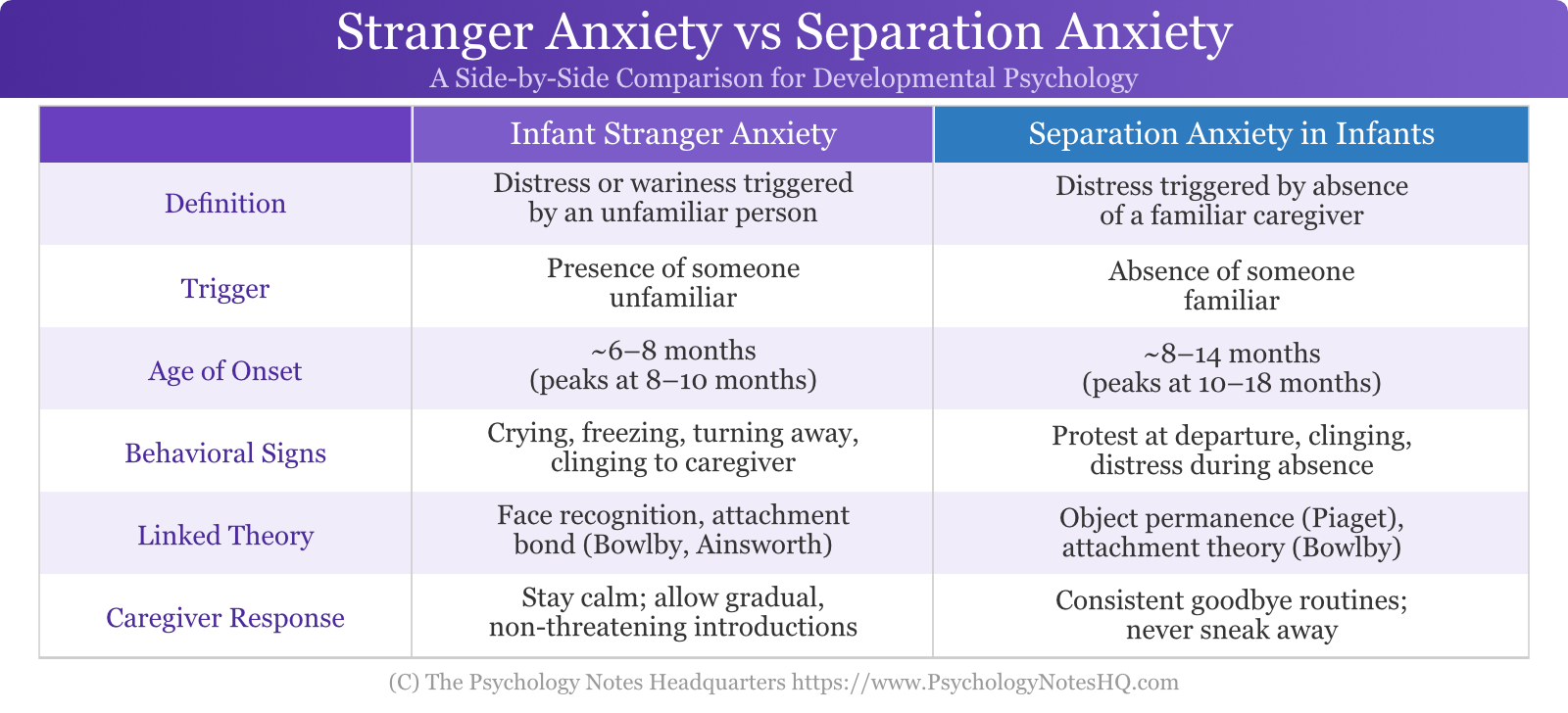
Stranger anxiety and separation anxiety are frequently mentioned together because they emerge during the same developmental window and share a common cognitive root. But they’re triggered by different things. Stranger anxiety is triggered by the presence of someone unfamiliar. Separation anxiety is triggered by the absence of someone familiar. One involves a person who shouldn’t be there; the other involves a person who should be there but isn’t.
They also follow slightly different timelines. Stranger anxiety typically arrives first, around 6 to 8 months, and is one of the earliest outward signs that an infant can now reliably distinguish familiar faces from unfamiliar ones. Separation anxiety follows a few weeks to months later, and tends to be more intense and longer-lasting. Understanding how they differ matters not just academically — it helps caregivers respond more accurately to what a baby is actually communicating in a given moment.
The Role of Object Permanence
To understand why both of these anxieties appear when they do, it helps to look at what’s happening cognitively around the same time. Object permanence — the understanding that things continue to exist even when they can’t be seen — develops during the sensorimotor stage of infancy, typically between 8 and 12 months according to Piaget’s framework.
Before object permanence develops, out of sight genuinely means out of mind. A caregiver who leaves the room simply ceases to exist in the infant’s mental world. But once object permanence clicks into place, the infant understands that the caregiver still exists somewhere — they’re just not here. That cognitive upgrade is wonderful in many ways, but it comes with an emotional cost: now absence is something that can be anticipated, noticed, and grieved. The timing of separation anxiety, appearing right as object permanence solidifies, is not a coincidence.
The Attachment Connection
Both anxieties make the most sense when viewed through the lens of attachment theory. John Bowlby proposed that infants are biologically wired to seek proximity to a primary caregiver — a figure who serves as a secure base from which to explore the world (Bowlby, 1969). Ainsworth’s work built on this, showing that the quality of the attachment bond shapes how infants respond to both separation and strangers.
In Ainsworth’s Strange Situation procedure — a controlled observation in which infants were briefly separated from their caregiver and exposed to a stranger — securely attached infants showed clear distress when the caregiver left but recovered quickly upon their return. Insecurely attached infants showed more extreme or more suppressed responses. The key insight is that some degree of separation protest is a marker of secure attachment, not a sign that something has gone wrong. Harlow’s research with infant monkeys offered earlier evidence for the same principle: contact and emotional security with a caregiver figure are foundational to healthy development, and their disruption produces measurable distress.
Why Intensity Varies Between Babies
Not every infant responds to strangers or separations with the same level of distress, and that variation is real and meaningful. Temperament plays a significant role — infants classified as “inhibited” or slow-to-warm tend to show stronger and more prolonged stranger anxiety than those with more easygoing dispositions (Kagan, 1997). Prior social exposure also matters: babies who have regular contact with a wider range of adults from early on tend to show less intense responses to unfamiliar faces.
A phenomenon called social referencing adds another layer to infant stranger anxiety specifically. When an unfamiliar person approaches, babies will often look to their caregiver’s face for an emotional cue. If the caregiver looks relaxed and welcoming, the baby is more likely to tolerate the stranger’s presence. If the caregiver looks tense or uncertain, that signal gets picked up and amplified. It’s a reminder that the infant’s response to the world is never entirely their own — it’s filtered through the emotional information provided by the people they trust most. This also connects to the broader foundation of trust that Erikson identified as the central task of infancy: a reliably responsive caregiver doesn’t just comfort a distressed baby, they help the baby calibrate how safe the world is.
Signs of Separation Anxiety in Infants to Watch For
The signs of separation anxiety in infants are usually unmistakable once they appear. Crying or screaming when a caregiver prepares to leave — sometimes before they’ve even walked out the door — is the most common presentation. Clinging, reaching, and refusing to be put down are also typical, as is increased fussiness in the hours before a known separation (like a regular daycare drop-off). Some infants also show sleep disturbances, becoming harder to settle at night because sleep itself involves a kind of separation.
What’s less commonly discussed is the way infant stranger anxiety can intensify these patterns. When a baby is already in a heightened state of attachment vigilance, an unfamiliar person entering the space can tip them into full distress quickly — even if the stranger approaches gently and slowly. Understanding that both responses feed into each other can help caregivers manage environments more thoughtfully, particularly in the 8 to 18 month window when both are most active.
Is It Normal? When Does It Become a Concern?
For the vast majority of infants, both of these responses are entirely normal and resolve on their own. The developmental window for peak intensity — roughly 8 to 18 months — gives way to a gradual reduction as toddlers develop language, a broader understanding of social relationships, and trust in the predictability of their caregivers’ return.
It’s worth noting that clinical Separation Anxiety Disorder, as defined in the DSM-5, is a distinct condition diagnosed in older children, adolescents, and sometimes adults — it is not the same as the developmentally expected distress seen in infancy (American Psychiatric Association, 2013). A flag worth watching for in infants is distress that is unusually severe, shows no signs of improvement past 24 months, or is accompanied by significant feeding or sleep disruption that isn’t explained by other factors. In those cases, a conversation with a pediatrician is a reasonable next step, though even then, the most likely explanation remains within the normal range.
What Caregivers Can Do
The instinct to minimize distress by sneaking out quietly is understandable, but research consistently suggests it backfires. When caregivers disappear without warning, infants can’t build a reliable mental model of departure and return — which is exactly what they need to develop tolerance for separation (Bowlby, 1988). A predictable goodbye routine, however brief, is more effective: a consistent phrase, a hug, and a calm departure signal to the baby that this is a known, safe event.
Gradual exposure to new people also helps with infant stranger anxiety. Rather than having an unfamiliar person approach the baby directly, letting the stranger interact with the caregiver first — and allowing the baby to observe from a safe distance — gives the infant time to social-reference and lower their threat response. Staying calm as a caregiver during these moments matters more than most parents realize. Babies are reading emotional signals constantly, and a caregiver who appears relaxed sends a powerful message that the situation is manageable. Over time, repeated experiences of departure-and-return and of strangers-who-turn-out-to-be-fine build exactly the kind of confidence that allows these anxieties to fade naturally.
Conclusion
Separation anxiety in infants and infant stranger anxiety are two of the most studied — and most misunderstood — behaviors in early development. Both emerge from the same cluster of cognitive and emotional advances: the recognition of familiar people, the dawning awareness that things persist even when absent, and the formation of a meaningful attachment bond. They’re not signs that a child is too dependent or that something has gone wrong. They’re signs that a child’s mind is working exactly as it should.
References
- American Psychiatric Association. (2013). Diagnostic and statistical manual of mental disorders (5th ed.). American Psychiatric Publishing.
- Bowlby, J. (1969). Attachment and loss: Vol. 1. Attachment. Basic Books.
- Bowlby, J. (1988). A secure base: Parent-child attachment and healthy human development. Basic Books.
- Ainsworth, M. D. S., Blehar, M. C., Waters, E., & Wall, S. (1978). Patterns of attachment: A psychological study of the strange situation. Lawrence Erlbaum Associates.
- Kagan, J., Kearsley, R. B., & Zelazo, P. R. (1978). Infancy: Its place in human development. Harvard University Press.
- Kagan, J. (1997). Temperament and the reactions to unfamiliarity. Child Development, 68(1), 139–143.
- Piaget, J. (1954). The construction of reality in the child. Basic Books.
- Sroufe, L. A. (1977). Wariness of strangers and the study of infant development. Child Development, 48(3), 731–746.
{
“@context”: “https://schema.org”,
“@type”: “FAQPage”,
“mainEntity”: [
{
“@type”: “Question”,
“name”: “When does separation anxiety start in infants?”,
“acceptedAnswer”: {
“@type”: “Answer”,
“text”: “Separation anxiety in infants typically begins between 8 and 14 months of age. It often peaks around 10 to 18 months and gradually fades as toddlers develop greater confidence, language, and trust in their caregiver’s return.”
}
},
{
“@type”: “Question”,
“name”: “What age does stranger anxiety appear in babies?”,
“acceptedAnswer”: {
“@type”: “Answer”,
“text”: “Stranger anxiety typically appears around 6 to 8 months of age. This is when infants first develop the cognitive ability to distinguish familiar faces from unfamiliar ones, making the presence of a stranger a source of wariness or distress.”
}
},
{
“@type”: “Question”,
“name”: “What is the difference between stranger anxiety and separation anxiety?”,
“acceptedAnswer”: {
“@type”: “Answer”,
“text”: “Stranger anxiety is triggered by the presence of an unfamiliar person. Separation anxiety is triggered by the absence of a familiar caregiver. Both emerge during the same developmental window but involve different triggers and slightly different timelines.”
}
},
{
“@type”: “Question”,
“name”: “Is separation anxiety in infants a sign of insecure attachment?”,
“acceptedAnswer”: {
“@type”: “Answer”,
“text”: “No. Separation protest is actually a marker of secure attachment. Securely attached infants show clear distress when a caregiver leaves but recover quickly on their return. It signals that a meaningful bond has formed, which is exactly what healthy development looks like.”
}
},
{
“@type”: “Question”,
“name”: “How can caregivers reduce separation anxiety in infants?”,
“acceptedAnswer”: {
“@type”: “Answer”,
“text”: “Consistent goodbye routines are the most effective strategy. Sneaking out quietly tends to worsen anxiety by making departures unpredictable. A brief, calm, and repeatable farewell helps infants build a mental model of departure and return over time.”
}
},
{
“@type”: “Question”,
“name”: “What role does object permanence play in separation anxiety?”,
“acceptedAnswer”: {
“@type”: “Answer”,
“text”: “Object permanence — the understanding that things exist even when out of sight — develops around 8 to 12 months. Once infants grasp this, a caregiver’s absence becomes something that can be anticipated and grieved. This cognitive milestone directly drives the onset of separation anxiety.”
}
}
]
}
How to cite this article:
The Psychology Notes Headquarters. (2026). Separation Anxiety in Infants and Stranger Anxiety: What’s Normal and Why It Happens. Retrieved from https://www.psychologynoteshq.com/separation-anxiety-in-infants/