
Confirmation Bias Examples: How It Secretly Shapes You
Confirmation bias is the tendency to search for, interpret, and remember information in a way that confirms what we already believe, while unconsciously filtering out evidence that contradicts it. It is one of the most well-documented cognitive biases in psychology, and it operates in virtually every domain of human judgment: politics, relationships, medicine, finance, and the courtroom. The confirmation bias definition sounds simple, but its effects are profound. Understanding it doesn’t make you immune to it, but it does give you a fighting chance at catching yourself in the act.
Key Takeaways
- Confirmation bias is the tendency to favor information that confirms existing beliefs and discount information that challenges them.
- It works through three mechanisms: selective search, biased interpretation, and selective memory, often all three at once.
- It is not a sign of low intelligence. Research shows it affects experts as reliably as novices, sometimes more.
- Confirmation bias examples are everywhere: politics, relationships, health decisions, and the workplace.
- Awareness alone does not eliminate it. Specific debiasing strategies are needed to genuinely counteract it.
What Is Confirmation Bias?
The confirmation bias definition, as used in confirmation bias psychology, refers to our tendency to actively seek out, favor, and recall information that is consistent with our existing beliefs, and to downplay, dismiss, or simply not notice information that contradicts them. It was first formally studied by British psychologist Peter Wason in 1960, and it has been replicated so consistently across cultures, domains, and populations that it is now considered one of the most robust findings in cognitive psychology (Wason, 1960).
The key word in the definition is “unconsciously.” Confirmation bias is not deliberate dishonesty or willful ignorance. Most people genuinely believe they are evaluating evidence fairly. The bias operates below conscious awareness, shaping which information we look for, what we make of it when we find it, and what we later remember about it. That is precisely what makes it so difficult to detect and correct in ourselves.
At its psychological root, confirmation bias is closely connected to the discomfort of cognitive dissonance, the mental tension that arises when we hold contradictory beliefs, or when new information clashes with something we already believe. Confirmation bias is, in part, the mind’s strategy for avoiding that discomfort. If we only let in information that fits, we never have to experience the strain of updating our worldview.
The Three Mechanisms of Confirmation Bias
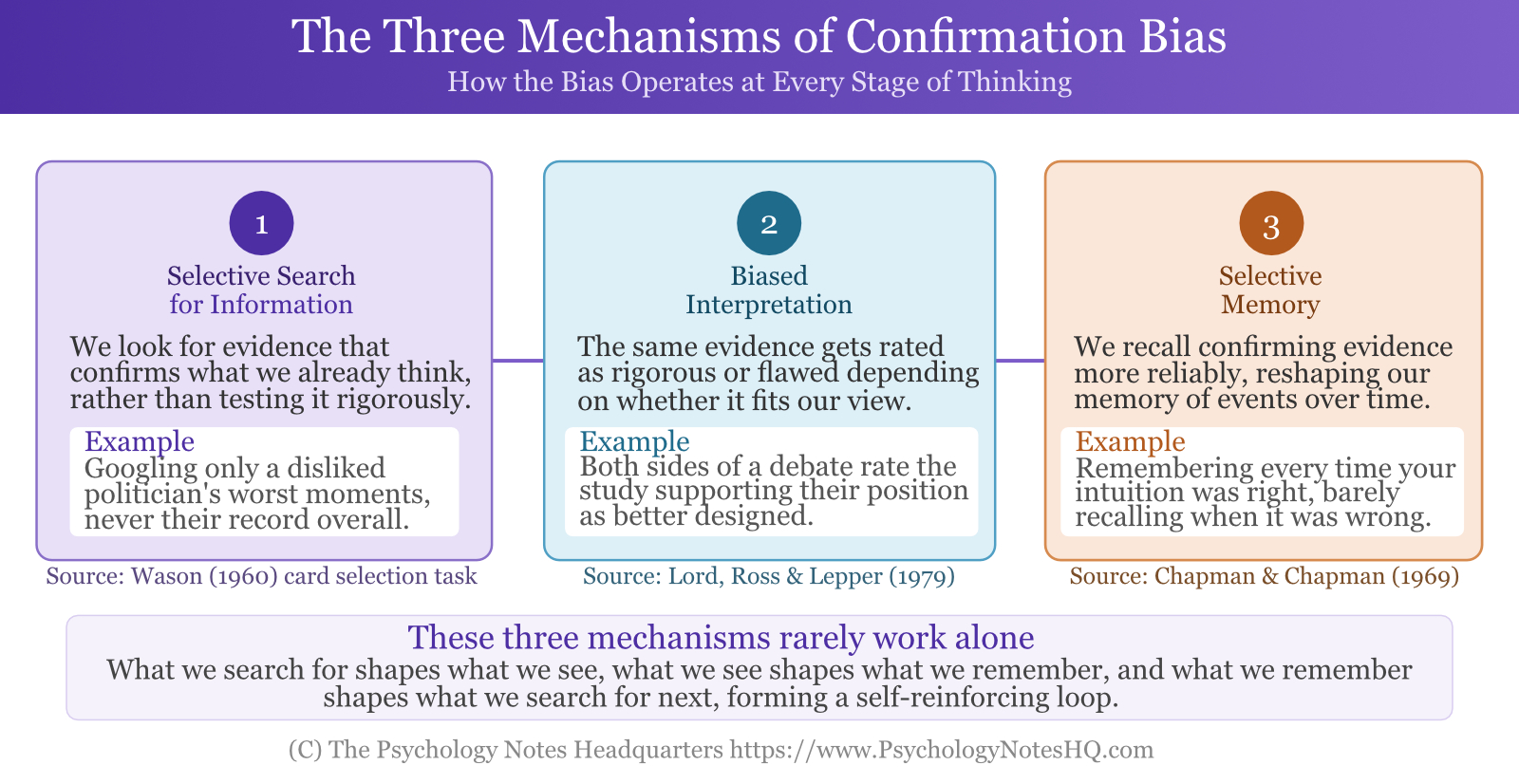
Confirmation bias is not a single process. Psychologists have identified three distinct but interacting mechanisms through which it operates.
Selective Search for Information
The first mechanism is the most visible: we look for evidence that confirms what we already think. When we form a hypothesis, even a casual one like “I think this candidate is unqualified” or “I think this treatment works,” we tend to ask questions and seek information designed to confirm it, rather than to test it rigorously.
Wason’s (1960) card selection task demonstrated this with striking clarity. Participants were shown four cards and a rule, and asked which cards they would need to turn over to test whether the rule was true. The overwhelming majority of participants chose only cards that could confirm the rule, not the cards that could falsify it. And this was in a purely abstract, non-emotional reasoning task with no personal stakes. The confirmation-seeking impulse ran even without personal investment.
In real life this looks like: the person who already dislikes a politician Googling that politician’s worst moments; the manager who thinks an employee is a poor performer reviewing only the files where they fell short; the patient convinced a supplement is helping them who reads testimonials but not clinical trials.
Biased Interpretation
The second mechanism operates once we have information in front of us. Even when both sides of an argument are presented with equal force, people with strong prior beliefs tend to rate the evidence supporting their view as more rigorous and the evidence challenging it as more flawed.
Lord, Ross, and Lepper (1979) demonstrated this in a landmark study. They showed participants, half of whom supported capital punishment and half of whom opposed it, two research studies on whether the death penalty deterred crime. One study supported deterrence; the other did not. Both groups rated the study supporting their position as better designed and more convincing, and the study challenging their position as methodologically weak. Having been exposed to the same evidence, both groups ended up more confident in their original position than before, not less. Exposure to mixed evidence had paradoxically strengthened polarization.
Selective Memory
The third mechanism is the most insidious because it reshapes the past. We remember evidence that fits our beliefs more reliably than evidence that doesn’t, which means our memory of events becomes an increasingly biased record over time.
Chapman and Chapman (1969) documented a version of this in clinical psychology, where practitioners “remembered” correlations between patient drawings and diagnoses that the data didn’t actually support, because the correlations matched their expectations. In everyday life it shows up as the person who remembers every time their intuition was right and barely recalls the times it led them wrong; the couple in conflict who each remember a detailed history of the other’s failures and a much vaguer record of their own.
Confirmation Bias Examples in Everyday Life
The confirmation bias definition becomes most useful when it’s applied. Here are some of the clearest confirmation bias examples from everyday contexts.
In politics, confirmation bias is structural. People select news sources that align with their existing views, interpret neutral policy proposals through a partisan lens, and remember the statements of politicians they distrust in the most damaging possible light. What makes social media particularly powerful as a confirmation bias amplifier is that the algorithms are designed to serve more of what you engage with, which means more of what already confirms your worldview. The filter bubble is not an accident; it is confirmation bias at industrial scale.
In relationships, once we form an impression of someone as trustworthy or unreliable, kind or selfish, we begin interpreting ambiguous behavior through that lens. The person we’ve decided is cold gets their neutral facial expression read as contempt. The person we’ve decided is generous gets their forgetfulness read as endearing absent-mindedness. The impression, once formed, becomes self-reinforcing through biased attention and memory. This connects to the patterns attribution theory describes: we make dispositional attributions for people we’ve already judged negatively, and situational attributions for those we favor.
In health and medicine, patients who believe a treatment is working report improvements more readily and attribute setbacks to other causes. Doctors who form an early diagnosis are susceptible to anchoring, continuing to interpret symptoms as consistent with that first hypothesis even when accumulating evidence points elsewhere. This is not a failure of competence; it is a documented feature of expert cognition under uncertainty. One of the more current confirmation bias examples in this space involves AI-powered symptom checkers and health chatbots: users who already suspect a diagnosis tend to phrase their symptoms in ways that steer the tool toward confirming what they already fear or hope is true, then treat the output as independent validation.
In the workplace, managers who form positive impressions of employees early tend to notice and remember their successes more readily, and to attribute mistakes to circumstance. Those who form negative impressions do the reverse. Performance review processes that lack structured evaluation criteria are particularly vulnerable to this pattern.
The Wason Selection Task: The Experiment That Proved It
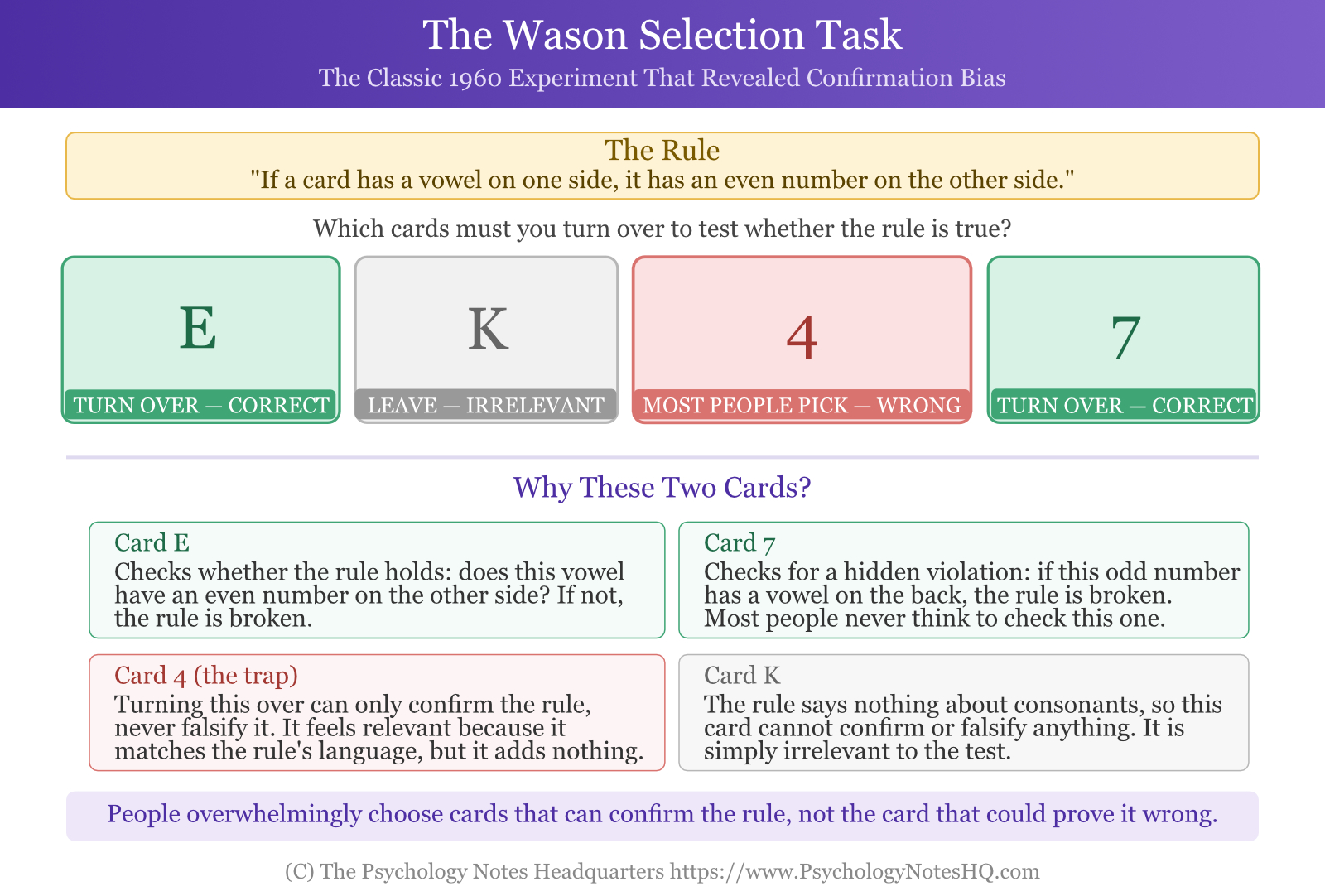
Wason’s 1960 card experiment remains one of the most replicated and discussed findings in cognitive psychology. Participants were shown four cards showing E, K, 4, and 7, and told the rule: “If a card has a vowel on one side, it has an even number on the other side.” They were asked which cards they needed to turn over to test whether the rule was true.
The correct answer is E and 7. E checks whether there’s an even number, and 7 checks whether there’s a vowel that would violate the rule. Most people choose E and 4 instead, the cards that can only confirm the rule, not the card that could falsify it.
What made this significant was its context. This was not a politically charged question, not an emotionally loaded scenario, not a domain where people had personal investment. It was a pure logic puzzle. And still, participants defaulted to seeking confirmation rather than disconfirmation. Wason’s conclusion that humans are biased toward seeking confirming rather than falsifying evidence as a default mode of reasoning has held up across decades of replication and extension (Nickerson, 1998).
Why Smart People Are Not Immune
A reasonable assumption might be that education, intelligence, or expertise protects against confirmation bias. The evidence suggests the opposite in important respects.
Stanovich and West (2007) found that people with higher cognitive ability showed stronger myside bias, the tendency to evaluate arguments in favor of their own position more favorably than arguments against it, not weaker. Smarter people, it turns out, are often better at generating reasons why the evidence supports what they already believe, which can make them more resistant to updating, not less. This has been called the “smart idiot” effect: intelligence amplifies the ability to rationalize, not just the ability to reason correctly.
Expert domains show the same pattern. Financial analysts show confirmation bias in their stock assessments. Physicians show it in diagnosis. Lawyers show it in case evaluation. The expertise provides domain knowledge but does not neutralize the underlying cognitive tendency. If anything, confidence in domain expertise can reduce the felt need to check for disconfirming evidence.
Confirmation Bias vs Related Concepts
It is worth distinguishing confirmation bias from three concepts it is frequently confused with.
Cognitive dissonance is the psychological discomfort of holding conflicting beliefs. Confirmation bias is one of the strategies the mind uses to avoid that discomfort, by filtering out evidence that would create the conflict in the first place. Dissonance is the feeling; confirmation bias is a mechanism that prevents the feeling from arising.
Motivated reasoning is the broader process of reasoning toward a desired conclusion. Confirmation bias can operate without a conscious desired outcome. Sometimes we filter evidence simply because of cognitive efficiency, not because we are trying to win an argument. Motivated reasoning implies more intentionality; confirmation bias can be entirely automatic.
The availability heuristic is the tendency to judge probability or frequency by how easily examples come to mind. Confirmation bias shapes what gets encoded in memory in the first place, so these two biases can compound each other. When biased memory makes confirming examples more available, confirmation bias and availability heuristic reinforce the same distorted conclusion.
When confirmation bias operates at the group level, where shared beliefs go unchallenged because everyone around the table already agrees, it contributes directly to groupthink, one of the most consequential collective reasoning failures documented in social psychology.
How to Reduce Confirmation Bias
Awareness is necessary but not sufficient. Simply knowing about confirmation bias does not reliably reduce it. What the research supports is more deliberate and structural.
The most consistently effective individual strategy is actively considering the opposite: deliberately generating reasons why your current belief might be wrong before finalizing a judgment (Galinsky and Moskowitz, 2000). The goal is not to convince yourself you are wrong. It is to genuinely engage with the disconfirming case, which breaks the automatic filtering process.
Pre-mortem thinking is a related technique: before committing to a decision, assume the decision turned out to be a mistake and work backward to explain why. This forces engagement with disconfirming scenarios in a way that feels productive rather than threatening.
Seeking out disconfirming evidence deliberately, not just waiting to see if it appears, is structurally important in high-stakes domains like medicine, law, and hiring. Checklists, structured evaluation criteria, and red team exercises exist partly to build this search into the process rather than relying on individual motivation to do it.
Finally, slowing down matters. Confirmation bias is stronger under time pressure and cognitive load. When decisions are important, building in time for considered evaluation, and where possible, separating the evidence-gathering phase from the evaluation phase, reduces the influence of first impressions and prior beliefs on how subsequent information is processed.
Conclusion
Confirmation bias is not a flaw in broken minds. It is a feature of all minds, a cognitive shortcut that generally serves us well in familiar environments but reliably distorts judgment when precision matters. The goal is not to eliminate it, which is not achievable, but to recognize its signature and create conditions that make it harder to operate unchecked. The most useful question you can train yourself to ask is not “Am I right?” but “What would it look like if I were wrong?” That question is uncomfortable by design. The discomfort is the point.
References
- Chapman, L. J., & Chapman, J. P. (1969). Illusory correlation as an obstacle to the use of valid psychodiagnostic signs. Journal of Abnormal Psychology, 74(3), 271-280.
- Galinsky, A. D., & Moskowitz, G. B. (2000). Perspective-taking: Decreasing stereotype expression, stereotype accessibility, and in-group favoritism. Journal of Personality and Social Psychology, 78(4), 708-724.
- Lord, C. G., Ross, L., & Lepper, M. R. (1979). Biased assimilation and attitude polarization: The effects of prior theories on subsequently considered evidence. Journal of Personality and Social Psychology, 37(11), 2098-2109.
- Nickerson, R. S. (1998). Confirmation bias: A ubiquitous phenomenon in many guises. Review of General Psychology, 2(2), 175-220.
- Stanovich, K. E., & West, R. F. (2007). Natural myside bias is independent of cognitive ability. Thinking and Reasoning, 13(3), 225-247.
- Wason, P. C. (1960). On the failure to eliminate hypotheses in a conceptual task. Quarterly Journal of Experimental Psychology, 12(3), 129-140.
How to cite this article:
The Psychology Notes Headquarters. (2026). Confirmation Bias Examples: How It Secretly Shapes You. Retrieved from https://www.psychologynoteshq.com/confirmation-bias/