
Groupthink Examples: The 8 Symptoms and the Fix Kennedy Found
Picture a group project meeting where everyone nods along to a plan you privately think is a mistake. You stay quiet because nobody else seems worried, and the plan sails through. Now put that same moment in a room full of presidential advisers or NASA managers, and you have some of the most famous groupthink examples in history. Psychologist Irving Janis studied these decisions and found the same eight warning signs showing up again and again. Once you know them, you will start spotting them in class, at work, and in your own friend group.
Key Takeaways
- Irving Janis did not actually invent the word “groupthink.” A journalist got there first, but Janis turned it into the theory psychology students are tested on today.
- A friendly, close-knit team is not enough to cause groupthink. Janis pointed to three conditions that leave a group vulnerable before anyone says a word.
- Most of the eight symptoms are easy to miss because they sound like teamwork. The most dangerous one looks like nothing at all.
- The same advisers who fell into groupthink at the Bay of Pigs made a far better call a year later, mostly by changing how their meetings worked.
- Groupthink also turns up in group projects and friend groups, and a few simple habits can stop it before a bad plan goes ahead.
What Is Groupthink?
Janis described groupthink as a way of thinking that takes over when members of a close-knit group care more about agreeing with each other than about realistically weighing their options (Janis, 1972). The decision feels solid inside the room. It only falls apart once it meets reality.
The word itself is older than the theory. Journalist William H. Whyte Jr. coined “groupthink” in a 1952 Fortune magazine article, using it to describe a culture of rationalized conformity (Pol et al., 2022). Janis, a Yale psychologist, gave the term its modern meaning in a 1971 Psychology Today article and then in his 1972 book, Victims of Groupthink.
This detail trips up a lot of students on exams. Whyte coined the word. Janis built the psychological theory behind it.
Groupthink is also not the same as a group simply agreeing. Healthy teams reach consensus all the time. The difference is how they get there. A healthy group argues, tests ideas, and then agrees. A group caught in groupthink agrees first and skips the testing.
Why Groupthink Happens: Janis’s Three Conditions
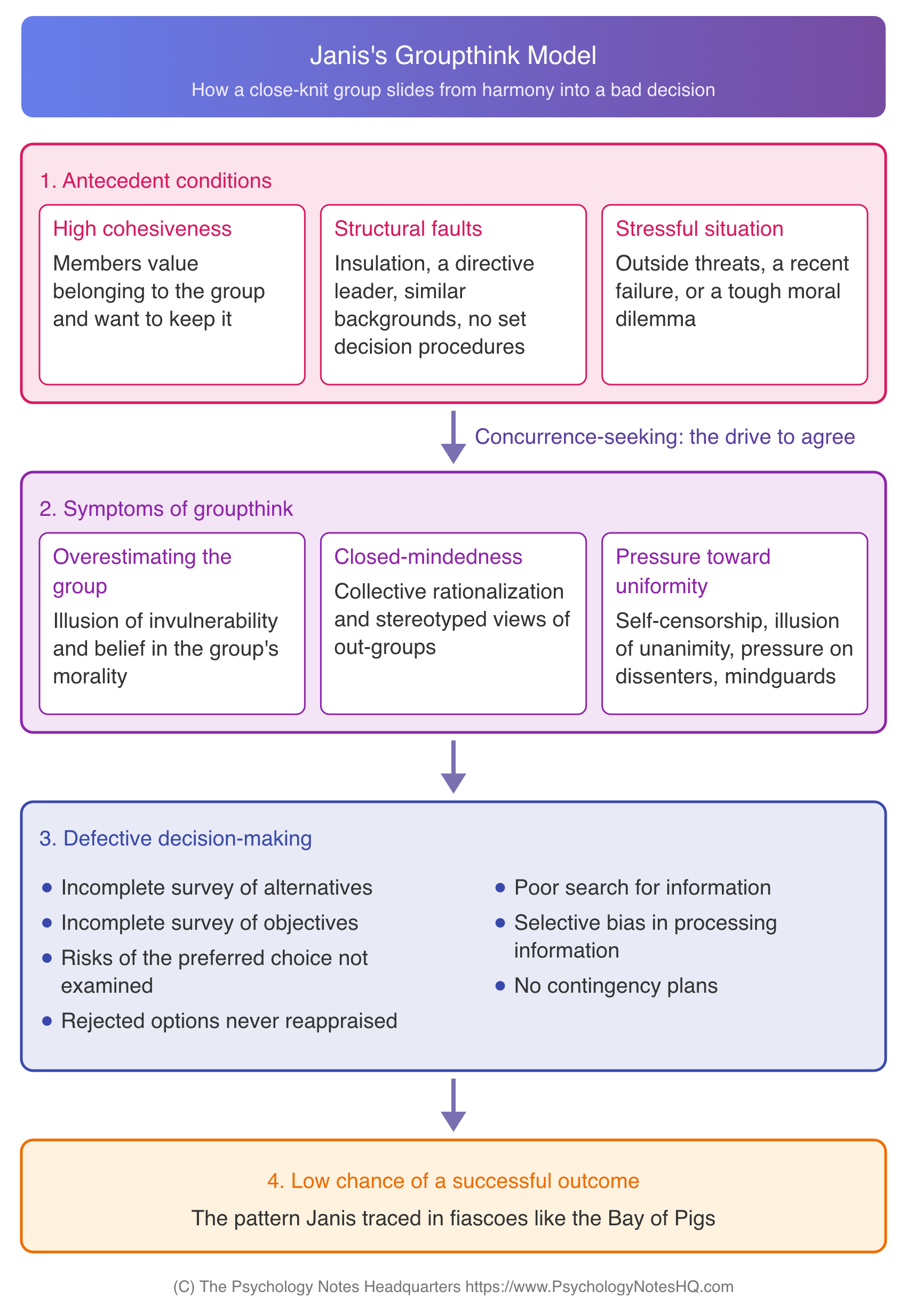
Groupthink rarely comes out of nowhere. Janis (1982) described three sets of antecedent conditions that push a group toward concurrence-seeking, a strong drive to reach agreement. His work built on earlier group dynamics research into how social forces shape what people do in groups.
High cohesiveness comes first. Members value belonging to the group and want to protect it. Cohesion alone does not cause groupthink, though. Plenty of close teams make excellent decisions.
Structural faults make a group more vulnerable. These include insulation from outside opinions, a leader who signals a preferred option early, members with very similar backgrounds, and no clear procedure for weighing alternatives.
A stressful situation adds the final push. Outside threats, a recent failure, or a painful moral dilemma all make quick agreement feel like relief.
The 8 Symptoms of Groupthink
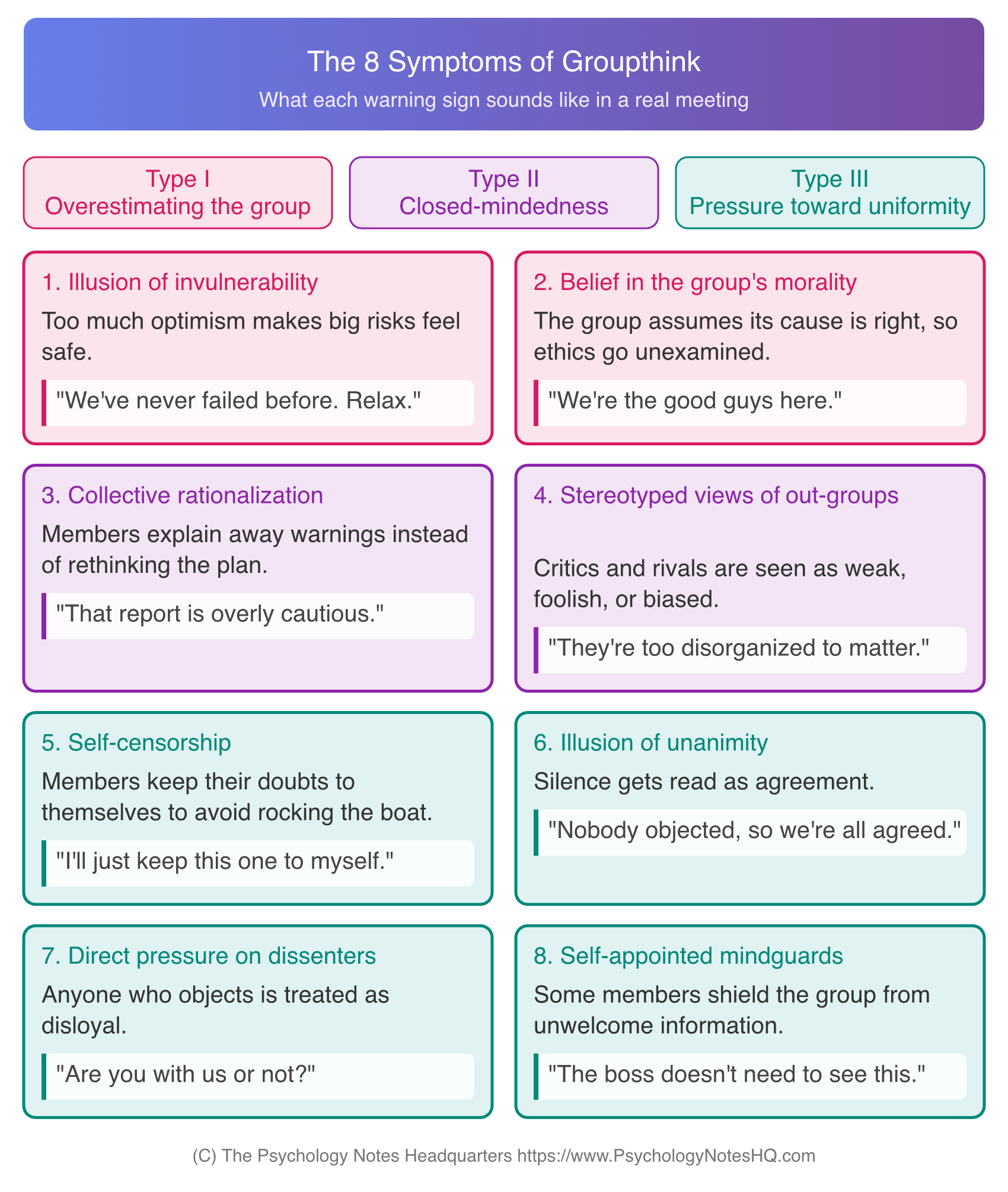
Janis sorted the symptoms into three types: overestimating the group, closed-mindedness, and pressure toward uniformity. Below, each symptom comes with the kind of line you might actually hear in a meeting.
Illusion of Invulnerability
This first Type I symptom is excessive optimism. Past success starts to feel like proof that failure is impossible, so the group takes risks it would normally avoid. Warnings get brushed off as too cautious.
What it sounds like: “We’ve never failed before. Relax.”
Belief in the Group’s Inherent Morality
Members assume their cause is right, so they stop asking whether their methods are. Ethical concerns feel unnecessary because “people like us” would never do anything wrong.
What it sounds like: “We’re the good guys here.”
Collective Rationalization
This Type II symptom happens when the group works together to explain away warning signs instead of rethinking the plan. Much like the discomfort described in cognitive dissonance theory, it feels easier to dismiss the bad news than to admit the plan might be flawed.
What it sounds like: “That report is overly cautious.”
Stereotyped Views of Out-Groups
Rivals, critics, and outsiders get painted as too weak, foolish, or biased to take seriously. It is the same us-versus-them thinking found in in-group and out-group psychology, and it lets the group ignore valid criticism by attacking whoever raised it.
What it sounds like: “They’re too disorganized to matter.”
Self-Censorship
Type III symptoms create pressure toward uniformity, and this one starts inside each person’s head. Members decide their doubts are probably not important enough to mention, especially when everyone else seems confident.
What it sounds like: “I’ll just keep this one to myself.”
Illusion of Unanimity
When nobody speaks up, the group assumes everyone agrees. The illusion of unanimity is the symptom that looks like nothing at all, because it is built from silence. It also feeds itself, since each quiet member makes the next doubter feel even more alone.
What it sounds like: “Nobody objected, so we’re all agreed.”
Direct Pressure on Dissenters
Anyone who does push back gets treated as disloyal or difficult. Disagreement is framed as not being a team player, which teaches everyone else to stay quiet next time.
What it sounds like: “Are you with us or not?”
Self-Appointed Mindguards
Some members take it upon themselves to protect the group from unwelcome information. They filter out bad news, discourage critics from reaching the leader, and keep the consensus comfortable.
What it sounds like: “The boss doesn’t need to see this.”
What Groupthink Does to Decisions
Janis (1982) linked these symptoms to seven defects in how groups make decisions. Groups survey too few alternatives and too few objectives. They fail to examine the risks of their preferred choice and never go back to options they rejected early.
They also search poorly for information and process what they find selectively, a group-level version of confirmation bias. Finally, they skip contingency plans, because planning for failure feels unnecessary when everyone is sure of success.
Groupthink Examples From History
The best-known groupthink examples come from high-stakes decisions where smart, experienced people talked themselves into plans that failed.
The Bay of Pigs Invasion (1961)
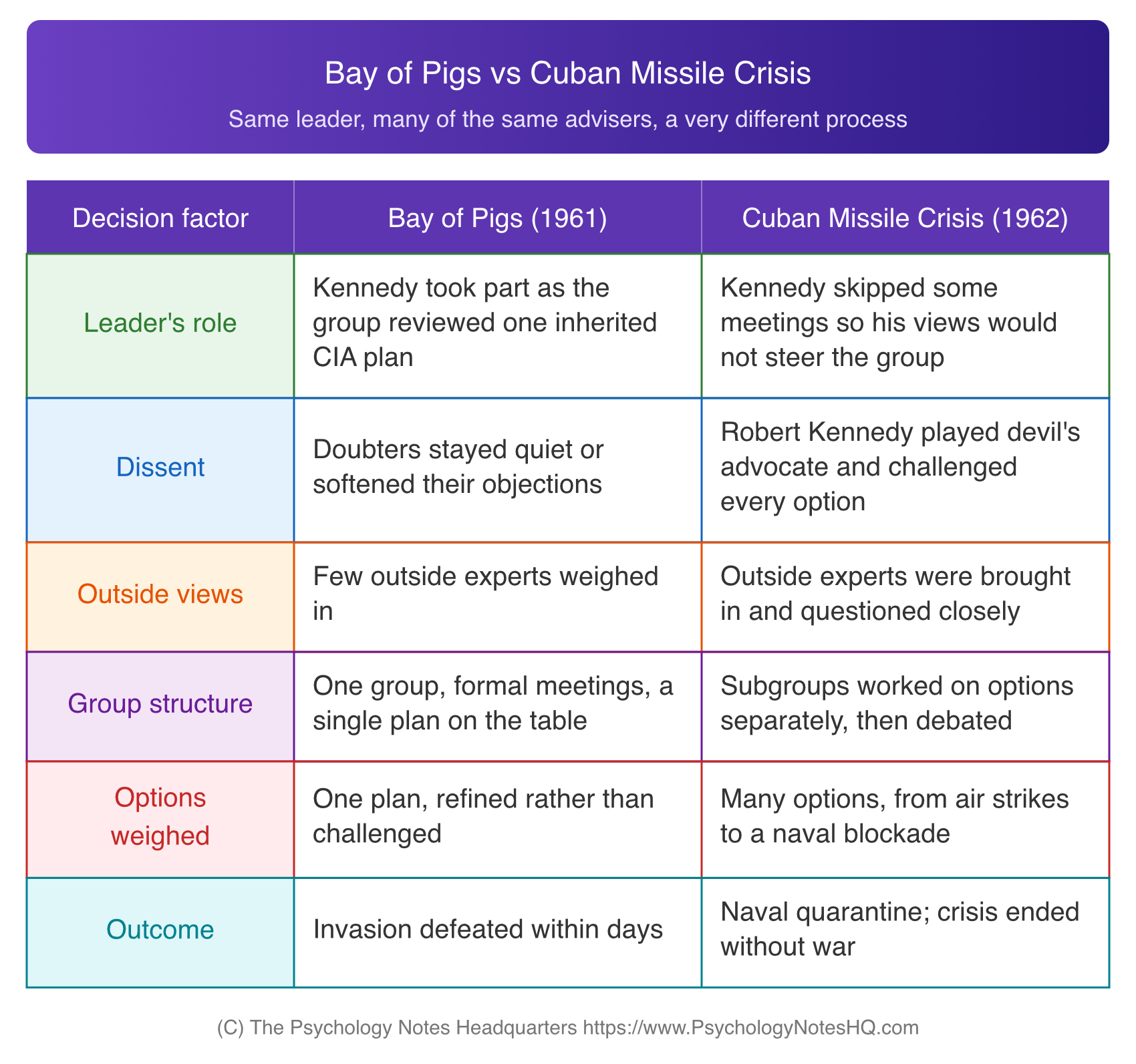
In April 1961, about 1,400 CIA-trained Cuban exiles landed at the Bay of Pigs, expecting to spark an uprising against Fidel Castro. The invasion collapsed within days. Janis (1982) made it his signature case because Kennedy’s advisers were widely seen as exceptionally capable.
Several advisers had doubts but kept them mostly to themselves. Arthur Schlesinger Jr. later regretted his near silence, and Janis described Robert Kennedy privately urging him to drop his objections, a textbook mindguard move. With so few voices raised, the group mistook quiet for consent, a clear case of the illusion of unanimity.
Pearl Harbor (1941)
Janis also studied Admiral Husband Kimmel and his naval officers in Hawaii. They received repeated warnings about possible Japanese aggression but assumed Japan would not risk attacking such a heavily defended base so far from home. That mix of invulnerability and out-group stereotyping left the fleet unprepared, and the attack killed more than 2,400 Americans.
The Challenger Disaster (1986)
Engineers at Morton Thiokol warned that the shuttle’s O-ring seals might fail in the unusually cold launch-day temperatures. After pushback from NASA, Thiokol managers reversed the no-launch recommendation, and the concerns never reached NASA’s top officials. NASA’s long record of successful flights made disaster feel unthinkable. Challenger broke apart 73 seconds after liftoff, killing all seven crew members.
Janis did not analyze this case himself. Later researchers coded statements from the official investigation and found signs of groupthink twice as often as signs against it (Esser & Lindoerfer, 1989).
Iraq WMD Intelligence (2002 to 2003)
In its 2004 review of prewar intelligence, the U.S. Senate Select Committee on Intelligence (2004) concluded that the intelligence community shared a collective presumption that Iraq had active weapons of mass destruction programs. The committee called it a “group think” dynamic: analysts read ambiguous evidence as conclusive and played down evidence that pointed the other way.
Groupthink Examples in Everyday Life
You do not need a war room to fall into groupthink. It shows up anywhere a group values getting along.
Group projects. Four students settle on the first topic someone suggests. Two of them think it is too broad, but nobody wants to slow things down. Group projects already invite problems like social loafing, and groupthink adds a second trap: a plan nobody actually tested.
Friend group plans. A group books an expensive trip after one enthusiastic person pitches it. Several friends privately worry about the cost, but each assumes they are the only one.
Workplace teams. A team keeps pouring time into a project the manager loves. The one colleague who questioned it early gets labeled negative, and nobody else raises the issue again.
Sports teams and clubs. A coaching staff sticks with a game plan that keeps failing because the head coach designed it. The assistants see the problem, but questioning the boss in front of the team feels disloyal.
Online communities. Members who question the group’s shared view get mocked or blocked, and moderators remove posts that challenge the consensus. Those moderators are acting as mindguards, whether they realize it or not.
How Kennedy Fixed Groupthink
The hopeful part of Janis’s work is that groupthink is not permanent. In October 1962, Kennedy faced the Cuban Missile Crisis with many of the same advisers who had planned the Bay of Pigs. Janis (1982) treated it as a model of careful, vigilant decision-making.
After the 1961 fiasco, Kennedy changed how the group worked. He skipped some meetings so his own views would not steer the discussion. Robert Kennedy and Ted Sorensen were tasked with challenging every assumption. Subgroups developed options separately, outside experts were brought in, and the group weighed alternatives from air strikes to a naval blockade before choosing a quarantine. The crisis ended without war.
How to Avoid Groupthink
Janis (1982) turned lessons like Kennedy’s into practical safeguards. Most of them work just as well in a study group as in the White House.
Keep the leader impartial at first. When the person in charge shares a preference early, everyone else tends to line up behind it. Leaders should ask for views before offering their own.
Assign a devil’s advocate. Give one person the job of challenging the plan, and rotate the role so it never becomes one person’s reputation.
Split into subgroups. Two small teams working on the same problem separately will usually produce different ideas that the full group then has to debate.
Bring in outsiders. Invite someone from outside the group to poke holes in the plan, and encourage members to talk it over with people they trust.
Hold a second-chance meeting. Once a decision seems settled, meet again and give everyone one last chance to voice lingering doubts.
For your next group project, try one simple rule: before voting on any plan, each person names one thing that could go wrong. It takes five minutes and turns doubt into a normal part of the process instead of a threat to the group.
Groupthink vs Related Concepts
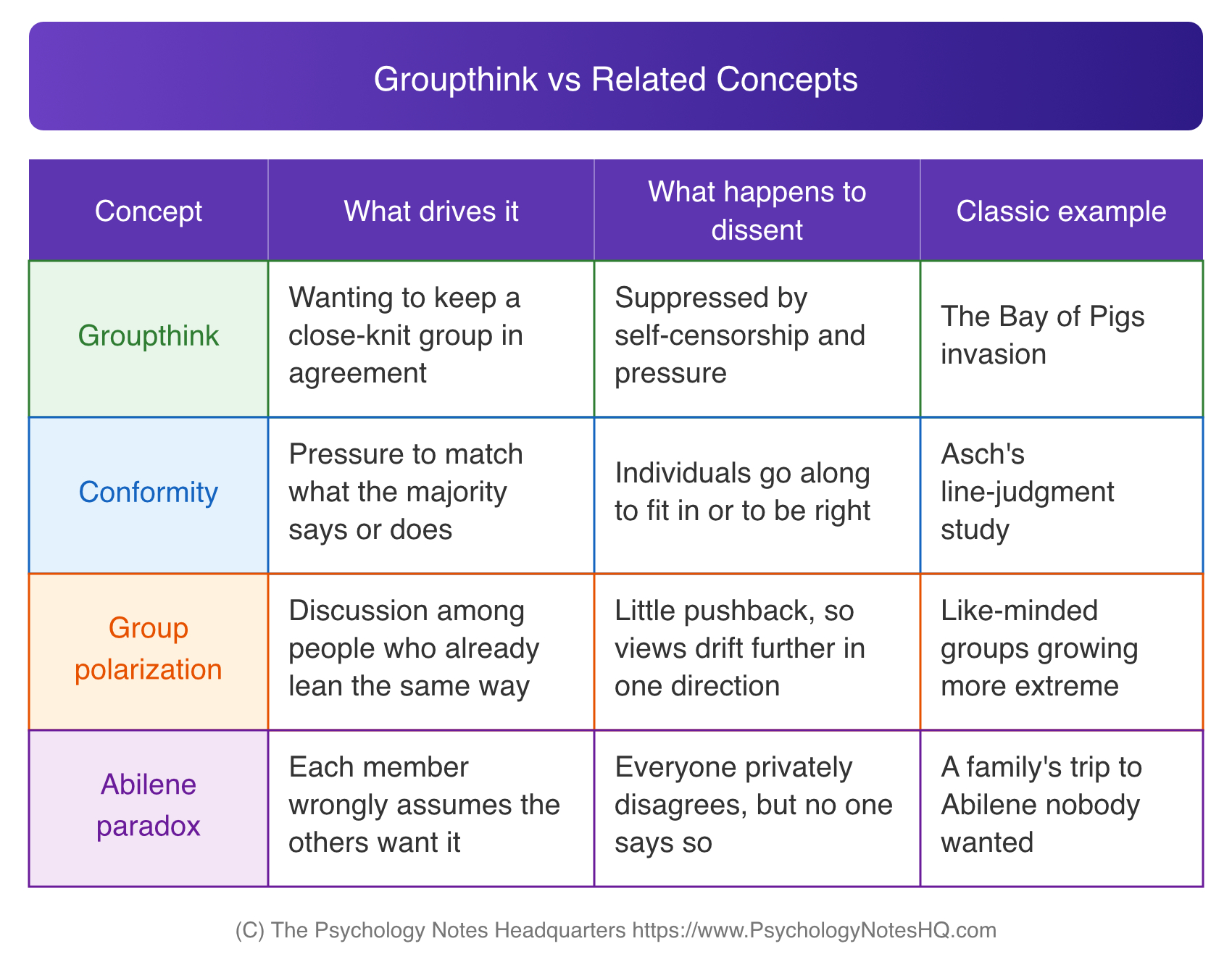
Groupthink overlaps with several classic social psychology ideas, and exam questions love to test the differences.
Research on conformity, such as Asch’s line studies, shows individuals going along with a majority on simple judgments. Groupthink is narrower, focusing on flawed decisions inside cohesive groups. It also differs from obedience, which Milgram’s obedience experiment studied as following an authority figure’s orders.
Group polarization happens when discussion pushes a group’s shared leaning further in the same direction, even when everyone feels free to speak. Groupthink, by contrast, is defined by suppressed doubt.
The Abilene paradox describes a group agreeing to something nobody actually wants, because each member wrongly assumes the others want it (Harvey, 1974). In groupthink, members often do believe in the plan.
You may also see the phrase “groupthink bias.” Groupthink is better understood as a group process than a single cognitive bias, though individual biases clearly feed into it.
Does the Research Support Groupthink?
Historical case studies made groupthink famous, but laboratory evidence has been mixed. In a review marking the theory’s 25th anniversary, Esser (1998) found only a small, growing body of empirical work, and cohesion did not reliably predict groupthink the way Janis expected.
Baron (2005) went further with his ubiquity model, arguing that groupthink-style symptoms are common in everyday groups and do not require all of Janis’s antecedent conditions. Janis’s exact model may need revising, but his central warning still holds: groups can value harmony so much that they stop thinking clearly.
Conclusion
These groupthink examples all share one pattern: capable people who valued harmony more than honest debate. Groupthink usually hides behind something that looks like teamwork. The eight symptoms give you a checklist for spotting it, from the illusion of invulnerability to quiet mindguards. The Kennedy story shows the fix is often surprisingly simple: make disagreement safe, invite outside eyes, and never mistake silence for consent.
References
- Baron, R. S. (2005). So right it’s wrong: Groupthink and the ubiquitous nature of polarized group decision making. Advances in Experimental Social Psychology, 37, 219-253.
- Esser, J. K. (1998). Alive and well after 25 years: A review of groupthink research. Organizational Behavior and Human Decision Processes, 73(2-3), 116-141.
- Esser, J. K., & Lindoerfer, J. S. (1989). Groupthink and the space shuttle Challenger accident: Toward a quantitative case analysis. Journal of Behavioral Decision Making, 2(3), 167-177.
- Harvey, J. B. (1974). The Abilene paradox: The management of agreement. Organizational Dynamics, 3(1), 63-80.
- Janis, I. L. (1972). Victims of groupthink: A psychological study of foreign-policy decisions and fiascoes. Houghton Mifflin.
- Janis, I. L. (1982). Groupthink: Psychological studies of policy decisions and fiascoes (2nd ed.). Houghton Mifflin.
- Pol, O., Bridgman, T., & Cummings, S. (2022). The forgotten ‘immortalizer’: Recovering William H Whyte as the founder and future of groupthink research. Human Relations, 75(8), 1615-1641.
- U.S. Senate Select Committee on Intelligence. (2004). Report on the U.S. intelligence community’s prewar intelligence assessments on Iraq (S. Rep. No. 108-301).
How to cite this article:
The Psychology Notes Headquarters. (2026). Groupthink Examples: The 8 Symptoms and the Fix Kennedy Found. Retrieved from https://www.psychologynoteshq.com/groupthink/