
Contralateral Hemispheric Organization: Why Your Left Brain Controls Your Right Side
A person has a stroke on the left side of their brain, and it’s their right hand that stops working. That strange crossover is contralateral hemispheric organization in action, and it’s one of the most tested ideas in intro and AP psychology. Your brain hemispheres are wired to the opposite side of your body, but the reasons behind that wiring, and what happens when the two halves stop talking, turn out to be far stranger than any “left-brained vs right-brained” quiz suggests.
Key Takeaways
- Damage to one side of the brain shows up on the opposite side of the body, but the nerve fibers behind this crossover don’t all cross at the same spot.
- Vision follows its own crossover rule, and it has nothing to do with which eye sees something.
- A thick bridge of nerve fibers keeps your two hemispheres in constant conversation. Cut it, and something remarkable happens.
- Sperry and Gazzaniga’s Nobel Prize-winning research revealed what each hemisphere can do alone, including things one half of the brain can know but never say.
- Hemispheric specialization is real, yet brain scans of more than 1,000 people found no evidence for “left-brained” or “right-brained” personalities.
The Two Brain Hemispheres: Basic Anatomy
The human brain divides physically into a left hemisphere and a right hemisphere, separated by a deep groove called the longitudinal fissure. From above, the two halves look nearly identical, like mirror images sharing the same layout.
Each hemisphere contains the same four cortical lobes: the frontal lobe (planning and voluntary movement), the parietal lobe (sensory input), the temporal lobe (hearing and memory), and the occipital lobe (vision). Beneath the cortex, each side also houses its own thalamus, hippocampus, and other subcortical structures.
This symmetry already hints that your left and right hemispheres aren’t built for completely different jobs. Both stay active during virtually all cognitive tasks, whether you’re solving a math problem, listening to music, or recognizing a familiar face. Even the way the brain interprets apparent motion, as in the phi phenomenon, depends on both sides working together.
The differences that do exist are differences of degree, not capability. Both hemispheres take part in language, spatial reasoning, emotion, and every other area of mental life. The brain’s architecture is built for integration, not division.
What Is Contralateral Hemispheric Organization?
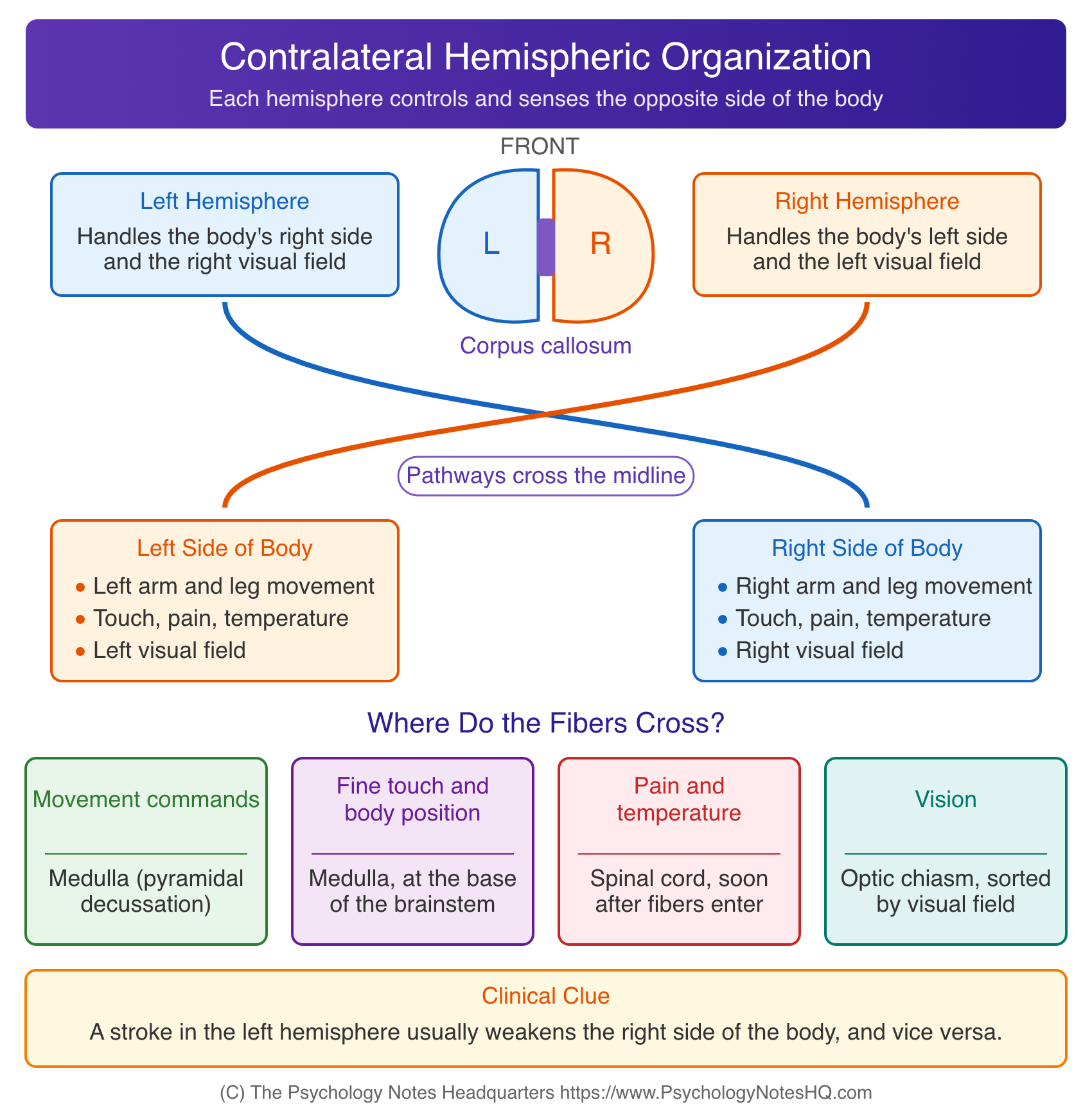
Picture a patient in the emergency room who suddenly can’t lift their left arm. Before any scan comes back, the neurologist already suspects a problem in the right hemisphere. That educated guess rests on contralateral hemispheric organization: each hemisphere controls movement on, and receives sensation from, the opposite side of the body.
So the left hemisphere runs the right arm and right leg, while the right hemisphere handles the left. The crossover applies to both motor output (commands sent to muscles) and sensory input (signals from touch, pain, and temperature receptors).
Where does the crossing actually happen? It depends on the pathway. Most fibers carrying voluntary movement commands cross over, or decussate, in the medulla at the base of the brainstem. Fine touch signals also cross in the medulla, while pain and temperature fibers cross almost as soon as they enter the spinal cord (Kolb & Whishaw, 2015). Different routes, same result: each side of the body reports to the opposite hemisphere.
This is why a stroke in the left hemisphere typically causes weakness or paralysis on the right side of the body. Neurologists and clinical psychologists use this pattern every day to locate brain damage based on which side of the body is affected.
Vision follows a slightly different rule. Each eye sends information to both hemispheres. What matters is not which eye sees something but which visual field it falls in.
Anything to the right of where you’re looking goes to the left hemisphere, and anything to the left goes to the right hemisphere. The sorting happens at the optic chiasm, where fibers from the nose-side half of each retina cross over. This split visual pathway is exactly what made the split-brain experiment possible.
One vocabulary pair shows up on exams again and again. Contralateral means “opposite side,” while ipsilateral means “same side.” Most cortical control is contralateral, but not every brain structure follows that rule. The cerebellum, which fine-tunes balance and coordinated movement, influences the same side of the body, so damage to the left cerebellum tends to affect coordination on the left. Keeping the two terms straight makes clinical case questions much easier to untangle.
Hemispheric differences also show up in emotional processing. The right hemisphere plays a particular role in reading emotional tone, facial expressions, and the emotional melody of speech, a thread that connects to the major theories of emotion. Both hemispheres still contribute to the full emotional experience.
The Corpus Callosum: How the Two Hemispheres Communicate
Running along the brain’s midline is a thick band of roughly 200 to 250 million nerve fibers called the corpus callosum. It is the largest white matter structure in the brain and the main channel the two hemispheres use to exchange information.
Signals cross this bridge in milliseconds, far too fast for you to notice any delay. When you read a sentence, the left hemisphere handles grammatical structure while the right contributes context and emotional nuance. What you experience is one act of comprehension, not two competing interpretations. The corpus callosum is what produces that seamless unity.
Some sophisticated social abilities also lean on this integration. Theory of mind, the ability to understand that other people hold beliefs and intentions different from your own, is one example. Research has linked disrupted corpus callosum connectivity to difficulties with social cognition and perspective-taking.
The popular claim that people “use one hemisphere more than the other” has no neurological foundation. Both hemispheres stay active across essentially all tasks, and the corpus callosum makes that teamwork invisible to conscious experience. Take the bridge away, and the teamwork suddenly becomes very visible.
Sperry and Gazzaniga’s Split-Brain Experiments
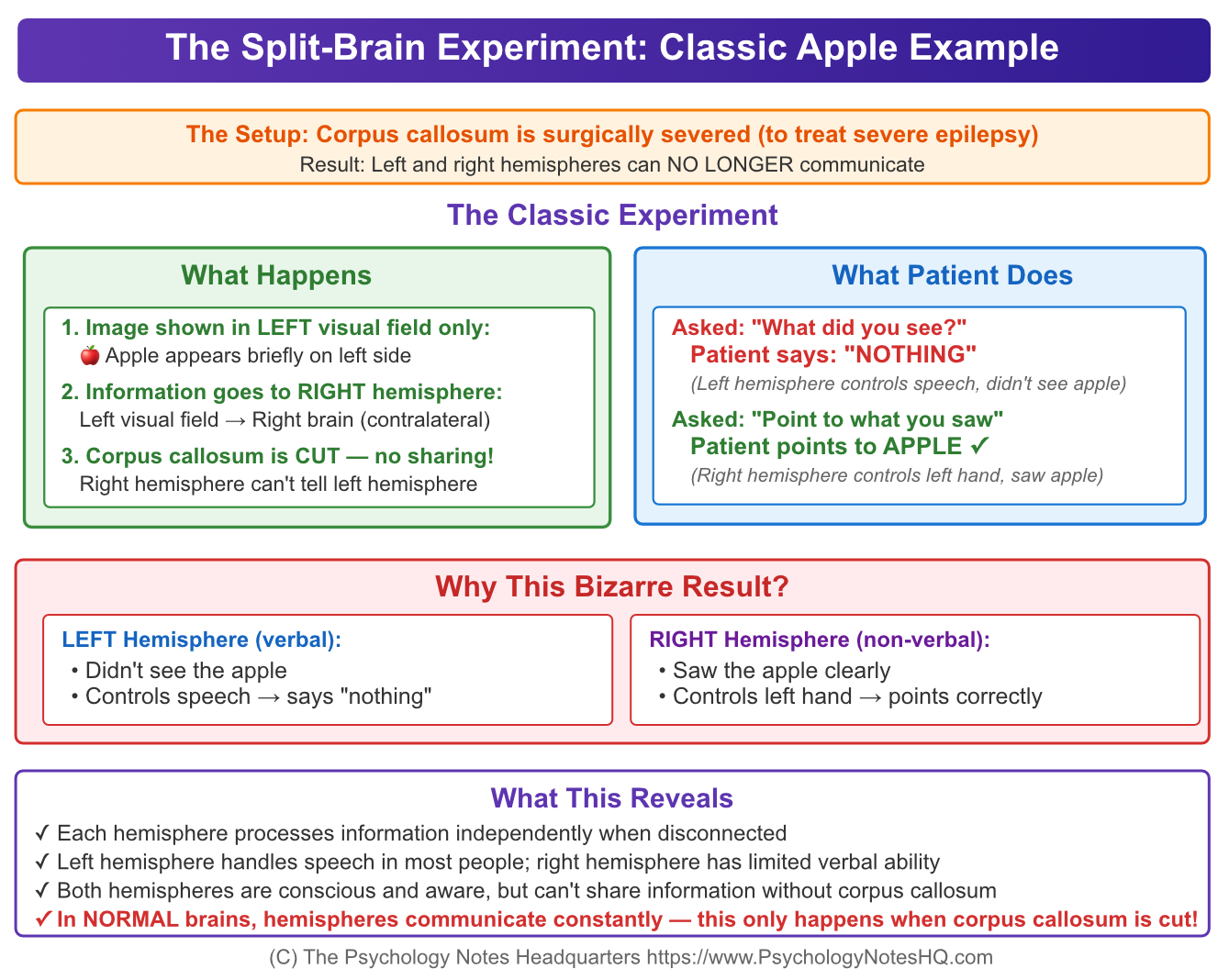
During the 1960s, neuroscientist Roger Sperry and his student Michael Gazzaniga studied patients whose corpus callosum had been surgically cut to treat severe, medication-resistant epilepsy. The procedure, called a corpus callosotomy, stopped seizures from spreading between hemispheres. It also opened an unprecedented window into what each hemisphere can do on its own (Gazzaniga, 2005).
In everyday life, these patients seemed entirely normal. They walked, talked, and held conversations without obvious problems. The disconnection only showed up under carefully controlled lab conditions designed to send information to just one hemisphere.
In a typical version of the split-brain experiment, a patient stared at a dot in the center of a screen. An image of an apple flashed briefly in the left visual field, too fast for the eyes to shift, so it reached only the right hemisphere. Asked what they saw, the patient answered, “Nothing.”
That wasn’t evasion or confusion. The speaking left hemisphere genuinely never received the image. But when the patient reached behind a screen and felt through a group of objects with the left hand, that hand picked out the apple right away.
The right hemisphere had seen the apple perfectly and guided the hand it controls. It just couldn’t put the answer into words, because speech production relies mainly on the left hemisphere. Two parts of the same person held different information with no way to share it. The left hand knew something the mouth couldn’t say.
Things got even stranger when the left hemisphere had to explain actions it didn’t start. In later studies, Gazzaniga found that the verbal left hemisphere would quickly invent a plausible reason for behavior actually driven by the right hemisphere, delivering the story with complete confidence. He called this storytelling system the “interpreter,” and it remains one of the most discussed findings to come out of split-brain research (Gazzaniga, 2005).
These findings don’t show how normal brains operate. They show what each hemisphere can do in isolation. The right hemisphere can recognize objects and understand simple language but has very limited speech output, while the left hemisphere speaks fluently but is cut off from what the right has processed. Sperry received the Nobel Prize in Physiology or Medicine in 1981 for this work (Sperry, 1982).
Left vs Right Hemisphere: What Each Side Actually Does
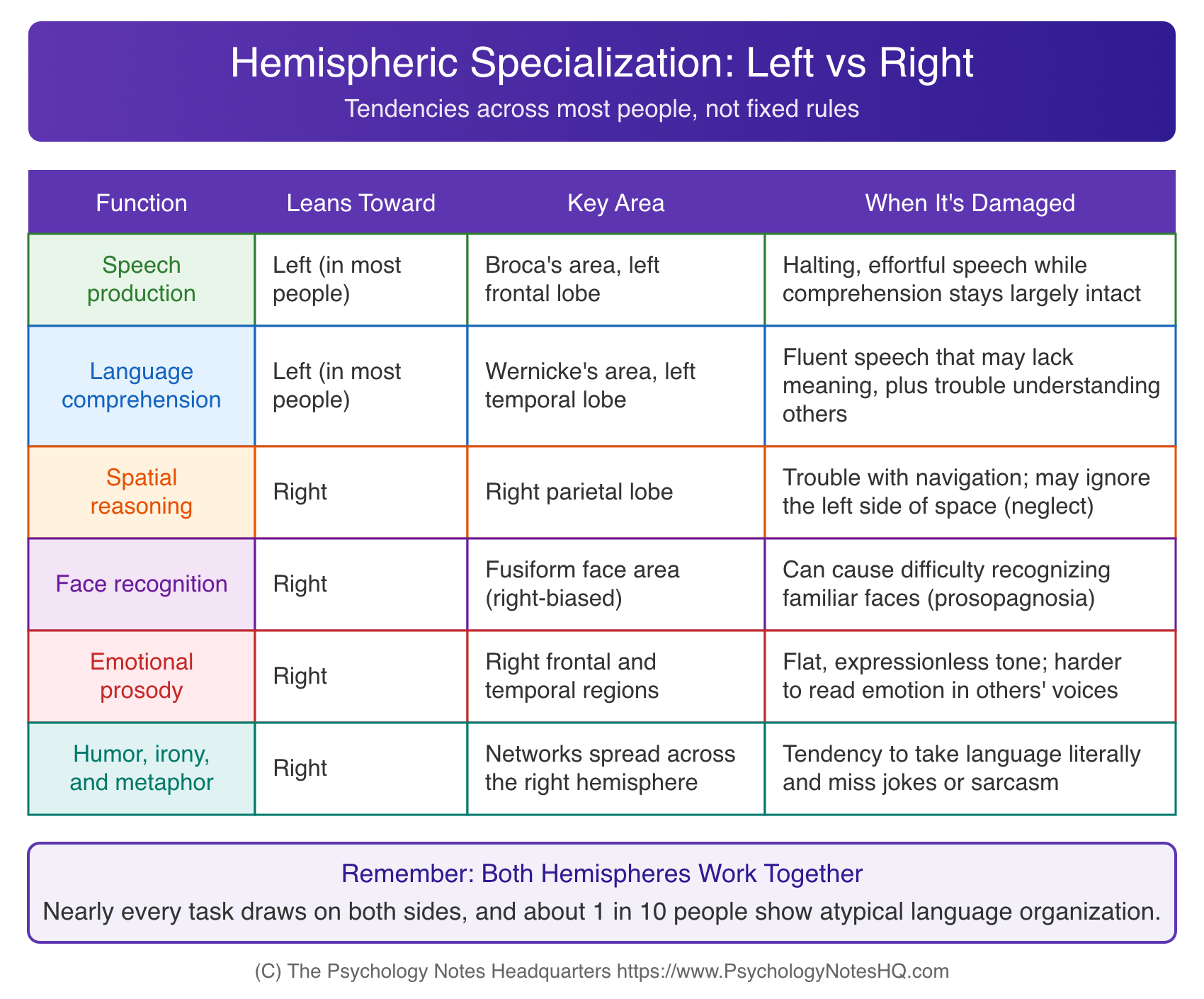
Hemispheric specialization is real, but it is task-specific and probabilistic rather than sweeping. The differences describe tendencies across populations, not fixed rules for individuals, and neither hemisphere works as a self-contained unit.
In most right-handed people, the left hemisphere houses the main language areas. Broca’s area in the left frontal lobe supports speech production, and Wernicke’s area in the left temporal lobe supports language comprehension. The left hemisphere also leans toward sequential, step-by-step processing and fine-grained analysis of detail and grammar.
The right hemisphere shows relative specialization for spatial reasoning and navigation. It takes the lead in face recognition, relying heavily on a region with a strong right-side bias called the fusiform face area.
It also handles prosody, the rhythm and emotional melody of speech. That’s why right hemisphere damage can leave someone speaking grammatically correct sentences in a flat, expressionless voice. Understanding humor, irony, and metaphor also recruits right hemisphere processes, because these tasks require reading beyond the literal meaning of words.
Higher-order thinking draws on both sides. Metacognition, your ability to monitor and regulate your own thinking, relies on networks spanning both hemispheres. There is no “metacognitive side.” The same goes for math, creativity, music, and logic.
Individual differences matter too. Roughly 10 percent of people show reversed or bilateral language organization, and left-handers show more variable lateralization than right-handers (Kolb & Whishaw, 2015). Specialization describes a central tendency in the population, not a universal blueprint.
Debunking the Left-Brain/Right-Brain Personality Myth
The popular framework sorts people into analytical, logical “left-brainers” and creative, intuitive “right-brainers.” It has fueled a whole industry of quizzes, educational programs, and self-help content, none of it backed by science.
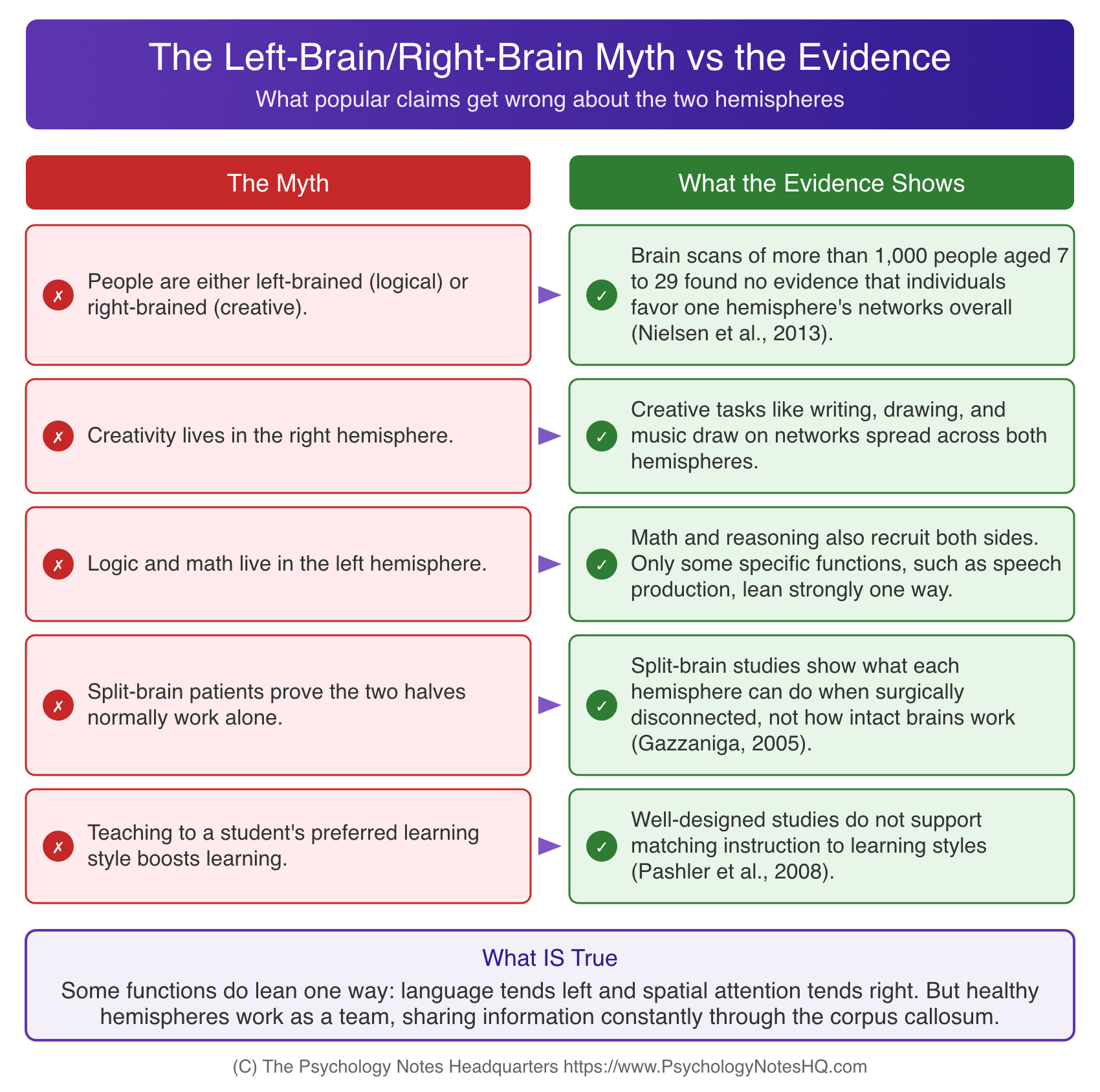
The most decisive evidence came from a 2013 University of Utah study. Researchers analyzed resting-state fMRI data from more than 1,000 people aged 7 to 29, looking for signs that individuals rely more heavily on one hemisphere’s networks overall. They found none (Nielsen et al., 2013).
Some specific functions were lateralized, with language leaning left and attention leaning right. But no one showed a stronger left-sided or right-sided brain network across the board. Solving equations, writing poetry, and creating visual art all activate networks in both hemispheres.
So why does the myth hang on? Confirmation bias leads people to notice what fits their self-image and dismiss the rest. Cognitive dissonance makes revising a personally meaningful belief uncomfortable, even when the evidence is clear.
The idea also spreads efficiently through social learning. Once teachers, coaches, and parents absorb it, they model it and pass it on to the next generation as received wisdom.
The learning styles myth follows the same pattern. It claims students learn best through a dominant sensory channel, such as visual, auditory, or kinesthetic. Like the hemisphere myth, it has been tested repeatedly and lacks empirical support (Pashler et al., 2008).
Neuroplasticity: When a Hemisphere Is Damaged
Neuroplasticity is the brain’s capacity to reorganize itself by forming new neural connections (Pascual-Leone et al., 2005). It becomes most dramatic when one hemisphere is severely damaged. The brain doesn’t passively accept the loss. It actively redistributes what it can, especially early in development.
Children show this most strikingly. When a young child sustains major damage to the left hemisphere, where language usually lives, the right hemisphere can take over language functions. With time and therapy, speech and comprehension can come close to typical. The younger the child at the time of injury, the more extensive this reorganization can be.
Hemispherectomy, the surgical removal or disconnection of an entire hemisphere, is performed in rare cases of severe childhood epilepsy that no other treatment can control. Many of these children go on to attend school and develop language and social skills. The remaining hemisphere takes on work it was never originally assigned.
In adults, plasticity works on a smaller scale but still matters clinically. After a stroke, surviving tissue near the damage and the opposite hemisphere can both increase their contribution to affected abilities. That’s why intensive physical, occupational, and speech therapy matters so much: it actively promotes reorganization rather than simply waiting for lost skills to return.
Research on learned helplessness makes a related point about behavior: entrenched patterns can change, but only with deliberate, structured effort. Plasticity has real limits, and adult recovery rarely matches what children achieve. Still, the same experience-dependent principles behind all learning, including classical conditioning, help explain why the brain keeps adapting.
Conclusion
The brain hemispheres aren’t rival personalities sharing one skull. They’re integrated partners, linked by the corpus callosum. Contralateral hemispheric organization explains why damage on one side of the brain shows up on the opposite side of the body, a pattern clinicians rely on every day.
The split-brain experiment revealed genuine specialization while confirming that normal thinking depends on integration. Neuroplasticity shows how much the brain can adapt, even after serious damage. And the left-brain/right-brain personality idea? Memorable, marketable, and wrong.
References
- Gazzaniga, M. S. (2005). Forty-five years of split-brain research and still going strong. Nature Reviews Neuroscience, 6(8), 653–659.
- Kolb, B., & Whishaw, I. Q. (2015). Fundamentals of human neuropsychology (7th ed.). Worth Publishers.
- Nielsen, J. A., Zielinski, B. A., Ferguson, M. A., Lainhart, J. E., & Anderson, J. S. (2013). An evaluation of the left-brain vs. right-brain hypothesis with resting state functional connectivity magnetic resonance imaging. PLOS ONE, 8(8), e71275.
- Pascual-Leone, A., Amedi, A., Fregni, F., & Merabet, L. B. (2005). The plastic human brain cortex. Annual Review of Neuroscience, 28, 377–401.
- Pashler, H., McDaniel, M., Rohrer, D., & Bjork, R. (2008). Learning styles: Concepts and evidence. Psychological Science in the Public Interest, 9(3), 105–119.
- Sperry, R. W. (1982). Some effects of disconnecting the cerebral hemispheres. Science, 217(4566), 1223–1226.
How to cite this article:
The Psychology Notes Headquarters. (2026). Contralateral Hemispheric Organization: Why Your Left Brain Controls Your Right Side. Retrieved from https://www.psychologynoteshq.com/brain-hemispheres/
Hi Alexandra,
Firstly thank you for all your posts they are really helpful. I am a psychology teacher in a school and I have to start the chapter of Attitude and Social Behavior with students.I would appreciate if you can send me the tutorial for the same.
Regards
Ravdeep Kaur
Hi Ravdeep,
I’m glad to hear that the posts are helpful to you. I’ll add your suggested topic to my to-do list.
Thanks,
A.
hi Alexandra.
God bless you for your post I’m really benefiting from them.i will to know more about threshold potential and synthesis of neurotransmitters
Hi Harriet,
Thanks for the comment. I had written a post on neurons a little while ago and had sort of touched on threshold potential and neurotransmitters. You may want to check it out. I’ll add your topics to my to-do list and write a post that is more specific to them later.
Thanks again for your comment,
A.
Hello Alexandra
I also want to know how to train babies.What is the training session to develop their brains.What goes on in their brains.And everything related to their brain development,so that I can train my baby.
Ur notes are simple and effective.I hope I get to read them as soon as possible
Hi Samruddha,
Thanks for the comment. I’ll add these to my to-do list. Meanwhile, you may want to check out one of the two free psychology notes eBooks that you get when you subscribe to my mailing list. There is a section on developmental psychology.
Take care,
A.
Hi Alex
Am really grateful for your posts and wish to thank you for such a kind gesture. They are very helpful. Am a psychology student, in my 300 level, we have done gestalt theory and phi phinomenon, but l still need your help on the topic please.
Thanks alot
Hi Joy,
Thanks for the comment. I’ll add these topics to my to-do list.
Take care,
A.
thank you for posting these helpful notes to me iam so grateful continue helping me iam a psychology 100
Hi Terry,
You’re very welcome. Have you downloaded the 2 free ebooks?
A