
Phi Phenomenon: How Two Flashing Lights Changed Psychology
Two stationary lights sit side by side. One flashes and goes dark, then the other flashes. Nothing moves, yet the observers see a single light travelling across the gap. That deceptively simple result, now called the phi phenomenon, helped launch Gestalt psychology in 1912 and still shapes how psychologists think about perception. It also raises a question worth sitting with: if the brain can invent motion from two flashes, what else is it filling in? Here is the story behind the experiment, the debate over what Wertheimer actually saw, and where the effect shows up every day.
Key Takeaways
- The origin story involves a train trip, a toy, and two colleagues who became the first test subjects.
- Some observers saw motion with no object in it at all, a detail that structuralism could not explain.
- Many textbooks treat phi and beta movement as one effect. Some researchers say that is a mistake, and it changes how film gets explained.
- Timing decides whether you see motion, and brain imaging shows visual cortex responding along a path where nothing was ever displayed.
- From cinema to neon signs, the effect is everywhere, and everyday cases show how much your brain fills in.
Historical Context and Discovery
The popular telling starts in 1910, when Max Wertheimer reportedly stepped off a train in Frankfurt and bought a toy stroboscope, a spinning drum that shows a sequence of pictures. Details of the story vary by source, but Steinman et al. (2000) describe his research as inspired by a chance observation of pure apparent motion.
At the Psychological Institute in Frankfurt, he moved from toy to tachistoscope, a device that presents visual stimuli for precisely controlled, brief intervals. Two younger colleagues, Kurt Koffka and Wolfgang Köhler, served as his observers. All three went on to found Gestalt psychology (Wagemans et al., 2012).
Wertheimer published his results in 1912, and the monograph set off a new direction in perceptual theory and research (Steinman et al., 2000; Wertheimer, 1912). The findings were awkward for structuralism, the school associated with Wilhelm Wundt and Edward Titchener, which held that complex perceptions can be broken down into elementary sensations. If that were right, observers should report exactly what was physically present: two lights flashing separately. Instead, they reported motion. The elements were two separate flashes, and the motion lived in neither of them.
That gap between the parts and the experience became a founding idea of Gestalt psychology: the whole is different from the sum of its parts.
What Is the Phi Phenomenon?
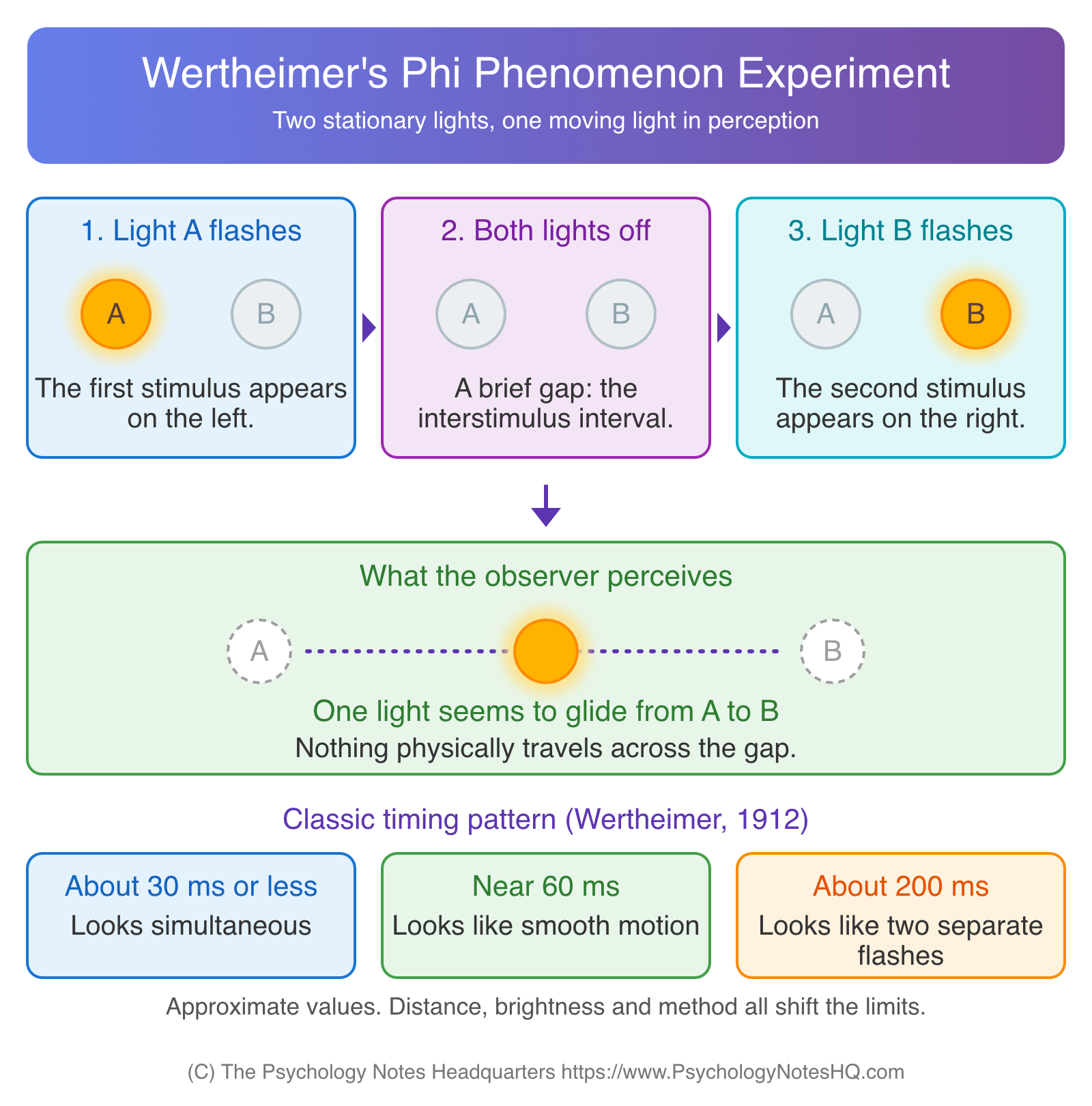
The phi phenomenon is the perception of movement between two or more stationary stimuli that appear in quick succession at different locations. Nothing travels between the positions, yet observers experience motion across the gap. It is a form of apparent motion, meaning movement that exists in perception but not in the physical stimulus.
Wertheimer used the Greek letter phi for the effect and stressed what he called pure motion, seen with no clearly defined object doing the moving. Observers have described it as something like a shadow moving between the lights (Steinman et al., 2000).
Here is a simple phi phenomenon example. The left light flashes and goes off, then the right light flashes. Instead of two separate events, you see movement crossing the gap between them.
Real motion sends a continuous stream of changing images across the retina. Here, the light literally disappears in one place and appears in another, yet the experience can feel like movement. That contrast is why the effect matters: your visual system does not record the world like a camera. It interprets what it receives and fills gaps, and this time it fills a gap with motion.
How the Phi Phenomenon Works
The key variable is the interstimulus interval (ISI), the gap between the first stimulus disappearing and the second one appearing. Wertheimer mapped out a rough pattern (Wertheimer, 1912). With gaps under about 30 milliseconds, the two stimuli looked simultaneous. Motion looked best near 60 milliseconds. Between about 60 and 200 milliseconds, observers reported partial movement of one or both stimuli. By about 200 milliseconds, they saw two separate events, one after the other.
Treat these numbers as a classic pattern, not fixed cutoffs. Distance, brightness, and the method used all shift the boundaries.
You may also see the term stimulus onset asynchrony (SOA), the time from the start of one stimulus to the start of the next. The ISI is measured from the end of the first stimulus to the start of the second, so the two differ by how long the first stimulus stays on.
One way to think about it: inside the motion window, the visual system registers activity at one position followed closely by activity at another, and it settles on the simplest interpretation, which is that one thing moved. Outside the window, that story falls apart. Too fast and you see two flashes at once. Too slow and you see two separate events.
Wertheimer also reported that the effect still appears when one light goes to one eye and the second to the other, a hint that the illusion is not just a quirk of the retina (Wertheimer, 1912).
If you want to see it yourself, alternate two dots on a screen and vary the delay between them. Very short gaps give you two dots at once, moderate gaps give you a dot that seems to hop, and long gaps give you two separate flashes.
Key Characteristics and Conditions
Several factors decide whether the phi phenomenon appears and how strong it feels.
Timing Factors
Timing sets the basic conditions. Very fast alternation favors the objectless, shadow-like motion Wertheimer called pure phi. Slower alternation favors beta movement, where a clear object seems to travel (Steinman et al., 2000). That link between speed and the kind of motion is why timing sits at the center of the phi versus beta debate covered below. The same pair of lights can look like phi, beta, or two separate flashes depending on speed alone.
Spatial Factors
Distance matters as much as timing. Stimuli that are too close together may not register as a change in position. Stimuli that are too far apart imply motion that seems implausible, and the illusion breaks down. In general, as the separation grows, the timing has to change to keep the motion convincing.
Stimulus Characteristics
Brightness and size also play a role, with stronger, clearer stimuli generally holding the illusion together across more conditions. The two shapes do not have to match, but matching shapes tend to give the smoothest, most reliable effect.
In 1915, Adolf Korte proposed laws linking spatial separation, brightness, and timing. One example is that larger separations call for stronger stimuli and slower alternation. Later researchers questioned how universal these laws are, so they work best as rules of thumb.
Individual Differences
Observers do not all report identical experiences under identical conditions. Small differences in where the boundaries fall are normal, and studies of how much instructions and prior experience shape what people report have produced mixed results.
Types of Apparent Motion and Distinctions
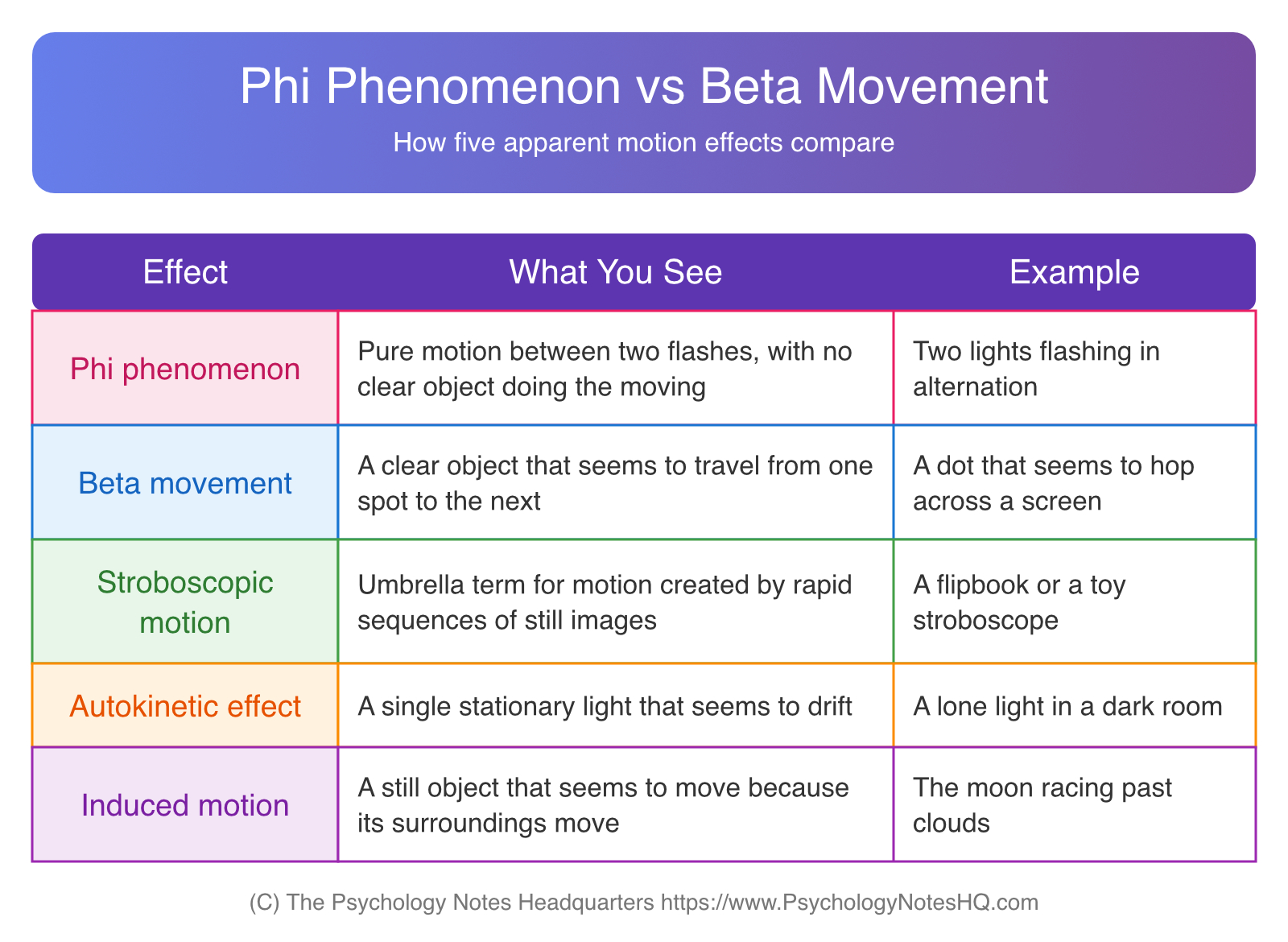
The phi phenomenon belongs to a family of apparent motion effects, and the names get tangled quickly. The table below sorts them out.
Phi Phenomenon vs Beta Movement
Wertheimer described two related effects. Phi is pure motion, seen without a clearly defined object moving. Beta, or optimal apparent movement, looks like real motion: a specific object seems to travel from one position to another (Steinman et al., 2000).
The confusion started early. Steinman and colleagues trace considerable confusion in later research to the way Wertheimer’s original monograph described phi and the best conditions for seeing it. That is the point of their paper’s title, Phi Is Not Beta.
A quick way to keep them straight: phi is motion without a thing, and beta is a thing in motion. Many everyday examples are beta-like, because you see objects moving, and modern researchers often use apparent motion as the umbrella term for both.
Stroboscopic Motion
Stroboscopic motion is the broad label for motion created by rapid sequences of still presentations. The term comes from stroboscopes, devices that present images in rapid sequence. Some textbooks use it as another name for the phi phenomenon, which adds to the confusion. Film and animation produce stroboscopic motion, though people usually describe them with more specific terms.
Autokinetic Effect
A single stationary light in an otherwise dark room can seem to wander. Unlike the phi phenomenon, this involves one continuously visible stimulus, not two in succession. Explanations usually point to the lack of a stable frame of reference.
Induced Motion
Induced motion happens when a stationary object seems to move because its surroundings do. The classic case is the moon appearing to race past drifting clouds. No successive presentation is involved, which sets it apart from phi.
What makes the phi phenomenon special is that its motion comes purely from the timing and spacing of separate stimuli.
Phi Phenomenon Examples in Everyday Life
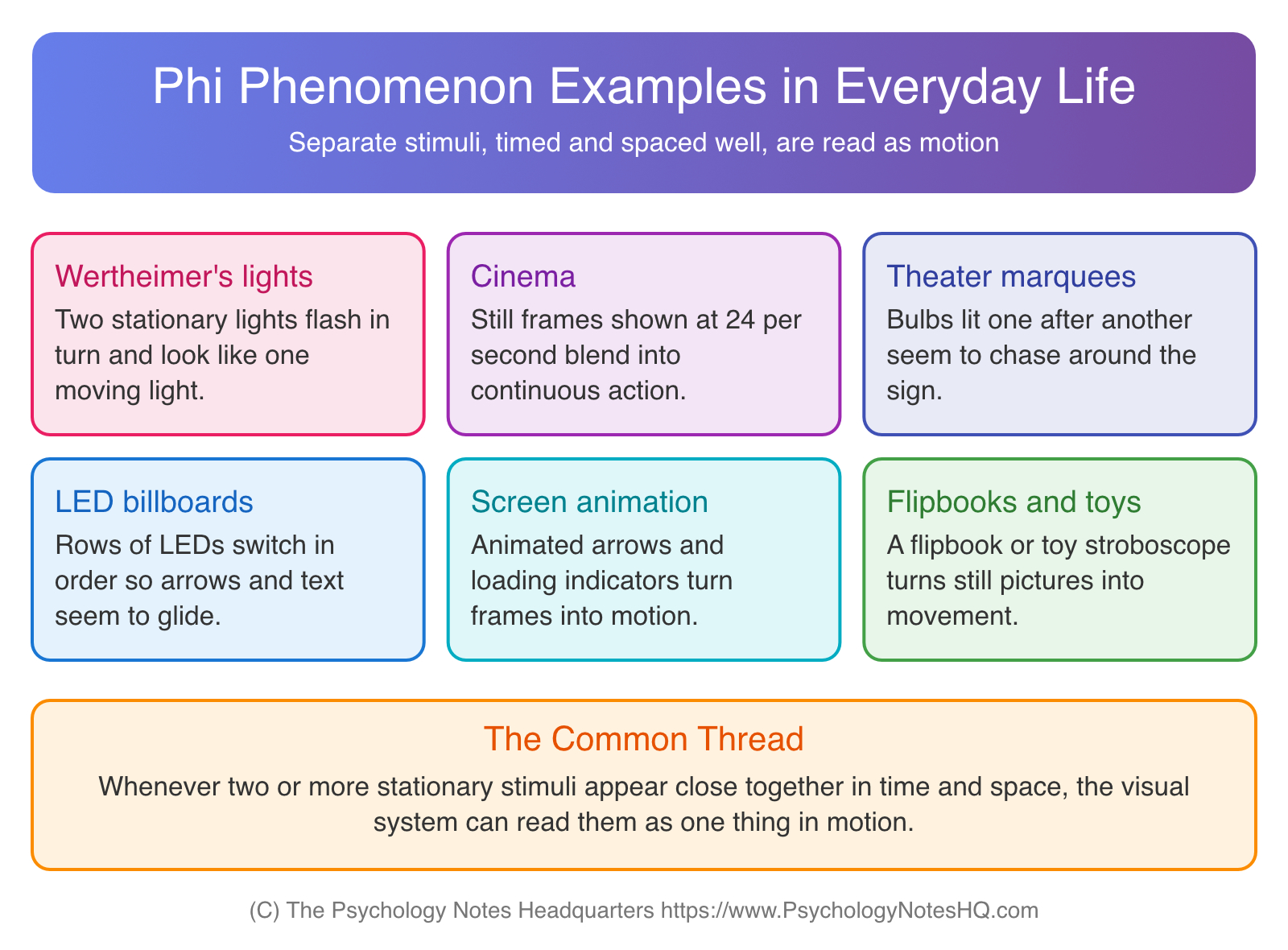
The phi phenomenon is not just a lab curiosity. Each phi phenomenon example below works because separate stimuli, timed and spaced well, get read as movement.
Film and Cinema
Standard cinema runs at 24 frames per second, so a new still image arrives roughly every 42 milliseconds. Your brain stitches those stills into continuous action. Textbooks often credit the phi phenomenon for this, though researchers note that phi and beta are frequently confused in such explanations (Steinman et al., 2000).
Broadcast television has traditionally used about 25 or 30 frames per second, depending on the region. Some modern films use 48 or 60 frames per second, which some viewers find more lifelike and others find unnaturally smooth.
Animation and Digital Media
Animators build motion from sequences of drawn or rendered frames, and hand-drawn animation often reuses drawings across frames to save work. Video games generate frames in real time, and many aim for 60 frames per second or more so motion stays smooth while the game responds to the player. Flipbooks work the same way: each page is a still, and flipping fast enough turns the stack into motion. Even the toy stroboscope from the origin story belongs in this family.
Advertising and Digital Displays
Theater marquees and neon signs make lights appear to chase each other by switching stationary bulbs on in sequence. LED billboards do the same at a larger scale.
Interface designers use the same idea in animated arrows, transitions, and loading indicators, all of which depend on well-timed, well-spaced changes.
Neurological and Psychological Basis
Brain imaging shows that apparent motion leaves a footprint in early visual cortex. Muckli et al. (2005) found activity in primary visual cortex (V1) along the path of the illusory motion, including regions that the flashes never directly stimulated.
Earlier studies had already linked motion-sensitive regions beyond V1 to apparent motion. The 2005 findings suggested that V1 is also part of the network that represents the illusory path (Muckli et al., 2005). So the illusory path is not just a story you tell yourself. It shows up in measurable brain activity.
Wertheimer speculated that excitation spreading between two points in visual cortex produced the illusion (Wertheimer, 1912). Later work complicated that picture by pointing to processes at several levels of the visual system.
A common explanation for why the brain does this is that a visual system tuned to detect real motion, which matters for spotting predators, prey, and obstacles, can also be fooled by stimulus patterns that mimic motion.
For students, the takeaway is straightforward. The motion you experience is not sitting in the stimulus. The visual system assembles it, and parts of that assembly show up in brain imaging.
Significance in Gestalt Psychology
The phi phenomenon gave Gestalt psychology its most vivid demonstration that perception is more than a pile of sensations. Structuralism treated complex experiences as sums of elementary parts. In Wertheimer’s demonstration, the parts contained no motion at all: a light here, a pause, a light there. The motion appeared only in the relationship between them.
That is why Wertheimer, Koffka, and Köhler are credited with launching a research program on perceptual organization (Wagemans et al., 2012). The same tradition later produced grouping principles such as proximity, similarity, and closure, which researchers still study today.
It helps to keep the claim in proportion. The phi phenomenon supports the Gestalt critique of elementary-sensation accounts, but it does not by itself prove every later Gestalt claim.
Modern vision science keeps the Gestalt insight while adding neural and computational tools. Reviews such as Wagemans et al. (2012) weigh what has changed since Wertheimer and what has held up.
Conclusion
The phi phenomenon shows that perception is construction, not recording. Two flashes become one moving light because the visual system reads their timing and spacing and fills in the rest. Wertheimer’s simple demonstration undercut an elements-first view of the mind, and the phi versus beta debate is a reminder that even famous discoveries can be misread.
If you remember one thing for an exam, make it this: phi is pure motion between stimuli, beta is an object in motion, and both are forms of apparent motion. The next time a movie starts, the motion on screen is something your brain builds, one still image at a time.
References
- Muckli, L., Kohler, A., Kriegeskorte, N., & Singer, W. (2005). Primary visual cortex activity along the apparent-motion trace reflects illusory perception. PLoS Biology, 3(8), e265.
- Steinman, R. M., Pizlo, Z., & Pizlo, F. J. (2000). Phi is not beta, and why Wertheimer’s discovery launched the Gestalt revolution. Vision Research, 40(17), 2257-2264.
- Wagemans, J., Elder, J. H., Kubovy, M., Palmer, S. E., Peterson, M. A., Singh, M., & von der Heydt, R. (2012). A century of Gestalt psychology in visual perception: I. Perceptual grouping and figure-ground organization. Psychological Bulletin, 138(6), 1172-1217.
- Wertheimer, M. (1912). Experimental studies on the seeing of motion. Zeitschrift für Psychologie, 61, 161-265.
How to cite this article:
The Psychology Notes Headquarters. (2026). Phi Phenomenon: How Two Flashing Lights Changed Psychology. Retrieved from https://www.psychologynoteshq.com/phi-phenomenon/
” Do not weep. Do not wax indignant. Understand.” Baruch Spinoza
Decorative lights and the movie pictures are other examples of phi phenomenon
Good answers, Marie. Thanks.
what is the actual cause for mental disorder?
Hi Mike,
Check out Ubaldini’s answers.
A
causes for mental disorders are multiple:
1. genetic, where the chances of eventually getting the disorder is high, i.e. schizophrenia
2. one may have a genetic susceptibility but whether one develops the disorder will depend on the circumstances, i.e. stressful events
3. physiological malfunctioning, i.e. with regard to neurotransmitters
4. psychological factors i.e, unrealistic fear, pessimism
Great answers!
Many years ago I learned about a phenomenon in which a person watching something moving begins to feel that the watched thing is not moving but the watcher is. I thought that was phi phenomenon, but apparently not. What would this be called?
Hi Stephen,
You could be referring to “vection”. For example, you’re sitting on a stationary train. When your neighboring train starts to move, sometimes you have the illusion that your train is moving in the opposite direction (when in fact it isn’t moving at all).
Hope this helps.
A