
The Cannon-Bard Theory of Emotion: Why Fear and a Racing Heart Hit Together
You sprint up four flights of stairs to make your 9 a.m. lecture, and your heart is hammering. That night, walking to your car, you hear footsteps close behind you, and your heart hammers again. Same pounding pulse, completely different experience. Only one of those moments feels like fear.
That puzzle sat at the center of a century-old fight about where feelings come from, and the Cannon-Bard theory of emotion was one side’s answer. It put the starting point inside the brain, and it made a bold claim about timing that many summaries still get slightly wrong.
Key Takeaways
- Walter Cannon did more than disagree with William James. He built a five-point case showing why the body alone can’t explain how emotions work.
- The theory’s core claim is about timing: feeling and bodily arousal share one trigger, and neither one waits for the other.
- Bard’s experiments on cats produced “sham rage,” and his results pointed to a different brain structure than the one most summaries name.
- Everyday moments, from a snake on a trail to a racing heart after the stairs, show where the theory shines and where it strains.
- Students tend to lose exam points on four predictable mistakes about this theory, and each one is easy to fix once you see it.
What the Cannon-Bard Theory of Emotion States
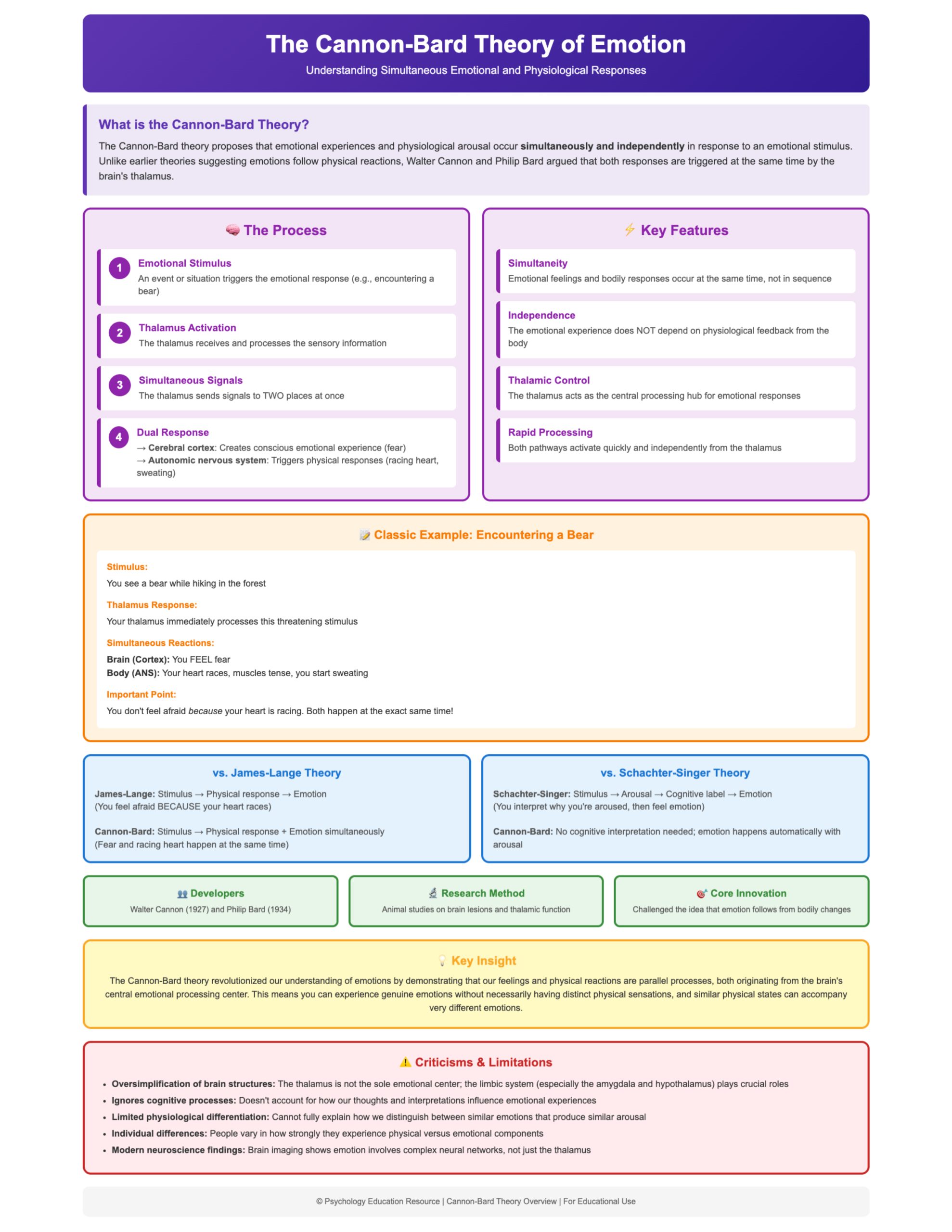
The Cannon-Bard theory of emotion states that an emotional event triggers two responses at the same time: the conscious feeling of emotion and the body’s physiological arousal. Neither response causes the other. Both are launched by the same signal from deep inside the brain.
Because Walter Cannon pointed to the thalamus as the source of that signal, the idea is also called the thalamic theory of emotion. Cannon published the core argument in 1927, and his student Philip Bard supplied much of the experimental support (Cannon, 1927; Bard, 1928).
Who Were Walter Cannon and Philip Bard?
Walter Cannon was a Harvard physiologist who spent decades studying how the body handles stress. He coined the phrase “fight or flight” and later popularized the term homeostasis, the body’s tendency to keep its internal state stable. That idea went on to shape motivation research such as drive reduction theory.
Philip Bard trained under Cannon as a doctoral student at Harvard Medical School. He later held professorships at Princeton and Johns Hopkins, where he led the physiology department. Cannon brought the big-picture argument. Bard brought the lab work that tested it.
The Problem With the James-Lange Theory
In the 1880s, William James and Carl Lange independently argued that emotion follows the body. You see a bear, your heart races and your legs start moving, and only then does your brain read those changes as fear.
The James-Lange theory made the body the source of feeling. Cannon, who knew the autonomic nervous system as well as anyone of his era, didn’t think the physiology supported that story.
Cannon’s Five Critiques
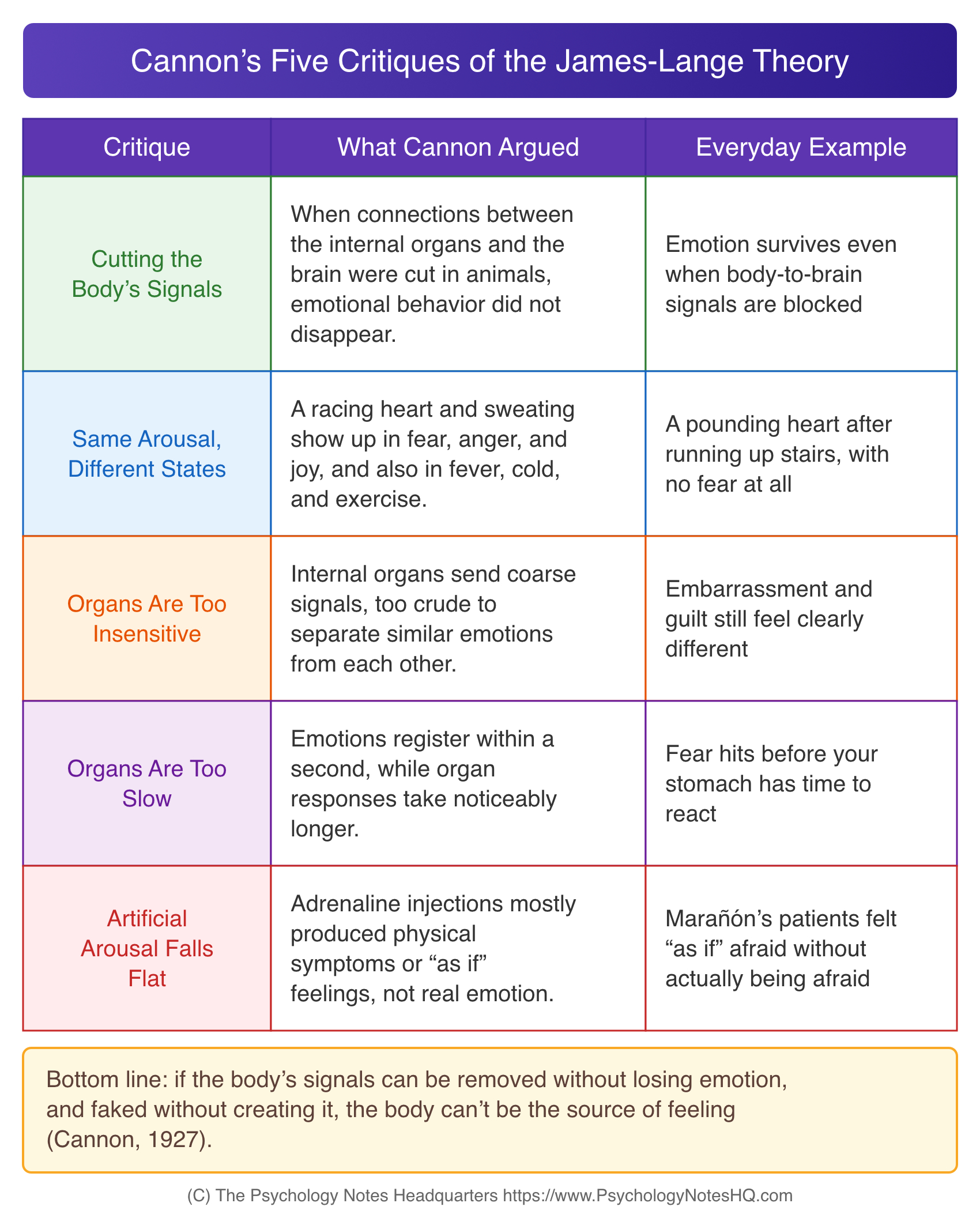
In a 1927 paper, Cannon laid out five objections to the James-Lange theory (Cannon, 1927). They fall into three groups, and together they explain why he went looking for the source of emotion inside the brain.
The Body Is Too Slow and Too Numb
Two critiques target the internal organs, or viscera. First, visceral changes are slow. Emotions often register within a second, while organs like the stomach and intestines take noticeably longer to respond.
Second, the viscera are relatively insensitive. They send the brain fairly coarse signals, so Cannon doubted they could produce the fine distinctions between, say, embarrassment and guilt. If the feeling shows up before the bodily change, the bodily change can’t be its cause.
The Same Arousal Shows Up Everywhere
This is the critique students tend to remember best. A racing heart, faster breathing, and sweating appear in fear, anger, and excitement alike.
The same pattern also shows up in situations with no emotion at all, such as fever, exposure to cold, and hard exercise. If one bodily pattern accompanies so many different states, Cannon argued, it can’t be what makes fear feel different from joy.
Cutting or Faking the Body’s Signals
The last two critiques come from experiments. When the connections between the viscera and the brain were cut in animals, emotional behavior did not disappear, which is the opposite of what James and Lange would predict.
Going the other way, producing arousal artificially with adrenaline rarely produced a genuine emotion. Sever the body’s signals and emotion stays. Fake them and emotion rarely appears.
How the Cannon-Bard Theory Works
With the body-first account set aside, Cannon needed a replacement. His answer ran through a single relay point in the brain and then split into two signals traveling in different directions.
The Thalamus as a Relay Station
The thalamus sits near the center of the brain and acts as a sorting hub for incoming sensory information. Nearly every sense, with the exception of smell, passes through it on the way to the cortex.
Cannon proposed that when the thalamus processes something emotionally significant, it does more than pass the message along. It releases an emotional response of its own, activity that the cortex normally holds in check until the right situation arrives.
Two Signals, One Moment

Once activated, the thalamus sends signals along two routes at once. One travels up to the cerebral cortex, producing the conscious experience of fear, joy, or anger. The other travels toward the body through the hypothalamus and autonomic nervous system, speeding up your heartbeat and breathing and tensing your muscles.
That parallel design was the theory’s real innovation. Feeling and arousal happen together because they share a source, not because one produces the other.
What Bard’s Cats Really Showed
Most summaries boil Bard’s research down to a single line about the thalamus. The actual findings were more interesting than that, and they are worth knowing if your professor likes to test details.
Sham Rage in Decorticate Cats
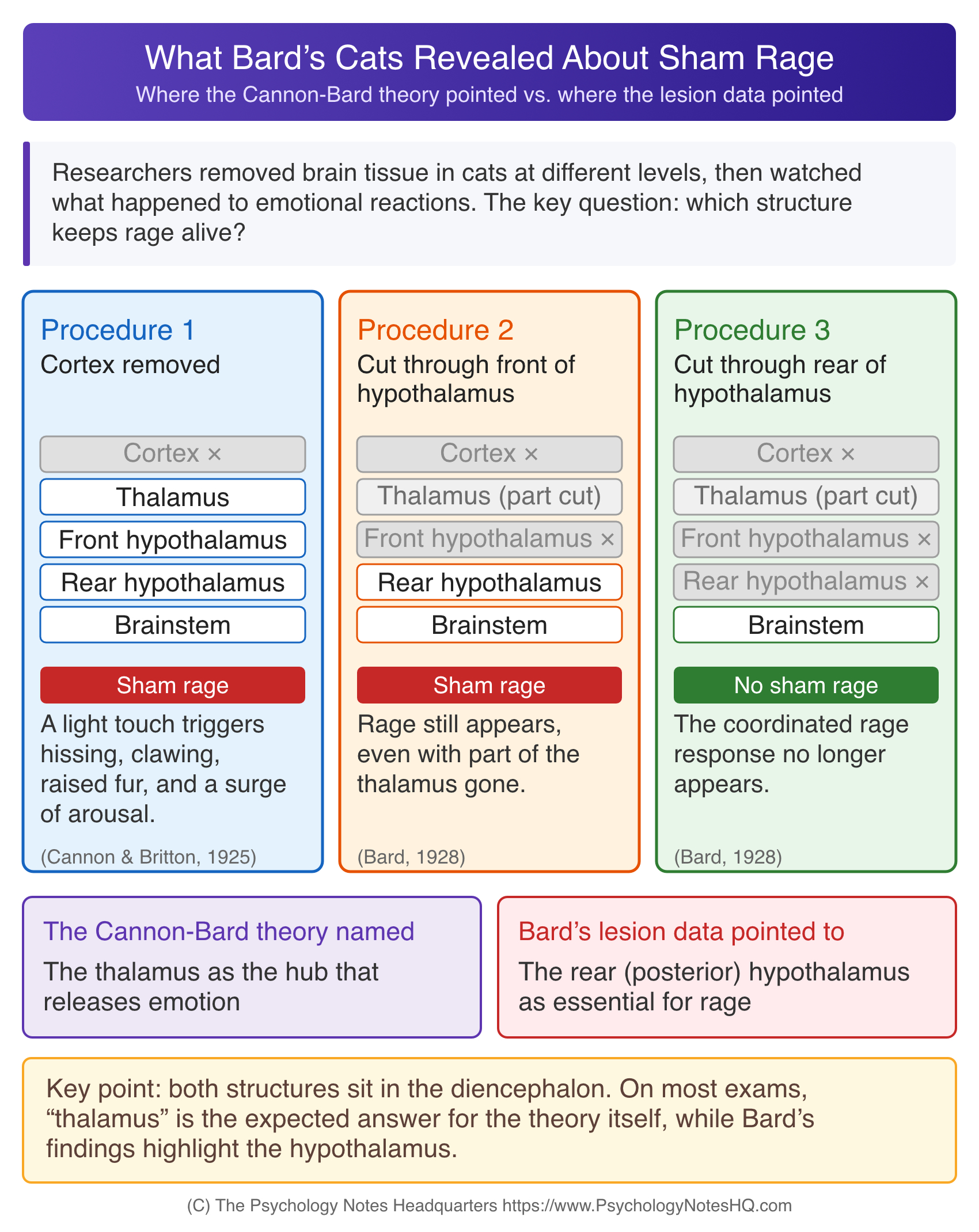
When researchers surgically removed the cerebral cortex in cats, the animals did not become calm. Instead, a light touch could set off hissing, clawing, raised fur, and a surge of sympathetic arousal.
Because the display lacked any real provocation, Cannon and his colleague Britton called it sham rage (Cannon & Britton, 1925). The term is often credited to Bard, but it came out of Cannon’s lab a few years before Bard’s key study. The lesson was striking: full emotional expression did not require the cortex.
The Hypothalamus Twist
Bard then set out to find exactly which structure kept the rage going. In a 1928 study, he made cuts at different levels of the brain. Sham rage still appeared as long as the rear portion of the hypothalamus was intact, even when part of the thalamus had been removed. When the cut passed through that rear region, the rage no longer appeared (Bard, 1928).
So Bard’s own data pointed to the hypothalamus, while Cannon’s theory kept its spotlight on the thalamus. Both structures sit in the same brain region, the diencephalon.
Cannon-Bard Theory Examples in Everyday Life
Theories click faster when you can watch them work. The Cannon-Bard theory examples below include two classic cases and two drawn straight from Cannon’s own arguments. Notice how each one either shows feeling and arousal arriving together or shows arousal arriving with no feeling at all.
Spotting a Snake on a Trail
You’re hiking and freeze at the sight of a snake a few feet ahead. The visual information reaches your thalamus, which flags it as a threat.
In the same instant, one signal reaches your cortex and you feel a jolt of fear, while another kicks up your heart rate and tenses your muscles. According to Cannon and Bard, you don’t notice your pounding heart first and then decide you’re scared. The fear and the arousal arrive as a package.
Receiving Unexpected Good News
You open an email and learn you’ve been accepted into a program you had almost given up on. Joy floods in, and at the same moment your face breaks into a grin and your body feels a burst of energy.
In Cannon-Bard terms, the good news was processed once and sent out twice: once to create the feeling of elation and once to create the physical lift. Positive emotions follow the same parallel logic that fear does.
Sprinting Up the Stairs
Back to the stairs from the opening. After four flights, your heart pounds and you’re breathing hard, yet you feel no fear, anger, or excitement.
This is Cannon’s point about non-emotional states in action. If a racing heart were enough to create an emotion, running to class would leave you terrified. The mismatch suggests that arousal and feeling can come apart, which is exactly what a parallel model predicts.
The Adrenaline Shot That Felt “As If”
Spanish physician Gregorio Marañón injected 210 patients with adrenaline and asked them to describe how they felt. About 71% reported only physical symptoms. Most of the rest described “cold” or “as if” emotions, feeling as if they were afraid without actually being afraid (Marañón, 1924, as cited in Schachter & Singer, 1962).
Cannon treated results like these as strong evidence that producing the body’s side of an emotion does not produce the emotion itself.
How Cannon-Bard Differs From James-Lange

The disagreement comes down to order and origin. For James and Lange, the sequence is stimulus, then bodily response, then emotion. For Cannon and Bard, it’s stimulus, then brain processing, then emotion and bodily response together.
The two models also place emotion in different parts of the nervous system. James-Lange starts in the body’s periphery, while Cannon-Bard starts in the brain. That brain-first shift set the stage for later debates among the major theories of emotion.
Where Schachter-Singer Fits In
In 1962, Stanley Schachter and Jerome Singer offered a third answer. Their two-factor theory holds that arousal is general and vague, and that we identify the emotion by interpreting the situation around us (Schachter & Singer, 1962).
Interestingly, they borrowed part of Cannon’s reasoning, agreeing that arousal looks much the same across emotions. But where Cannon-Bard says the brain produces a specific feeling directly, Schachter-Singer adds a labeling step. You feel aroused, look around, and decide what that arousal means.
Evidence That Supported the Theory
If bodily feedback creates emotion, people who lose much of that feedback should feel far less. Chwalisz et al. (1988) tested this by interviewing people with spinal cord injuries, which limit the signals traveling from the body to the brain.
Participants still described intense emotional experiences, which fits the Cannon-Bard view that the brain can generate emotion without full input from the body. There was a catch, though. Those with more remaining bodily feedback tended to report somewhat stronger negative emotions, a hint that the body adds intensity even if it isn’t required.
Criticisms and Limitations
The Thalamus Wasn’t the Whole Story
The theory’s biggest weakness is anatomical. Emotion turned out to depend on a wide network, including the amygdala, hypothalamus, prefrontal cortex, and insula, rather than a single relay point. Bard’s own lesion work had already hinted that the hypothalamus mattered more than the thalamus.
The model also leaves out thinking. It says little about how memories, expectations, and interpretation shape what we feel, a gap that cognitive theories later worked to fill.
The Body Talks Back
Cannon may have undersold the body. People holding a pen in their teeth, which forces a smile, rated cartoons as funnier than people whose pen position blocked a smile (Strack et al., 1988), though later replications have made the finding debated.
It fits the broader idea that facial expressions and posture, key channels of nonverbal communication, can feed back into feeling. Research also weakened Cannon’s claim that arousal is identical across emotions, finding measurable differences in heart rate and finger temperature between emotions such as anger and fear (Ekman et al., 1983).
What Modern Neuroscience Reveals
Joseph LeDoux’s fear research offers a modern echo of Cannon’s idea. He described a fast “low road” from the thalamus straight to the amygdala that can trigger a defensive response before you consciously register danger, and a slower “high road” through the cortex that adds detail and context (LeDoux, 1996).
The anatomy differs from Cannon’s version, but the logic is familiar: parallel routes running at once. That separation between activation and experience also shows up in research on arousal and performance, where the same level of physical activation can sharpen focus on one task and derail another.
Common Exam Mistakes
Cannon-Bard questions show up on nearly every intro psych exam, and the wrong answers are predictable. Watch for these four traps.
Thinking “Simultaneous” Means “Identical”
The theory says feeling and arousal happen at the same time, not that they are the same thing. They are separate outputs traveling separate pathways. An answer claiming the feeling simply is the arousal doesn’t describe Cannon-Bard.
Mixing Up the Thalamus and the Hypothalamus
On most exams, the expected answer for the theory’s hub is the thalamus, because that’s the structure Cannon’s theory names. Just know that Bard’s data implicated the hypothalamus, which also carries the signal to the body in most textbook diagrams.
Adding a Cognitive Label
If an answer mentions interpreting or labeling arousal, it describes Schachter-Singer, not Cannon-Bard. Cannon and Bard did not require any appraisal step. The brain produces the specific feeling directly, which is why the theory counts as biological rather than cognitive.
Assuming the Body Doesn’t Matter
Cannon never claimed bodily arousal is unimportant. It prepares you to fight, flee, or celebrate. His claim was narrower: arousal is not the cause of the feeling. Keep that distinction clear, and his critiques make much more sense.
Why the Cannon-Bard Theory Still Matters
The Cannon-Bard theory of emotion moved the study of feelings from the heart and gut to the brain, and that shift proved enormously productive. Its core idea of parallel processing anticipated how researchers now describe emotion as several systems running at once.
Even its mistakes were useful. Arguing about the thalamus pushed researchers to map the hypothalamus, amygdala, and cortex in far more detail. Later models are, in many ways, answers to questions Cannon forced into the open.
Conclusion
The next time your heart pounds, ask whether a feeling came with it. That simple check captures what Cannon and Bard were arguing: arousal and emotion can travel together, but one doesn’t manufacture the other.
Their brain map didn’t survive intact, and the body turned out to matter more than they allowed. Still, the Cannon-Bard theory of emotion remains the clearest example of psychology’s turn toward a brain-first view of feeling.
References
- Bard, P. (1928). A diencephalic mechanism for the expression of rage with special reference to the sympathetic nervous system. American Journal of Physiology, 84(3), 490–515.
- Cannon, W. B. (1927). The James-Lange theory of emotions: A critical examination and an alternative theory. The American Journal of Psychology, 39(1/4), 106–124.
- Cannon, W. B., & Britton, S. W. (1925). Studies on the conditions of activity in endocrine glands: XV. Pseudaffective medulliadrenal secretion. American Journal of Physiology, 72(2), 283–294.
- Chwalisz, K., Diener, E., & Gallagher, D. (1988). Autonomic arousal feedback and emotional experience: Evidence from the spinal cord injured. Journal of Personality and Social Psychology, 54(5), 820–828.
- Ekman, P., Levenson, R. W., & Friesen, W. V. (1983). Autonomic nervous system activity distinguishes among emotions. Science, 221(4616), 1208–1210.
- LeDoux, J. E. (1996). The emotional brain: The mysterious underpinnings of emotional life. Simon & Schuster.
- Schachter, S., & Singer, J. (1962). Cognitive, social, and physiological determinants of emotional state. Psychological Review, 69(5), 379–399.
- Strack, F., Martin, L. L., & Stepper, S. (1988). Inhibiting and facilitating conditions of the human smile: A nonobtrusive test of the facial feedback hypothesis. Journal of Personality and Social Psychology, 54(5), 768–777.
How to cite this article:
The Psychology Notes Headquarters. (2026). The Cannon-Bard Theory of Emotion: Why Fear and a Racing Heart Hit Together. Retrieved from https://www.psychologynoteshq.com/cannon-bard-theory-of-emotion/
to the point anwers are provided.