
James-Lange Theory of Emotion: Stages, Criticism & How It Works
The James-Lange theory of emotion proposes that emotions are not the cause of physical reactions — they are the result of them. Developed independently by William James and Carl Lange in the 1880s, the theory states that when we encounter an emotionally charged stimulus, our body responds first, and the conscious feeling of emotion follows from our awareness of that bodily response. We don’t run because we’re afraid of the bear — we’re afraid because we run.
Key Takeaways
- The James-Lange theory states that physiological changes come first — conscious emotion arises from perceiving those changes, not the other way around.
- The sequence unfolds in four steps: stimulus → bodily response → perception of that response → emotional experience.
- Each emotion has a distinct physiological signature; without these differences, all emotions would feel the same.
- Walter Cannon’s criticism of the James-Lange theory — that bodily responses are too slow and too similar across emotions — remains the most influential challenge to the model.
- Modern research on facial feedback and interoception gives partial support, but later theories like Cannon-Bard and Schachter-Singer address gaps the original model couldn’t explain.
Historical Context and Origins
In 1884, American psychologist William James published “What is an Emotion?” in the journal Mind, while Danish physiologist Carl Lange independently developed nearly identical ideas around 1885 (James, 1884). Their convergent thinking reflected a broader scientific shift — psychology was moving toward observable, measurable phenomena rather than abstract philosophical reasoning about the mind.
Before James and Lange, the common-sense view ran like this: you see something frightening, you feel afraid, and then your heart starts racing. James flipped that logic entirely. As he put it, “We feel sorry because we cry, angry because we strike, afraid because we tremble” (James, 1890, p. 1066). Lange reached the same conclusion from a more physiological direction, focusing on vascular changes as the engine of emotional experience. Both arrived at the same radical claim: bodily changes don’t follow emotion — they produce it. This body-first framing connected well with William James’s broader work on instinct and biological drives, which also emphasized the role of inherited physical tendencies in shaping behavior.
The James-Lange Theory Stages: The 4-Step Sequence
The james lange theory is built around a specific sequence of events. Each stage feeds into the next, and skipping or reversing any step breaks the model’s internal logic.
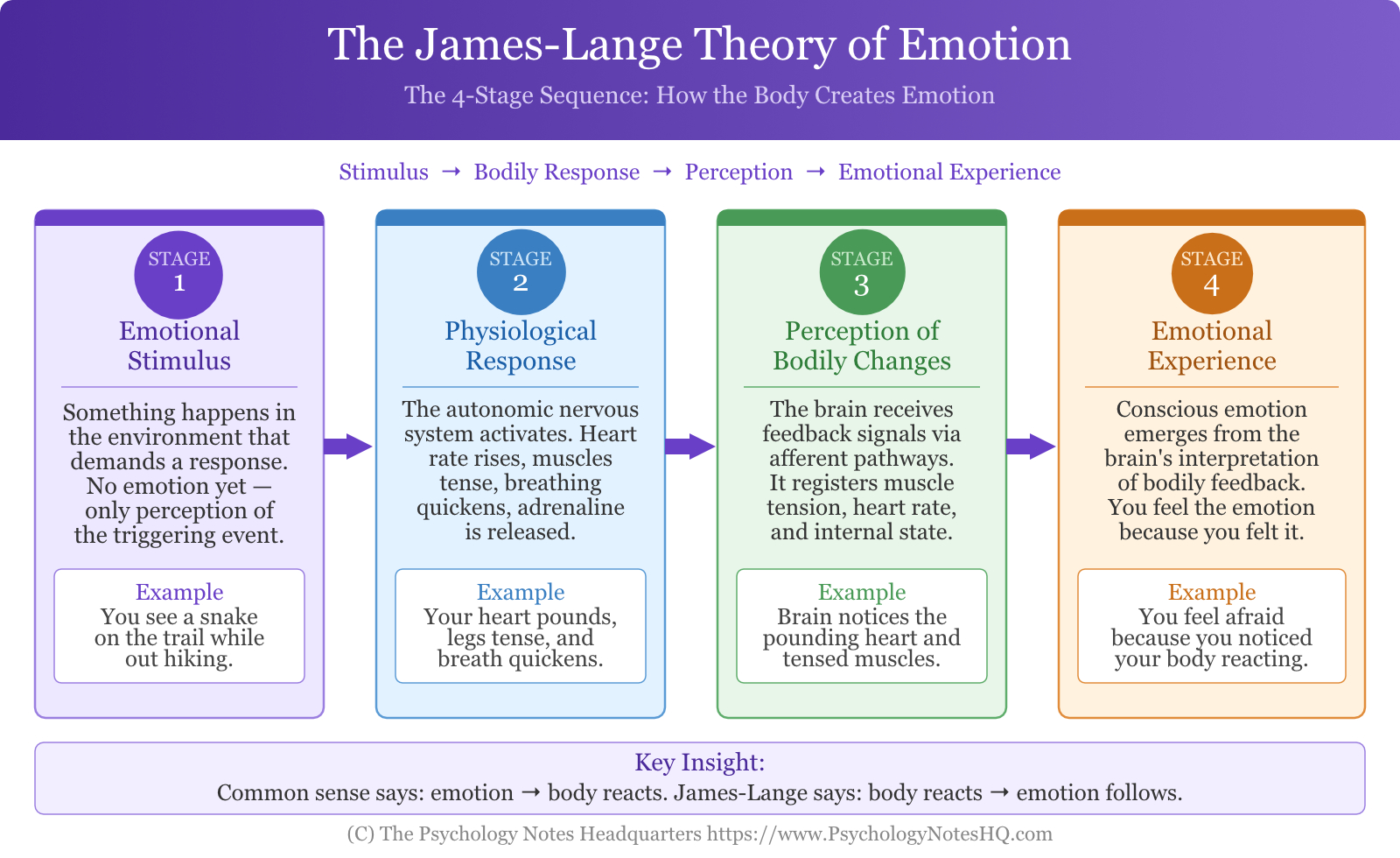
Stage 1: The Emotional Stimulus. Something happens in the environment — a car cuts into your lane, you open an exam result, you hear footsteps behind you at night. This event doesn’t produce an emotion directly. Instead, it triggers the body’s automatic response systems before any conscious feeling registers.
Stage 2: Physiological Response. The autonomic nervous system activates almost immediately. The sympathetic branch releases adrenaline and cortisol, heart rate climbs, breathing quickens, muscles tense, pupils dilate, and digestion slows. This happens largely outside conscious awareness and varies in pattern depending on the type of stimulus encountered.
Stage 3: Perception of Bodily Changes. The brain begins receiving feedback signals through afferent neural pathways — proprioceptors report muscle tension, baroreceptors register blood pressure changes, and interoceptive systems communicate the state of internal organs. Together, these signals create a detailed map of the body’s current state.
Stage 4: Emotional Experience. The conscious experience of emotion emerges from the brain’s interpretation of that bodily feedback. The racing heart and tight chest don’t result from feeling afraid — your awareness of them is what generates the feeling of fear. Different patterns of physiological activation produce what we label as different emotions.
This four-step sequence is what makes the James-Lange theory genuinely counterintuitive. It doesn’t just add a step to common sense — it reverses the assumed direction of causation entirely.
Key Principles and Assumptions
Several core assumptions hold the theory together, and understanding them helps clarify both what the theory predicts and where it runs into trouble.
The Primacy of Physiological Response. Bodily arousal must precede emotional experience. Without physical changes, there is no emotion. This makes emotion an embodied phenomenon rather than a purely mental one — a point that has grown more influential, not less, in contemporary neuroscience.
Specificity of Physiological Patterns. James and Lange assumed each emotion corresponds to a unique pattern of bodily changes. Fear produces a different physiological signature than anger, joy, or grief. Without this specificity, every emotion would feel the same, since they would all arise from undifferentiated arousal. This assumption became a major target for later critics, particularly Walter Cannon.
The Causal Role of Perception. Emotions don’t arise from bodily changes themselves — they arise from our perception of those changes. The brain has to register and interpret the physiological state. This is subtly different from saying “the body causes emotion”; it’s the awareness of the body’s state that matters, which introduced a cognitive dimension the theory never fully developed.
Feedback Mechanisms Are Essential. If the feedback pathways between body and brain are disrupted, emotional experience should weaken or disappear. This prediction generated testable hypotheses and motivated several decades of empirical work, including studies on spinal cord injury patients.
James-Lange Theory Examples in Everyday Life
One of the most useful ways to grasp this theory — and to evaluate it — is through concrete situations. The james lange theory examples below show how the body-first sequence plays out in real scenarios students encounter regularly.
Public speaking anxiety. You’re about to present in front of a large lecture hall. Before you’ve said a word, your palms are sweating, your voice tightens, and your heart is pounding. According to the James-Lange theory of emotion, noticing those bodily sensations is what produces the feeling of anxiety — the physical state comes first, the label “I’m nervous” follows. This is why telling someone to “calm down” before a speech rarely works: the body is already ahead of the conscious mind.
The roller coaster effect. On a roller coaster, your stomach drops, your grip tightens, and your breathing becomes rapid before you’ve consciously processed the drop. You then interpret all of that arousal as excitement or thrill. Interestingly, some people interpret the same bodily state as fear — which points to a limitation the theory struggles with, since identical physiological arousal seems to produce different emotions depending on the person.
Grief and crying. James’s own phrasing — “we feel sorry because we cry” — is worth sitting with. When someone cries at a funeral, the physical act of weeping, the tightness in the throat, the heaviness in the chest — according to this model, those sensations generate and sustain the conscious feeling of sadness. Suppressing the physical response (holding back tears) can sometimes diminish the emotional experience, which aligns with what the theory would predict.
Aggressive emotions and physical tension. Consider someone who feels their jaw clench and fists tighten in a confrontational situation. The james lange theory would explain aggressive emotions like anger as following from that muscular tension and arousal — you feel angry because your body is already in a state of physical readiness to act. This explains why physical de-escalation techniques (unclenching hands, slowing breathing, relaxing posture) can actually reduce the felt intensity of anger, not just its expression.
Exercise-induced emotion. After an intense workout, the body is flooded with arousal signals — elevated heart rate, flushed skin, rapid breathing. People often report feeling energized, confident, or even euphoric in this state. The James-Lange framework would attribute this positive emotional shift directly to the perception of those physiological changes. This connects to broader research on optimal arousal and performance, where physiological activation levels shape psychological states and motivation.
These examples illustrate both the theory’s intuitive power and its tension points. The body clearly shapes felt emotion in each case — but context and interpretation seem to matter too, which is precisely what theories like Schachter and Singer’s two-factor model later tried to account for.
Evidence Supporting the Theory
Despite being over 140 years old, the James-Lange theory continues to attract empirical support from several directions.
Facial Feedback Hypothesis. Studies have shown that manipulating facial expressions can influence emotional experience. When participants held a pen in their teeth — activating the muscles used in smiling — they rated cartoons as funnier than those who held the pen with their lips, blocking the smile (Strack et al., 1988). Subtle bodily changes, even ones the person isn’t aware of, can shape conscious emotional states, which is exactly what James and Lange predicted.
Embodied Cognition Research. Contemporary research on embodied cognition has demonstrated that bodily states influence psychological processes in ways that align with the James-Lange emphasis on body-first causation. Adopting expansive postures can increase feelings of confidence; contracted postures produce opposite effects (Carney et al., 2010). Physical states — posture, temperature, muscle engagement — bleed into the emotional and motivational experiences we report, much as cognitive theories of motivation now acknowledge the body as more than a passive vehicle.
Interoceptive Accuracy and Emotional Intensity. Neuroscience research has found that individuals who are more accurate at perceiving their own internal bodily states — a capacity called interoceptive accuracy — report more intense emotional experiences (Critchley & Garfinkel, 2017). The stronger the body-brain feedback signal, the more vivid the emotion, which directly supports the James-Lange framework.
Autonomic Specificity Research. Early critiques assumed that all emotions produce identical physiological patterns. Later, more sophisticated measurement has revealed genuine, if subtle, differences in cardiovascular, electrodermal, and respiratory signatures across different emotional states — offering at least partial support for James and Lange’s specificity assumption.
James-Lange Theory Criticism: Where It Falls Short
The most influential james lange theory criticism came from physiologist Walter Cannon in the 1920s, and it hit the model on multiple fronts simultaneously.
Cannon’s Speed Argument. Cannon pointed out that physiological responses are too slow to account for the near-instantaneous onset of emotion. We often feel fear in a fraction of a second — well before the cascade of autonomic changes could fully develop. If emotion requires awareness of bodily change, how do we feel fear before the body has finished reacting?
The Undifferentiated Arousal Problem. Cannon also argued that many different emotions produce essentially the same pattern of physiological activation — elevated heart rate, increased respiration, hormonal release. If the body’s response is the same for fear and excitement, how does the body-first theory explain why they feel so different? This remains the most stubborn structural weakness in the James-Lange model.
Evidence from Spinal Cord Injuries. If emotions require bodily feedback, people with reduced sensory feedback from below a spinal injury should experience diminished emotions. Early evidence suggested this was true, but later studies found that people with spinal cord injuries continue to have rich, varied emotional lives (Cobos et al., 2004) — suggesting the body’s feedback loop isn’t as essential to emotion as James and Lange claimed.
The Role of Cognitive Appraisal. The theory has almost nothing to say about how context, beliefs, and memories shape emotional experience. The same physiological arousal — racing heart, quickened breath — can feel like romantic excitement before a first date or dread before a medical procedure. The difference isn’t in the body; it’s in how the brain interprets the situation. This gap opened the door for later emotion theories to incorporate cognitive appraisal as a central mechanism.
Artificial Arousal Doesn’t Produce Specific Emotions. If bodily change causes emotion, artificially triggering those changes should reliably produce the corresponding feeling. Adrenaline injection studies, however, show that artificial arousal doesn’t generate specific emotions — participants search for an environmental explanation for what they’re experiencing, which suggests that cognitive interpretation is doing more work than James and Lange acknowledged.
Emotional Complexity. The model handles basic emotions like fear, anger, and joy reasonably well. It struggles considerably with complex social emotions — jealousy, shame, nostalgia, guilt — which depend heavily on beliefs about oneself and one’s relationships in ways that don’t reduce to physiological patterns.
Comparison with Other Emotion Theories
The James-Lange theory makes the most sense when read alongside the theories it directly inspired or provoked.

Cannon-Bard Theory. Cannon and Philip Bard proposed that emotional experience and physiological response occur simultaneously rather than sequentially. In their model, the thalamus sends parallel signals — to the cortex producing conscious emotion, and to the autonomic nervous system producing bodily change. Neither causes the other. This sidesteps the speed problem and the undifferentiated arousal problem in one move, and it’s the most direct structural response to the James-Lange framework. The core disagreement is about timing and causation: does one come before the other, or do they happen in parallel?
Schachter-Singer Two-Factor Theory. Stanley Schachter and Jerome Singer offered a middle position in 1962. They agreed with James and Lange that physiological arousal contributes to emotion, but added that cognitive labeling of that arousal — based on environmental context — is what determines which emotion is felt. The famous suspension bridge study showed that identical physiological arousal could be interpreted as attraction or anxiety depending on the setting. This model preserved the James-Lange insight about bodily contributions while addressing the undifferentiated arousal problem directly.
Contemporary Appraisal Theories. Modern appraisal approaches flip James-Lange’s logic: cognitive evaluations of a situation cause both the emotional feeling and the physiological response. The body reacts because the mind has appraised the situation as threatening — not the other way around. However, contemporary neuroscience has complicated this clean reversal. Some emotional responses follow rapid subcortical pathways consistent with James-Lange; others involve cortical appraisal. The brain appears to run multiple systems in parallel rather than obeying any single sequential model, which is one reason the james lange theory and its alternatives all capture something real without any one of them being the complete story. This complexity is also visible in the study of classical conditioning, where emotional responses can be learned and triggered through physiological pathways entirely outside conscious awareness.
Conclusion
The James-Lange theory of emotion reframed a question people thought they already understood — where feelings come from — and gave psychology a body-first answer that has proven remarkably durable. Its core claim, that awareness of physiological change constitutes emotional experience, continues to generate research and practical applications in emotion regulation. The model’s limitations are real, but they produced some of the most important theories in psychology, each built partly in response to what James and Lange left unresolved.
References
- Carney, D. R., Cuddy, A. J., & Yap, A. J. (2010). Power posing: Brief nonverbal displays affect neuroendocrine levels and risk tolerance. Psychological Science, 21(10), 1363–1368.
- Cobos, P., Sanchez, M., Garcia, C., Vera, M. N., & Vila, J. (2004). Revisiting the James versus Cannon debate on emotion: Startle and autonomic modulation in patients with spinal cord injuries. Biological Psychology, 68(3), 251–269.
- Critchley, H. D., & Garfinkel, S. N. (2017). Interoception and emotion. Current Opinion in Psychology, 17, 7–14.
- James, W. (1884). What is an emotion? Mind, 9(34), 188–205.
- James, W. (1890). The principles of psychology (Vol. 2). Henry Holt and Company.
- Schachter, S., & Singer, J. (1962). Cognitive, social, and physiological determinants of emotional state. Psychological Review, 69(5), 379–399.
- Strack, F., Martin, L. L., & Stepper, S. (1988). Inhibiting and facilitating conditions of the human smile: A nonobtrusive test of the facial feedback hypothesis. Journal of Personality and Social Psychology, 54(5), 768–777.
How to cite this article:
The Psychology Notes Headquarters. (2026). James-Lange Theory of Emotion: Stages, Criticism & How It Works. Retrieved from https://www.psychologynoteshq.com/jameslangetheoryofemotion/
What are the educatonal implications of James-Lange Theory?
I want to know that what will be the definition about the cause and effect in the James Lange theory of emotion?
I think there is no educational implication (upon the class room implication I meant.) bt there is some points in favour of this theory.
1. if physical reaction are discarded then there is no place for emotion.
2. in for psychiatric patients behavioural response is not needed in case of emotion.
3. if physical manifestation increases the emotion can be increased also. etc
It was helpful for me