
The Schachter-Singer Theory of Emotion: Why the Same Racing Heart Can Mean Love or Fear
Your heart is pounding, your palms are damp, and your breathing is quick. Are you afraid, excited, or falling for someone? The schachter singer theory of emotion argues that your body alone cannot answer that question. What actually decides the answer is something most people never notice they’re using, and it changes everything about how psychologists think emotions get built.
Key Takeaways
- The schachter singer theory of emotion claims every feeling needs two ingredients, and one of them is not physical at all.
- The exact same racing heart can turn into fear, excitement, or attraction, depending on a factor most people never notice they’re applying.
- A famous bridge experiment shows how easily the body’s signals get pinned on the wrong cause entirely.
- Modern critics say the theory misses something the amygdala can do in a fraction of a second, long before conscious thought.
- A caffeine habit, a first date, and a big competition all reveal the same hidden mechanism at work.

What Is the Schachter-Singer Theory of Emotion?
Stanley Schachter and Jerome Singer introduced their theory in a 1962 paper titled “Cognitive, Social, and Physiological Determinants of Emotional State.” It grew out of a disagreement between two older accounts of emotion.
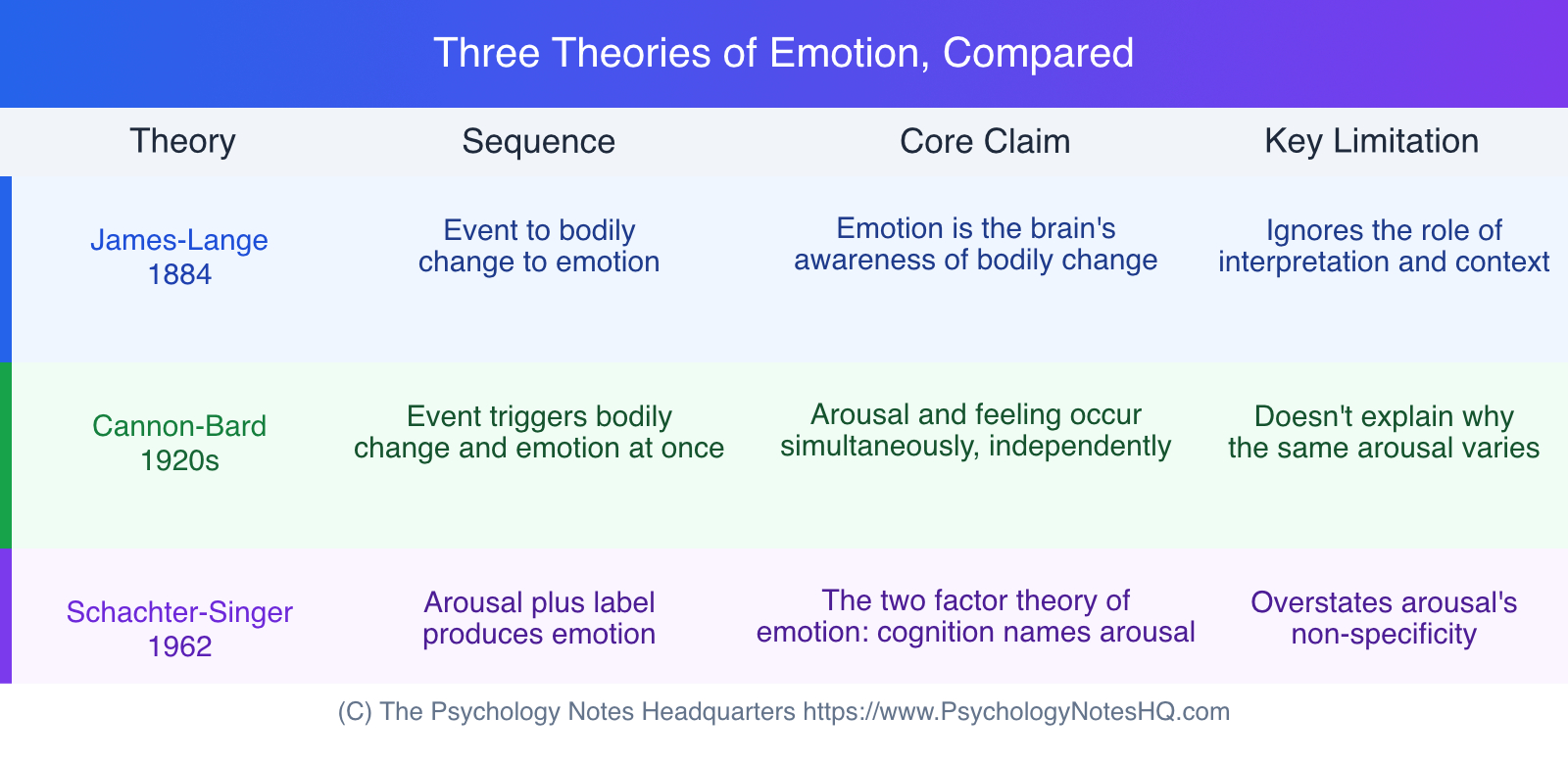
The James-Lange theory held that emotion is simply the brain noticing bodily changes: you feel afraid because your heart is racing, not the other way around. The Cannon-Bard theory countered that emotional experience and physical arousal happen at the same time, through separate neural pathways, with neither one causing the other.
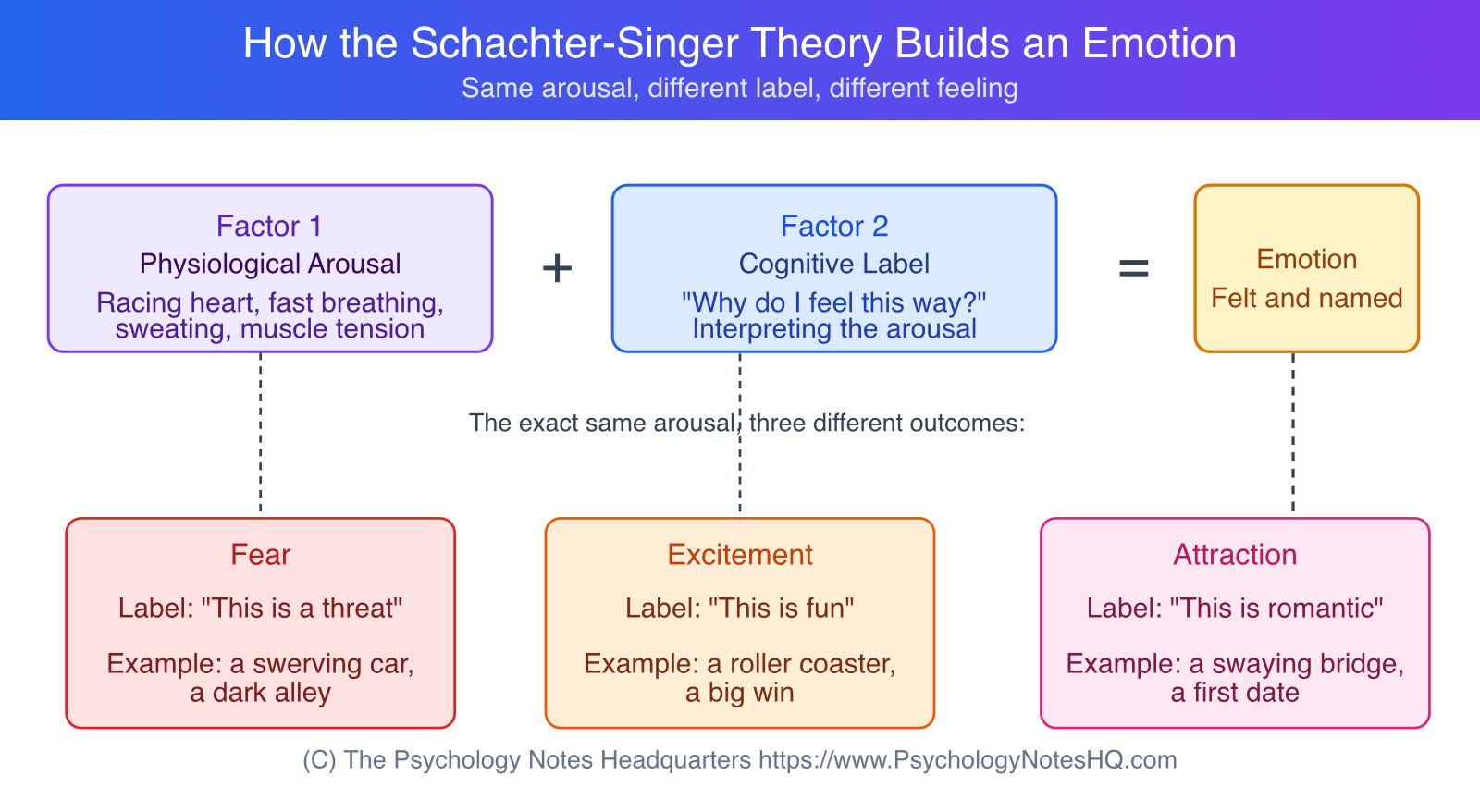
Schachter and Singer thought both were incomplete. Their answer: emotion is the product of two factors working together. Factor one is physiological arousal, the activation of the autonomic nervous system. Factor two is cognitive labeling, the mental step of interpreting what caused that arousal and naming it.
Neither factor produces a full emotion on its own. Arousal without interpretation leaves you keyed up but unable to say why. Interpretation without arousal is just cold, intellectual understanding. The schachter singer theory of emotion says a real emotional experience only shows up once both pieces combine.
Factor 1: Physiological Arousal
Physiological arousal is activation of the sympathetic nervous system: a faster heart rate, quicker breathing, more sweating, tense muscles, and dilated pupils. These changes mobilize the body for action and sharpen alertness.
The key claim is that this arousal is non-specific. The physical sensations of fear closely resemble those of excitement or romantic attraction. A racing heart before a job interview and a racing heart at the top of a roller coaster are, physiologically, nearly identical.
Because arousal carries no built-in label, the same internal state can become several different emotions depending on the situation. Earlier motivation models, including the instinct theory of motivation and drive reduction theory, assumed internal states automatically drove specific behaviors. Schachter and Singer pushed back on that by showing identical internal states can lead to very different outcomes, depending entirely on how they get interpreted.
Factor 2: Cognitive Labeling
Once arousal is detected, a search for its cause starts almost automatically: “Why do I feel this way?” The answer becomes the emotion.
This process leans heavily on available cues: what is happening around you, who else is there, and what emotions make sense given the moment. Social context matters a lot here. Work on social comparison theory shows that people often look to others when they’re unsure about their own internal state. If the people nearby look frightened, arousal gets labeled fear. If the crowd looks joyful, that same arousal can turn into excitement.
Once the label is applied, vague physical activation turns into a specific, nameable emotion. Arousal attributed to a threat becomes fear. Attributed to an insult, it becomes anger. Attributed to an attractive person, it becomes interest.
This also explains why emotions can be wrong. Misattribution of arousal happens when someone assigns the wrong source to their activation, producing a feeling that doesn’t actually match the situation. It’s one of the most useful, and most surprising, implications the theory ever produced.
The Schachter Singer Experiment and the Bridge Study
The two factor theory of emotion earned its reputation through two landmark studies that tested cognitive labeling under controlled conditions.
In the original 1962 experiment, Schachter and Singer injected participants with epinephrine, which raises heart rate and causes hand tremors and facial flushing. Participants believed they were testing a vitamin’s effect on vision. Some were told exactly what side effects to expect. Others were given no explanation, leaving their arousal unaccounted for.
Each person then waited with a confederate acting either euphoric, making paper airplanes and playing with a hula hoop, or irritated and angry. Informed participants had a ready explanation for their sensations and were largely unaffected by the confederate. Uninformed participants had no internal explanation, so they borrowed one from the room. Paired with the euphoric confederate, they reported feeling happy. Paired with the angry one, they reported irritation. Same physiological state, two different emotions, decided entirely by the social cue on hand.
The second, the bridge study (Dutton and Aron, 1974), tested misattribution outside the lab. Men crossing a high, swaying suspension bridge over a gorge met an attractive researcher who offered her phone number. Men crossing a low, stable bridge got the same interaction. Men from the scary bridge were far more likely to call afterward. The arousal from the frightening crossing got misattributed to attraction, exactly what the schachter singer theory of emotion would predict.
Misattribution of Arousal in Everyday Life
The bridge study is one of social psychology’s most memorable demonstrations, but misattribution shows up constantly outside the lab.
Exciting first dates tend to build attraction faster than calm, low-key ones, partly because novelty and mild adventure generate arousal that gets folded into romantic feeling. Leftover arousal from a workout can intensify attraction if someone appealing shows up shortly after. Knowing this is genuinely useful: a feeling that seems intensely real in the moment may be partly borrowed from something else entirely.
Performance settings make it especially clear. Athletes and performers feel nearly identical arousal before competing: a faster heart rate, heightened alertness, quicker breathing. Those who label that activation as readiness tend to perform better than those who label it as dread. Research on self-efficacy reinforces this, showing that beliefs about one’s own capability shape how pre-performance arousal gets interpreted.
Caffeine is another common culprit. Someone who’s had too much coffee before a high-stakes meeting may attribute their jitteriness to the meeting itself, generating anxiety that’s really just pharmacological. Work in attribution theory documents plenty of these everyday reasoning errors about internal states, a pattern the two-factor framework anticipated decades before the research caught up.
Schachter Singer Theory of Emotion Example: Reappraisal Under Pressure
Here’s a simple schachter singer theory of emotion example that shows up in a lot of undergraduate coursework. Two students feel the same racing pulse right before a final exam. One labels it as anxiety and starts to spiral. The other labels the exact same sensation as focus and readiness, and performs better as a result. The arousal never changed. Only the label did.
This is the logic behind reappraisal strategies used in cognitive-behavioral therapy: change the label, and the felt experience of the emotion often changes along with it.
A second schachter singer theory of emotion example plays out at haunted houses and horror movies. Two friends walk through the same dark hallway with the same jump scares. One friend labels the pounding heart and adrenaline as fun and leaves grinning. The other labels the identical sensations as genuine dread and leaves rattled. The arousal was built by the exact same environment. Only the interpretation differed, and that interpretation decided which memory each friend walked away with.
How the Theory Fits Among Emotion Frameworks
Against James-Lange, Schachter and Singer argued that bodily responses don’t automatically produce specific emotions on their own; they only provide undifferentiated activation that cognition has to interpret. Against Cannon-Bard, they showed that physiological arousal does shape emotional experience, but only once it’s filtered through interpretation.
Later appraisal theories (Lazarus, 1991) built on this by proposing multiple dimensions of cognitive evaluation beyond simple labeling. Constructionist frameworks (Barrett, 2017) take a related but distinct position, arguing emotions are built from core affect and conceptual knowledge rather than arousal plus a label alone.
The cognitive theory of motivation shares this theory’s focus on mental processes as central drivers of behavior. Meanwhile, classical conditioning research is a good reminder that some emotional responses develop through learned association rather than conscious interpretation, something the two factor theory of emotion doesn’t fully capture. The arousal theory of motivation intersects here too, treating arousal level itself as the key variable behind behavior, regardless of labeling.
Strengths of the Theory
The theory bridged physiology and cognition at a time when emotion research treated them as separate concerns. Rather than picking a side between body-centric and brain-centric accounts, Schachter and Singer showed both factors mattered, and this integrative move helped establish the two factor theory of emotion as a genuine bridge between the two camps. It opened decades of research on cognitive appraisal, emotion regulation, and the link between bodily states and mental experience.
It also explained things simpler theories couldn’t. Why does the same situation produce fear in one person and excitement in another? Because their interpretations differ. The misattribution concept alone went on to influence research on attraction, aggression, anxiety, and even consumer behavior, and it underpins several therapeutic techniques still in use today. The same logic running through cognitive dissonance theory, that internal interpretations shape experienced reality, points to a broader principle at work across social psychology. This theory was among the first to make that case specifically for emotion.
Criticisms and Limitations
Arousal may not be as non-specific as the theory claims. Later research found that different emotions produce distinguishable physiological patterns: anger tends to raise peripheral temperature while fear tends to lower it, and disgust and sadness carry different autonomic signatures of their own. The non-specificity assumption, so central to the whole framework, looks at least overstated today.
Not every emotion needs cognitive labeling. Fast fear responses, like flinching at a spider or a swerving car, happen before conscious interpretation is even possible. Subcortical pathways through the amygdala generate reactions faster than the cortical processes labeling requires. The theory may fit ambiguous, slower-building emotional situations better than it fits the full range of human emotional experience.
The replication record is mixed, too. The original 1962 study had small cell sizes and subjective behavior coding, and later replications produced inconsistent results. Finally, the framework’s focus on conscious interpretation underestimates how automatic and socially shaped emotional responding really is. Studies of conformity and the famous Milgram experiment show that people’s responses are routinely shaped by forces well below deliberate awareness, something a model built around conscious labeling will always struggle to capture.
Where the Two Factor Theory of Emotion Shows Up Today
The two factor theory of emotion didn’t stay locked inside a psychology journal. It quietly shaped a handful of fields that have nothing to do with an academic lab.
Marketers lean on it constantly. A thrilling ad, a countdown timer, or a roller coaster themed campaign generates arousal, and if the brand is the most obvious available cue in that moment, some of that arousal gets folded into positive feeling toward the product. This is part of why energetic music and fast cuts show up so often in advertising aimed at younger audiences.
Clinicians use a version of the same logic in exposure and reappraisal work. A client with performance anxiety is sometimes coached to relabel a racing heart as excitement rather than dread, since the sensation itself is nearly identical either way. The schachter singer theory of emotion predicts that this relabeling alone, without changing anything physiological, can shift the felt experience of the moment.
Sports psychologists apply the same principle before competition. Pre-game nerves and pre-game excitement share a physiological signature, so athletes are often trained to interpret their arousal as fuel rather than a warning sign. None of this requires the theory to be perfectly correct in every detail. It only requires the core claim, that labeling changes the felt emotion, to hold up in practice, and across decades of applied work, it largely has.
Conclusion
The schachter singer theory of emotion made a lasting contribution by putting cognition at the center of how we feel. The core insight, that arousal is raw material the mind actively shapes into a specific emotion, still holds up even where the finer details have been challenged. Context and interpretation matter enormously. Emotions aren’t just things that happen to us. In part, they’re things we build.
References
- Barrett, L. F. (2017). How emotions are made: The secret life of the brain. Houghton Mifflin Harcourt.
- Dutton, D. G., & Aron, A. P. (1974). Some evidence for heightened sexual attraction under conditions of high anxiety. Journal of Personality and Social Psychology, 30(4), 510-517.
- Lazarus, R. S. (1991). Emotion and adaptation. Oxford University Press.
- Reisenzein, R. (1983). The Schachter theory of emotion: Two decades later. Psychological Bulletin, 94(2), 239-264.
- Schachter, S., & Singer, J. (1962). Cognitive, social, and physiological determinants of emotional state. Psychological Review, 69(5), 379-399.
- Schwarz, N., & Clore, G. L. (1983). Mood, misattribution, and judgments of well-being: Informative and directive functions of affective states. Journal of Personality and Social Psychology, 45(3), 513-523.
- White, G. L., Fishbein, S., & Rutsein, J. (1981). Passionate love and the misattribution of arousal. Journal of Personality and Social Psychology, 41(1), 56-62.
How to cite this article:
The Psychology Notes Headquarters. (2026). The Schachter-Singer Theory of Emotion: Why the Same Racing Heart Can Mean Love or Fear. Retrieved from https://www.psychologynoteshq.com/schachter-singer-two-factor-theory/