
The Electra Complex: Why Freud Rejected His Own Theory
In 1913, Carl Jung introduced a term to describe something he had observed in his female patients: deep attachment to the father, quiet hostility toward the mother. There is just one twist. Sigmund Freud, the theorist most closely tied to this idea, spent much of his career trying to distance himself from it. The electra complex is one of psychology’s most widely taught concepts and one of its most disputed, and understanding why starts with a disagreement Freud himself never fully resolved.
Key Takeaways
- Carl Jung named a theory in 1913 that Sigmund Freud spent the rest of his career trying to disown, and the reason why says more about psychoanalysis than most textbooks let on.
- The electra complex and oedipus complex are often taught as mirror images, but their resolution mechanisms differ in ways that reveal a deeper asymmetry in Freud’s theory.
- Freud’s own account relied on a claim about female moral development that even his own students eventually challenged.
- Feminist psychologists including Horney and Chodorow did not just critique the theory, they offered alternative explanations that reshaped how psychology understands gender development.
- Modern research has a clear verdict on whether the electra complex holds up, and it is not the one Freud predicted.
What Is the Electra Complex?
The electra complex describes the stage when a young girl develops an unconscious attachment to her father while beginning to view her mother as a rival for his attention and affection. It is the female counterpart to the Oedipus complex, and it is sometimes referred to as the female oedipus complex, though the two differ considerably in their underlying mechanisms and how they resolve.
The term itself was coined by Carl Jung in 1913, drawn from Greek mythology. In the story, Electra conspires with her brother Orestes to avenge their father Agamemnon’s murder at the hands of their mother Clytemnestra and her lover. Jung believed this myth captured the psychological dynamic he observed in female patients: a deep attachment to the father paired with hostility toward the mother (Jung, 1913).
Freud rejected this framing from the start. In 1920 he stated he did not consider the term useful, and by 1931 he went further, arguing that the female developmental process differed enough from the male Oedipus complex that treating them as parallel would be misleading (Freud, 1931/1961). He preferred to describe the female phallic-stage conflict without a separate label, emphasizing its differences rather than its symmetry with the male pattern.
Despite Freud’s objections, the term electra complex stuck. It became a convenient shorthand in psychology education, even as the man credited with the underlying theory refused to endorse it.
The Sigmund Freud Electra Complex: What He Actually Claimed
Freud’s account of female psychosexual development centers on the phallic stage, when girls between ages three and six supposedly undergo a psychological shift triggered by noticing anatomical differences. According to Freud, when a girl discovers that boys have penises and she does not, she interprets this as a loss, as though castration has already occurred. He called the resulting state penis envy: a desire for the male organ and the social power it symbolically represents (Freud, 1925/1961).
This discovery reshapes the girl’s relationship with both parents. She turns away from her mother, blaming her for the perceived deficiency, and redirects her attachment toward her father. This shift marks the beginning of the Oedipal conflict in girls. The father becomes the primary love object; the mother becomes the rival.
The Freud electra complex, as it came to be known, received far less systematic attention than his theorizing about boys. Where the Oedipus complex was elaborated in detail across multiple major works, the female equivalent was scattered across papers and lectures, often marked by uncertainty and revision. Within his broader theory of psychosexual development, female psychology was treated as a complication of the primary male pattern rather than a phenomenon deserving its own framework. Freud himself described female psychology as his dark continent, acknowledging that his account remained incomplete (Freud, 1925/1961). This asymmetry in theoretical development is not incidental. It reflects the male-centered assumptions running through the entire model.
How the Complex Develops
Before the phallic stage, girls and boys share a similar developmental trajectory. Both are primarily attached to their mothers as the first source of nourishment, comfort, and care. Through the oral stage and the anal stage, this mother-centered attachment holds steady for children of both sexes. Female development diverges sharply at the phallic stage, requiring something boys never face: a complete transfer of the primary love object from mother to father.
The shift is triggered, in Freud’s account, by the girl’s discovery of anatomical sex differences. Unlike boys, who experience castration anxiety as a feared future event, girls interpret the difference as a loss already sustained. This creates a different emotional dynamic: not dread of what might happen, but resentment of what has apparently already occurred.
The girl’s response unfolds gradually. She may initially deny the difference or hope things will change. Over time, she begins to direct blame toward her mother, reasoning unconsciously that her mother is responsible for her condition. The mother, once the primary love object, becomes an object of resentment. The father, who possesses what the girl feels she lacks, becomes the new focus of attachment and longing.
These dynamics remain largely unconscious. They surface not as explicit desires but as behavioral patterns: preferring the father’s company, competing with the mother for his attention, and heightened sensitivity to paternal approval during the preschool years.
Resolution and Its Consequences
The electra complex resolves differently from the Oedipus complex, and for Freud, this difference had significant consequences for personality development.
Boys resolve their conflict through castration anxiety: fear of paternal punishment motivates them to identify with the father and internalize his values, producing a strong superego. Girls, having already experienced castration, lack this motivating threat. Their resolution unfolds through a different mechanism altogether.
Rather than fear-driven identification, girls gradually identify with their mothers through resigned acceptance, recognizing that they share the mother’s anatomical reality and that identification is the available path forward. They also displace the wish for a penis onto the wish for a baby, particularly a male baby who would, in Freud’s symbolic logic, serve as a substitute for what was lost.
The superego that emerges from this process is, according to Freud, weaker than the one boys develop, a claim he used to make sweeping and controversial assertions about women’s capacity for moral reasoning. These assertions have no empirical support and represent some of the most indefensible elements of his theory (Freud, 1925/1961). This connects directly to how Freud conceptualized moral development in women, a position later thoroughly dismantled by feminist psychologists.
The resolution also remains unfinished in Freud’s account. Unlike the male Oedipus complex, which Freud described as being decisively ended by castration anxiety and identification, the female complex trails off without a clear endpoint. Residual tensions may persist into the latency stage and beyond, influencing later development in ways Freud never satisfactorily specified.
Electra Complex vs. Oedipus Complex
The electra complex and oedipus complex are often presented as symmetrical, but they differ in three important ways.
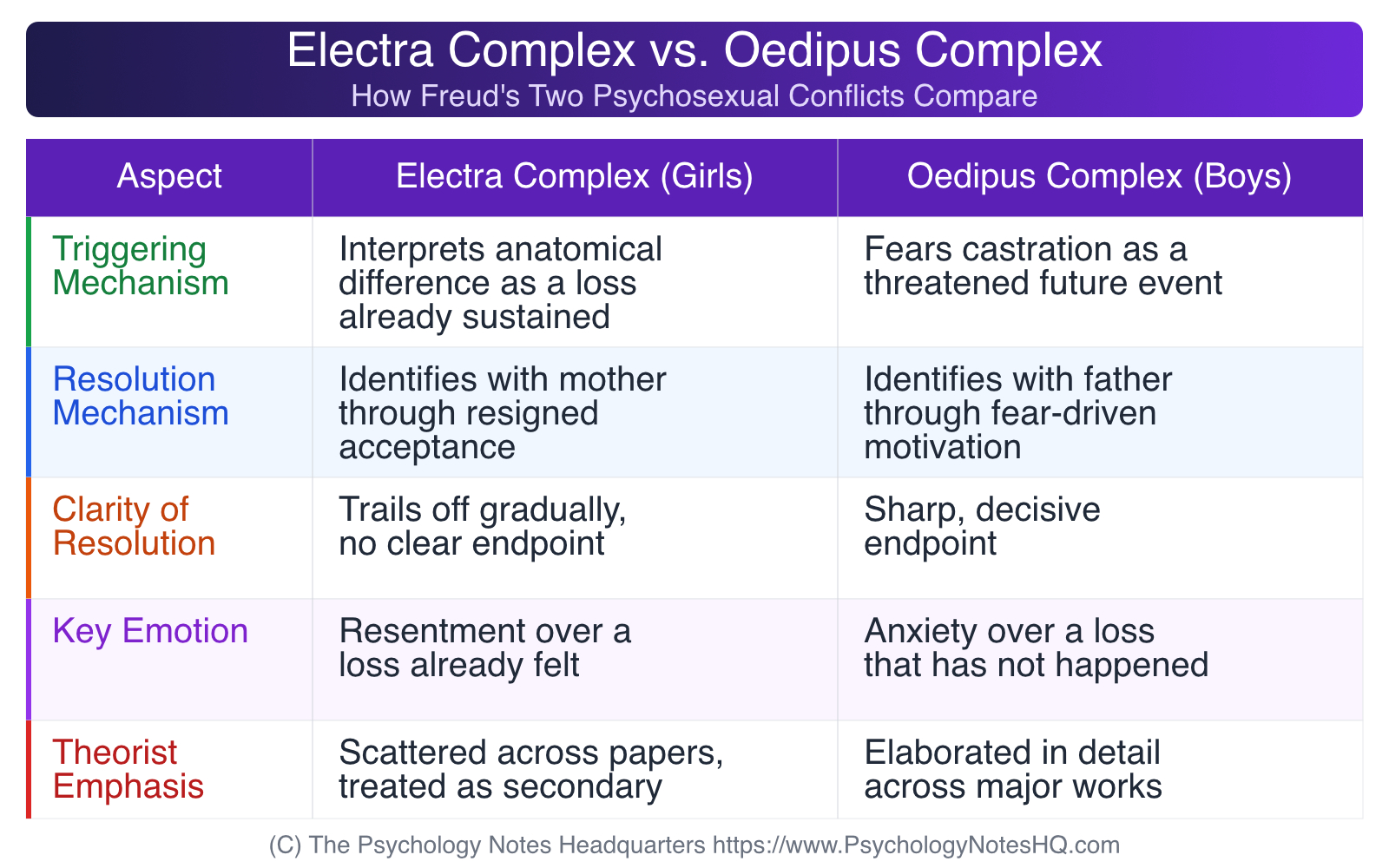
First, the triggering mechanism differs. Boys fear future castration as a potential event; girls have already experienced it. Boys are driven by anticipatory anxiety; girls are driven by retrospective interpretation of perceived loss. This means the emotional quality of the two conflicts is quite distinct from the start.
Second, the resolution mechanism differs. Boys resolve their conflict through identification driven by fear: they become like the father to neutralize the threat. Girls resolve theirs through identification driven by acceptance: they align with the mother because that is the available path. One resolution is sharp and externally motivated; the other is gradual and internally negotiated.
Third, the clarity of the resolution differs. The Oedipus complex in boys has a relatively clean endpoint: castration anxiety peaks, identification occurs, the conflict recedes, and a strong superego forms. The female complex, in Freud’s account, trails off rather than concludes. Its boundaries are vague and its resolution partial. This is one reason the electra complex and oedipus complex are rarely treated as true equivalents in contemporary reviews of Freud’s work, and a key reason Freud himself remained dissatisfied with his account of female development throughout his career.
The Electra Complex in Adulthood
Freud suggested that an unresolved electra complex could surface in adult life, shaping personality and relationship patterns. In contemporary psychoanalytic thinking, this framing has shifted away from literal penis envy toward broader relational dynamics rooted in early father-daughter attachment (Mitchell, 1974).
Electra complex examples that show up in adult patterns include an intense need for approval from older male figures, a tendency to idealize romantic partners who resemble paternal figures, and competitive or dismissive attitudes toward female peers and authority figures. These patterns reflect what can happen when early father-attachment dynamics remain unintegrated, when the relational questions raised during the phallic stage are never adequately resolved.
There is some conceptual overlap here with identity vs. role confusion in Erikson’s model: individuals who have not developed a secure sense of self may rely on external validation, particularly from older male figures, as a substitute for genuine identity formation. Attachment theory offers a more empirically grounded explanation for similar patterns, linking anxious or preoccupied attachment styles to early relational experiences with caregivers, without requiring psychosexual conflict as the mechanism.
The practical takeaway: early father-daughter dynamics genuinely shape adult relationship patterns. Attributing those patterns specifically to the electra complex, however, goes well beyond what the evidence supports.
Feminist and Modern Critiques
The Freud electra complex attracted some of the most sustained feminist critique in the history of psychology, and many of the sharpest objections came from psychoanalysts working within Freud’s own tradition.
Karen Horney challenged the concept of penis envy directly. In her 1926 paper, she argued that when girls express envy of male anatomy, they are more likely reflecting awareness of male social privilege, the freedom, autonomy, and status afforded to men in patriarchal societies, than expressing a literal desire for male genitalia. She also introduced the concept of womb envy, pointing out that men’s fascination with and envy of women’s reproductive capacity was at least as psychologically plausible as the reverse, and that Freud had simply failed to theorize it (Horney, 1926/1967). Clara Thompson extended this line of thinking, arguing that what Freud observed in his patients was a culturally produced response to gender inequality, not a universal biological drive (Thompson, 1943).
Nancy Chodorow offered a structural alternative. Rather than locating gender development in anatomical discovery, she argued that it emerges from relational dynamics, specifically from the different ways mothers relate to daughters versus sons. Because mothers tend to identify more closely with daughters, girls develop a more relational sense of self, not because of penis envy but because of how caregiving is organized in gendered family structures (Chodorow, 1978).
The methodological problems with Freud’s theory compound these theoretical objections. His evidence came almost entirely from adult women’s retrospective accounts during therapy, not from direct observation of children. His patients were predominantly upper-middle-class Viennese women, hardly a foundation for universal claims about female psychology. Contemporary frameworks, including gender socialization theory, social learning theory, and the work of feminist developmentalists like Carol Gilligan, have provided more empirically grounded accounts of how girls develop identity, morality, and sense of self.
Is the Electra Complex Real?
Contemporary developmental psychology’s answer is clear: not in the way Freud described. Systematic research has found no evidence for universal penis envy as a psychological phenomenon, no consistent link between phallic-stage experiences and adult personality outcomes, and no empirical support for Freud’s claims about female moral development (Blakemore, Berenbaum, & Liben, 2009).
What research does support is a considerably more complex picture. Gender identity develops through a combination of biological predispositions, cognitive maturation, family dynamics, peer relationships, and cultural context. Moral development in children follows trajectories better explained by cognitive-developmental accounts than by Freudian superego theory. Broader child development theories have largely shifted toward integrative models that treat biological, social, and cognitive influences as operating together rather than reducing everything to a single psychosexual conflict at age four.
That said, the concept retains value as a historical and cultural artifact. It opened a conversation about female development that psychoanalysis had previously neglected, and the critiques it generated helped produce lasting insights about how girls develop identity, navigate family relationships, and construct a sense of self. The theory may be empirically discredited, but the questions it raised were worth asking, and the feminist responses it provoked were among the most important contributions in the history of developmental psychology.
The electra complex endures in psychology textbooks and cultural vocabulary long after the evidence has moved on. Understanding what it actually claims, and why those claims fail to hold up, is valuable not just as historical knowledge, but as practice in thinking critically about how psychological theories get made, whose experiences they center, and what assumptions they quietly carry. That kind of scrutiny is exactly what the field’s best thinkers eventually turned on Freud’s own framework.
References
- Freud, S. (1925/1961). Some psychical consequences of the anatomical distinction between the sexes. In J. Strachey (Ed. & Trans.), The standard edition of the complete psychological works of Sigmund Freud (Vol. 19, pp. 248-258). Hogarth Press.
- Freud, S. (1931/1961). Female sexuality. In J. Strachey (Ed. & Trans.), The standard edition of the complete psychological works of Sigmund Freud (Vol. 21, pp. 225-243). Hogarth Press.
- Jung, C. G. (1913). The theory of psychoanalysis. Psychoanalytic Review, 1, 1-40.
- Horney, K. (1926/1967). The flight from womanhood. In H. Kelman (Ed.), Feminine psychology (pp. 54-70). Norton.
- Thompson, C. (1943). Penis envy in women. Psychiatry, 6(2), 123-125.
- Chodorow, N. (1978). The reproduction of mothering: Psychoanalysis and the sociology of gender. University of California Press.
- Mitchell, J. (1974). Psychoanalysis and feminism. Pantheon Books.
- Blakemore, J. E. O., Berenbaum, S. A., & Liben, L. S. (2009). Gender development. Psychology Press.
How to cite this article:
The Psychology Notes Headquarters. (2026). The Electra Complex: Why Freud Rejected His Own Theory. Retrieved from https://www.psychologynoteshq.com/freud-electra-complex/