
Carol Gilligan’s Ethics of Care: Why Kohlberg’s Moral Stages Got Women Wrong
Gilligan’s ethics of care emerged as a direct challenge to the most influential model of moral development in psychology — and it permanently changed the field. Carol Gilligan, once a student and research collaborator of Lawrence Kohlberg, identified a critical flaw in her mentor’s work: his six-stage framework was built entirely on data from boys and men, then presented as universal. When researchers applied it to women, they consistently scored lower. Gilligan’s response wasn’t to help women “catch up” to Kohlberg’s standards. She argued the entire measuring stick was wrong — and proposed a fundamentally different moral framework built on relationships, empathy, and the responsibility to prevent harm.
Key Takeaways
- Kohlberg built his six-stage moral development theory on an all-male sample, which led to women being consistently rated as less morally mature when researchers applied his framework to them.
- Gilligan argued women weren’t morally deficient — they were reasoning from a different but equally valid orientation centered on relationships, empathy, and preventing harm.
- The ethics of care and the ethics of justice represent two distinct moral frameworks: one prioritizes contextual compassion, the other prioritizes abstract rules and fairness.
- Gilligan identified three stages of care-based moral development, moving from self-interest to self-sacrifice to a mature balance of care for both self and others.
- Modern research shows both orientations exist across genders, with context and culture playing a larger role than gender in which framework a person uses.
What Is Gilligan’s Ethics of Care?
Gilligan’s ethics of care is a moral framework that treats relationships, empathy, and responsibility to specific others — rather than abstract rules or universal principles — as the foundation of morality. Rather than asking “what does justice require?” it asks “who could be hurt, and what does genuine care demand here?”
Carol Gilligan introduced this framework in her 1982 book In a Different Voice, which became one of the most cited works in feminist psychology and moral philosophy. She wasn’t claiming that women are simply more emotional or nurturing than men by nature. She was making a sharper theoretical point: that the relational, context-sensitive way many women approached ethical decisions wasn’t a failure to reason correctly — it was a different kind of moral reasoning altogether, one that psychology had no framework to recognize because it had never thought to look for it.
The ethics of care framework has since expanded well beyond psychology. It’s foundational in nursing ethics, influential in bioethics, and widely adopted in feminist political philosophy. But its origins are entirely psychological — a direct response to the distorting effects of male-centered research on how we understand human moral development. To appreciate why Gilligan’s contribution mattered so much, you need to understand what Kohlberg was claiming, and exactly where that claim broke down.
Kohlberg’s Six Stages — and the Sample That Skewed Everything
Lawrence Kohlberg studied moral reasoning primarily through responses to carefully constructed hypothetical scenarios. The most famous is the Heinz dilemma: a man’s wife is dying of a rare disease; he cannot afford the drug that would save her; should he steal it? Kohlberg’s interest wasn’t in whether participants answered yes or no — it was in the reasoning behind their answers.
His research began in the 1950s with a longitudinal study of 84 boys, whose moral reasoning he tracked from childhood into adulthood. From this dataset, he identified six stages of moral development organized across three levels. Preconventional morality represents the earliest level, where behavior is driven by avoiding punishment or pursuing reward. Conventional morality reflects a shift toward social norms and maintaining order. Postconventional morality — Kohlberg’s highest level — involves reasoning from self-chosen universal ethical principles that can override social laws when necessary.
Kohlberg explicitly presented this sequence as universal, applying to all humans regardless of gender or culture. The problem is straightforward: a developmental sequence derived entirely from male experience cannot be assumed to apply to everyone. When researchers began studying moral development in children and adolescents using Kohlberg’s scoring system, female participants didn’t fit neatly into it — and the framework’s response was to classify them as less morally developed rather than to ask whether the framework itself was adequate (Kohlberg, 1984).
The Gender Bias Problem: Why Women Scored “Lower”
When Kohlberg’s scoring system was applied to female participants, a consistent pattern emerged. Women clustered at Stage 3 — the stage defined by wanting to be a “good person,” maintaining relationships, and seeking social approval from those around them. Men more frequently reached Stages 4 and 5, which prioritize law-and-order thinking, respect for institutional authority, and abstract universal principles.
Within Kohlberg’s framework, Stage 3 was a transitional phase, not a destination. Mature moral reasoning was supposed to move beyond interpersonal concerns toward impartial, principle-based thinking. The implication was uncomfortable: women appeared to plateau at a less mature stage, too focused on relationships and social harmony to reach the higher rungs of moral reasoning.
This conclusion wasn’t the result of hostility — it was simply what the framework produced when applied to a population it was never designed to measure. The effect, however, was to encode a long-standing stereotype into scientific language: that women are guided more by feeling than reason, more by personal loyalty than by principle. The attribution errors embedded here were significant — behavior shaped by socialization and measurement bias was treated as evidence of women’s inherent moral capacity.
Gilligan’s key move was to stop asking why women scored lower and start asking whether Kohlberg’s framework was actually measuring what it claimed to measure — and whose experience it genuinely reflected. This reframing is at the heart of Gilligan’s moral development critique.
A Different Voice, Not a Deficit
Gilligan’s central argument can be stated simply: Kohlberg didn’t discover universal moral development. He mapped one particular pathway — the one that tends to emerge from male socialization in Western cultures — and assumed it was the only pathway worth tracking.
The process of gender socialization produces systematically different moral orientations. Boys in most Western cultures are raised toward independence, competition, and respect for rules. Girls are raised toward empathy, nurturing, and maintaining relationships. These aren’t random differences — they reflect deeply embedded cultural expectations about what each gender is supposed to value. Neither set of values is inherently superior, but they do produce different ways of framing and solving ethical problems.
When a woman approached the Heinz dilemma by focusing on relationships — “What happens to trust between people?” or “What does this do to the family?” — Kohlberg’s system registered that as lower-stage reasoning. Gilligan read the same response as moral sophistication operating from a different set of priorities.
The shift in framing is significant. Gilligan moved the question from “why can’t women reason abstractly like men?” to “why is male reasoning being treated as the universal benchmark?” This challenge didn’t apply only to Kohlberg. It reached across the major frameworks in developmental psychology, many of which — including Freud’s account of moral development — centered male experience without acknowledging it as a limitation.
The Ethics of Care vs. The Ethics of Justice
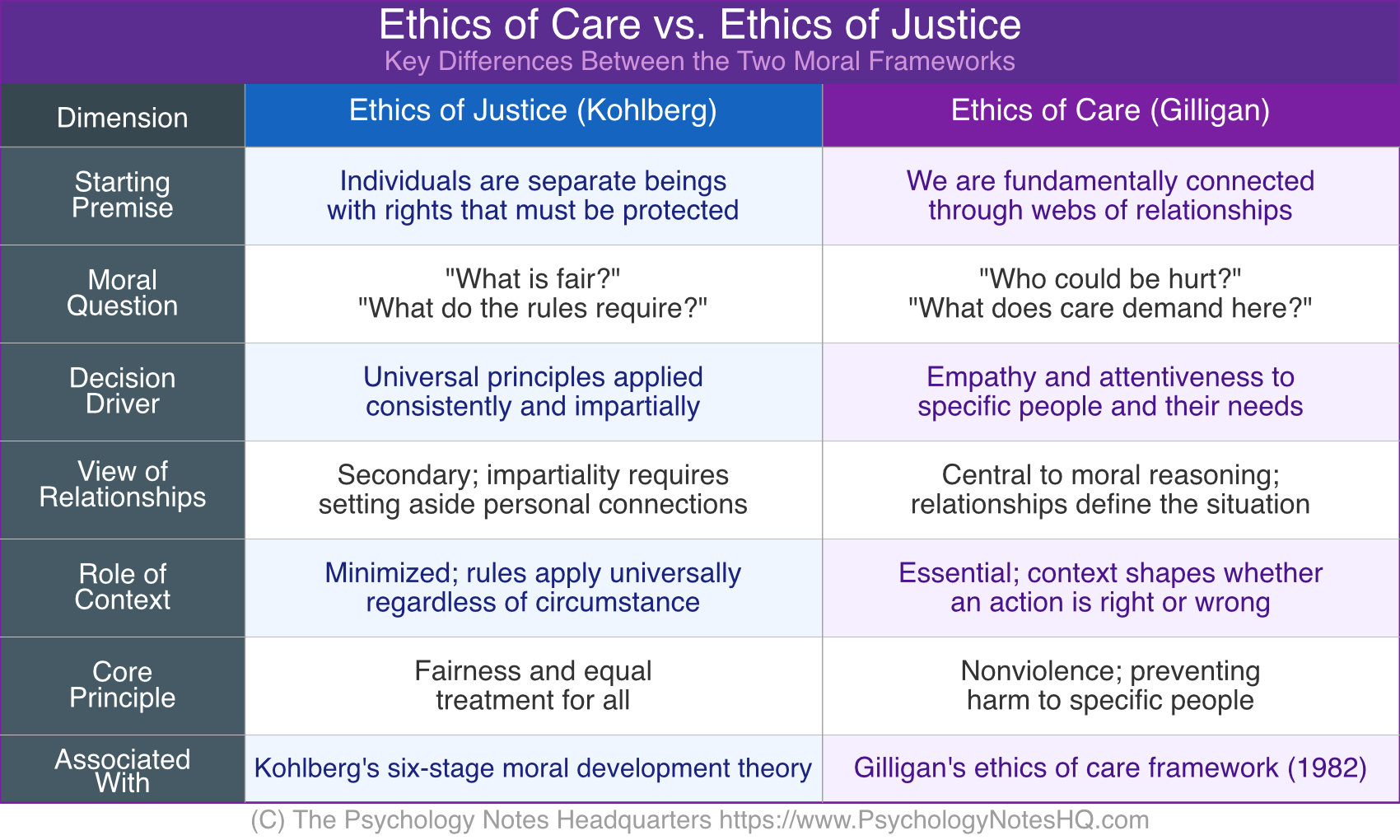
These two frameworks begin from fundamentally different premises about what morality is and what it is for.
The ethics of justice, which underpins Kohlberg’s model, treats individuals as essentially separate beings with rights that must be protected. Moral reasoning means applying universal principles consistently and impartially — the same rules apply to everyone regardless of who they are or what relationship they have to you. The blindfolded figure of Justice holding scales captures this ideal: detached, consistent, unmoved by personal feeling or circumstance.
The ethics of care inverts this premise. We are not isolated individuals — we are embedded in webs of relationships and mutual dependencies. Morality, in this view, means paying attention to those relationships: identifying who is vulnerable, how to respond with genuine compassion, and how to prevent harm without abandoning those who depend on you. Context matters profoundly here, and a fixed universal rule often fails to capture the specific weight of a specific relationship.
This care vs justice distinction isn’t a simple female vs male divide, and Gilligan was careful to frame it that way. Both orientations coexist within individuals. The ethics of care doesn’t dismiss fairness any more than the ethics of justice dismisses compassion — but each has a different moral center of gravity. Gilligan’s argument was that the most mature moral reasoning integrates both: holding principles while remaining attentive to persons, pursuing justice while practicing genuine care (Gilligan, 1982).
Gilligan’s 3 Stages of Care Development
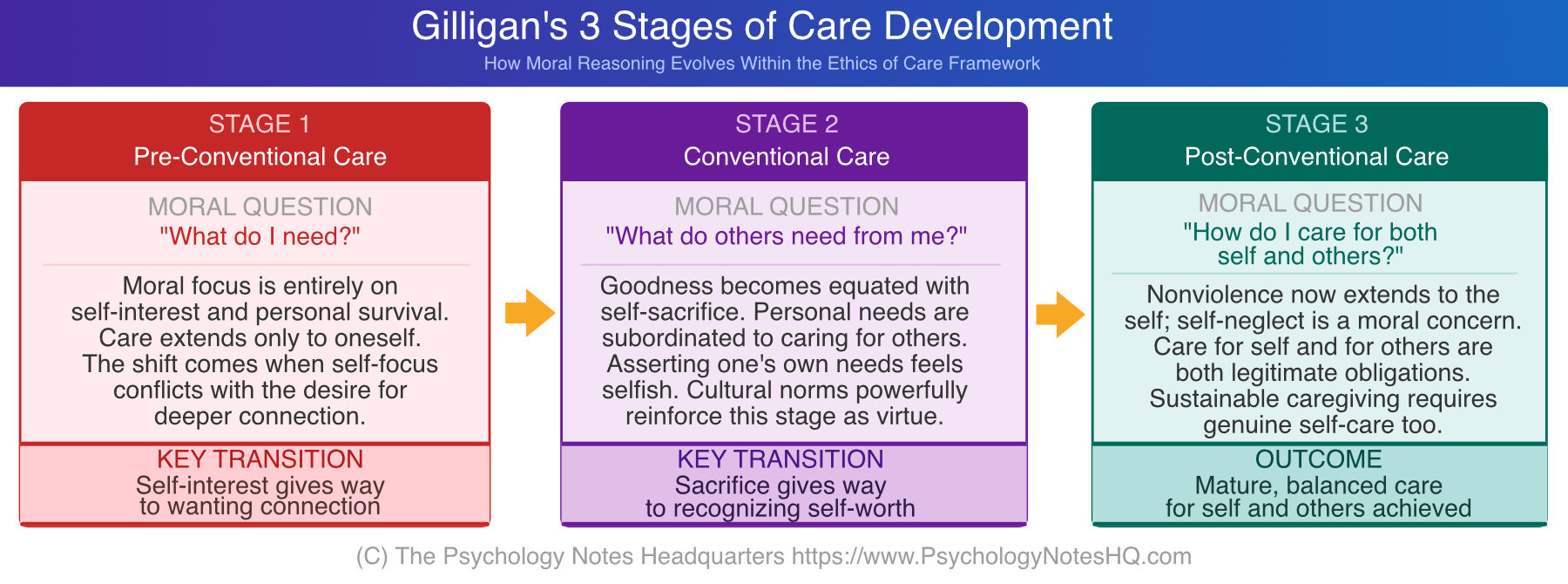
Alongside her critique of Kohlberg, Gilligan proposed her own developmental sequence within the care framework. These three stages describe how care-based moral reasoning develops over time — and they follow a very different arc than Kohlberg’s stages.
Stage 1: Pre-Conventional Care
The first stage centers on individual survival and self-interest. The primary moral concern is simply “what do I need?” Care extends only to oneself, and decisions are made on the basis of self-preservation. This isn’t pathological selfishness — it reflects an early developmental position where the capacity to hold multiple perspectives hasn’t yet formed. The move out of this stage typically happens when the person begins to feel that pure self-focus conflicts with the relationships they want and need.
Stage 2: Conventional Care
The second stage swings dramatically in the opposite direction. Goodness becomes equated with self-sacrifice — caring for others even at the expense of oneself. The moral question transforms from “what do I need?” to “what do others need from me?” Women at this stage often experience asserting their own needs as inherently selfish. They may derive their sense of worth almost entirely from their caregiving role.
This stage aligns closely with traditional ideals of femininity, which is precisely why it can feel like virtue rather than limitation. Cultural reinforcement — praising women who put others first, criticizing those who assert their own needs — keeps many people anchored here.
Stage 3: Post-Conventional Care
The third stage achieves a mature balance. Gilligan grounds it in the principle of nonviolence, which she extends to include violence against oneself through perpetual self-neglect. Care for self and care for others are both recognized as legitimate moral obligations. The person can set limits, assert their own needs, and recognize that sustainable caregiving requires caring for oneself too (Gilligan, 1982). This mirrors the sophistication of Kohlberg’s highest stages while arriving there through a fundamentally different moral logic.
Real-World Applications of the Ethics of Care
One reason Gilligan’s framework has had lasting influence beyond academic psychology is that it describes how moral reasoning actually functions across a wide range of real human situations — not just hypothetical dilemmas.
In healthcare, care ethics is foundational to nursing practice and increasingly central to medical ethics more broadly. A justice framework asks whether a clinical decision was procedurally consistent with patient rights. A care framework asks how this specific patient is experiencing their situation, what their support network needs, and how the caregiver-patient relationship shapes what the most appropriate response actually looks like. Both dimensions matter — but the care dimension is often what patients and families experience most directly and remember longest. Noddings (2013) describes this as the difference between applying an ethical principle and genuinely attending to the person in front of you.
In parenting, care ethics maps closely onto what developmental research consistently finds. The literature on attachment theory shows that responsive, empathic caregiving — attentive to the specific needs of a specific child — produces the most secure development. This is care ethics in action.
In everyday social behavior, care reasoning underlies much of what researchers study as prosocial behavior — the motivation to help and support others not because a rule demands it but out of genuine concern for their wellbeing. The contrast with the bystander effect is instructive: the absence of felt relational connection is precisely what allows people to disengage from someone else’s distress.
What Modern Research Says
The Kohlberg–Gilligan debate generated an enormous volume of empirical research over the following decades, and the picture that eventually emerged was considerably more nuanced than either theorist had initially proposed.
A landmark meta-analysis by Jaffee and Hyde (2000) reviewed over 100 studies and found that while women showed a modest tendency toward care reasoning and men toward justice reasoning, the differences were far smaller than the theoretical debate implied. Both orientations appeared regularly across genders. Men reason from care frameworks routinely — particularly in parenting, close friendships, and caregiving contexts. Women reason from justice frameworks readily in professional, legal, and institutional settings.
Context proved to be a stronger predictor of moral orientation than gender. Walker (2006) found that the type of dilemma — whether it involved personal relationships or abstract social issues — predicted which framework a person used far more reliably than their gender did.
Cultural factors also emerged as significant. In more collectivist cultures, care-oriented reasoning appears broadly across all genders. In more individualistic cultures, justice reasoning tends to dominate — again regardless of gender. This pattern connects to Havighurst’s insight that moral development is shaped by the social and cultural context in which a person develops, not just by internal stages unfolding independently of the world around them.
These findings refine rather than refute Gilligan’s contribution. Her argument that moral psychology needed a broader, more complete framework was correct. The stronger claim — that care reasoning is specifically or essentially female — has not held up. The two are separable, and the field is better for having made that distinction.
Conclusion
Gilligan’s ethics of care didn’t just critique one theorist — it challenged the deeply embedded assumption that male experience could stand in for universal human experience in psychological research. That methodological correction has proven at least as important as the theoretical content of the framework itself. Whether or not care reasoning is distinctively female, Gilligan gave psychology a richer vocabulary for understanding how people actually navigate moral life — one that holds space for empathy, relationships, and context alongside principle, consistency, and justice.
References
- Gilligan, C. (1982). In a different voice: Psychological theory and women’s development. Harvard University Press.
- Gilligan, C., & Attanucci, J. (1988). Two moral orientations: Gender differences and similarities. Merrill-Palmer Quarterly, 34(3), 223–237.
- Kohlberg, L. (1981). Essays on moral development, Vol. I: The philosophy of moral development. Harper & Row.
- Kohlberg, L. (1984). Essays on moral development, Vol. II: The psychology of moral development. Harper & Row.
- Jaffee, S., & Hyde, J. S. (2000). Gender differences in moral orientation: A meta-analysis. Psychological Bulletin, 126(5), 703–726.
- Walker, L. J. (2006). Gender and morality. In M. Killen & J. G. Smetana (Eds.), Handbook of moral development (pp. 93–115). Lawrence Erlbaum Associates.
- Noddings, N. (2013). Caring: A relational approach to ethics and moral education (2nd ed.). University of California Press.
How to cite this article:
The Psychology Notes Headquarters. (2026). Carol Gilligan’s Ethics of Care: Why Kohlberg’s Moral Stages Got Women Wrong. Retrieved from https://www.psychologynoteshq.com/kohlberg-vs-gilligan/