
Kohlberg’s Conventional Ethics: Why Rules Feel Like Right
A driver stops at a red light at 3am with no one else on the road. Nobody’s watching, there’s no ticket coming, and yet they wait for green. That instinct sits at the center of Kohlberg’s conventional ethics — the mid-level of his moral development model, where right and wrong get defined by social approval and law rather than self-interest or abstract principle. It’s the level where most adolescents and adults live, split between two stages: fitting in with people who matter (Stage 3) and following the rules that hold society together (Stage 4).
Key Takeaways
- Conventional morality represents most adolescents’ and adults’ moral reasoning, characterized by internalizing social norms and defining right by social approval and law-following.
- Stage 3 focuses on being a “good person” through nice behavior, good intentions, and maintaining positive relationships to gain approval from family and peers.
- Stage 4 emphasizes obeying laws, respecting authority, and fulfilling duties because societal order depends on everyone following rules to prevent chaos.
- A conventional morality example in the Heinz Dilemma shows Stage 3 justifying theft as good-husband behavior while Stage 4 opposes it to maintain law.
- Stage 3 and Stage 4 reasoning shows up constantly in everyday life — from a teen keeping a promise to protect a friendship, to a professional following regulations even when no one is watching.
Understanding Conventional Morality
Conventional morality occupies the middle level of Lawrence Kohlberg’s three-level framework, representing the most common form of moral reasoning among adolescents and adults worldwide. While preconventional morality focuses on self-interest and avoiding punishment, and postconventional morality transcends social norms to follow abstract principles, this middle layer of conventional ethics centers on conforming to social expectations and maintaining social order.
This level is most common because it serves society’s fundamental need for cooperation and stability. Conventional moral reasoning supports family cohesion, community functioning, and societal order by motivating individuals to fulfill social roles, follow laws, and consider others’ expectations. Most people never progress beyond conventional morality, not because they lack cognitive ability but because this level adequately addresses most ethical situations they encounter.
The shift to internalized social norms distinguishes conventional from preconventional morality. While preconventional thinkers follow rules to avoid external punishment or gain personal rewards, conventional thinkers have internalized social standards as genuinely valuable. They follow rules because rules are right, not just because punishment follows rule-breaking. They seek approval because being respected matters intrinsically, not just instrumentally.
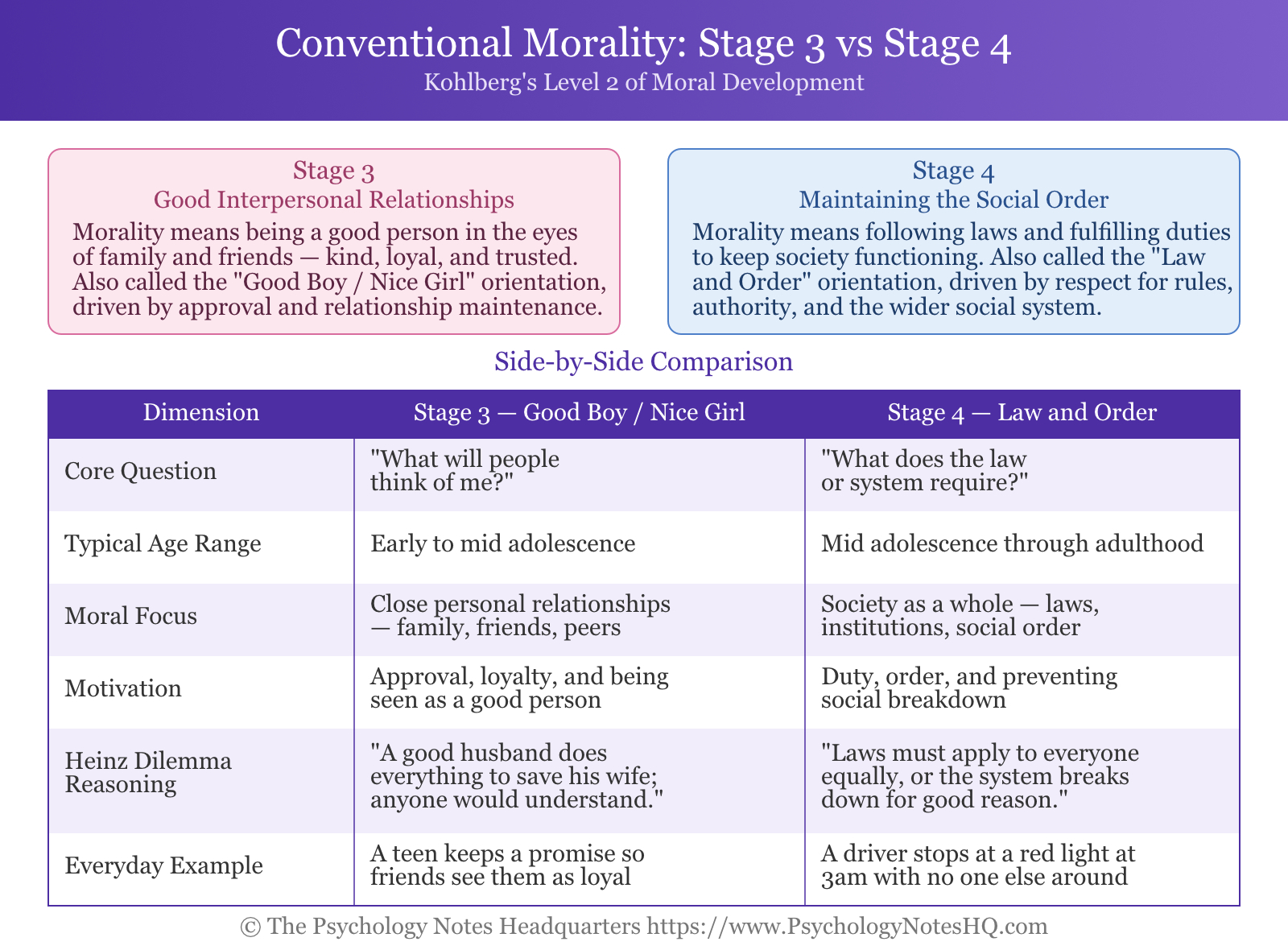
Kohlberg stage 3 and 4 both qualify as conventional but differ in scope and focus. Stage 3 centers on close personal relationships — family, friends, immediate community. What matters is being a good family member, loyal friend, and respected community member. Stage 4 expands focus to society broadly — laws, institutions, duties to the broader social system. Both stages value social conformity but at different scales.
Understanding conventional morality helps explain why most people are law-abiding, care about reputation, feel genuine guilt when disappointing others, and experience moral outrage when social norms are violated. This reasoning supports the social cooperation and institutional functioning that complex societies require.
How Conventional Morality Develops
The shift into conventional morality typically happens during late childhood and early adolescence, driven by two key developments: improved perspective-taking and growing social investment. Children begin to see themselves through others’ eyes — asking not just “Will I get punished?” but “What will my parents think?” or “How will my friends see me?” This capacity for social perspective-taking is what separates conventional reasoning from the self-interest focus of the first level of moral development. At the same time, children become genuinely invested in relationships, group memberships, and social roles. Being a good friend, a trustworthy classmate, or a rule-following student starts to matter intrinsically — not just to avoid punishment. Social approval becomes a real moral motivator, and internalized norms replace external enforcement as the primary guide for behavior. This shift sets the foundation for both Stage 3 and Stage 4 thinking.
Stage 3: Good Interpersonal Relationships (Good Boy/Nice Girl)
Stage 3 represents the first conventional stage, where morality centers on living up to social expectations in close personal relationships. Often called the “Good Boy/Nice Girl” stage, it emphasizes being perceived as a good person by family, friends, and immediate community through kind behavior and good intentions.
Key Characteristics of Stage 3 Reasoning:
– Emphasis on being nice – Kind, helpful, considerate behavior toward others, particularly those in one’s social circle
– Good intentions matter – Judging actions by underlying motivations rather than just outcomes
– Seeking approval – Strong desire to be seen positively by family members, friends, teachers, and respected others
– Relationship maintenance – Prioritizing loyalty, trust, and harmony in close personal relationships
– Role expectations – Living up to expectations for sons/daughters, friends, students, teammates
– Empathy and caring – Genuine concern for others’ feelings, particularly those emotionally close
At Stage 3, individuals define morality through the lens of interpersonal relationships. Right action means being a good family member, loyal friend, caring person, and respected community member. Wrong action means disappointing people who matter, betraying trust, or acting selfishly in relationships.
The focus on intentions represents important moral progress. Unlike Stage 2’s exclusive focus on outcomes, Stage 3 recognizes that well-meaning people sometimes make mistakes and that intentional harm differs morally from accidental harm. A friend who forgot your birthday isn’t morally equivalent to one who deliberately ignored it. Good intentions can excuse poor outcomes.
Seeking approval drives much Stage 3 behavior. Adolescents at this stage care intensely about what parents, friends, and respected adults think of them. They want to be seen as “good kids,” “loyal friends,” and “responsible students.” This desire for approval motivates prosocial behavior — helping, sharing, cooperating, being kind.
Golden Rule thinking emerges strongly at Stage 3: “Treat others as you want to be treated.” This reciprocal empathy goes beyond Stage 2’s instrumental exchange. It’s not “I’ll help you so you’ll help me” but rather “I should help because I’d want help if I were in your situation.” The motivation is empathetic identification rather than calculated self-interest.
Loyalty and trust become paramount values. Stage 3 individuals feel genuine guilt betraying friends’ confidence, letting down family, or failing to support those who’ve supported them. Relationships are maintained through mutual caring, trust-building, and meeting others’ expectations.
Stage 3 Examples:
A teenager doesn’t lie to parents not just to avoid punishment but because “good children don’t lie to their parents” and disappointing them feels genuinely wrong. A student helps a struggling classmate not for future favors but because “that’s what good friends do” and they’d want help in similar situations. An adolescent follows school rules because “good students respect teachers and school expectations.”
Stage 4: Maintaining the Social Order (Law and Order)
Stage 4 expands moral concern from immediate relationships to society broadly, emphasizing laws, duties, and social institutions. Often called the “Law and Order” stage, it focuses on maintaining social order through universal rule-following and respect for authority and social systems.
Key Characteristics of Stage 4 Reasoning:
– Laws as absolute – Rules must be followed by everyone to maintain social order
– Respect for authority – Legitimate authorities (government, police, courts) deserve obedience
– Duty and obligation – Everyone has responsibilities to society that must be fulfilled
– Social system perspective – Considering what happens if everyone breaks rules
– Preventing chaos – Belief that social order requires consistent rule enforcement
– Categorical reasoning – Laws apply equally to everyone without exception
At Stage 4, morality becomes more abstract and impersonal. Rather than focusing on specific relationships, Stage 4 thinkers consider society as a system requiring rules for functioning. Laws aren’t just authority figures’ preferences but necessary frameworks for social cooperation and order.
The key insight at Stage 4 is understanding what philosophers call the “universalizability problem” — what if everyone did this? Stage 4 thinkers recognize that individual rule violations, while perhaps beneficial to the violator, threaten social fabric if universalized. “If everyone stole when they thought it justified, society would collapse into chaos.”
Respect for authority stems from recognizing that social order requires designated authorities enforcing consistent rules. Without police, courts, and government, competing individual judgments would create conflict. Authority isn’t valued because powerful people demand obedience (Stage 1) but because authority structures enable societal functioning.
Duty and obligation feature prominently. Citizens have duties to obey laws, pay taxes, serve on juries. Workers have duties to employers. Parents have duties to children. These obligations exist regardless of personal feelings or circumstances. Fulfilling duties maintains the social contract enabling cooperation.
The difference between Stage 3 and Stage 4 becomes clear in scope and abstraction. Stage 3 says “I should keep promises because friends trust me.” Stage 4 says “People should keep promises because society depends on people honoring commitments.” Stage 3 is personal and relationship-focused; Stage 4 is impersonal and system-focused.
Stage 4 thinking tends toward rigidity. Because maintaining social order requires consistent rule enforcement, exceptions and special circumstances are viewed suspiciously. If we allow rule-breaking for seemingly good reasons, where does it end? Better to maintain strict compliance ensuring predictability and order.
Stage 4 Examples:
An adult opposes civil disobedience even for causes they support because “we can’t have people breaking laws just because they disagree with them.” A citizen reports tax cheating not from personal animosity but because “everyone must pay their fair share for society to function.” A professional follows industry regulations strictly because “standards exist for good reasons and must be maintained.”
The Heinz Dilemma at Conventional Level
The Heinz Dilemma — where a man considers stealing an overpriced drug to save his dying wife — elicits characteristically different responses at Stages 3 and 4, revealing conventional morality’s focus on social expectations and social order.
Stage 3 Conventional Response
Stage 3 thinkers typically support Heinz stealing, but their reasoning centers on relationships and role expectations:
“Heinz should steal the drug because he is a good husband and his family expects him to save his wife. A good husband does everything possible to protect his wife. Everyone would understand — they’d do the same for their spouse. His wife and family are counting on him, and he’d feel terrible letting them down. People would think badly of him if he didn’t try to save her. Being a caring, devoted husband means doing whatever it takes.”
This reasoning emphasizes Heinz’s role as husband, family expectations, empathy from others who’d act similarly, concern about being judged as uncaring, and intentions to save someone loved. The focus remains on interpersonal relationships and social expectations for spouses.
Stage 3 might also argue against stealing: “Heinz shouldn’t steal because good people don’t steal. His family would be ashamed if he became a criminal. He should find another way that doesn’t involve doing something wrong.” Even opposing theft, Stage 3 frames reasoning through relationships and reputation.
Stage 4 Conventional Response
Stage 4 thinkers typically oppose Heinz stealing, focusing on law and social order:
“Heinz should not steal because it is against the law, and laws must be followed to maintain a functional society. If everyone broke laws when they thought circumstances justified it, we’d have chaos. We can’t have people deciding which laws to follow based on personal situations. The law says stealing is wrong, so Heinz shouldn’t steal regardless of why he wants to. Yes, his situation is tragic, but the law must apply to everyone equally. If we make exceptions, where does it stop? The solution is working within the legal system — asking for payment plans, seeking charity help, or appealing to authorities — not breaking laws.”
This reasoning emphasizes law as absolute, preventing social breakdown, universal application without exceptions, working within legal systems, and maintaining social order. The focus is societal functioning rather than personal relationships.
Stage 4 might support stealing only by arguing: “Heinz should steal if the law is unjust, but then he should accept punishment to show respect for the legal system.” Even supporting theft, Stage 4 maintains concern for law’s authority.
Why Conventional Reasoning Differs
Both stages demonstrate conventional morality’s defining features — moral reasoning based on social expectations (Stage 3) or social order (Stage 4) rather than self-interest (preconventional) or abstract principles (postconventional). Neither considers whether property rights should supersede life in principle. Instead, they focus on social roles, expectations, laws, and order.
Conventional Morality Examples in Everyday Life
A conventional morality example turns up almost anywhere you look, since this reasoning characterizes most people’s moral decision-making throughout adolescence and adulthood.
Stage 3 Examples in Daily Life
A teenager doesn’t cheat on a test not just to avoid consequences but because “good students don’t cheat” and their parents and teachers would be disappointed. An employee works hard not only for compensation but because “good workers take pride in their work” and colleagues depend on them. A friend keeps confidences because “that’s what loyal friends do” and betraying trust would damage the relationship.
Adolescents at Stage 3 dress according to peer group norms to fit in and be accepted. They participate in family rituals because “that’s what our family does” and it maintains family bonds. They volunteer because helping others is “what good people do” and earns respect from their community.
Stage 4 Examples in Daily Life
An adult pays parking tickets promptly because “laws must be followed even when inconvenient.” A professional follows industry standards strictly because “regulations exist for good reasons.” A citizen votes regularly because “everyone has a duty to participate in democracy.”
People at Stage 4 respect police authority because “society needs law enforcement to maintain order.” They oppose civil disobedience even for causes they support because “we can’t have people breaking laws they disagree with.” They file taxes honestly because “everyone must pay their fair share.”
Business owners follow regulations even when costly because “rules apply to everyone equally and ensure fair competition.” Parents enforce household rules consistently because “children need structure and predictability.” Teachers maintain strict classroom policies because “students need to learn respect for authority and rules.”
Law and Order Orientation Examples
The law and order orientation is Stage 4 in action. A driver who never runs a red light — even at 3am with no one around — because “that’s what traffic laws are for” is reasoning from Stage 4. A nurse who follows medication protocols exactly, even when a shortcut seems harmless, because “regulations exist to protect patients regardless of circumstances” reflects the same thinking. So does an employee who reports a colleague’s minor rule violation not out of personal animosity, but because “rules only work if everyone follows them.” In each case, the moral logic is the same: laws and rules maintain the social order that everyone depends on, so exceptions — however understandable — are a threat to the system.
Conventional Morality in Context
These examples show conventional morality’s pervasiveness. Most people navigate daily life through conventional reasoning — following social norms, respecting laws, maintaining relationships, fulfilling role expectations, seeking social approval, and respecting legitimate authority. This reasoning serves society well by promoting cooperation, stability, and predictability.
Strengths and Limitations of Conventional Morality
Conventional morality serves crucial societal functions while also having important limitations that become apparent in certain contexts.
Strengths of Conventional Reasoning
Conventional morality promotes social stability and cooperation essential for complex societies. When most people internalize norms and follow laws, society functions smoothly with less need for external enforcement. Trust develops, allowing economic transactions, community cooperation, and institutional functioning.
This level balances individual and collective needs better than preconventional morality. While preconventional thinking prioritizes self-interest, conventional thinking recognizes that individual welfare depends on social cooperation and functioning institutions. Conventional thinkers understand their stake in social order.
Conventional morality is accessible and practical. Unlike postconventional reasoning requiring abstract philosophical thinking, conventional reasoning builds on everyday social experiences and relationships. Most people can understand and apply conventional moral reasoning in daily situations.
Limitations and Potential Problems
Conventional morality can support unjust laws and systems. Because Stage 4 emphasizes law-following and authority respect, individuals might comply with immoral laws — segregation, discrimination, human rights violations — simply because “it’s the law.” Conventional thinking may fail to question whether laws are just.
Conformity pressure at Stage 3 can promote harmful peer influences. The desire for approval and acceptance may lead adolescents to engage in risky behaviors if peer groups value them. Stage 3’s emphasis on being liked and fitting in creates vulnerability to negative social influence.
Rigid application of rules at Stage 4 may ignore legitimate exceptions. Real-world ethical situations often involve competing values requiring nuanced judgment. Stage 4’s categorical rule-following may produce outcomes violating common sense or basic humanity.
The Need for Balance
Healthy moral functioning requires conventional morality’s social cooperation orientation while retaining capacity to question unjust norms. The ideal isn’t abandoning conventional thinking but supplementing it with critical evaluation of whether laws and social expectations truly serve justice and human welfare. This is, ultimately, the tension at the heart of conventional ethics: the same rule-following that holds a society together can also let it excuse itself from asking whether the rules are fair.
Conclusion
Conventional morality represents the moral reasoning level of most adolescents and adults, characterized by internalizing social norms and defining right by social approval and law-following. Through Stage 3’s emphasis on being a good person in relationships and Stage 4’s focus on maintaining social order through law adherence, conventional thinkers create the social cooperation and institutional functioning that complex societies require. While this level serves society well by promoting stability and mutual respect, its potential for supporting unjust laws and uncritical conformity highlights the importance of also developing capacity to evaluate social norms critically against principles of justice and human welfare.
References
- Kohlberg, L. (1984). The psychology of moral development: The nature and validity of moral stages. Harper & Row.
- Kohlberg, L. (1981). Essays on moral development, Vol. I: The philosophy of moral development. Harper & Row.
- Gibbs, J. C. (2014). Moral development and reality: Beyond the theories of Kohlberg, Hoffman, and Haidt (3rd ed.). Oxford University Press.
- Rest, J. R. (1979). Development in judging moral issues. University of Minnesota Press.
- Walker, L. J. (1989). A longitudinal study of moral reasoning. Child Development, 60(1), 157-166.
- Turiel, E. (2006). The development of morality. In N. Eisenberg, W. Damon, & R. M. Lerner (Eds.), Handbook of child psychology: Social, emotional, and personality development (pp. 789-857). John Wiley & Sons.
How to cite this article:
The Psychology Notes Headquarters. (2026). Kohlberg’s Conventional Ethics: Why Rules Feel Like Right. Retrieved from https://www.psychologynoteshq.com/conventional-morality/