
Kohlberg’s Preconventional Stage: Why Kids Reason This Way
Picture a kid who stops hitting his younger brother not because he understands that it hurts, but because getting caught means no screen time for a week. That is Kohlberg’s preconventional stage in action — moral reasoning built entirely around consequences rather than values. It is the starting point of Lawrence Kohlberg’s three-level framework, typical for children roughly between ages 4 and 10, though plenty of adults reason this way too.
Key Takeaways
- Kohlberg’s preconventional stage is his first level, where moral decisions are driven by self-interest, punishment avoidance, and reward-seeking rather than internalized values.
- Stage 1 (Obedience and Punishment) reasons “If I do it, I’ll get in trouble” while Stage 2 (Self-Interest) reasons “What’s in it for me?”
- In the Heinz Dilemma, preconventional thinkers focus entirely on consequences for Heinz rather than abstract principles like the value of human life.
- The preconventional stage is typical in early childhood, but some adults continue to operate at this level throughout their lives.
- The shift out of the preconventional stage marks a fundamental move from self-focused to society-focused moral reasoning.
Understanding Kohlberg’s Moral Development Theory
Lawrence Kohlberg, inspired by Jean Piaget’s work on cognitive development, developed his influential theory in the 1950s and 1960s. Through presenting moral dilemmas to children and adults, Kohlberg identified three levels of moral reasoning, each containing two stages, representing increasingly sophisticated ways of thinking about right and wrong. The preconventional stage of moral development is where this journey begins — and understanding it is key to grasping how the entire model works.
The three levels progress from preconventional (self-focused), to conventional (society-focused), to postconventional (principle-focused). Most children begin at the preconventional level, progress to conventional morality during adolescence, and a much smaller number go on to develop the principle-based thinking found at Kohlberg’s third level, though many adults never progress beyond conventional morality.
Moral reasoning matters because it affects how individuals make ethical decisions, resolve conflicts, and navigate social situations. Understanding these developmental stages helps parents, educators, and society recognize age-appropriate moral expectations and support children’s progression toward more sophisticated ethical thinking.
The developmental progression is not automatic but depends on cognitive maturation, social experiences, and opportunities to encounter moral conflicts requiring resolution. Children must develop certain cognitive capabilities — particularly perspective-taking — before progressing beyond preconventional reasoning focused exclusively on self-interest.
Kohlberg’s Preconventional Stage: The Two Stages Explained
Stage 1: Obedience and Punishment Orientation
Stage 1 represents the most foundational form of moral reasoning, characteristic of young children (typically ages 4–7). At this stage, children determine right and wrong entirely based on consequences from authority figures. Actions that result in punishment are “bad”; actions that avoid punishment are “good.” The focus is exclusively on physical consequences rather than on intentions, feelings, or abstract principles.
Key characteristics of Stage 1 thinking include authority-based reasoning, where rules come from powerful figures who must be obeyed without question; punishment avoidance as the primary motivation; an egocentric perspective that prevents considering others’ viewpoints; concrete thinking focused on immediate outcomes; and literal rule following where breaking rules always leads to consequences.
Children at Stage 1 think in very black-and-white terms: “If I do it, I’ll get in trouble, so it’s wrong” or “If I don’t get caught, it’s okay.” The wrongness of an action depends entirely on whether punishment follows, not on harm caused or principles violated. A child might say stealing is wrong because “You’ll go to jail” or hitting is bad because “You’ll get a time-out.”
This reasoning explains common behaviors in young children. They might confess to breaking something immediately because they assume they will be caught and punished anyway. They believe in immanent justice — the idea that punishment automatically follows wrongdoing, even without human intervention. A child who trips after lying might genuinely think the universe punished them for the lie.
The power dynamic is central to Stage 1 thinking. Morality means doing what powerful people say. If dad says hitting is wrong, it’s wrong because dad can impose consequences. If a peer says hitting is okay, that carries no weight because peers lack authority and punishment power. Right and wrong are defined entirely by those who can enforce compliance.
Intentions do not factor into Stage 1 moral judgments. If two children break vases — one accidentally while helping and one purposefully while misbehaving — Stage 1 thinkers judge them equally harshly because the outcome (broken vase) is the same. They cannot yet consider mental states or motivations in moral evaluation.
Stage 2: Individualism and Exchange (Self-Interest)
Stage 2 represents a slight advancement, typically emerging around ages 7–10. Children recognize that different people have different interests and perspectives, but moral reasoning remains firmly egocentric. Right and wrong are determined by “What’s in it for me?” Actions are judged based on how they serve one’s own needs and desires, with fairness understood as equal exchange.
Key characteristics of Stage 2 thinking include instrumental purpose (actions are means to satisfy personal needs); reciprocity reasoning (“you scratch my back, I’ll scratch yours”); relativism awareness that different people want different things; pragmatic cooperation based on mutual benefit; and concrete fairness meaning identical exchange rather than equity.
The shift from Stage 1 to Stage 2 involves recognizing that others have their own needs and wants, not just that they have power. However, this awareness does not create genuine concern for others. Instead, it leads to strategic thinking about how to get what you want while managing others’ self-interest. Cooperation emerges not from caring but from recognizing that helping others can lead to reciprocal benefits.
Stage 2 fairness is strictly transactional. Fair means everyone gets the same thing or equivalent exchanges occur. A child dividing candy thinks fairness means each person receives identical amounts, without considering that different children might have different needs or contributed differently to earning the candy. Equal doesn’t yet mean equitable.
This reasoning explains why Stage 2 children often seem calculating. They will cooperate when it serves them, but withdraw cooperation when benefits disappear. They will follow rules when enforcement is likely but bend or break them when they can get away with it. Morality is instrumental — a tool for getting what you want.

Preconventional Reasoning and the Heinz Dilemma
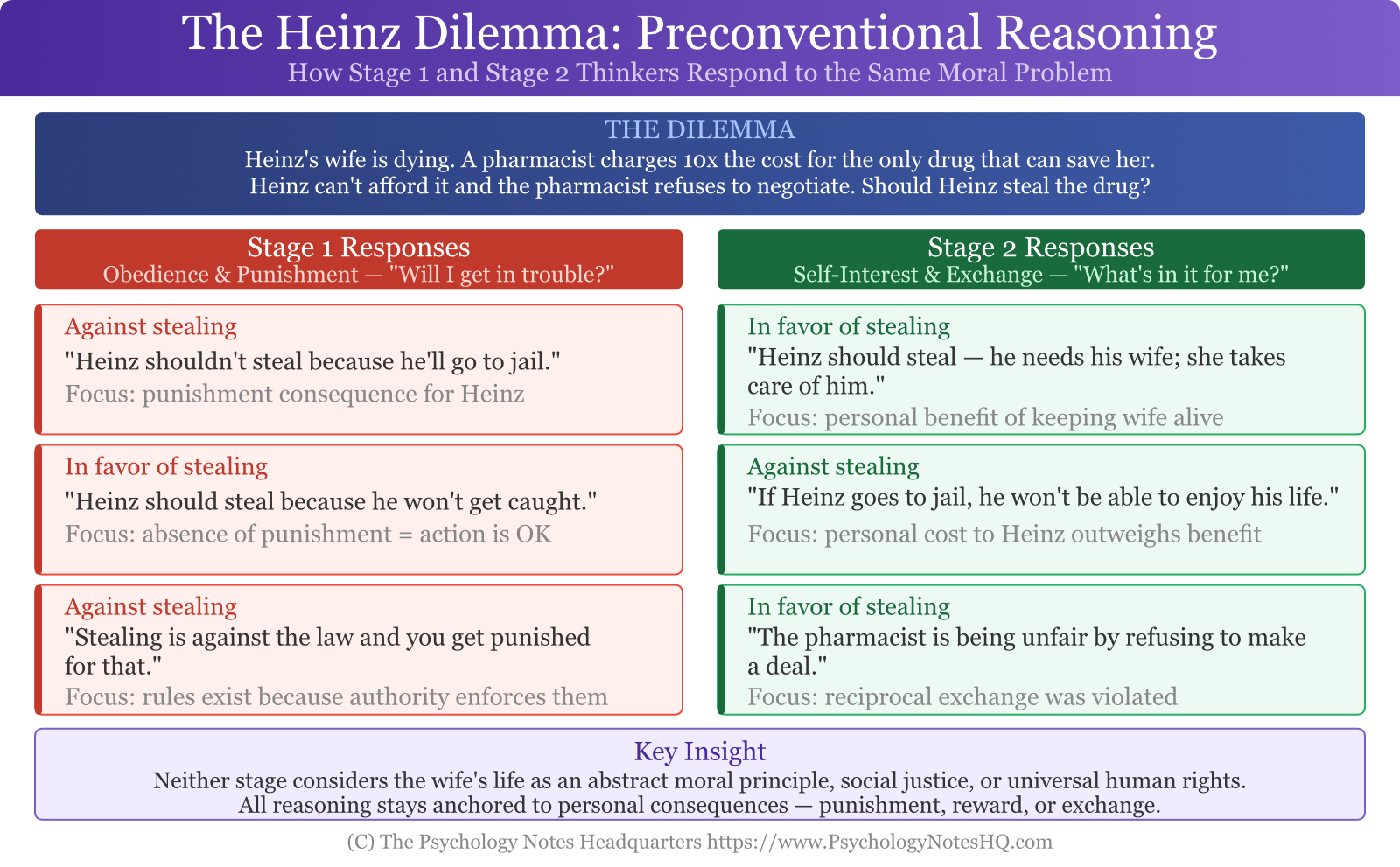
Kohlberg famously used moral dilemmas to assess reasoning levels, with the Heinz Dilemma being the most well-known. In this scenario, a man named Heinz considers stealing an overpriced drug to save his dying wife when the pharmacist refuses to lower the price and Heinz cannot afford it. Respondents are asked whether Heinz should steal the drug and, more importantly, why.
Kohlberg cared more about the reasoning than the yes/no answer. Two people might both say “Yes, steal it” while using completely different moral reasoning levels. The quality of preconventional reasoning is revealed not in the decision itself but in the justification behind it.
A Stage 1 thinker focuses entirely on punishment. They might say “Heinz shouldn’t steal because he’ll go to jail,” or “Heinz should steal because he won’t get caught.” Notice the reasoning never considers the wife’s life, the pharmacist’s rights, or abstract principles. The only consideration is whether Heinz will face consequences.
A Stage 2 thinker focuses on self-interest and exchange. They might say “Heinz should steal because he needs his wife — she cooks for him and takes care of him,” or “Heinz shouldn’t steal because if he goes to jail, he won’t be able to enjoy life.” Stage 2 responses recognize multiple perspectives but frame everything in terms of individual interests and what each party stands to gain or lose.
Neither stage considers abstract moral principles like the sanctity of human life, social contracts, or universal human rights. These concepts require the more advanced reasoning found at the conventional and postconventional levels. Preconventional thinkers remain focused on concrete, personal consequences — punishment or reward, loss or gain.
Preconventional vs Conventional Morality
The transition out of the preconventional stage marks a fundamental shift in moral reasoning orientation. This progression typically occurs during late childhood or early adolescence as children develop more sophisticated cognitive abilities and broader social awareness.
The Shift from “Self” to “Society”
Preconventional morality centers entirely on the self — “What happens to me if I do this? Will I be punished or rewarded? Does this serve my interests?” Right and wrong are determined by personal consequences and individual desires. There is no internalization of social norms or genuine concern for others beyond instrumental relationships.
Conventional morality shifts focus from self to society. Children begin asking “What will others think of me? What do good people do? What rules does society need to function?” Right and wrong become defined by social norms, expectations, and the need for social order. Morality is internalized rather than externally imposed through punishment and reward.
Moving Beyond Punishment and Reward
Preconventional thinkers need external consequences to motivate moral behavior. Remove the threat of punishment or promise of reward, and moral behavior disappears because there is no internal moral compass directing action. Rules are external constraints rather than internalized values.
Conventional thinkers have internalized social norms and moral values. They follow rules even without external enforcement because they’ve adopted these standards as their own. They feel genuine guilt when violating norms — not just fear of consequences — because they’ve integrated society’s moral expectations into their self-concept. The contrast with preconventional reasoning couldn’t be sharper: one is driven by fear, the other by identity.
The Developmental Progression
This shift requires several cognitive and social developments. Children must develop perspective-taking ability to understand how others view their behavior. They need experience with peer relationships where reciprocity and cooperation aren’t purely transactional. They require exposure to social institutions and norms showing that rules serve collective rather than just individual purposes.
The progression is not sudden but gradual. Children might show conventional reasoning in some contexts while reverting to preconventional thinking in others, particularly when under stress or when personal stakes are high. The connection between cognitive development and moral reasoning helps explain why this shift can’t be rushed — it depends on maturation that unfolds over time.
Real-World Examples of the Preconventional Stage
Stage 1: Cleaning Room to Avoid Punishment
Eight-year-old Marcus’s room is a disaster — clothes everywhere, toys scattered, bed unmade. His mother tells him to clean it or he’ll be grounded for the weekend. Marcus immediately starts cleaning, working diligently until the room is spotless.
Why did Marcus clean? Not because he values cleanliness, appreciates his mother’s efforts, or wants to contribute to household harmony. He cleaned entirely to avoid being grounded — a concrete, immediate punishment. This is a textbook example of Stage 1 preconventional moral reasoning in everyday life.
If his mother hadn’t threatened consequences, Marcus wouldn’t have cleaned. The moment the threat of punishment disappears, so does the motivation for the “right” behavior. Morality is entirely external — imposed by authority and enforced through consequences.
Stage 2: Helping a Peer for a Future Favor
Ten-year-old Sarah notices her classmate Emma struggling with math homework during recess. Sarah is excellent at math and could easily help. She considers whether to offer assistance, thinking: “If I help Emma now, she’ll probably let me borrow her new art supplies later.” Sarah decides to help — not from kindness or empathy, but from calculated self-interest.
This exemplifies Stage 2 reasoning perfectly. Sarah recognizes Emma has something she wants and that helping now creates an implicit obligation for reciprocal benefit later. It’s instrumental morality — helping as a tool to get what you want. Sarah has progressed beyond Stage 1 in that she’s not helping to avoid punishment, but it’s still firmly preconventional because everything centers on “What’s in it for me?” There’s no genuine concern for Emma’s wellbeing.
Additional everyday Stage 1 examples include a child telling the truth about breaking a lamp only because they assume they’ll be caught anyway, a student avoiding cheating solely because the teacher is watching, or a child sharing a toy only when a parent commands it. Stage 2 examples include a teenager doing extra chores expecting parents to be lenient about curfew later, or siblings negotiating trades: “I’ll take out the trash if you load the dishwasher.”
When Adults Stay at the Preconventional Stage
While the preconventional stage of moral development is appropriate in early childhood, Kohlberg and subsequent researchers found that some adolescents and adults continue operating primarily at this level. This has important implications for understanding moral behavior across the lifespan.
Some adults never progress beyond preconventional moral reasoning, particularly those who grew up in environments lacking stable social structures, experienced minimal consequences for rule-breaking, have limited perspective-taking abilities, or consistently prioritize short-term gratification over long-term social integration.
Criminal justice contexts reveal preconventional reasoning in adults who commit crimes purely for personal gain without considering harm to victims, avoid illegal behavior only when the likelihood of getting caught is high, or view laws as obstacles to personal desires rather than social necessities. The persistence of this type of reasoning challenges the assumption that moral development is inevitable — cognitive maturity alone doesn’t guarantee moral progression.
Carol Gilligan’s critique of Kohlberg also raised questions about whether his stage model, including the preconventional level, fully captures the moral reasoning of women and girls, whose development may be more oriented around care and relationships from the start.
Conclusion
The preconventional stage represents the starting point of moral development, where children first learn to navigate social rules through consequence-based reasoning. Stage 1’s obedience and punishment orientation and Stage 2’s self-interest thinking may appear unsophisticated, but they’re developmentally appropriate ways for children to begin understanding right and wrong. As cognitive abilities mature and social experiences broaden, most individuals move beyond this stage toward moral reasoning grounded in social norms, relationships, and eventually universal principles — though for some, external consequences remain the primary moral guide throughout life.
References
- Kohlberg, L. (1984). The psychology of moral development: The nature and validity of moral stages. Harper & Row.
- Kohlberg, L. (1981). Essays on moral development, Vol. I: The philosophy of moral development. Harper & Row.
- Gilligan, C. (1982). In a different voice: Psychological theory and women’s development. Harvard University Press.
- Rest, J. R. (1979). Development in judging moral issues. University of Minnesota Press.
- Turiel, E. (2006). The development of morality. In N. Eisenberg, W. Damon, & R. M. Lerner (Eds.), Handbook of child psychology: Social, emotional, and personality development (pp. 789–857). John Wiley & Sons.
- Lapsley, D. K. (1996). Moral psychology. Westview Press.
How to cite this article:
The Psychology Notes Headquarters. (2026). Kohlberg’s Preconventional Stage: Why Kids Reason This Way. Retrieved from https://www.psychologynoteshq.com/preconventional-morality/