
Freud’s Latency Stage of Development: The Quiet Years
Picture a nine-year-old who was inseparable from her best friend a year ago suddenly declaring boys “gross,” disappearing into hours of Lego building, and going quiet the moment anything remotely romantic comes up. Freud had a name for this shift: the latency stage of development, and he argued it is not a lull so much as one of the busiest periods in a child’s psychological life. Spanning roughly age six to the onset of puberty, this stage marks a period when sexual impulses seem to vanish, redirected instead into schoolwork, hobbies, and tight same-sex friendships. What looks like a quiet stretch between the drama of early childhood and the upheaval of adolescence is, according to Freud, doing far more developmental work than it appears to on the surface.
Key Takeaways
- The latency stage of development looks like a psychological pause, but Freud argued it is one of the busiest periods for a child’s mind.
- Sublimation quietly redirects childhood energy into schoolwork, sports, and hobbies, though not in the way most people assume.
- Same-sex friendships are not just a phase kids grow out of. Freud connected them to specific identity work.
- The ego and superego change in ways during this stage that shape how kids handle rules, guilt, and independence later on.
- Unlike the stages before it, this one rarely leaves a lasting fixation, and the reason why says a lot about Freud’s theory.
From Phallic to Latency: The Calm After the Storm
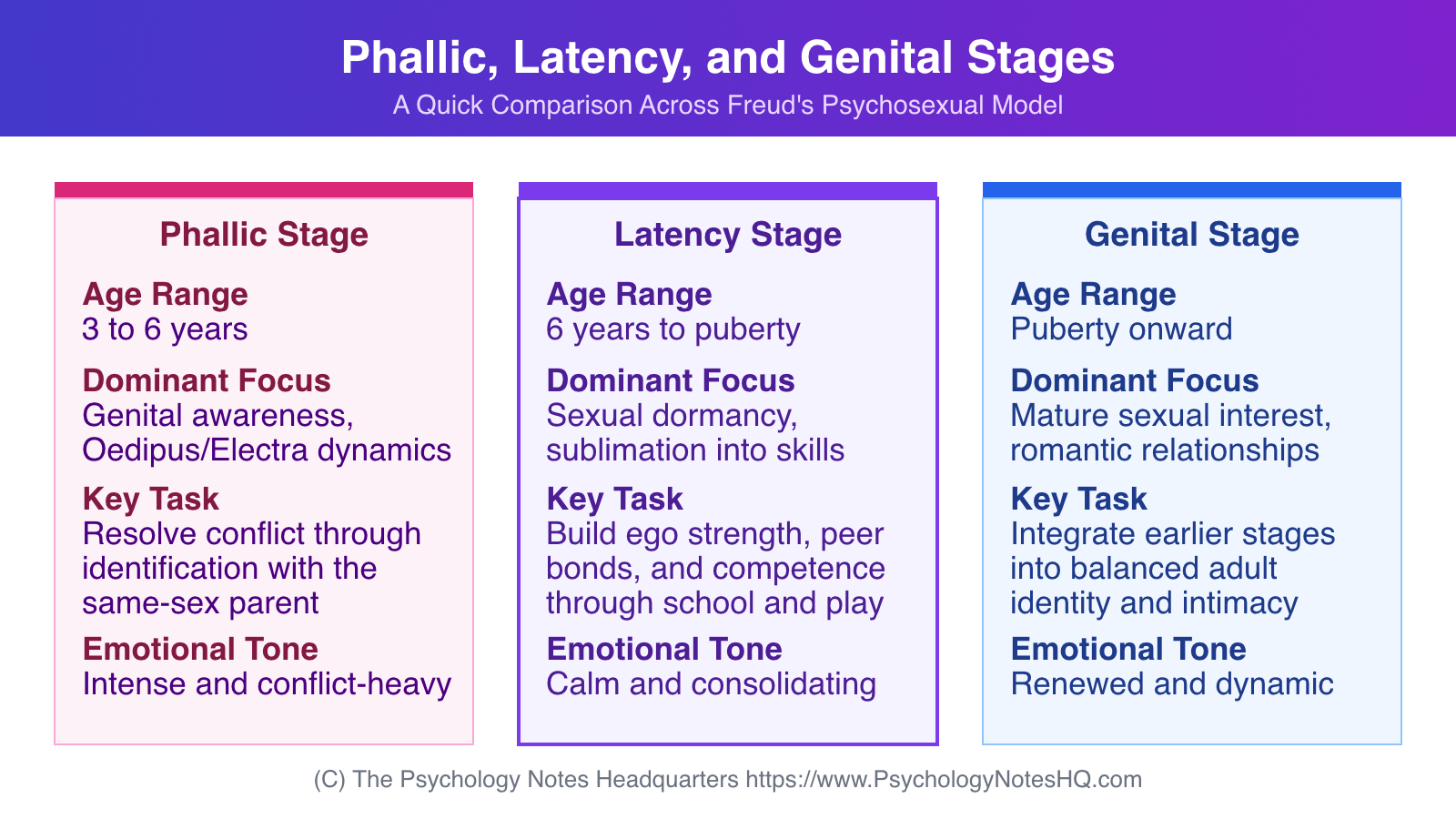
The transition from the tumultuous phallic stage to the relatively peaceful latency period marks a dramatic shift in the child’s psychosexual development. After successfully resolving the Oedipus or Electra complex through identification with the same-sex parent, the child enters a period of psychological calm. The intense desires, anxieties, and conflicts that characterized the phallic stage seem to vanish, replaced by focused engagement with the external world of school, peers, and skill development.
Freud viewed the latency stage as fundamentally different from the three stages preceding it and the genital stage that follows. While the oral, anal, phallic, and genital stages all involve active psychosexual conflicts centered on specific erogenous zones, the latency period represents a pause or intermission in psychosexual development. Sexual interests do not simply shift to a new bodily zone; instead, they become dormant, pushed underground by the powerful forces of repression. This lack of drama is exactly what makes the latency stage of development one of the more misunderstood phases in Freud’s model, since it is easy to mistake quiet for uneventful.
This repression serves important developmental purposes. The child, having just navigated the difficult territory of Oedipal desires and anxieties, needs time to consolidate the psychological gains achieved through resolution of those conflicts. The newly formed superego requires strengthening. The ego needs to develop more sophisticated defenses and capabilities. Gender identification, freshly established through same-sex parent identification, needs reinforcement through practice and peer interaction.
The latency period also provides a developmental breathing space before the renewed sexual challenges of puberty and adolescence. Like the eye of a hurricane, latency offers relative calm between two periods of intense psychosexual turbulence, giving children room to build the cognitive, social, and physical skills that later stages will draw on.
Sublimation: Redirecting Sexual Energy
Freud’s concept of sublimation provides the key to understanding what happens to sexual energy during the latency period. Sublimation, one of the most mature and adaptive defense mechanisms, involves channeling unacceptable impulses into socially valuable activities. The sexual energy that drove the conflicts of earlier stages does not disappear during latency; instead, it gets transformed and redirected into pursuits that society encourages and rewards. This is a core idea behind the freud latency stage concept and one reason it still gets taught in nearly every introductory psychology course.
This redirection occurs unconsciously and serves multiple purposes simultaneously. It allows the child to manage sexual impulses that society deems inappropriate for children while simultaneously producing behaviors that adults praise and support. The same energy that once focused on oral gratification, anal control, or Oedipal desires now powers academic achievement, athletic accomplishment, and creative expression. The transformation makes the child socially acceptable while providing outlets for libidinal energy.
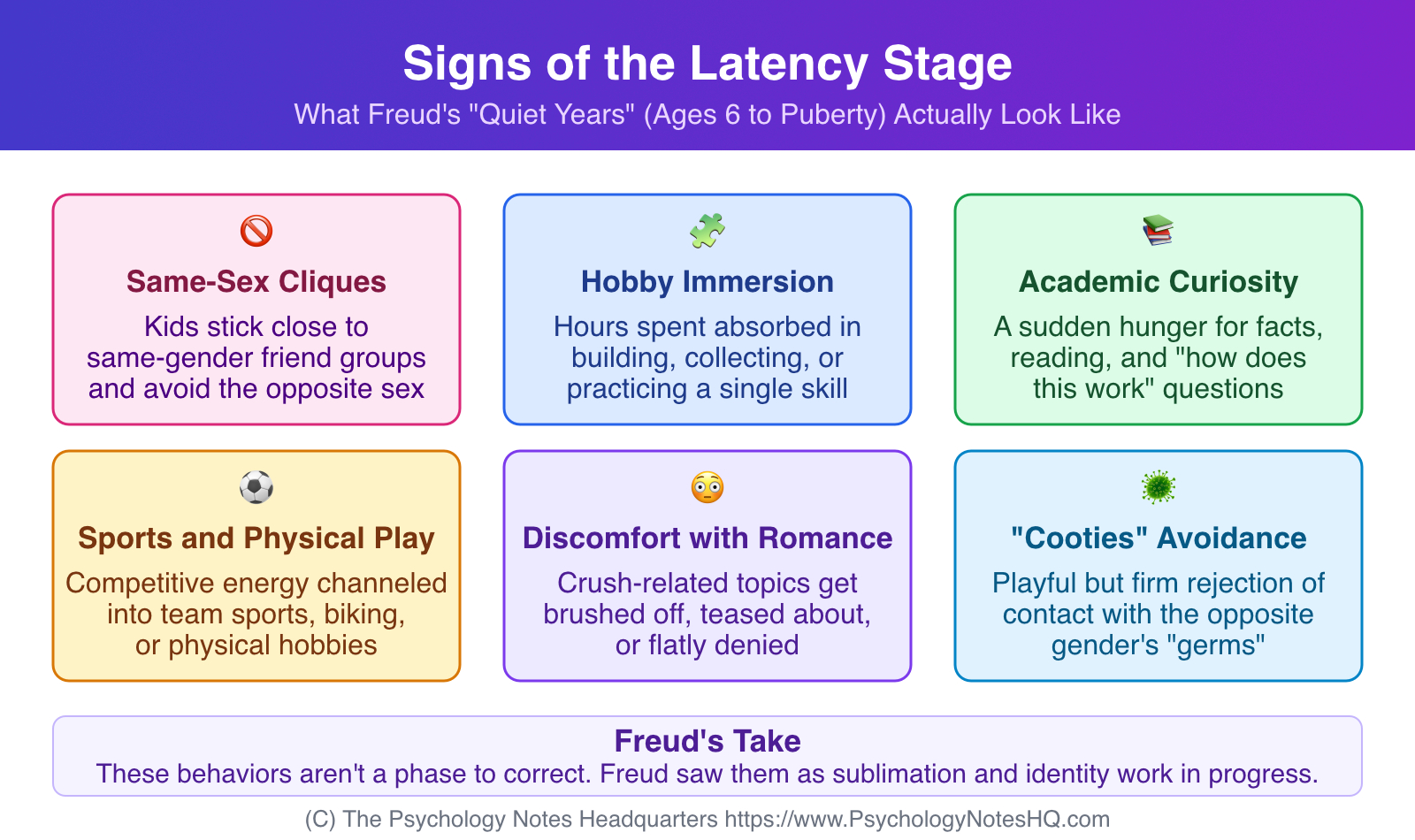
Latency period characteristics related to sublimation become evident in children’s intense engagement with learning, hobbies, and structured activities. The seven-year-old who spends hours practicing piano scales, the nine-year-old absorbed in building elaborate Lego creations, or the eleven-year-old devoted to perfecting soccer skills all demonstrate sublimation in action. These children channel enormous energy into mastery and achievement, energy that Freud would argue derives from rechanneled libido.
Academic pursuits provide particularly clear examples of sublimation. Children during latency often display voracious curiosity, eagerly absorbing information about everything from dinosaurs to planets to historical events. They take pride in learning to read fluently, solve complex math problems, or write compelling stories. This intellectual energy, this drive to know and understand, represents sublimated sexual curiosity. The child who once asked “Where do babies come from?” now asks equally probing questions about how things work, why events happen, and what causes various phenomena.
Creative and artistic activities offer another avenue for sublimation. Drawing, painting, music, drama, and creative writing allow children to express and channel emotional and instinctual energy in socially acceptable forms. A child might create elaborate fantasy worlds through storytelling or express complex feelings through art, transforming raw emotional and instinctual energy into culturally valued products.
Sports and physical activities similarly channel libidinal energy into socially approved outlets. The physical exertion, competitive drive, and pursuit of mastery characteristic of children’s sports involvement reflect sublimation of aggressive and sexual impulses into rule-bound, adult-supervised activities. Team sports add the dimension of cooperation and social integration, further transforming individual drives into group-oriented pursuits.
Freud viewed sublimation during latency as essential for civilization. By channeling children’s instinctual energy into education, skill development, and cultural participation, society perpetuates itself. Each generation learns the knowledge, values, and capabilities necessary to maintain and advance culture. Without the latency period’s sublimation, Freud argued, children might remain too focused on primitive impulses to acquire the sophisticated abilities civilization requires.
The Development of Ego and Superego
The latency stage provides crucial time for strengthening and consolidating the psychological structures that emerged during earlier development. Both the ego and superego, which began forming during the oral and anal stages and crystallized during the phallic stage, undergo significant development during latency. This psychological maturation enables children to function more independently and morally as they prepare for adolescence and adulthood.
Ego development during latency involves expanding capacities for reality testing, problem-solving, and self-regulation. Children become increasingly able to distinguish fantasy from reality, understand cause-and-effect relationships, and plan ahead. They develop more sophisticated defense mechanisms beyond simple repression, including intellectualization, rationalization, and the aforementioned sublimation. These ego functions allow children to navigate the social world more effectively.
Competence and mastery become central themes of ego development during latency. Erik Erikson, building on Freud’s work, identified this period as the “Industry vs. Inferiority” stage, emphasizing children’s drive to develop skills and feel capable. Children measure themselves against peers, strive to excel in various domains, and build self-esteem through accomplishment. Successfully mastering age-appropriate tasks strengthens ego functions and creates confidence that carries forward into subsequent development.
Growing independence from parents characterizes latency ego development. While younger children rely heavily on parents for emotional regulation, decision-making, and problem-solving, children of latency age increasingly manage these functions themselves. They spend more time away from parents at school and with peers, making independent choices and handling challenges without immediate parental intervention. This autonomy strengthens ego capabilities while maintaining the secure base parents provide.
The superego, having formed through resolution of the Oedipus or Electra complex, undergoes further refinement during latency. Children internalize increasingly complex moral standards, moving beyond simple rules to understand principles of fairness, justice, and ethical behavior. They develop more sophisticated conscience, feeling guilty not just about actions but about intentions and thoughts. The superego becomes more nuanced, capable of evaluating situations contextually rather than applying rigid rules.
Moral reasoning develops substantially during latency. Children progress from viewing rules as absolute and unchangeable to understanding that rules serve purposes and can be modified based on circumstances. They begin grasping concepts of intentionality, recognizing that accidents differ from deliberate harm. They develop empathy and perspective-taking abilities that allow them to consider how their actions affect others. These advances in moral cognition reflect superego maturation.
Interactions with teachers, coaches, religious leaders, and other authority figures further shape superego development. These adults reinforce, modify, or sometimes challenge the parental values children internalized during the phallic stage. Children learn that different contexts involve different rules and expectations, developing flexibility in applying moral standards. They also begin questioning and testing rules, a process that helps them truly internalize rather than merely comply with external standards.
Social Skills: Learning to Interact with Peers
The latency stage marks a dramatic shift from family-centered to peer-centered social life. While family relationships remain important, peers become increasingly central to children’s daily experience and psychological development. School provides the primary context for peer interaction, creating a social world with hierarchies, alliances, conflicts, and complex dynamics that children must learn to navigate.
Same-sex friendships dominate the latency social landscape. Freud observed that children during this period show marked preference for same-sex peers while actively avoiding or expressing disdain for opposite-sex children. Boys play with boys, girls with girls, and each group often views the other with suspicion or disgust. The “cootie” phenomenon, where children claim that opposite-sex peers carry imaginary germs, exemplifies this gender segregation. Children might declare “No girls allowed!” or “Boys are gross!” reinforcing group boundaries.
This gender segregation serves important developmental functions according to Freud. Having just consolidated gender identity through identification with the same-sex parent, children reinforce this identity through immersion in same-sex peer groups. Boys learn what it means to be a boy through interaction with other boys, while girls learn femininity through female friendships. These peer groups enforce gender norms, teasing or excluding children who violate gender expectations and rewarding those who conform.
Peer relationships during latency provide essential practice for adult social interactions. Children learn cooperation, negotiation, and compromise through group play and activities. They experience conflict and develop strategies for resolution, from direct confrontation to avoidance to seeking adult mediation. They learn to read social cues, understand group dynamics, and navigate the politics of friendship formation and maintenance.
Social hierarchies emerge during latency, with some children achieving popularity or leadership while others occupy peripheral positions. Children learn where they fit in these hierarchies and develop strategies for improving their social standing or coping with lower status. These experiences, while sometimes painful, teach important lessons about social reality and one’s place within groups.
Team sports, clubs, and other organized activities provide structured contexts for social skill development. Children learn to work toward common goals, support teammates, accept coaching and feedback, and handle both victory and defeat. They discover how individual contributions fit into larger group efforts and experience the satisfaction of collective achievement.
Gender role consolidation occurs through peer interaction during latency. Boys’ groups often emphasize physical competition, risk-taking, and emotional restraint, teaching boys cultural definitions of masculinity. Girls’ groups may emphasize verbal communication, relationship maintenance, and emotional expression, teaching feminine social patterns. These peer-enforced gender norms powerfully shape children’s developing identities and behavioral repertoires.
Intellectual Development: Focus on School and Mastery
School becomes the dominant environment during the latency stage, occupying the bulk of children’s waking hours and mental energy. Academic learning provides both the content and context for much of latency development, with intellectual growth proceeding at a rapid pace. Children transition from basic literacy and numeracy to increasingly complex and abstract thinking across multiple domains.
This shift from concrete to abstract thinking shows up across every subject. In reading, children move from laboriously decoding words to comprehending complex texts and analyzing literature, opening up books they choose for themselves rather than books assigned to them. In math, they progress from counting and simple arithmetic to fractions, decimals, and basic algebraic reasoning, developing the spatial reasoning needed for multi-step problems.
Science education introduces systematic inquiry, teaching children to form hypotheses, run experiments, and draw conclusions from evidence rather than relying on the magical thinking typical of early childhood. Writing follows the same arc, moving from simple sentences to multi-paragraph essays that support an argument and adapt to different audiences. Across all four subjects, the underlying shift is the same: children are trading concrete, rule-based thinking for abstract, evidence-based reasoning.
Beyond specific academic subjects, children develop general intellectual capabilities during latency. They improve attention span, working memory, and executive function skills like planning and organization. They learn study strategies, time management, and self-directed learning approaches. These metacognitive skills prove as important as content knowledge for academic and life success.
Intellectual curiosity flourishes during latency. Children ask endless questions, pursue special interests intensively, and seek to understand how things work. Adults who nurture this curiosity support healthy latency development.
Academic achievement provides important feedback for ego development. Success builds confidence and reinforces the sense of competence, while struggles and failures create opportunities to develop resilience and coping strategies. Children learn that effort leads to improvement, that mistakes provide learning opportunities, and that different people excel in different areas. These lessons shape self-concept and approaches to challenges throughout life.
Physical Skills: Sports and Hobbies
Physical development and skill acquisition represent another crucial domain of latency growth. Children’s improving motor control, strength, and coordination enable mastery of increasingly complex physical activities. Sports, games, dance, and various hobbies provide outlets for physical energy while building capabilities and confidence.
Team sports become popular during latency, offering opportunities to develop both physical and social skills simultaneously. Soccer, basketball, baseball, and other team sports teach children to coordinate their movements with others, follow complex rules, and pursue shared goals. They experience the thrill of competition, learn to handle winning and losing gracefully, and discover how individual contributions affect team outcomes.
Individual sports and activities like swimming, gymnastics, martial arts, or dance allow children to focus on personal mastery and improvement. These pursuits teach persistence, discipline, and the satisfaction of achieving difficult physical feats through sustained practice. Children learn that consistent effort produces progress, a lesson applicable far beyond physical domains.
Physical hobbies extend beyond traditional sports. Some children become absorbed in activities like skateboarding, bike riding, rock climbing, or horseback riding. Others pursue creative physical activities like building, woodworking, or model construction that require fine motor skills and hand-eye coordination. These diverse pursuits allow children to find activities matching their interests and abilities.
The physical energy characteristic of children at latency age requires outlets. Recess, physical education, after-school play, and organized sports provide essential opportunities for physical activity and energy release. Children who lack adequate physical outlets may struggle with restlessness, attention difficulties, or behavioral problems. Movement and physical activity support not just physical health but also cognitive and emotional regulation.
Achievement through physical mastery contributes significantly to ego development during latency. Children who excel athletically or in physical hobbies gain confidence and status among peers. Even children who do not achieve elite performance can experience the satisfaction of personal improvement and physical competence. These experiences build self-esteem and resilience.
Gender differences in physical activities during latency often reflect cultural expectations about masculinity and femininity. Boys may gravitate toward team sports emphasizing physical contact and aggression, while girls may prefer dance, gymnastics, or less contact-intensive sports. However, individual variation exceeds gender differences, and many children pursue activities regardless of gender stereotypes.

The Unique Stage: Lack of Fixation
The latency stage occupies a unique position in Freud’s psychosexual theory because it rarely produces specific fixations comparable to those resulting from the oral, anal, or phallic stages. This absence of characteristic fixation patterns is really what sets the latency stage of development apart from everything that comes before it, reflecting its nature as a period of consolidation and skill development rather than a time of intense psychosexual conflict requiring resolution.
Unlike earlier stages where specific developmental challenges create potential for fixation, latency lacks a central conflict that might derail development. There is no weaning crisis, no toilet training battleground, no Oedipal triangle to navigate. Instead, latency represents a relatively stable period where children build on psychological structures already established. This stability contributes to the lack of distinctive fixation patterns.
The protective nature of latency serves development well. After the intense conflicts of the first three stages, children benefit from a period of relative calm to practice and integrate the capabilities they have acquired, preparing them for the renewed psychosexual challenges of adolescence.
However, disruptions during latency can create problems even if they do not produce fixations in the traditional sense. Traumatic experiences, significant losses, family dysfunction, or other adverse events during latency can interfere with normal development. Children might struggle with peer relationships, academic achievement, or self-confidence. Some might exhibit regression to earlier developmental patterns or fail to adequately sublimate instinctual drives.
Sexual abuse or premature sexualization during latency can be particularly damaging precisely because this stage should involve sexual dormancy. When children are exposed to inappropriate sexual content or experiences during latency, it disrupts the normal developmental trajectory and may prevent healthy progression to the genital stage. Such trauma requires professional intervention to support recovery and development.
Individual variations in latency experiences create different developmental pathways. Some children thrive during latency, excelling academically, building strong friendships, and developing diverse competencies. Others struggle socially, academically, or emotionally, emerging from latency with less robust ego development and lower self-esteem. These variations reflect interactions between constitutional factors, family environments, school quality, peer relationships, and countless other influences.
Cultural contexts significantly shape latency experiences. Cultures vary in educational approaches, gender role expectations, childhood activities, and the degree of age segregation in children’s lives. These cultural differences produce varied latency experiences while maintaining the core features Freud identified: sexual dormancy, sublimation into productive activities, and preparation for adolescence.
Modern Perspectives and Criticisms
Freud’s characterization of latency as a period of sexual dormancy has faced substantial challenge from empirical research. Studies of children’s sexual behavior and curiosity during the elementary school years suggest that sexual interest does not completely disappear but rather becomes less overt and more private. Children continue experiencing sexual feelings and curiosity but learn to keep them hidden from adults due to social expectations and shame. This suggests that repression, rather than true dormancy, better describes the latency period.
The gender segregation Freud viewed as near-universal also varies more than he assumed. Modern schools often include more gender-integrated activities, and some children maintain cross-gender friendships despite peer pressure toward segregation, suggesting culture shapes this pattern as much as psychosexual development does.
Contemporary developmental theories offer alternative frameworks for understanding middle childhood. Cognitive developmental theories emphasize the concrete operational thinking that emerges during this period. Social learning theories focus on modeling, reinforcement, and observational learning. Attachment theory examines how early relationship patterns continue influencing social development. These perspectives provide different but often complementary explanations for latency-period development, and some critics argue the freud latency stage framework has aged less well than its neighboring stages precisely because of this.
Despite criticisms, several of Freud’s observations about latency retain validity. The period from age six to puberty does represent a distinct developmental phase with characteristic features. Children do focus intensely on skill development, academic learning, and peer relationships during these years. Same-sex friendships do predominate, even if less absolutely than Freud suggested. The concept of sublimation, while difficult to test empirically, offers insight into how children channel energy into productive activities.
Modern understanding also validates Freud’s recognition that middle childhood provides crucial preparation for adolescence. The ego and superego development occurring during latency, the social skills acquired through peer interaction, and the academic and physical competencies built through various activities all prove essential when children face adolescent challenges. Children who navigate latency successfully typically handle adolescence more effectively than those who struggle during these middle years.
Conclusion
The latency stage of development provides a crucial interlude between the psychosexual turmoil of early childhood and the renewed sexual challenges of adolescence. During this period of relative calm, children develop the intellectual, social, and physical competencies that will serve them throughout life while consolidating the psychological gains achieved through earlier developmental conflicts. As puberty approaches, bringing biological and psychological changes, children transition into the final stage of Freud’s theory: the genital stage, where mature sexuality emerges and the patterns established across all previous stages culminate in adult personality and functioning.
References
- Freud, S. (1905). Three essays on the theory of sexuality. In J. Strachey (Ed. & Trans.), The standard edition of the complete psychological works of Sigmund Freud (Vol. 7, pp. 125-243). Hogarth Press.
- Freud, S. (1923). The ego and the id. In J. Strachey (Ed. & Trans.), The standard edition of the complete psychological works of Sigmund Freud (Vol. 19, pp. 1-66). Hogarth Press.
- Hall, C. S. (1954). A primer of Freudian psychology. World Publishing Company.
- Erikson, E. H. (1963). Childhood and society (2nd ed.). W. W. Norton & Company.
- Blos, P. (1962). On adolescence: A psychoanalytic interpretation. Free Press.
- Westen, D. (1998). The scientific legacy of Sigmund Freud: Toward a psychodynamically informed psychological science. Psychological Bulletin, 124(3), 333-371.
How to cite this article:
The Psychology Notes Headquarters. (2026). Freud’s Latency Stage of Development: The Quiet Years. Retrieved from https://www.psychologynoteshq.com/freud-latency-stage/