
Postconventional Morality: Why So Few People Ever Reach It
A government contractor leaks classified documents, fully expecting prison, because he believes citizens have a right to know what their government is doing to them. That kind of reasoning — where conscience outranks the law itself — sits at the far end of Kohlberg’s model. Postconventional morality is what psychologists call this territory: reasoning built on self-chosen ethical principles rather than rules, approval, or fear of consequences. Very few people reason here consistently, and Kohlberg considered it the rarest kind of moral thinking a person can develop.
Key Takeaways
- Postconventional morality transcends social conventions, basing decisions on abstract principles like justice, equality, and human dignity rather than laws or social approval.
- Stage 5 views laws as social contracts serving the greater good that should be democratically changed when they fail to protect individual rights.
- Stage 6 follows self-chosen universal ethical principles and willingly accepts legal consequences when conscience conflicts with unjust laws, exemplified by civil disobedience.
- A postconventional morality example in the Heinz Dilemma argues that human life holds objective value exceeding property rights, justifying rule-breaking for ethical reasons.
- Kohlberg stage 5 and 6 face criticism for Western individualistic bias, difficulty distinguishing between stages empirically, and potential elitism in defining “highest” morality.
Understanding Postconventional Morality
Postconventional morality represents the pinnacle of Lawrence Kohlberg’s framework, achieved by relatively few individuals even in adulthood. While most people progress from preconventional (self-focused) to conventional morality (society-focused) during childhood and adolescence, only a minority advance to postconventional reasoning where principles transcend societal norms.
The rarity of postconventional morality stems from its cognitive and experiential demands. This level requires abstract thinking capabilities, extensive perspective-taking skills, exposure to diverse viewpoints and moral conflicts, and willingness to question authority and social consensus. These conditions don’t automatically emerge with age but require specific developmental experiences and intellectual engagement.
The shift from conventional to postconventional morality involves a fundamental reorientation. Conventional thinkers define right and wrong by social norms, laws, and expectations — morality means conforming to society’s standards. Postconventional thinkers evaluate social norms themselves against higher principles, recognizing that laws and conventions can be unjust and questioning rather than automatically accepting societal dictates.
This doesn’t mean postconventional thinkers reject all laws or social norms. Rather, they distinguish between rules serving justice and human welfare versus those perpetuating injustice. They typically follow laws because most align with ethical principles and social cooperation benefits everyone. However, when laws conflict with fundamental ethical principles, postconventional thinkers prioritize principles over rules.
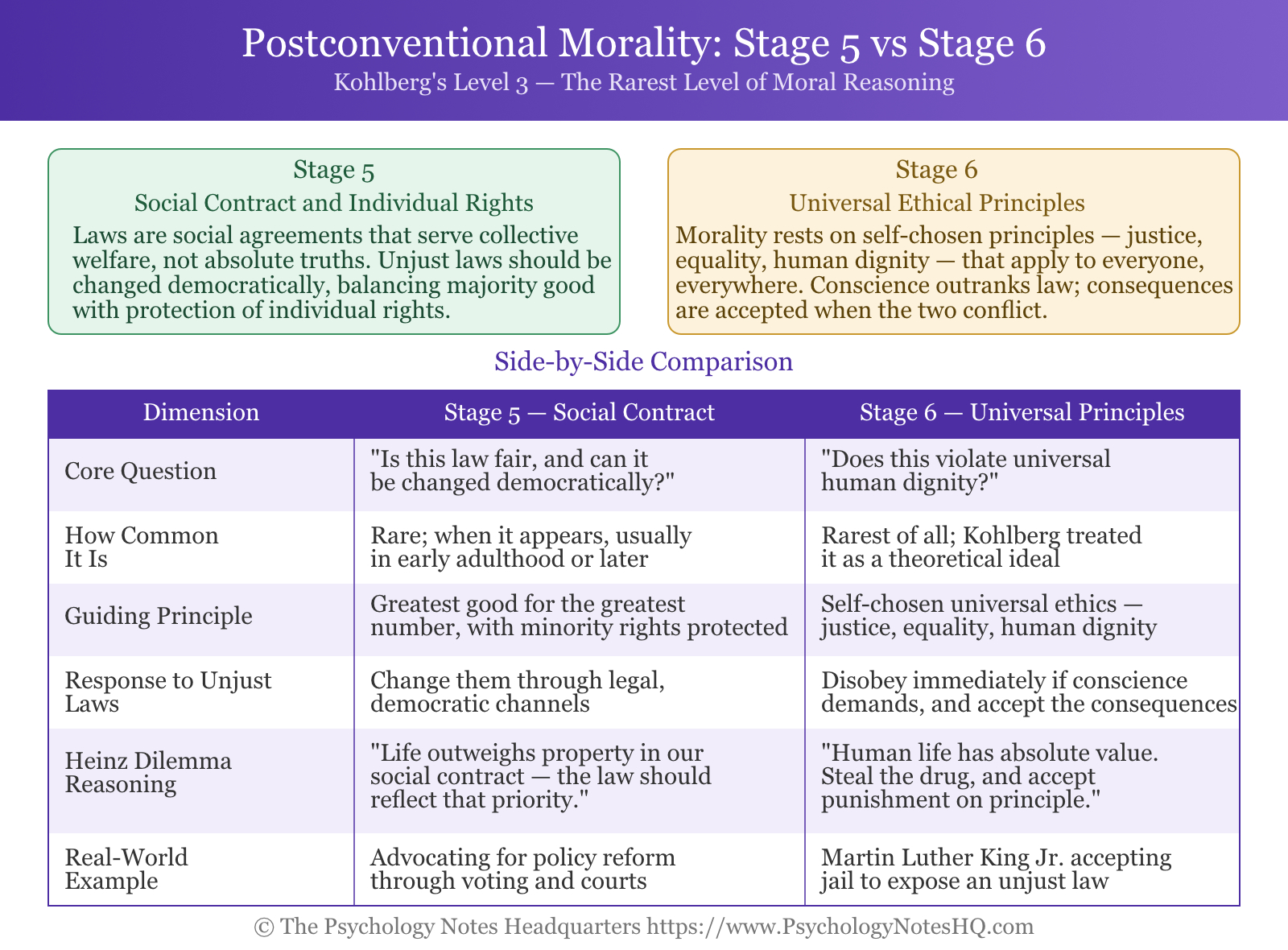
Kohlberg stage 5 and 6 both qualify as postconventional but differ in emphasis and sophistication. Stage 5 focuses on democratic processes, social contracts, and balancing individual rights with collective welfare. Stage 6 emphasizes universal ethical principles that transcend specific societies and legal systems. Understanding these distinctions clarifies the progression of moral reasoning at the highest developmental level.
Stage 5: Social Contract and Individual Rights
Stage 5 represents a democratic, rational approach to morality where laws are viewed as social agreements created to serve collective welfare rather than absolute truths handed down by authority. This stage recognizes that societies need rules for cooperation but understands these rules as human constructions subject to evaluation and modification.
Key Characteristics of Stage 5 Reasoning:
- Laws as flexible social contracts – Rules exist to serve human welfare and can be changed through democratic processes when they fail this purpose
- Utilitarian orientation – Focus on “the greatest good for the greatest number” as a guiding principle
- Individual rights protection – Recognition that certain fundamental rights (life, liberty, pursuit of happiness) must be protected even if majority disagrees
- Value pluralism – Understanding that people hold diverse values and beliefs, all deserving respect in a free society
- Democratic problem-solving – Preference for changing unjust laws through legal channels rather than breaking them
The social contract concept underlying Stage 5 derives from Enlightenment philosophers like John Locke and Jean-Jacques Rousseau. People implicitly agree to follow laws in exchange for protection of rights and maintenance of social order. However, this contract is conditional — if government fails to protect rights or laws become unjust, citizens have basis for demanding change.
Stage 5 thinkers apply utilitarian reasoning — evaluating actions by whether they maximize overall welfare. A law is good if it benefits the majority while protecting minority rights. A law is bad if it serves narrow interests, causes unnecessary suffering, or violates fundamental liberties. This cost-benefit analysis extends beyond individual interests to consider societal impact.
The “greatest good for the greatest number” principle guides Stage 5 decision-making. However, this isn’t simple majoritarianism. Stage 5 recognizes that tyranny of the majority threatens individual rights, so protections for minorities and dissenters are essential. Good laws serve collective welfare while respecting individual freedom and dignity.
Diverse values and opinions receive respect at Stage 5. Rather than assuming one’s own moral views are absolute truth, Stage 5 thinkers recognize that reasonable people disagree about ethics, religion, and lifestyle. A free society allows this pluralism provided individuals don’t harm others. Laws should protect this freedom rather than enforcing particular moral views.
When laws fail to serve the greater good or violate rights, Stage 5 thinkers advocate changing them through democratic processes — voting, advocacy, legislation, court challenges. They typically work within the system because they believe in democratic legitimacy and the social contract. Civil disobedience might be justified in extreme cases, but changing laws legally is preferred.
Examples of Stage 5 reasoning include supporting marriage equality because denying rights to same-sex couples violates equality without serving the greater good, advocating for drug policy reform based on evidence that criminalization causes more harm than drug use itself, or opposing mandatory minimum sentences because they prevent judges from considering individual circumstances.
Stage 6: Universal Ethical Principles
Stage 6 represents the highest level of moral reasoning, where individuals base decisions on self-chosen ethical principles they believe apply universally to all people in all contexts. These principles — typically justice, equality, and human dignity — transcend specific laws or cultural norms, serving as ultimate moral authorities guiding behavior.
Key Characteristics of Stage 6 Reasoning:
- Self-chosen principles – Moral standards are personally adopted through rational reflection, not inherited or externally imposed
- Universal application – Principles apply to all humans equally regardless of culture, law, or circumstance
- Abstract and comprehensive – Principles are broad ethical concepts (justice, human dignity) rather than specific rules
- Conscience as ultimate authority – Following internal moral compass even when it conflicts with laws or social expectations
- Willingness to accept consequences – Prepared to face legal punishment when principles require breaking unjust laws
- Reversibility test – Asking whether one would accept a rule if positions were reversed with those affected
The principles guiding Stage 6 are typically Kantian in nature — treating people as ends in themselves rather than means, respecting human dignity, applying principles consistently regardless of personal gain. The categorical imperative — act only according to rules you’d want everyone to follow — exemplifies Stage 6 thinking.
Justice stands as the paramount Stage 6 principle. Not justice as legal compliance but justice as fairness, equality, and respect for human rights. Stage 6 thinkers ask whether actions or laws treat all people with equal respect and dignity. Practices that violate this equality are unjust regardless of legality or cultural acceptance.
Conscience over law distinguishes Stage 6 from Stage 5. While Stage 5 works within legal systems to change unjust laws, Stage 6 may require immediate violation of unjust laws when conscience demands. The commitment to principles supersedes concern for legal consequences. If a law violates fundamental human dignity, Stage 6 obligates disobedience despite potential punishment.
Willingness to face consequences demonstrates the depth of Stage 6 commitment. These individuals don’t break laws lightly or to benefit themselves. They accept punishment as the cost of maintaining integrity, often using their willing acceptance of consequences to highlight laws’ injustice. Think of civil rights protesters accepting arrest to expose segregation’s immorality.
The reversibility test captures Stage 6’s impartiality. Before accepting a moral rule or action, ask: “Would I accept this if I were in the other person’s position?” This perspective-taking forces consideration of whether principles truly serve justice or merely self-interest. Genuine principles survive this reversal; self-serving rationalizations fail.
Examples of Stage 6 reasoning include Martin Luther King Jr. violating segregation laws because they contradicted human dignity, whistleblowers revealing illegal government activities despite career destruction because principles required transparency, or individuals harboring refugees in defiance of laws they consider unjust because human life supersedes legal status.
The Heinz Dilemma at Postconventional Level
Kohlberg’s Heinz Dilemma — where a man considers stealing an overpriced drug to save his dying wife — elicits distinct reasoning patterns at postconventional levels. Both Stage 5 and Stage 6 typically support Heinz stealing, but their justifications differ significantly and reveal the sophisticated moral thinking characterizing this level.
Stage 5 Postconventional Response
Stage 5 thinkers employ social contract and utilitarian reasoning. They might argue:
“Heinz should steal the drug because the right to life is more fundamental than property rights — this is recognized in our social contract and most legal systems. The pharmacist is acting within legal rights but violating the spirit of social cooperation by valuing profit over human life. While we can’t have people stealing whenever they disagree with prices, this extreme case involves imminent death versus property loss. The law should protect both property rights and life, but when they conflict, life takes precedence because property serves human welfare, not vice versa. Ideally, society would provide better healthcare access so such dilemmas don’t arise. Heinz’s action highlights systemic failures requiring remedy. Though technically illegal, his action serves the greater good and most reasonable people would agree life matters more than money.”
This reasoning evaluates competing rights, applies utilitarian calculus, considers societal implications, and acknowledges that laws sometimes fail to balance rights appropriately.
Stage 6 Postconventional Response
Stage 6 thinkers apply universal ethical principles. They might argue:
“Heinz must steal the drug because the principle of human dignity demands protecting life. Human life has absolute value — it’s an end in itself, not something to be weighed against property. The pharmacist has legal rights but acts immorally by valuing profit over someone’s life. Using the reversibility test: Would I accept a rule that says ‘Let people die to protect property rights’ if I were the dying wife? No. Would anyone rationally choose a society where property trumps life when they could be the person dying? No. Therefore, this principle fails the universality test. The law prohibiting theft serves important purposes, but following it here would violate a more fundamental principle. Heinz should steal, and accept legal consequences while maintaining moral rightness. His willingness to face punishment demonstrates he’s not simply acting from self-interest but from principled conviction that life supersedes property.”
This reasoning emphasizes universal principles, applies logical tests, recognizes law’s moral limits, and accepts consequences while maintaining ethical stance.
Life as Objectively More Valuable Than Property Rights
Both postconventional stages argue that human life holds objective value exceeding property rights, but they arrive there differently. Stage 5 uses social contract reasoning — societies exist to protect life and welfare, making life more fundamental than property. Stage 6 uses universal principle reasoning — human dignity and life’s intrinsic value transcend cultural or legal constructions.
This contrasts sharply with lower levels. Preconventional thinking focuses on consequences for Heinz (punishment or benefit). Conventional thinking emphasizes law-following and social expectations. Only postconventional reasoning evaluates the principles underlying laws themselves.
Real-World Examples of Postconventional Morality
A postconventional morality example throughout history usually demonstrates someone prioritizing ethical principles over laws, social conventions, or personal safety when justice demands it.
Historical Figures
Martin Luther King Jr. exemplified Stage 6 reasoning through civil disobedience against segregation laws. In his “Letter from Birmingham Jail,” King distinguished just laws from unjust ones, arguing that laws upholding human dignity must be followed but laws degrading human personality must be resisted. He willingly accepted jail time, demonstrating principled commitment rather than self-interest.
Mahatma Gandhi’s nonviolent resistance against British colonial rule reflected postconventional morality. Gandhi violated laws he considered unjust while accepting punishment, using civil disobedience to expose imperialism’s immorality. His principle of ahimsa (nonviolence) transcended legal and cultural boundaries, representing a universal ethical commitment.
Nelson Mandela spent 27 years imprisoned for opposing apartheid, refusing to renounce his principles in exchange for freedom. His moral reasoning prioritized human equality and dignity over legal compliance or personal liberty, exemplifying Stage 6’s willingness to sacrifice for principles.
Contemporary Whistleblowers
Edward Snowden revealed government surveillance programs, violating laws protecting classified information because he believed mass surveillance violated constitutional rights and human privacy. Whether one agrees with his actions, his reasoning — that principles of privacy and transparency supersede classification laws — reflects postconventional thinking.
Chelsea Manning leaked classified documents exposing potential war crimes, prioritizing principles about government accountability and human rights over military regulations. Again, regardless of agreement, the reasoning involves conscience over law based on universal ethical principles.
Everyday Postconventional Thinking
Less dramatic examples include professionals reporting workplace violations despite career risks, individuals refusing to comply with organizational policies they consider unethical, activists engaging in peaceful civil disobedience for environmental or social justice causes, or people challenging discriminatory practices even when legal.
The common thread is prioritizing ethical principles — justice, human rights, dignity, transparency — over laws, rules, or personal consequences. These individuals reason from abstract principles, accept personal costs, and often work to change systems they consider unjust.
Critiques of Postconventional Morality
Despite its influential status, Kohlberg’s postconventional level faces substantial criticism from researchers and theorists questioning its validity, universality, and underlying assumptions.
Cultural Bias Toward Western Individualism
The most significant critique argues that postconventional morality reflects Western liberal individualism rather than universal moral development. Stage 5’s social contract reasoning and Stage 6’s abstract individual principles align with Enlightenment philosophy and American constitutional thinking but may not represent “higher” morality in cultures emphasizing different values.
Many non-Western cultures prioritize collective welfare, family obligations, social harmony, and role-based duties over individual rights and abstract principles. In these contexts, conventional morality’s emphasis on maintaining social relationships and fulfilling role obligations might represent mature moral reasoning rather than developmental limitation.
For example, Confucian ethics emphasizes filial piety, role relationships, and maintaining social harmony — values that score as “conventional” in Kohlberg’s framework despite representing sophisticated moral philosophy. Similarly, many Indigenous cultures’ emphasis on community consensus and interconnection might appear conventional while reflecting complex ethical understanding.
This critique suggests Kohlberg mistook culture-specific values for universal developmental stages, privileging Western individualistic morality and potentially mischaracterizing other moral frameworks as less developed.
Difficulty Distinguishing Stage 5 from Stage 6
Empirical research struggles to reliably distinguish Stage 5 from Stage 6 reasoning. In practice, both postconventional stages often produce similar judgments and justifications. The theoretical distinction — social contract versus universal principles — proves difficult to operationalize in real-world research.
Kohlberg himself acknowledged this challenge, eventually questioning whether Stage 6 exists as a distinct stage versus representing an idealized philosophical position. Few research participants demonstrate clear Stage 6 reasoning, and those who do often blend Stage 5 and 6 elements.
This ambiguity raises questions about whether two separate stages exist or whether postconventional morality represents a single level with variation in how principles are articulated. If researchers cannot reliably distinguish stages, the theoretical distinction may lack practical meaning.
Research and Measurement Challenges
Assessing postconventional reasoning requires extensive interviews and sophisticated coding — expensive, time-consuming, and subject to interpretation. Different raters may score the same responses differently, particularly at higher stages where reasoning complexity increases.
Additionally, moral reasoning doesn’t always predict moral behavior. People articulate sophisticated principles but act from self-interest or emotion. The gap between reasoning and action limits Kohlberg’s framework’s practical utility.
Gender and Care Ethics Critique
Carol Gilligan’s famous critique argued that Kohlberg’s framework privileges justice-oriented “male” morality over care-oriented “female” morality. Stage 6’s abstract principles might represent one legitimate moral orientation but not necessarily “higher” than ethics of care emphasizing relationships, responsibility, and context.
This critique broadened to recognize multiple legitimate moral orientations rather than a single developmental hierarchy. Justice and care might represent different but equally sophisticated approaches to ethics rather than stages on a universal ladder.
Elitism Concerns
Labeling postconventional morality as “highest” development implies moral superiority for those reasoning at this level. This creates potential elitism, suggesting educated Westerners who articulate abstract principles are more morally developed than others who might demonstrate moral sophistication through different frameworks.
This concern becomes particularly problematic when applied cross-culturally or across educational levels. Is a philosophy professor discussing Kantian ethics more morally developed than an illiterate grandmother who’s lived according to compassionate principles? The framework’s emphasis on verbal articulation and abstract reasoning may confuse education with moral maturity.
Conclusion
Postconventional morality represents Kohlberg’s vision of moral reasoning’s highest development, where individuals transcend social conventions to base decisions on abstract ethical principles like justice, equality, and human dignity. Through Stage 5’s social contract orientation and Stage 6’s universal ethical principles, postconventional thinkers evaluate laws and norms against higher principles, willing to challenge unjust rules even at personal cost. While this framework illuminated moral development’s cognitive dimensions and influenced generations of researchers and educators, critiques highlighting cultural bias, measurement difficulties, and alternative moral frameworks remind us that moral sophistication takes many forms beyond any single developmental hierarchy.
References
- Kohlberg, L. (1984). The psychology of moral development: The nature and validity of moral stages. Harper & Row.
- Kohlberg, L. (1981). Essays on moral development, Vol. I: The philosophy of moral development. Harper & Row.
- Gilligan, C. (1982). In a different voice: Psychological theory and women’s development. Harvard University Press.
- Rest, J. R., Narvaez, D., Bebeau, M. J., & Thoma, S. J. (1999). Postconventional moral thinking: A neo-Kohlbergian approach. Lawrence Erlbaum Associates.
- Snarey, J. R. (1985). Cross-cultural universality of social-moral development: A critical review of Kohlbergian research. Psychological Bulletin, 97(2), 202-232.
- Walker, L. J., & Hennig, K. H. (2004). Differing conceptions of moral exemplarity: Just, brave, and caring. Journal of Personality and Social Psychology, 86(4), 629-647.
How to cite this article:
The Psychology Notes Headquarters. (2026). Postconventional Morality: Why So Few People Ever Reach It. Retrieved from https://www.psychologynoteshq.com/postconventional-morality/