
Types of Nonverbal Communication: 8 Signals Your Body Sends
You walk into a job interview, shake hands, and sit down. Before you say a complete sentence, the interviewer has already started forming an opinion of you, based almost entirely on your posture, your expression, and the tone in your voice. Psychologists have spent decades mapping the different types of nonverbal communication that shape these snap judgments, and the signals involved go far beyond a smile or a handshake. Some of them you control. Most of them you do not.
Key Takeaways
- Psychologists group these wordless signals into distinct types of nonverbal communication, from facial movement to the space you leave between yourself and a stranger.
- Some nonverbal communication examples are almost universal, while others shift completely depending on the culture a person grew up in.
- When your words and your body disagree, most people believe the body first, which explains why mixed signals feel so unsettling.
- A pause, a glance, or a handshake can carry more weight in a conversation than the sentence sitting next to it.
- The same gesture that reads as friendly in one country can be read as an insult in another, sometimes with real consequences.
The Types of Nonverbal Communication Psychologists Study
Communication extends far beyond spoken words. Research consistently shows that nonverbal signals often carry more meaning than verbal content, adding context, emotion, and relationship cues that words alone cannot supply. Nonverbal communication covers every wordless message sent and received between people.
Psychologist Albert Mehrabian (1971) proposed that communication effectiveness splits into three parts: 7 percent verbal, 38 percent vocal tone, and 55 percent nonverbal cues. The so called 55-38-7 rule should not be read as a fixed formula for every interaction, but it makes a fair point. Nonverbal elements shape how a message actually lands.
Nonverbal cues do real work in a conversation. They regulate turn-taking, express emotion more powerfully than words, build and maintain relationships, reinforce or contradict what is being said, and substitute for speech entirely when talking is not an option. These signals run alongside verbal communication constantly, layering extra meaning onto every exchange.
Everyday nonverbal communication examples make this concept concrete. A genuine smile looks different from a forced one. Crossed arms during an argument read as defensive. A sudden step backward signals discomfort. A flat, sarcastic “fine” means the opposite of what the word says. A firm handshake reads as confidence in a professional setting. Recognizing these types of nonverbal communication improves both how a message is sent and how it gets read.
8 Core Types of Nonverbal Communication
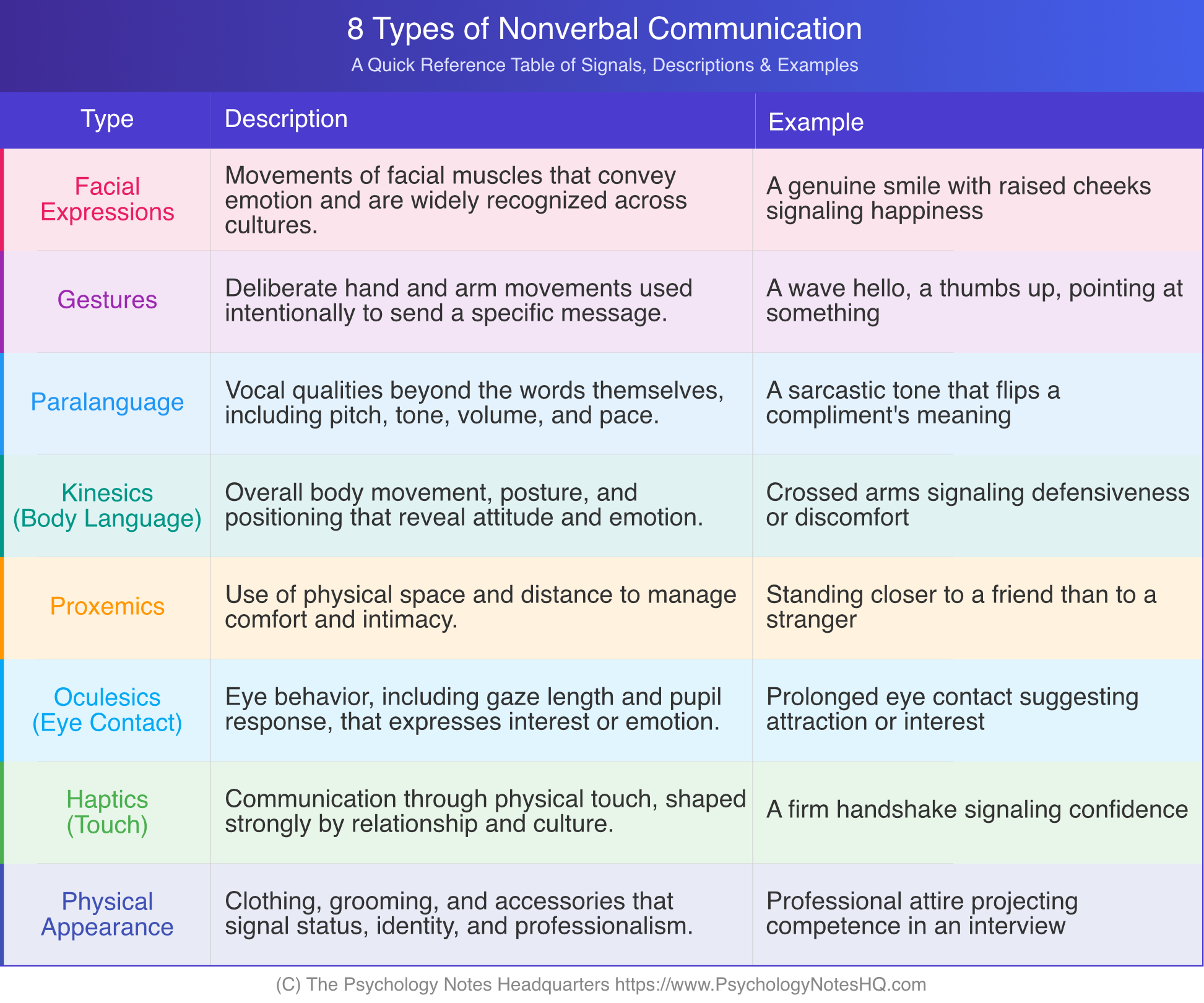
Facial Expressions
Facial expressions are probably the most powerful and universal form of nonverbal communication. The human face can produce thousands of distinct expressions, carrying emotional nuance that plays a huge role in how people read each other.
Psychologist Paul Ekman identified six basic emotions with facial expressions recognized across cultures: happiness, a smile with raised cheeks; sadness, a downturned mouth and drooping eyes; anger, narrowed eyes and pressed lips; fear, widened eyes and an open mouth; disgust, a wrinkled nose and raised upper lip; and surprise, raised brows and a dropped jaw (Ekman & Friesen, 1971). These expressions likely evolved as survival signals, communicating emotional states quickly across distance and language.
Microexpressions complicate the picture. These are fleeting facial movements lasting a fraction of a second, often leaking out an emotion someone is actively trying to hide. A trained observer can sometimes catch a flash of anger or discomfort before a person’s conscious expression takes over.
Interpreting someone else’s face in real time relies on Theory of Mind, the ability to recognize that another person’s internal state is different from your own.
Gestures
Gestures are deliberate hand and arm movements used to communicate a specific meaning or emphasize what is being said. Unlike more automatic body language, gestures are usually intentional and learned within a culture.
Researchers typically sort gestures into four categories. Emblems carry a specific verbal translation, like a thumbs up or a wave. Illustrators accompany speech to demonstrate size or direction. Regulators control the flow of conversation, like a nod that encourages someone to keep talking. Adaptors are self-touching habits, such as hair twirling, that often signal anxiety.
Common gestures include waving, pointing, nodding, shaking the head, shrugging, and beckoning with a finger. They add visual emphasis and clarify abstract ideas, but their meaning is not universal. The same movement can mean something completely different depending on where you are, which is where cross-cultural confusion tends to start.
Paralanguage
Paralanguage covers the vocal side of communication beyond the actual words: how something is said rather than what is said. Pitch, volume, tone, speaking rate, and pauses all shift how a message gets interpreted.
The same sentence can mean two opposite things depending on delivery. “That’s great” said with an enthusiastic, rising pitch reads as genuine excitement. The same two words said flatly, with a sarcastic edge, reads as disappointment. “I’m fine” spoken with a shaking voice reveals distress the words are trying to hide.
Paralanguage is hard to fake convincingly. Pitch tends to rise with anxiety, volume increases with anger, speaking rate speeds up with excitement, and pauses stretch out with sadness. These involuntary shifts make vocal tone one of the more reliable nonverbal cues available in a conversation.
Body Language (Kinesics)
Kinesics is the study of communication through body movement, posture, and positioning. Where a specific gesture sends one message, kinesics covers the broader pattern, revealing attitude, emotion, and relationship dynamics over the course of an interaction.
Open body language, uncrossed limbs, an open stance, leaning in, signals receptivity and confidence. Closed body language, crossed arms, turning away, hunching, signals discomfort or withdrawal. Expansive postures that take up space communicate dominance, while contracted postures that pull inward suggest insecurity.
Kinesics also shows up in movement quality. Smooth, purposeful movement reads as confident and controlled. Jerky, excessive movement reads as nervous. Mirroring someone else’s posture tends to build rapport, while a deliberately different posture creates distance.
Proxemics
Proxemics is the study of how people use physical space during social interaction. Anthropologist Edward Hall (1966) identified four spatial zones people maintain depending on how close the relationship is.
Intimate distance, roughly 0 to 18 inches, is reserved for close relationships where whispering and touch happen naturally. Personal distance, about 18 inches to 4 feet, is typical between friends and acquaintances. Social distance, 4 to 12 feet, fits professional interactions and casual conversation. Public distance, beyond 12 feet, is used for public speaking or interacting with strangers.
Proxemics gets tested constantly in daily life. Standing too close invades intimacy and makes people step back. Standing too far away can feel cold. A crowded elevator forces unwanted closeness, which is usually why people avoid eye contact and stare at the floor instead.
Eye Contact (Oculesics)
Oculesics examines communication through the eyes: where someone looks, how long they hold a gaze, and what their eyes reveal without a word being spoken.
Eye contact regulates conversation. Looking at a speaker signals attention. Looking away can signal a desire to jump in. Sustained eye contact while speaking tends to hold the floor. Eyes also widen with fear, narrow with suspicion, and soften with affection, adding an emotional layer most people read automatically.
Staring is different from glancing. A brief glance is a polite acknowledgment. A held gaze can read as interest, attraction, or a threat, depending entirely on context. Pupil dilation adds one more subtle signal, since pupils widen with interest and narrow with disgust, something almost nobody can consciously control.
Haptics (Touch)
Haptics is communication through touch, arguably the most primitive and immediate nonverbal channel available. Touch shapes emotion, builds relationships, and can measurably affect behavior.
Touch tends to fall into a few categories: functional-professional touch, like a doctor’s exam; social-polite touch, like a handshake; friendship touch, like a shoulder pat; and love-intimacy touch, reserved for close relationships. In a workplace setting, that functional-professional layer matters a lot. A firm handshake reads as confidence and competence in a job interview, while a weak one can quietly undercut an otherwise strong first impression, the same instinctive read that drives a lot of what Cialdini’s research on persuasion covers when it comes to building trust fast.
Cultural norms around touch vary widely. Contact cultures, including much of Latin America and the Mediterranean, use touch often in daily interaction. Non-contact cultures, including many parts of Northern Europe and Asia, reserve touch for close relationships only.
Physical Appearance
Physical appearance, meaning clothing, grooming, accessories, and other visible choices, communicates status, identity, and professionalism before a single word gets exchanged.
Professional attire signals competence, casual wear signals approachability, and personal choices like tattoos or a particular hairstyle express identity. First impressions form within seconds, largely built on appearance alone, and those snap judgments tend to stick even when they turn out to be wrong, a pattern closely related to the halo effect in how one strong trait colors an entire impression.
Nonverbal communication in the workplace leans heavily on appearance. Interviews, client meetings, and presentations all involve strategic choices about how to look, which is really what “dress for the job you want” is describing.
When Nonverbal Cues Contradict Verbal Messages
Communication gets messy when the nonverbal signal contradicts the words. Mixed messages confuse the listener and often reveal a feeling the speaker was trying to hide. When the two channels disagree, people usually trust the nonverbal cue, since it is harder to control on purpose.
Sarcasm is the clearest example. Saying “that’s just great” with an eye-roll and crossed arms communicates the opposite of the literal words. Strip away the nonverbal channel, in a text message with no tone or expression, and sarcasm becomes almost impossible to catch, which is exactly why people lean on exclamation points and emoji to compensate.
Detecting deception through nonverbal cues alone is far less reliable than popular belief suggests. Fidgeting, avoiding eye contact, or a shaky voice might signal a lie, or might just signal nerves about being disbelieved. Research consistently finds most people perform close to chance at spotting deception, regardless of how confident they feel in their own judgment.
Relationships run into this same contradiction constantly. Someone says “I’m fine” while their posture, tone, and expression all say the opposite. A date claims genuine interest while checking their phone every few minutes. These mixed signals create real confusion, and resolving them usually means choosing whether to take the words at face value or trust what the body is actually doing. Most people, most of the time, end up trusting the body.
Cultural Differences in Nonverbal Communication
Basic facial expressions look fairly universal, but most other nonverbal cues shift significantly by culture. A gesture that feels completely natural in one country can confuse, offend, or send a totally different message somewhere else.
The thumbs up signals approval in the West, means “one” in Germany, and reads as a serious insult in parts of the Middle East. The OK sign means approval in the United States but signals “worthless” in France and something obscene in Brazil. Beckoning with a single finger is normal in the West but considered insulting in the Philippines.
Eye contact norms diverge just as much. Western culture treats direct eye contact as honest and confident. Many Asian, Latin American, and African cultures treat sustained eye contact with an authority figure as disrespectful, with a lowered gaze signaling respect instead.
Personal space follows the same pattern. Latin American, Mediterranean, and Arab cultures maintain closer conversational distance than Northern European or North American norms, and cultures in denser countries tend to tolerate more physical closeness in public overall.
Touch conventions shift by culture too, and sometimes by quite a lot. Mediterranean, Latin American, and Eastern European cultures tend to weave touch into everyday social interaction more than Northern European, North American, or many Asian cultures do. A greeting alone can range from a bow with no contact at all in Japan, to a handshake in the United States, to a kiss on the cheek in France. Gender norms layer another variable on top, since some cultures accept opposite-sex touch more freely than same-sex touch, and others reverse that pattern entirely.
Display rules shift the picture even further. Individualistic Western cultures tend to encourage open emotional expression. Collectivist cultures often value restraint and saving face, which means the exact same emotion might show up as a much more controlled facial expression.
Conclusion
The different types of nonverbal communication, facial expression, gesture, tone of voice, posture, space, eye contact, touch, and appearance, do a lot of the real work in any conversation, often more than the sentence being spoken. Some nonverbal communication examples translate across cultures without much effort. Most do not. Paying attention to these signals, and noticing when they contradict the words attached to them, makes it easier to read a room, catch a lie, or simply understand what someone actually means.
References
- Ekman, P., & Friesen, W. V. (1971). Constants across cultures in the face and emotion. Journal of Personality and Social Psychology, 17(2), 124-129.
- Hall, E. T. (1966). The hidden dimension. Doubleday.
- Knapp, M. L., Hall, J. A., & Horgan, T. G. (2013). Nonverbal communication in human interaction (8th ed.). Cengage Learning.
- Matsumoto, D., & Hwang, H. S. (2013). Cultural influences on nonverbal behavior. In D. Matsumoto, M. G. Frank, & H. S. Hwang (Eds.), Nonverbal communication: Science and applications (pp. 97-120). SAGE Publications.
- Mehrabian, A. (1971). Silent messages. Wadsworth.
- Burgoon, J. K., Guerrero, L. K., & Floyd, K. (2016). Nonverbal communication. Routledge.
How to cite this article:
The Psychology Notes Headquarters. (2026). Types of Nonverbal Communication: 8 Signals Your Body Sends. Retrieved from https://www.psychologynoteshq.com/nonverbal-communication/
These lessons are quite good and interesting, hence educative and helpful.
Hi Mackson,
Thanks very much. I’m glad that these posts are helpful to you.
A
Good read! Nonverbal communication can often say just as much as our words. Things like facial expressions, posture, and gestures can completely change how a message is understood.