
The Frustration-Aggression Hypothesis: Why Blocked Goals Make People Lash Out
The frustration-aggression hypothesis, introduced by John Dollard, Neal Miller, and their colleagues at Yale in 1939, proposes that frustration — defined as the blocking of a goal-directed behavior — always leads to some form of aggression, and that aggression is always caused by frustration. Few ideas in social psychology sparked as much debate, inspired as much follow-up research, or held up as well under scrutiny — with some important modifications. Whether you’re trying to understand road rage, workplace conflict, or large-scale civil unrest, this framework offers a surprisingly clear starting point.
Key Takeaways
- The frustration-aggression hypothesis argues that blocked goals produce frustration, and frustration drives aggression — a bold claim that sparked decades of research and debate.
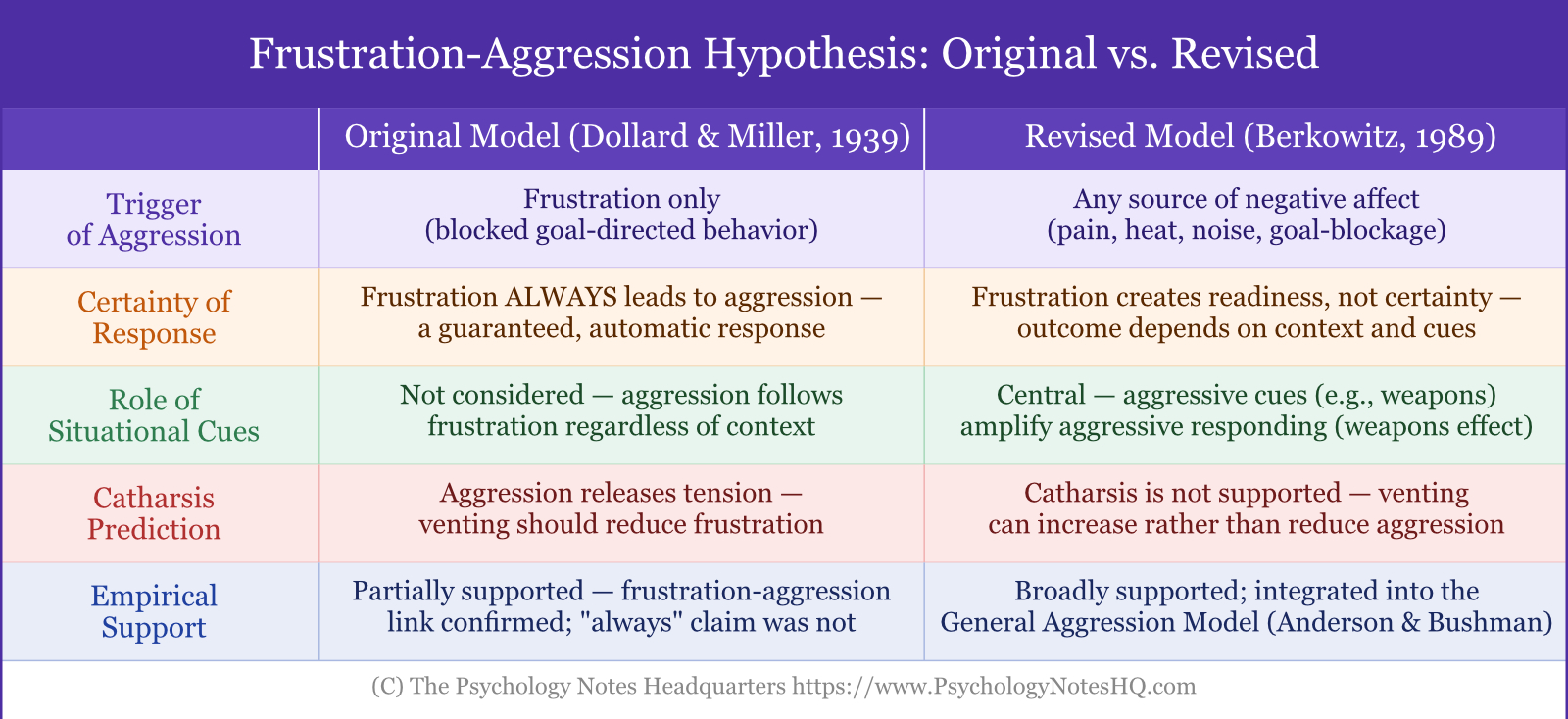
- The original “always” rule turned out to be too rigid; Berkowitz’s revision showed frustration creates a readiness for aggression, not a guarantee.
- Displacement aggression explains why people often take out frustration on targets other than the real source — including scapegoating at a group level.
- The popular idea that “venting” releases frustration is not supported by evidence; research suggests it can actually intensify aggressive feelings.
- The theory continues to inform criminology, political psychology, and conflict research, especially through the lens of relative deprivation.
The Original Theory: What Dollard and Miller Proposed
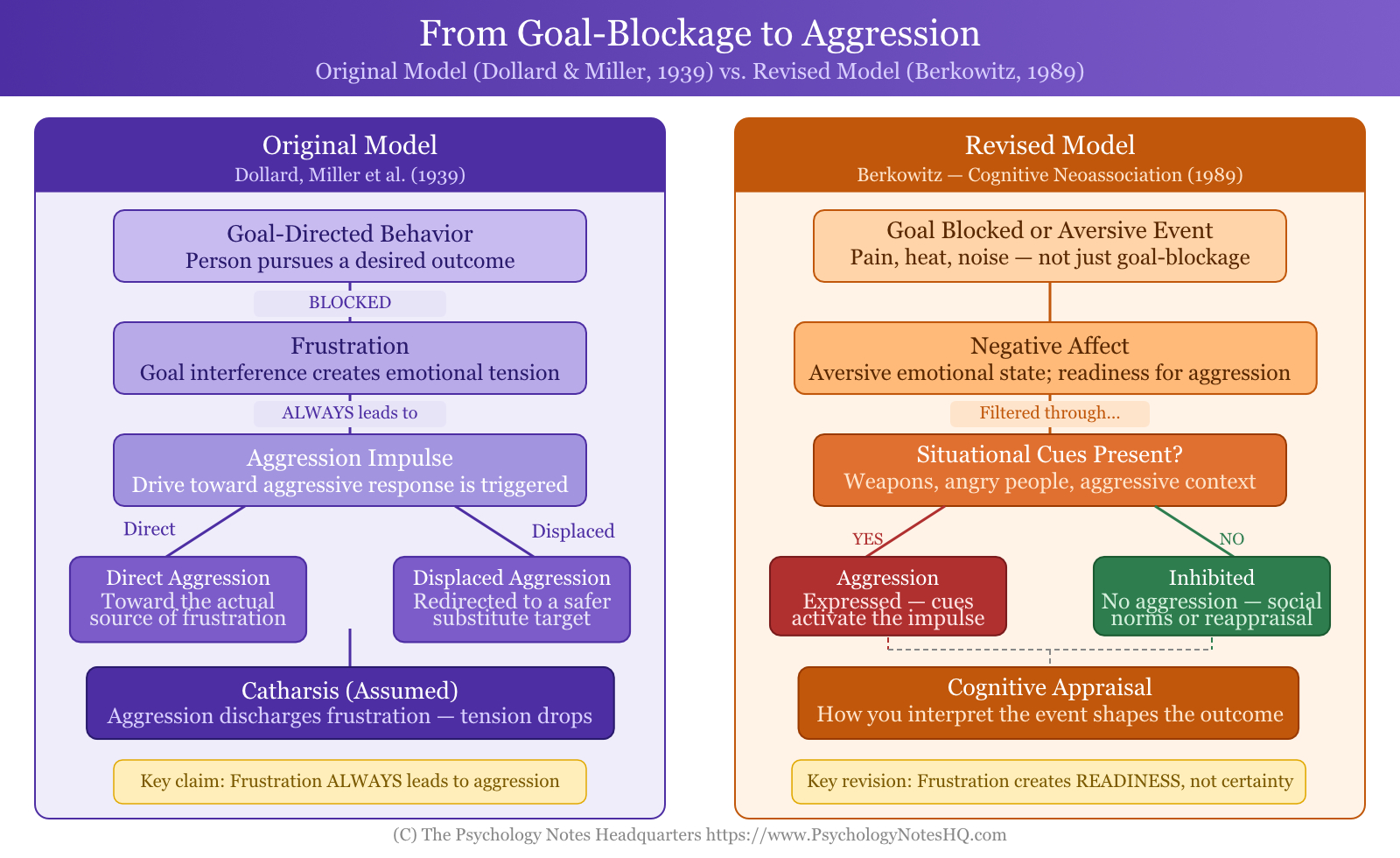
In their 1939 book Frustration and Aggression, the Yale group made two sweeping claims: frustration always leads to aggression, and aggression is always the result of frustration. Frustration, in their definition, is not simply feeling upset — it’s the interference with a goal-directed response. You’re driving to the airport and hit a traffic jam. You’re waiting in line and someone cuts in front of you. In each case, something is blocking the path to a desired outcome.
The group also recognized that direct aggression isn’t always possible. When the source of frustration is too powerful, too socially protected, or too ambiguous to confront, the aggressive impulse gets displaced — redirected toward a safer or more accessible target. A student snapped at by a professor may come home and pick a fight with a sibling. The energy goes somewhere; it just doesn’t always go where you’d expect. This displacement mechanism turned out to be one of the theory’s most durable and psychologically rich ideas.
Frustration-Aggression Hypothesis Examples in Everyday Life
The frustration-aggression hypothesis examples that resonate most are the ones we’ve all experienced or witnessed. Road rage is probably the clearest case: a driver cut off in traffic has their goal (getting somewhere on time) suddenly blocked, and the response — horn-honking, tailgating, shouting — follows almost reflexively. The frustration is real, the target is right there, and the threshold for aggression drops fast.
Workplace examples are just as common but often more subtle. An employee passed over for a promotion doesn’t usually confront the boss directly. Instead, the frustration leaks out sideways — shorter tempers with coworkers, less cooperation on shared projects, or complaints at home. Sports settings are another reliable demonstration: a foul called at a crucial moment, a referee’s questionable decision, a missed shot under pressure. Players and fans alike show how quickly blocked goals translate into aggressive reactions, even when the “aggressor” would behave perfectly calmly under normal circumstances.
Frustration-aggression dynamics also show up at a societal level. Relative deprivation — the gap between what people expect and what they actually receive — has been used to explain civil unrest and collective violence. When large groups experience economic frustration or perceived injustice, the theory predicts (and history frequently confirms) that aggression tends to follow. The Robbers Cave experiment demonstrated something similar: Sherif’s intergroup competition showed how resource frustration rapidly generates hostility between groups that had no prior conflict. In-group vs out-group dynamics are often fueled by exactly this kind of frustration-driven aggression.
The Catharsis Myth: Does Venting Actually Reduce Aggression?
The original theory carried an implicit assumption that acting aggressively would relieve frustration — a catharsis effect. Hit a pillow, scream into the void, vent to a friend, and the pressure drops. It’s an intuitive idea, and it’s also largely wrong.
Research by Brad Bushman and colleagues found that participants who vented their anger by hitting a punching bag reported feeling more aggressive afterward, not less. Rumination — which is essentially what venting encourages — keeps the frustration active rather than dissipating it. This has real-world implications: anger management approaches that rely on “getting it out” may actually be counterproductive. The evidence points more toward distraction, reappraisal, and problem-solving as more effective de-escalation strategies (Bushman, 2002). This is also a good example of how our intuitions about psychology can be confidently, consistently wrong — a pattern that shows up frequently in cognitive dissonance research as well, where people hold onto beliefs even when evidence contradicts them.
Berkowitz’s Revision: The Frustration-Aggression Theory in Psychology Gets Updated
The original theory’s insistence on “always” made it an easy target for critics, and Leonard Berkowitz took on the task of fixing it. His cognitive neoassociation model, developed through the 1960s and refined in a landmark 1989 paper, reframed the relationship in a more nuanced way: frustration doesn’t guarantee aggression. Instead, it generates negative affect — an aversive emotional state — which creates a readiness for aggressive responding. Whether that readiness tips into actual aggression depends on situational cues.
This is where Berkowitz’s famous “weapons effect” comes in. In a series of experiments, he found that the mere presence of a weapon in a room increased aggressive responses in frustrated participants. The weapon served as an aggressive cue — an environmental trigger that activated aggression schemas already primed by frustration. This revised frustration-aggression theory in psychology also expanded the trigger beyond goal-blockage: any source of negative affect, including physical pain, heat, or unpleasant noise, could increase aggressive readiness. Frustration was one cause among several, not the exclusive root of all aggression. Berkowitz’s update made the theory compatible with a much wider range of human behavior, including instrumental aggression — aggression used as a deliberate tool — which the original model couldn’t easily account for. Attribution theory adds another layer here: how people interpret the cause of a frustrating event (intentional vs. accidental, controllable vs. uncontrollable) shapes how strongly the aggressive response kicks in.
Displacement Aggression: When You Can’t Hit the Real Target
Displacement aggression is one of the most psychologically interesting predictions to come out of this framework. When the actual source of frustration is off-limits — because of power, social norms, or fear of retaliation — the aggressive impulse gets redirected to a substitute target. The classic example is the worker who gets chewed out by a manager, can’t respond directly, and then snaps at family members when they get home.
At a group level, displacement takes the form of scapegoating. When a society experiences widespread economic hardship or political instability — forms of collective frustration — minority groups often become targets for aggression that has nowhere obvious to go. This dynamic is well-documented historically and remains one of the more uncomfortable applications of the theory. The frustration is real; the target is just the wrong one. Understanding displacement also connects to Bandura’s social learning theory, which helps explain which targets tend to get selected — typically those observed to be vulnerable, lower in status, or already socially devalued.
Criticisms and Limitations
The frustration-aggression hypothesis has attracted significant criticism over the decades, and most of it is well-founded. The original “always” claims are the biggest problem: not all frustration leads to aggression. Sometimes people give up, withdraw, or simply adjust their goals — a pattern that looks far more like learned helplessness than aggression. Individual and cultural differences also play a substantial role in how frustration gets processed; frustration tolerance varies considerably across people and contexts.
The reverse claim — that all aggression is rooted in frustration — is equally hard to defend. Predatory aggression, instrumental violence, and aggression used strategically for personal gain don’t fit the frustration-first model comfortably. The theory also says relatively little about cognitive processes, emotion regulation, or the role of prior learning in shaping aggressive responses, all of which turn out to matter quite a lot. These gaps don’t invalidate the hypothesis, but they do clarify that it’s a starting point, not a complete explanation.
Where the Theory Stands Today
Despite its limitations, the frustration-aggression hypothesis remains a foundational framework in social psychology, criminology, and political science. The concept of relative deprivation — frustration arising from the gap between expectations and reality — continues to be applied to studies of civil conflict, terrorism, and economic inequality. Researchers studying collective violence still draw on the basic logic that blocked aspirations generate hostility.
The theory has also been integrated into broader models of human aggression, most notably the General Aggression Model developed by Anderson and Bushman, which treats frustration as one of many inputs that raise arousal and activate aggressive cognitions. In this sense, the original hypothesis didn’t get replaced — it got absorbed into something bigger. For students of psychology, it remains one of the best illustrations of how a bold, testable theory generates decades of productive debate, revision, and refinement. The core insight — that blocked goals create the conditions for aggression — has held up even as the “always” and “only” language around it has not.
Conclusion
The frustration-aggression hypothesis gave psychology one of its most debated and productive frameworks for understanding why people become aggressive. From road rage to displacement to collective unrest, the frustration-aggression hypothesis examples discussed here show how the theory maps onto real behavior at every scale. Berkowitz’s revisions made it more accurate; the catharsis research made it more practical; and its integration into modern aggression models keeps it relevant. It’s a theory that rewards careful study — not because it got everything right, but because the conversation it started is still going.
References
- Dollard, J., Miller, N. E., Doob, L. W., Mowrer, O. H., & Sears, R. R. (1939). Frustration and aggression. Yale University Press.
- Berkowitz, L. (1989). Frustration-aggression hypothesis: Examination and reformulation. Psychological Bulletin, 106(1), 59–73.
- Bushman, B. J. (2002). Does venting anger feed or extinguish the flame? Catharsis, rumination, distraction, anger, and aggressive responding. Personality and Social Psychology Bulletin, 28(6), 724–731.
- Anderson, C. A., & Bushman, B. J. (2002). Human aggression. Annual Review of Psychology, 53(1), 27–51.
- Berkowitz, L. (1993). Aggression: Its causes, consequences, and control. McGraw-Hill.
- Miller, N. E. (1941). The frustration-aggression hypothesis. Psychological Review, 48(4), 337–342.
- Staub, E. (1996). Cultural-societal roots of violence: The examples of genocidal violence and of contemporary youth violence in the United States. American Psychologist, 51(2), 117–132.
How to cite this article:
The Psychology Notes Headquarters. (2026). The Frustration-Aggression Hypothesis: Why Blocked Goals Make People Lash Out. Retrieved from https://www.psychologynoteshq.com/frustration-aggression-hypothesis/