
Emerging Adulthood: Arnett’s Theory of the In-Between Stage After Adolescence
Emerging adulthood is a distinct developmental stage spanning roughly ages 18 to 25, first proposed by psychologist Jeffrey Jensen Arnett in 2000. It sits between the end of adolescence and the full responsibilities of adult life — and according to Arnett, it is not simply a transition period but a stage with its own defining features, psychological tasks, and inner logic. For millions of people in industrialized societies today, this stage is the most identity-focused, self-exploratory, and genuinely open-ended period of their entire lives.
Key Takeaways
- Emerging adulthood (ages 18–25) is a stage coined by Jeffrey Arnett in 2000, distinct from both adolescence and young adulthood.
- Arnett identified five defining features: identity exploration, instability, self-focus, feeling in-between, and a sense of possibilities.
- Neurological development — especially in the prefrontal cortex — continues well into the mid-20s, lending biological support to the theory.
- This stage is not universal; cultural, economic, and social factors heavily shape whether and how emerging adulthood is experienced.
- Arnett’s theory draws important distinctions from Erikson’s Stage 5 and Stage 6, and from Havighurst’s young adult tasks.
Why Emerging Adulthood Exists as a Separate Stage
A century ago, the transition from adolescence to adulthood was fast and clearly marked. People left school in their mid-teens, entered the workforce, married young, and took on the full weight of adult responsibilities almost immediately. That compressed timeline left little room for extended identity exploration. The landscape has shifted dramatically since then. In many industrialized societies, the average age of first marriage has climbed well into the late 20s, college enrollment extends formal education for years beyond high school, and career paths have become less linear. Arnett (2000) argued that these structural changes didn’t just delay adulthood — they created the psychological and social space for a genuinely new stage of life to emerge.
Arnett’s Five Features of Emerging Adulthood
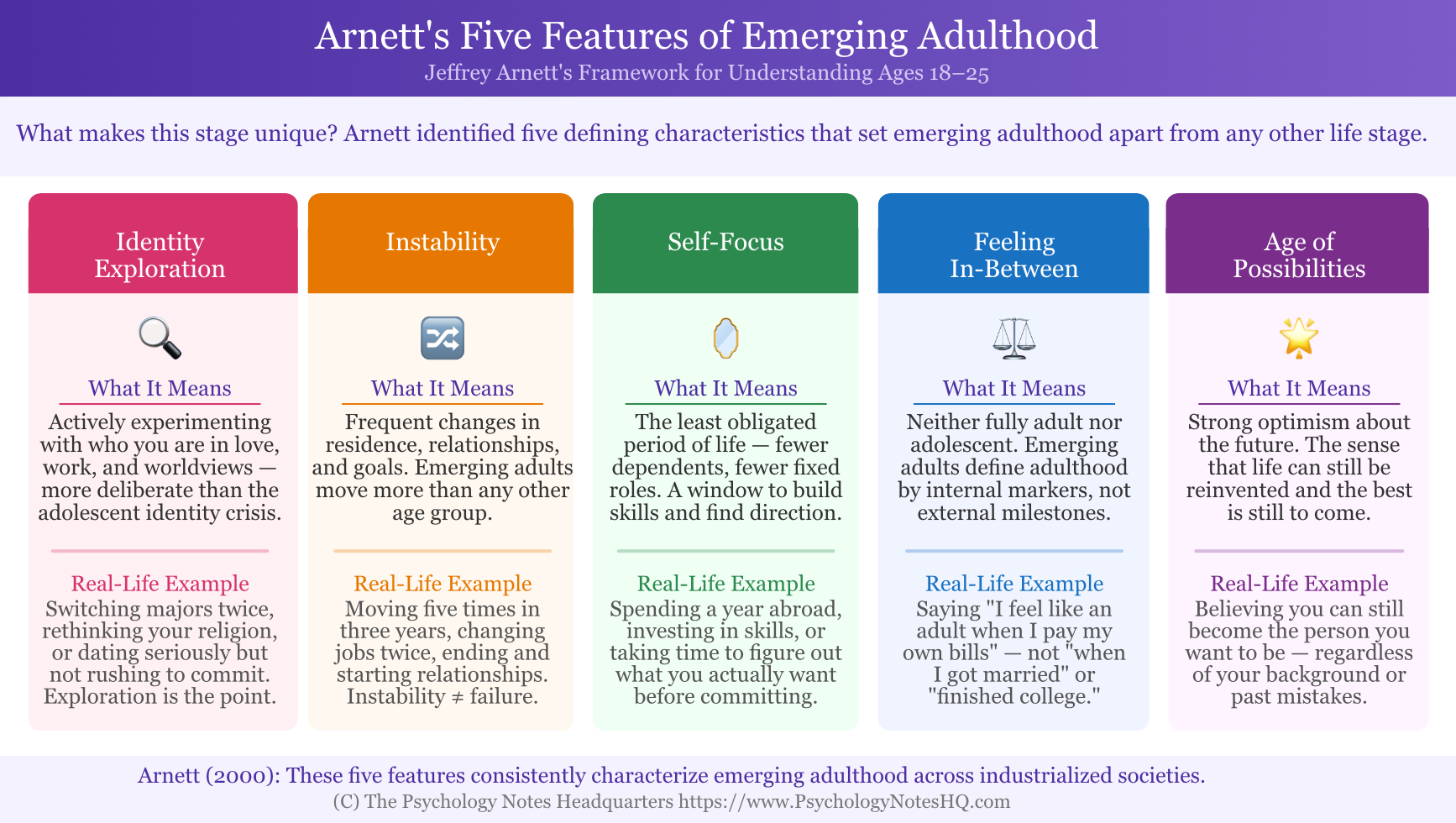
Arnett didn’t just name the stage; he gave it an anatomy. He identified five features that consistently characterize this period, and together they paint a picture quite unlike any other life stage.
The first is identity exploration — and this is the defining one. Emerging adults actively experiment with who they are in love, work, and worldviews. Unlike the identity crisis of adolescence (which tends to be reactive and turbulent), this exploration in the early-to-mid twenties tends to be more deliberate. Someone might try on two or three career paths, date seriously but without immediate commitment to marriage, or reconsider the religious or political beliefs they inherited from their family.
The second feature is instability. Residential moves, shifting relationships, changing jobs, and evolving goals are hallmarks of this period. Emerging adults move more frequently than any other age group. They change majors, change apartments, change partners. This instability isn’t dysfunction — it’s the byproduct of active exploration.
Third is self-focus. This is the least obligated period of life. Emerging adults are largely free from the demands of parenting, long-term partnership, and the kind of career accountability that comes with seniority. Arnett is careful to distinguish self-focus from selfishness — this period provides a window for developing competence, direction, and personal values before taking on lasting commitments.
Fourth is the feeling of being in-between. When surveyed, most emerging adults say they don’t feel fully adult yet — but they don’t feel like adolescents either. They occupy an ambiguous middle ground, and interestingly, they’re often comfortable there. They tend to cite internal markers — taking responsibility for themselves, making independent decisions — as signs of adulthood, rather than external ones like marriage or home ownership (Arnett, 2001).
The fifth feature is the age of possibilities. Despite the instability, emerging adulthood is experienced as a time of genuine optimism. People in this stage tend to believe their best years are ahead of them, that they can reinvent themselves, and that the future is open. For those from difficult backgrounds, this can feel like a genuine second chance. This feature distinguishes emerging adulthood sharply from the often-disillusioning experience of mid-adulthood.
What’s Actually Happening in the Brain
Arnett’s theory isn’t just sociological — it has meaningful neurological support. The prefrontal cortex, which governs executive functions like impulse control, long-term planning, and risk assessment, doesn’t reach full maturity until the mid-to-late twenties (Casey et al., 2008). This means that even after someone is legally an adult, the neural architecture for consistently adult-like decision-making is still being built. Risk-taking behavior, emotional reactivity, and susceptibility to peer influence — all of which peak in adolescence — don’t simply vanish at 18. They taper gradually, and emerging adulthood sits squarely in that tapering period. This neurological reality helps explain why the behavior of a 22-year-old often looks more like that of a 17-year-old than a 35-year-old, at least in certain domains.
Emerging Adulthood vs. Adolescence vs. Young Adulthood
Understanding where Arnett’s stage fits requires knowing what it’s being distinguished from. In Erikson’s framework, identity vs. role confusion covers adolescence (roughly 12–18), while intimacy vs. isolation begins in young adulthood. Arnett argues that the emerging adult period — ages 18 to 25 — doesn’t map cleanly onto either of those stages. Identity work isn’t done at 18, and true intimacy in Erikson’s sense (the merging of identity with another) typically can’t happen until identity is more settled. Emerging adulthood, in Arnett’s view, is where the rest of that identity work gets done before committed intimacy becomes the focus.
Havighurst’s developmental tasks for early adulthood — selecting a partner, starting a family, beginning a career — also assume a faster timeline than most people in wealthy industrialized nations now follow. Arnett’s stage is, in part, a response to that mismatch between classic developmental theory and the contemporary lived experience of young people.
Identity Exploration: The Core Task of Emerging Adulthood
Of the five features, identity exploration is the engine that drives the others. Emerging adults are asking three fundamental questions in parallel: Who do I want to love? What do I want to do for work? What do I believe? These aren’t idle questions — they’re the raw material from which adult identity gets constructed. James Marcia’s four identity statuses — diffusion, foreclosure, moratorium, and achievement — are useful here. The adolescent identity crisis tends to produce either diffusion or moratorium. Emerging adulthood is when moratorium — active searching without commitment — is most productive and socially supported. Many emerging adults shift toward identity achievement by their mid-twenties, but the path is rarely linear.
Work identity is especially complex in this stage. Social identity theory helps explain why career choices feel so high-stakes — what you do for work becomes part of who you are to yourself and others. Emerging adults often try multiple jobs or fields not because they’re uncommitted, but because they’re genuinely trying to find a match between self-concept and professional role.
Is Emerging Adulthood Universal? Criticisms of Arnett’s Theory
Arnett’s theory has been influential, but it has also attracted significant criticism. The most pointed critique is that it describes a privileged, culturally specific experience — primarily that of college-educated young people in wealthy Western nations (Hendry & Kloep, 2010). Critics note that the five features of emerging adulthood don’t translate easily to contexts where economic necessity requires early entry into full-time work, where marriage is arranged in the late teens, or where extended education simply isn’t available. In many parts of the developing world, and among lower-income populations within wealthy nations, the “age of possibilities” can feel more like an age of constraint.
The WEIRD problem — the tendency of psychological research to rely on Western, Educated, Industrialized, Rich, and Democratic samples — applies squarely to Arnett’s original work. Arnett himself has acknowledged this limitation and has since encouraged cross-cultural research to test which features of emerging adulthood appear across different contexts and which are products of specific social conditions. Bronfenbrenner’s ecological systems theory offers a useful framework here: the macrosystem and exosystem — cultural values, economic structures, policy environments — shape whether a 20-year-old has the structural freedom to be in an exploratory, self-focused stage at all.
Emerging Adulthood in the Real World
The practical expressions of emerging adulthood are visible everywhere once you know what to look for. The “boomerang generation” — young adults who return to live with their parents after college — is one manifestation. Rather than signaling failure, this pattern often reflects a strategic use of the emerging adulthood window: reducing financial pressure to allow more extended career exploration. Cohabitation before marriage, gap years, frequent job-hopping in the early career, and extended education are all behavioral correlates of the stage.
Mental health is also a significant concern during this period. Rates of anxiety, depression, and substance use peak in the late teens and early twenties, making emerging adulthood a critical window for both risk and intervention. The self-focus and instability that characterize the stage can be energizing for some and destabilizing for others. Access to support systems — family, community, institutional resources — interacts with individual temperament to determine whether this period is primarily one of growth or one of struggle. Self-determination theory offers one lens for understanding this variation: emerging adults who feel a sense of autonomy, competence, and relatedness during this period tend to navigate it more successfully than those who feel controlled, ineffective, or disconnected.
Parenting style also plays a role that extends beyond childhood. Research suggests that the kind of authoritative parenting associated with healthy adolescent outcomes continues to predict better adjustment in emerging adulthood — particularly in terms of identity exploration and psychological well-being.
Conclusion
Emerging adulthood stands as one of the more practically relevant contributions to developmental psychology in recent decades. It names something that millions of people live through — that stretched, searching, simultaneously thrilling and disorienting period between the end of adolescence and the anchoring commitments of adult life. Arnett’s theory isn’t without limitations, and its cultural scope is genuinely narrower than its proponents sometimes acknowledge. But as a framework for understanding identity development, instability, and the psychology of possibility in the early twenties, it remains both useful and important.
References
- Arnett, J. J. (2000). Emerging adulthood: A theory of development from the late teens through the twenties. American Psychologist, 55(5), 469–480.
- Arnett, J. J. (2001). Conceptions of the transition to adulthood: Perspectives from adolescence through midlife. Journal of Adult Development, 8(2), 133–143.
- Casey, B. J., Getz, S., & Galvan, A. (2008). The adolescent brain. Developmental Science, 11(1), 72–80.
- Hendry, L. B., & Kloep, M. (2010). How universal is emerging adulthood? An empirical example. Journal of Youth Studies, 13(2), 169–179.
- Erikson, E. H. (1968). Identity: Youth and crisis. Norton.
- Marcia, J. E. (1966). Development and validation of ego-identity status. Journal of Personality and Social Psychology, 3(5), 551–558.
- Schwartz, S. J., Côté, J. E., & Arnett, J. J. (2005). Identity and agency in emerging adulthood: Two developmental routes in the individualization process. Youth & Society, 37(2), 201–229.
How to cite this article:
The Psychology Notes Headquarters. (2026). Emerging Adulthood: Arnett’s Theory of the In-Between Stage After Adolescence. Retrieved from https://www.psychologynoteshq.com/emerging-adulthood/