
Herzberg’s Two Factor Theory: The Surprising Reason Perks Don’t Boost Motivation
Sarah just got the raise she had been asking for all year. Her paycheck went up, her complaints about the parking situation got resolved, and her manager even upgraded her office chair. Three months later, she is just as checked out as before. This is the exact puzzle Herzberg’s two factor theory was built to explain. Some workplace conditions stop people from feeling miserable, but they never actually make anyone feel motivated. Understanding that gap changes how psychologists think about what really drives people to care about their work.
Key Takeaways
- Herzberg found that the things that make people satisfied at work are not the opposite of the things that make them dissatisfied.
- Fixing a hygiene problem like low pay or bad supervision removes complaints, but it rarely creates any real drive to perform.
- Motivators like recognition and responsibility work through a completely separate psychological channel than hygiene factors.
- The theory has shaped decades of job design, even though its research method has drawn serious academic criticism.
- Comparing this framework to Maslow’s hierarchy and self-determination theory reveals both its influence and its limits.
The Study Behind the Theory
Frederick Herzberg developed motivation hygiene theory in the late 1950s, working alongside Bernard Mausner and Barbara Snyderman. Their 1959 book, The Motivation to Work, described interviews with 203 engineers and accountants in the Pittsburgh area (Herzberg et al., 1959).
They used a method borrowed from psychologist John Flanagan called the critical incident technique. Each participant was asked to describe a time they felt exceptionally good about their job, and a time they felt exceptionally bad about it. Herzberg then sorted these stories into categories based on what caused the feeling.
What emerged surprised him. The events tied to feeling good were almost never the same events tied to feeling bad. This asymmetry became the foundation of Herzberg’s two factor theory.
Hygiene Factors vs Motivators: What’s the Real Difference
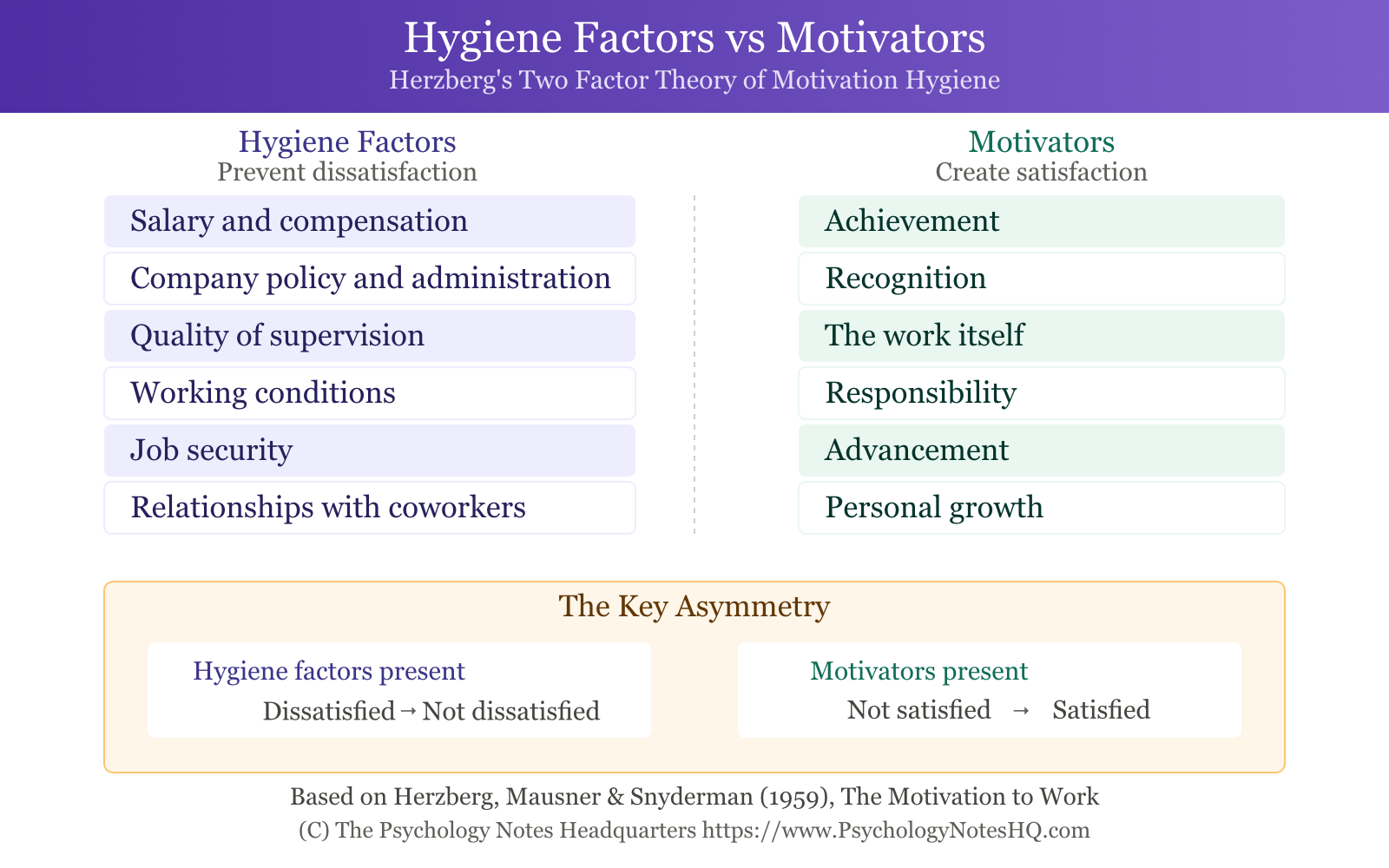
Herzberg’s team identified two separate clusters of workplace factors. Hygiene factors include things like salary, company policy, quality of supervision, working conditions, job security, and relationships with coworkers. When these are poor, people feel dissatisfied. When they are adequate, dissatisfaction fades, but satisfaction does not automatically appear.
Motivators are a different set entirely. These include achievement, recognition, the work itself, responsibility, advancement, and personal growth. When these are present, people report genuine satisfaction and engagement. When they are absent, the result is not usually strong dissatisfaction, just a kind of flatness or indifference.
This is the core insight behind motivation hygiene theory. Satisfaction and dissatisfaction are not two ends of a single scale. They behave like two separate dials that can move independently of each other.
Herzberg Hygiene Factors Examples in Real Workplaces
Modern workplaces offer plenty of examples of hygiene factors in action. A remote work stipend, a clear PTO policy, a comfortable office layout, and a fair grievance process all fall into this category. Employees expect these things, and their absence causes friction.
But raising the stipend or adding extra vacation days rarely produces a burst of enthusiasm. It just removes one more reason to feel annoyed. This distinction matters for anyone studying organizational behavior, since it explains why employee engagement surveys often show that pay satisfaction and overall motivation move independently of one another.
Why Removing a Hygiene Problem Doesn’t Create Motivation
This is the part of Herzberg’s two factor theory that trips people up. Managers often assume that if they eliminate every source of complaint, motivation will naturally rise to fill the space. Herzberg’s data suggested the opposite. Hygiene factors have a ceiling. Once they reach an acceptable level, additional investment in them produces diminishing returns on actual drive.
This idea overlaps with research on the overjustification effect, which shows that external rewards can sometimes undercut a person’s internal reasons for doing something well. Herzberg’s framework and the overjustification research come from different traditions, but both point to the same conclusion: extrinsic conditions and genuine motivation do not operate on the same track.
Contrast this with the incentive theory of motivation, which treats external rewards as a primary driver of behavior. Herzberg’s model complicates that picture by suggesting that not every external factor functions as an incentive. Some, like fair pay, only prevent dissatisfaction rather than actively pulling behavior forward.
How This Compares to Maslow and Self-Determination Theory
Herzberg’s own writing acknowledged a rough parallel to Maslow’s hierarchy of needs. Hygiene factors map loosely onto lower level needs like safety and belonging, while motivators echo Maslow’s higher level needs around esteem and self-actualization. The two theories were developed independently, but they share the assumption that psychological growth depends on more than just meeting basic requirements.
A more direct modern comparison comes from self-determination theory, which argues that people are driven by three core needs: autonomy, competence, and relatedness. Herzberg’s motivators, especially responsibility and achievement, line up closely with autonomy and competence. Where the two theories diverge is in mechanism. Herzberg described a static list of job features, while self-determination theory offers a more dynamic account of how those needs get satisfied or frustrated over time.
Herzberg’s work also set the stage for later thinking captured in the site’s overview of cognitive theories of motivation, which shifted attention toward how people interpret and evaluate their work rather than just react to its conditions.
Criticisms and Limitations
Herzberg’s two factor theory has faced substantial academic scrutiny since its publication. The most persistent critique, first raised by Victor Vroom and later formalized by House and Wigdor (1967), is that the two factor split may be an artifact of the critical incident method itself. When people explain a good experience, they tend to credit themselves. When they explain a bad experience, they tend to blame external circumstances. This self-serving attribution pattern could produce Herzberg’s results even if satisfaction and dissatisfaction actually operate on the same continuum.
Later studies using different methods, such as rating scales instead of open-ended interviews, often found more overlap between hygiene factors and motivators than Herzberg originally reported (House & Wigdor, 1967). The original sample was also limited to a specific group: white collar, mostly male professionals in one American city during the late 1950s, which raises questions about how well the findings generalize across industries, cultures, and job types.
A more recent literature review by Cai and Qu (2026) found that the theory continues to struggle with limited applicability outside of certain organizational contexts, and that individual differences among workers make a single universal list of hygiene factors and motivators hard to defend.
Why It Still Matters Today
Despite these limitations, motivation hygiene theory remains a common starting point for thinking about job design. It offers a simple, teachable distinction that still shows up in how organizations think about hybrid work policies, retention strategies, and the difference between an employee who tolerates their job and one who actually cares about it.
For psychology students, the real value of Herzberg’s two factor theory is not in treating it as settled fact, but in using it as a lens. It draws a useful line between what keeps people from quitting and what makes them want to do good work in the first place, even if the underlying research method has not held up perfectly under later scrutiny.
Sarah’s raise and her new office chair were never going to be the thing that brought her back. Real motivation, according to Herzberg, was always going to come from somewhere else.
References
- Cai, J., & Qu, J. (2026). Review of Herzberg’s two-factor theory: Limitations and improvements. Systems Research and Behavioral Science.
- Herzberg, F., Mausner, B., & Snyderman, B. (1959). The motivation to work. John Wiley & Sons.
- House, R. J., & Wigdor, L. A. (1967). Herzberg’s dual-factor theory of job satisfaction and motivation: A review of the evidence and a criticism. Personnel Psychology, 20(4), 369 to 389.
- Maslow, A. H. (1943). A theory of human motivation. Psychological Review, 50(4), 370 to 396.
How to cite this article:
The Psychology Notes Headquarters. (2026). Herzberg’s Two Factor Theory: The Surprising Reason Perks Don’t Boost Motivation. Retrieved from https://www.psychologynoteshq.com/herzberg-two-factor-theory/