
Maslow’s Humanistic Psychology: Self-Actualization & Human Potential
Self-actualization is Abraham Maslow’s term for the human drive to become everything you’re capable of becoming — developing your unique talents, values, and potential rather than simply meeting basic needs. For decades, psychology was dominated by two opposing forces: Freud’s psychoanalysis viewing humans as driven by unconscious sexual and aggressive urges, and behaviorism treating people as programmable organisms shaped by rewards and punishments. Maslow challenged both perspectives, proposing a “third force” built around self-actualization, creativity, and human potential. His humanistic psychology shifted focus from pathology to growth, from determinism to free will, and from reducing humans to component parts to understanding the whole, unique individual.
Key Takeaways
- Self-actualization is Maslow’s term for realizing your full potential, and it sits at the center of humanistic psychology’s “third force” alternative to Freud and behaviorism.
- Humanistic psychology emphasizes growth, free will, and subjective experience rather than pathology or conditioning.
- Peak experiences — moments of intense joy or transcendence — are how Maslow believed self-actualization shows up in everyday life.
- Maslow’s hierarchy of needs is the framework most people know him for, but self-actualization was always the point, not the pyramid diagram.
- The theory shaped positive psychology, person-centered therapy, and education, though critics still question its scientific rigor and cultural assumptions.

Download this overview in PDF format
What is Humanistic Psychology?
Humanistic psychology represents a comprehensive approach to understanding people that emphasizes inherent human goodness, potential for growth, and the subjective experience of being human. Rather than focusing on mental illness, unconscious drives, or conditioned responses, humanistic psychology asks what makes life worth living, how healthy people thrive, and what enables humans to reach their full potential.
This movement emerged in the 1950s and 1960s during the post-World War II era, when American society was questioning traditional assumptions and seeking new understandings of human nature. The horrors of war had revealed humanity’s capacity for destruction, but the postwar period also brought optimism about human possibilities and social progress. Humanistic psychology reflected this cultural moment, offering hope that humans could transcend base instincts and environmental conditioning to achieve higher purposes.
Humanistic psychologists explicitly positioned their approach as the “third force” in psychology, an alternative to two dominant paradigms. The first, psychoanalysis, pioneered by Sigmund Freud, viewed humans as driven by unconscious sexual and aggressive instincts shaped by early childhood conflicts. Freud’s deterministic view suggested that unconscious forces largely control behavior, leaving limited room for conscious choice or growth. The second, behaviorism, championed by John Watson and B.F. Skinner, treated humans as blank slates shaped entirely by environmental conditioning through rewards and punishments. Behaviorists denied the relevance of consciousness, focusing exclusively on observable behaviors.
Humanistic psychology rejected both these deterministic frameworks. Humanistic psychologists argued that neither biological instincts nor environmental conditioning fully determine human behavior. Instead, humans possess free will, make meaningful choices, and actively create their own lives. People aren’t merely products of their past or victims of unconscious drives; they’re forward-looking beings capable of growth, change, and self-direction.
Humanistic psychology emphasized studying human potential and growth rather than focusing exclusively on pathology. While psychoanalysis and behaviorism developed primarily from studying neurotic patients or laboratory animals, humanistic psychologists insisted on studying healthy, creative, fulfilled individuals to understand what humans could become at their best. This represented a profound shift from deficit models focusing on what’s wrong with people to growth models celebrating what’s right.
The holistic view of the person distinguished humanistic psychology from reductionistic approaches. Rather than reducing humans to id-ego-superego structures or stimulus-response associations, humanistic psychologists viewed people as integrated wholes whose thoughts, feelings, behaviors, and aspirations form unified systems. You can’t understand a person by examining isolated components; you must grasp their total lived experience.

Maslow’s Role as Founder
Abraham Maslow (1908-1970) stands as one of humanistic psychology’s principal architects. Born in Brooklyn, New York, to Russian Jewish immigrant parents, Maslow initially trained in behaviorism, earning his Ph.D. under Harry Harlow at the University of Wisconsin. However, his experiences — including watching his own children develop and witnessing World War II’s devastation — convinced him that behaviorism’s mechanistic view of humanity was profoundly inadequate.
Maslow co-founded the humanistic psychology movement alongside Carl Rogers, another pioneering psychologist who developed person-centered therapy. Together, they articulated a vision of psychology that honored human dignity, potential, and subjective experience. In 1967, Maslow served as president of the American Psychological Association, using this platform to advocate for humanistic approaches and legitimate them within mainstream psychology.
Maslow’s personal motivation for developing humanistic psychology stemmed from his conviction that psychology needed to address the best in human nature, not just pathology. He believed that psychoanalysis and behaviorism, while contributing valuable insights, painted incomplete and overly pessimistic pictures of humanity. Maslow wanted psychology to study love, creativity, joy, and fulfillment with the same rigor applied to anxiety, depression, and neurosis. He felt that understanding exceptional human functioning — exemplified by figures like Albert Einstein, Eleanor Roosevelt, and Abraham Lincoln — could reveal what all humans might achieve.
Maslow’s rejection of reductionism proved fundamental to his approach. He criticized psychology’s tendency to reduce complex human experiences to simpler components — whether unconscious drives, conditioned reflexes, or neural mechanisms. While acknowledging that humans have biological needs and respond to environmental influences, Maslow insisted that people transcend these factors through consciousness, meaning-making, and purposeful striving. Studying isolated variables in controlled experiments, he argued, misses the essence of human experience.
Core Principles of Humanistic Psychology
Several interconnected principles define humanistic psychology’s distinctive worldview.
Human Nature is Inherently Good
Humanistic psychology adopts an optimistic view of human nature, proposing that people are fundamentally good and naturally oriented toward growth and self-improvement. Given supportive conditions, humans develop in positive directions, actualizing their potentials and contributing constructively to society. This sharply contrasts with Freud’s view that civilization barely restrains humans’ destructive instincts.
Maslow believed people possess an innate tendency toward self-actualization — becoming all they’re capable of becoming. Just as acorns naturally develop into oak trees given proper conditions, humans naturally develop their capacities given freedom, safety, and respect. Problems arise not from inherent human badness but from environments that thwart natural growth tendencies.
Focus on Subjective Experience
Humanistic psychology embraces a phenomenological approach, emphasizing that understanding people requires grasping their subjective, first-person experience of reality. What matters isn’t just objective facts about a person’s life but how they perceive, interpret, and experience those facts.
Two people in identical circumstances might experience life completely differently based on their perceptions, meanings, and interpretations. Humanistic psychology studies this subjective reality — how individuals see themselves, understand their worlds, and create personal meanings. This phenomenological focus contrasts with behaviorism’s exclusive attention to observable behaviors and objective environmental stimuli.
Emphasis on Free Will and Agency
Humanistic psychology asserts that humans possess genuine free will and make authentic choices. People aren’t simply products of their conditioning or unconscious drives; they actively decide, choose, and direct their lives. This agency brings responsibility — humans can’t blame their behavior entirely on past experiences or external circumstances.
This emphasis on free will doesn’t deny that biology and environment influence behavior. Rather, it claims that humans can transcend these influences through conscious choice and intentional action. Even in constrained circumstances, people retain some freedom to choose their attitudes and responses.
Holistic View of the Person
Humanistic psychology views people as integrated wholes rather than collections of separate parts or functions. Thoughts, emotions, behaviors, physical sensations, and spiritual longings form interconnected systems that can’t be fully understood in isolation. Reducing a person to component processes misses essential qualities that emerge only at the level of the whole person.
This holism extends to mind-body integration. Humanistic psychologists reject mind-body dualism, viewing physical and psychological aspects of experience as inseparable. Emotions have bodily components; physical states affect thoughts and feelings. Understanding people requires grasping this integration.
Self-Actualization as Goal
Maslow proposed self-actualization — realizing one’s full potential — as the ultimate human motivation. Once basic needs for safety, belonging, and esteem are met, people naturally strive toward becoming their best selves, developing their unique capabilities and contributing meaningfully to the world.
This contrasts with deficiency motivation, which aims to reduce tension or fill lacks. Self-actualization represents growth motivation, driven not by deficits but by the inherent urge to expand, create, and fulfill potential. Self-actualizing people are pulled forward by possibilities rather than pushed by deficiencies.
Present-Centered Focus
Humanistic psychology emphasizes the present moment — the here and now of lived experience. While acknowledging that past experiences shape people, humanistic approaches focus on current experience, present choices, and future possibilities rather than dwelling on historical causes.
This present-centeredness reflects the belief that people can change regardless of their pasts. Freedom exists in the present moment, where choices occur and new directions become possible. Excessive focus on past determinants can obscure present agency and future potential.
Key Concepts in Maslow’s Humanistic Psychology
Several concepts central to Maslow’s thinking have shaped humanistic psychology’s development.
Self-Actualization
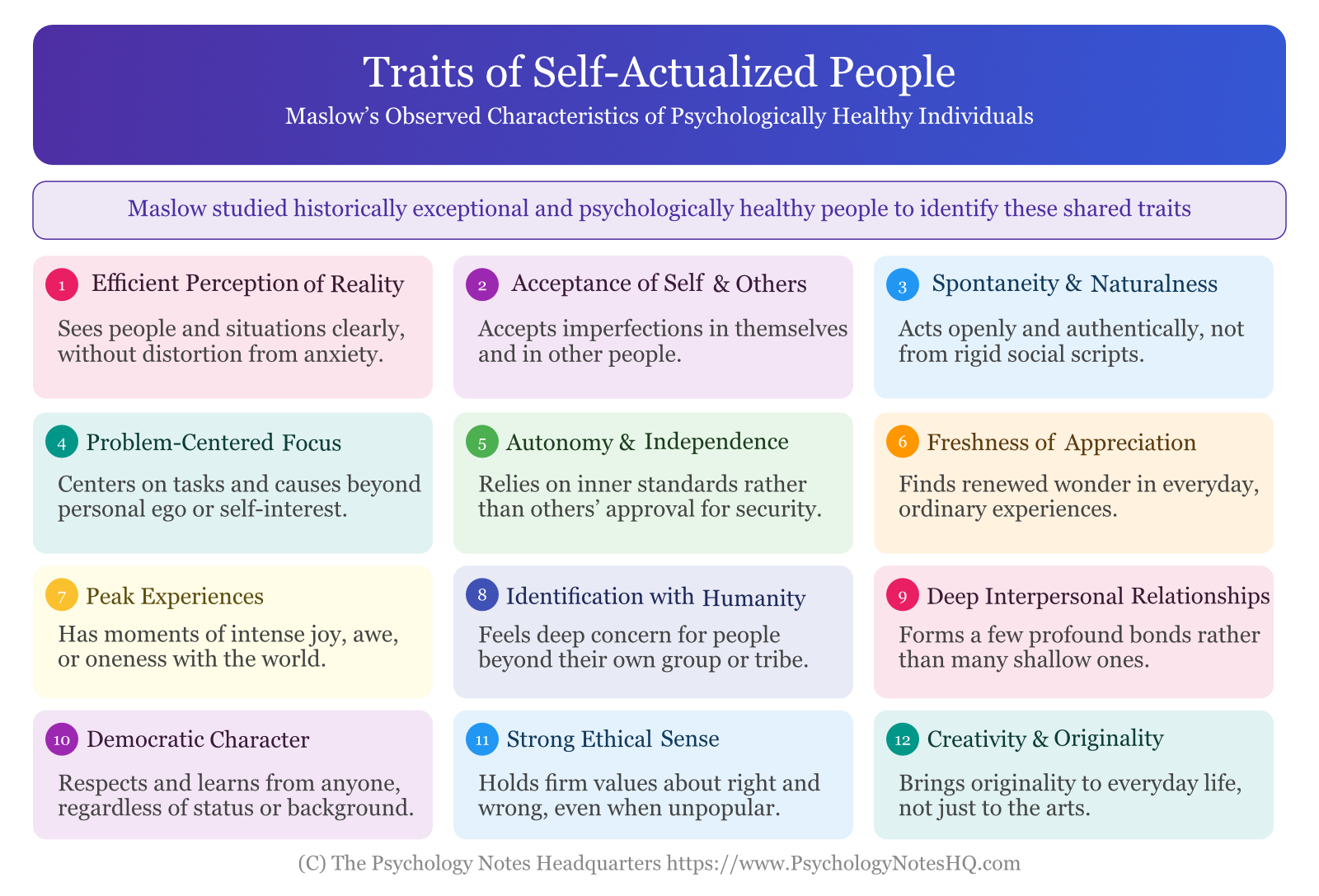
Self-actualization represents the pinnacle of human development — the realization of one’s inherent potentials, capacities, and talents. Maslow defined it as the desire to become everything one is capable of becoming. Self-actualizing people develop their unique abilities, pursue meaningful goals, and live authentically aligned with their values.
Maslow studied people he considered self-actualizers — historical figures like Abraham Lincoln and Eleanor Roosevelt, contemporaries like Albert Einstein, and personal acquaintances — identifying common characteristics. Self-actualizers show efficient perception of reality, accepting themselves and others, spontaneity and naturalness, problem-centeredness rather than self-centeredness, autonomy and independence, continued freshness of appreciation, peak experiences, identification with humanity, deep interpersonal relationships, democratic character structure, strong ethical sense, philosophical sense of humor, and creativity.
Most students first meet this idea through Maslow’s hierarchy of needs, the pyramid diagram that places self-actualization at the top tier above physiological, safety, belonging, and esteem needs. That pyramid shorthand is useful for remembering the order of needs, but Maslow himself described the climb toward self-actualization as far less linear — people move up and down the levels throughout life, and reaching the top isn’t a one-time event so much as an ongoing practice. While Maslow’s pyramid focuses on the fulfillment of complex psychological needs, achieving the focus required for self-actualization often depends on maintaining a “sweet spot” of mental stimulation, as explained in the Optimal Arousal Theory of Motivation.
Peak Experiences
Peak experiences are moments of intense joy, wonder, awe, or ecstasy that Maslow identified as common among self-actualizers. During peak experiences, people feel at one with the universe, experience profound meaning, transcend ordinary ego boundaries, and feel that everything is exactly as it should be.
These moments might occur while appreciating nature, creating art, falling in love, achieving a significant accomplishment, or experiencing spiritual revelation. Peak experiences provide glimpses of self-actualization, revealing what life can be at its fullest. Maslow considered them evidence that self-actualization isn’t reserved for a rare few living permanently at the top of the pyramid — it shows up in flashes for most people, even if only briefly. While self-actualizers experience peaks more frequently and describe them more vividly, anyone can have these transcendent moments.
Being vs. Deficiency Needs
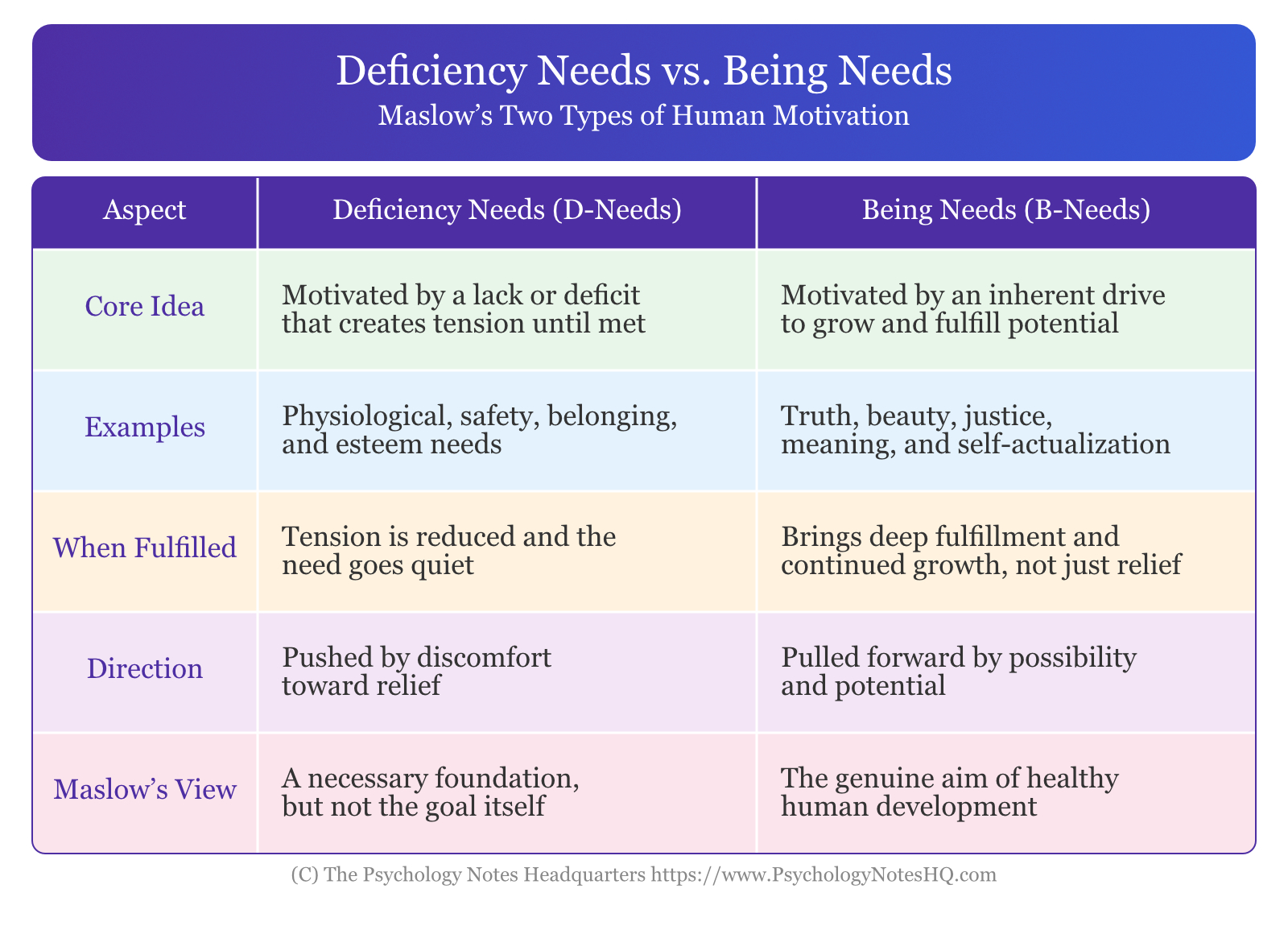
Maslow distinguished between deficiency needs (D-needs) and being needs (B-needs). Deficiency needs — physiological requirements, safety, belonging, and esteem — arise from lacks that create tension until satisfied. People motivated by D-needs seek to reduce discomfort and fill deficits.
Being needs represent growth motivations that emerge when deficiency needs are adequately met. B-needs include desires for truth, beauty, justice, meaningfulness, and self-actualization. These needs don’t stem from deficits but from the inherent human urge to grow, develop, and fulfill potential. Satisfying B-needs brings deep fulfillment rather than mere tension reduction. This D-needs/B-needs split is the logic underneath Maslow’s hierarchy of needs theory — the familiar five-tier pyramid most intro psychology courses teach — though Maslow treated the boundary between levels as fluid rather than a strict staircase you climb once and leave behind.
Humanistic psychology emphasizes internal drives for growth; however, human behavior is also significantly influenced by external rewards and environmental “pulls,” a concept explored in depth within the Incentive Theory of Motivation.
Metamotivation
Metamotivation refers to motivation beyond basic needs — the values and aspirations of self-actualizing people. Once freed from preoccupation with survival, safety, acceptance, and recognition, people pursue what Maslow called B-values: truth, goodness, beauty, wholeness, aliveness, uniqueness, perfection, necessity, completion, justice, order, simplicity, richness, effortlessness, playfulness, and self-sufficiency.
These values aren’t externally imposed moral rules but intrinsic human desires that emerge naturally in psychologically healthy individuals. Metamotivation represents the highest form of human functioning, where people transcend selfish concerns to pursue universal values and contribute to something larger than themselves.
Criticisms and Limitations
Despite its influence, humanistic psychology faces substantial criticisms.
Lack of Empirical Rigor
Critics charge that humanistic psychology lacks the empirical rigor characterizing scientific psychology. Concepts like self-actualization, peak experiences, and authentic living prove difficult to define operationally and measure reliably. How do you scientifically study subjective experience? What objective criteria identify self-actualized individuals?
Maslow’s research methods — studying selected historical figures and personal acquaintances he judged self-actualized — lacked the controlled, systematic approaches expected in scientific research. This makes findings difficult to verify or replicate, limiting humanistic psychology’s scientific credibility.
Vague Concepts and Definitions
Many humanistic concepts remain frustratingly vague. What exactly is self-actualization? How do you know when you’ve achieved it? What distinguishes peak experiences from ordinary happiness? Critics argue these concepts lack precision needed for scientific theory or reliable application.
Without clear definitions, different people interpret concepts differently, preventing cumulative knowledge building. Vagueness also enables broad applicability but sacrifices explanatory power.
Cultural Bias
Humanistic psychology reflects Western, particularly American, individualistic values emphasizing personal autonomy, self-expression, and individual achievement. Self-actualization prioritizes developing one’s unique potential — a value more prominent in individualistic than collectivistic cultures.
Many cultures prioritize group harmony, social obligation, and conformity to group norms over individual self-expression. Applying humanistic psychology’s individualistic framework universally may impose Western cultural values inappropriately.
Overemphasis on Positive Aspects
By focusing almost exclusively on positive human potentials, humanistic psychology may underestimate genuine human destructiveness, selfishness, and evil. Humans can be cruel, violent, and destructive — not just when environments thwart growth but sometimes from deliberate choice.
The optimistic view that people are inherently good if given proper conditions may be naive. Some critics argue this prevents humanistic psychology from adequately addressing serious pathology, violence, or moral evil.
Limited Applicability to Severe Pathology
Humanistic approaches work well with relatively healthy individuals seeking growth and meaning but may prove insufficient for severe mental illnesses like schizophrenia, bipolar disorder, or major depression. These conditions often require biological interventions and structured treatments that humanistic psychology alone can’t provide.
Self-Actualization as Elitist
Maslow’s self-actualizers were largely privileged individuals — educated, economically secure, socially recognized. Critics argue self-actualization becomes accessible primarily to those with resources and opportunities, making it an elitist concept irrelevant to people struggling with poverty, discrimination, or survival.
Methodological Concerns
The phenomenological approach, while valuable, raises methodological challenges. How can subjective experiences be studied systematically? Can findings based on individuals’ self-reports and researchers’ interpretations generate reliable knowledge? These questions persist.
Legacy and Modern Relevance
Despite criticisms, humanistic psychology’s influence endures. Positive psychology, one of contemporary psychology’s fastest-growing areas, directly descends from humanistic psychology’s emphasis on studying human flourishing. Martin Seligman and other positive psychologists acknowledge this debt while employing more rigorous research methods.
Humanistic principles pervade modern counseling and therapy. Person-centered approaches, emphasis on the therapeutic relationship, respect for client autonomy, and strengths-based interventions all reflect humanistic values. Even therapists using other approaches often incorporate humanistic attitudes.
Educational reforms emphasizing student-centered learning, social-emotional development, and fostering creativity owe debts to humanistic educational philosophy. Business innovations around employee engagement, meaningful work, and participative management continue applying Maslow’s insights.
Wellness movements, mindfulness practices, and coaching industries draw heavily on humanistic psychology’s vision of human potential and holistic well-being. Concepts like authentic living, finding meaning, and personal growth pervade contemporary culture, testifying to humanistic psychology’s cultural impact.
Continuing debates about human nature — whether people are fundamentally good or selfish, determined or free, passive recipients or active agents — echo tensions humanistic psychology highlighted. While few psychologists identify exclusively as humanistic today, the questions humanistic psychology raised remain vital.
Conclusion
Maslow’s humanistic psychology offered a hopeful vision of human nature as fundamentally good and oriented toward growth. By emphasizing subjective experience, free will, and self-actualization, it provided crucial balance to psychology’s deterministic traditions. While facing legitimate criticisms about scientific rigor and cultural limitations, the pursuit of self-actualization profoundly shaped clinical practice, education, management, and cultural understandings of human potential, leaving a legacy that continues influencing psychology and society.
Explore More Theories of Motivation:
Biological Balance: Learn how we find our performance “sweet spot” in our guide to Optimal Arousal Theory.
External Rewards: Discover how environment and incentives shape our choices in the Incentive Theory of Motivation.
References
- Maslow, A. H. (1943). A theory of human motivation. Psychological Review, 50(4), 370-396.
- Maslow, A. H. (1954). Motivation and personality. Harper & Row.
- Maslow, A. H. (1968). Toward a psychology of being (2nd ed.). Van Nostrand.
- Rogers, C. R., & Stevens, B. (1967). Person to person: The problem of being human. Real People Press.
- Taylor, E. (2001). Positive psychology and humanistic psychology: A reply to Seligman. Journal of Humanistic Psychology, 41(1), 13-29.
How to cite this article:
The Psychology Notes Headquarters. (2026). Maslow’s Humanistic Psychology: Self-Actualization & Human Potential. Retrieved from https://www.psychologynoteshq.com/abraham-maslows-humanistic-psychology/
Thanks