
Social Norms in Psychology: The Unwritten Rules Running Your Day
You step into a crowded elevator and, without a word, everyone turns to face the doors. Nobody announced a rule. Nobody is checking. Yet you comply, and facing the back would feel strangely exposed. That quiet pressure sits at the heart of social norms in psychology: shared expectations that steer behavior without any written rulebook. Norms do far more than shape elevator manners, though. They influence how much energy a household uses, how much a student thinks they should drink, and even which societies punish rule breakers most harshly. Once you spot them, daily life looks different.
Key Takeaways
- Some norms describe what people do, while others describe what people approve of. The two do not always agree, and that gap explains some surprising behavior.
- A well-known energy-saving study showed how a friendly message can push good citizens in exactly the wrong direction.
- Many students privately doubt a campus habit while assuming everyone else loves it. Why does that illusion last so long?
- Some nations tolerate rule breaking far more than others, and threat may be part of the reason.
- Psychologists now use norms to change behavior, but results depend on details most campaigns miss.
What Makes a Norm a Norm
A social norm is a shared expectation about how people in a group behave or should behave. It works like an invisible guide, and you usually notice it only when someone breaks it.
Norms are not the same as personal habits. Your habit of drinking coffee at seven belongs to you alone. A norm requires a group, and it carries pressure to match what others do or approve of. That link between individual behavior and group expectations is why social norms in psychology keep showing up in research on health, the environment, and everyday group life.
How Social Norms Form
Sherif’s Light in the Dark
Muzafer Sherif watched norms appear inside a laboratory. He used the autokinetic effect, an illusion in which a still point of light in a dark room seems to move. Working alone, people gave estimates that varied widely. Once they called out their estimates in a group, the numbers gradually drifted toward a shared range (Sherif, 1936).
Nobody told participants what to say. The group standard grew out of their interaction, and participants carried it with them afterward. Many real world norms start in exactly this quiet, unplanned way.
From Small Groups to Whole Cultures
Once a standard settles, repetition keeps it alive. Newcomers watch what others do, copy it, and eventually pass it on. Families, classrooms, sports teams, and online communities all build local rules this way.
Bigger forces add weight. Institutions, laws, and shared history can harden some norms into near certainty, which is why one behavior feels ordinary in one place and shocking in another. Here conformity in psychology enters the picture: norms are the standards themselves, while conformity is the act of matching them.
Why Norms Have Such a Grip
Shortcuts for Uncertain Moments
Sherif’s participants faced an ambiguous situation: nobody could say how far the light really moved. In moments like that, other people’s behavior becomes information. Following the crowd is quick, and it often works well enough.
Everyday life is full of small uncertainties. Which fork to use, how loudly to speak, when to leave a party. Norms fill the gaps so that you do not have to work everything out from scratch.
The Pull of Approval
People also want to be included. Disapproval stings, and being seen as different can feel uncomfortable even when the difference is small. The campus drinking studies capture this well: students who thought they were deviant reported feeling more alienated from campus life, even though their deviance was imaginary (Prentice & Miller, 1993).
Norms hold not only through information but through the desire to belong.
Types of Social Norms: Descriptive vs Injunctive
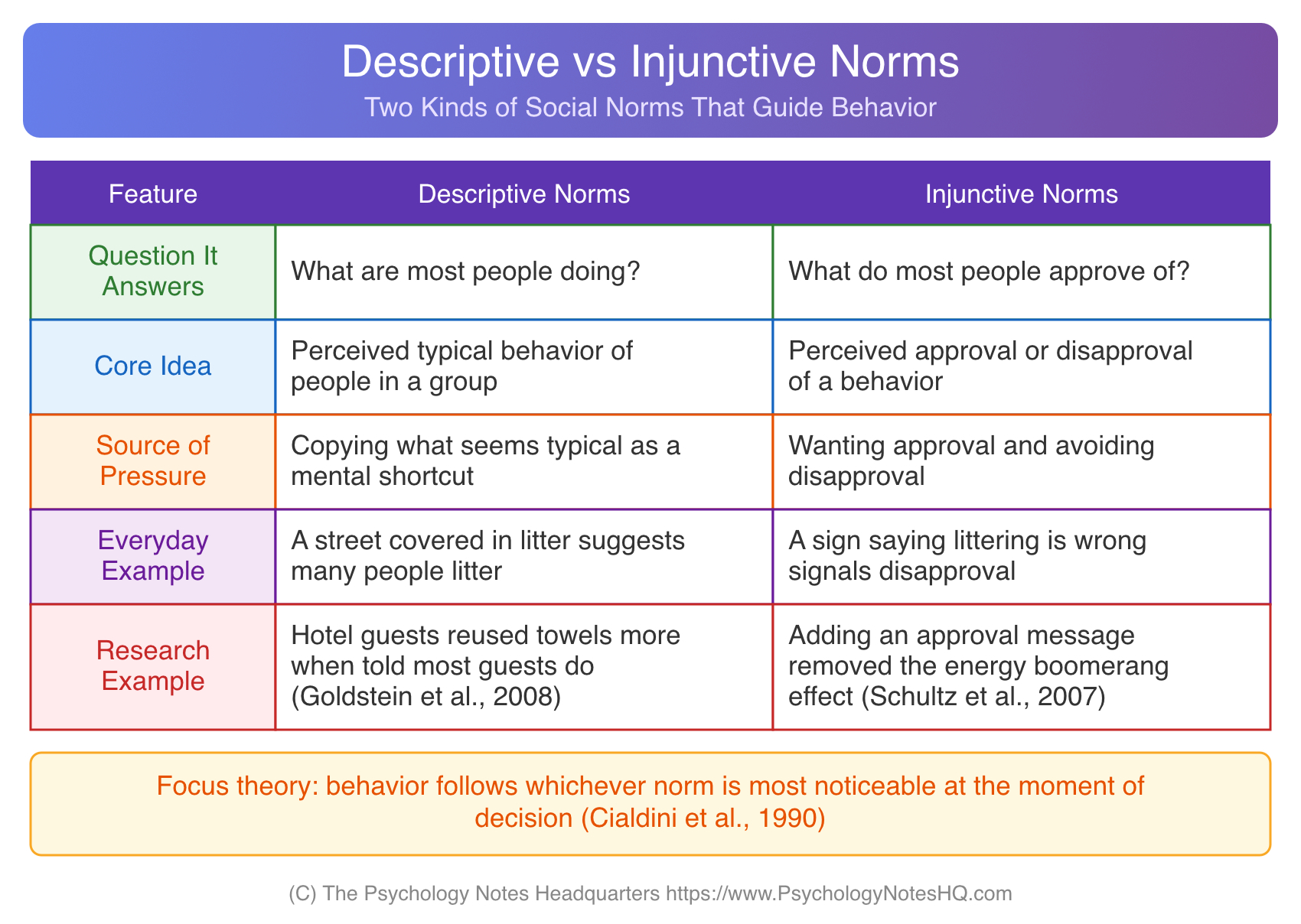
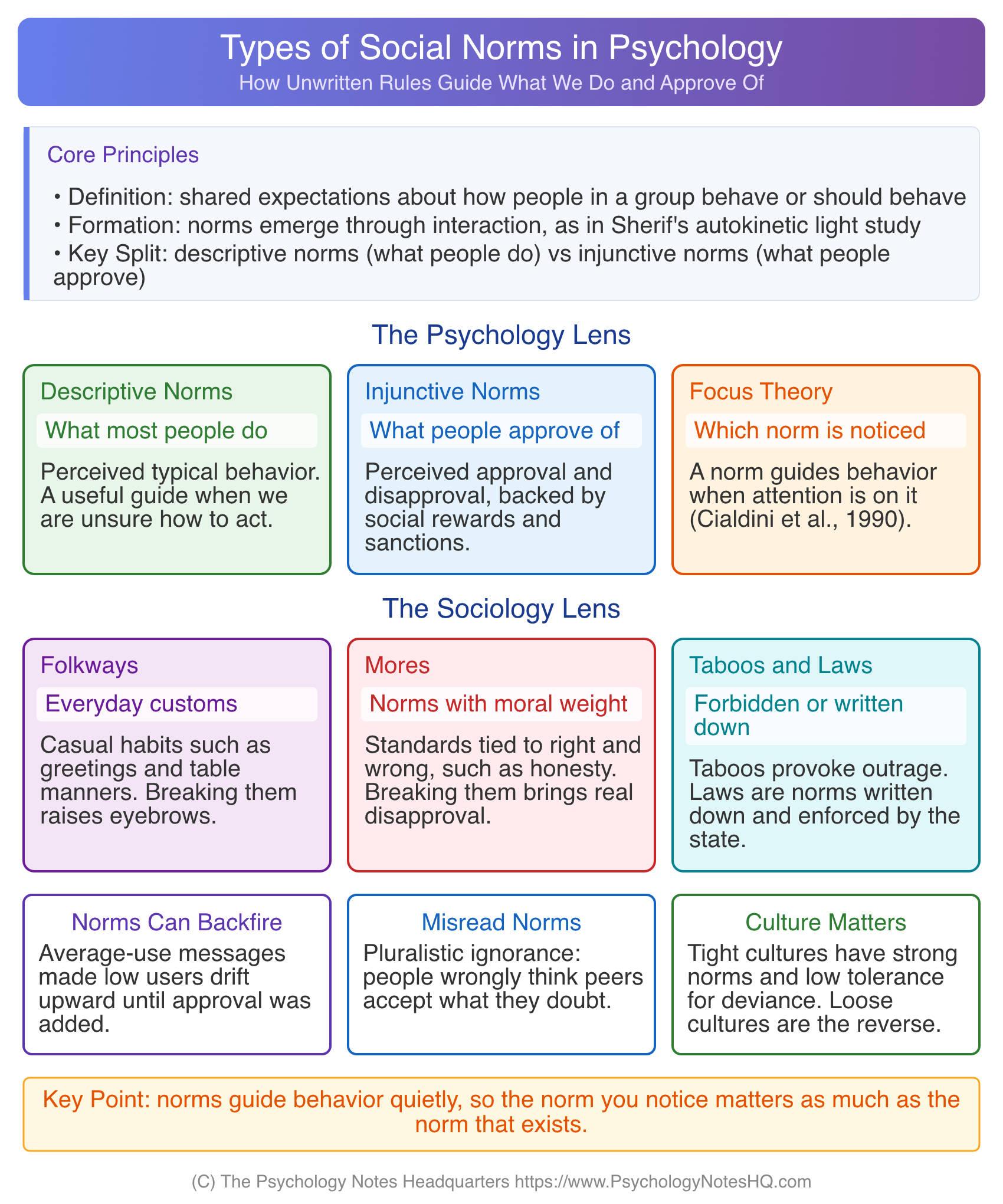
The most useful split among the types of social norms comes from Cialdini, Reno, and Kallgren (1990). They separated descriptive norms, which capture what most people actually do, from injunctive norms, which capture what most people approve or disapprove of. That distinction has guided decades of research, and the descriptive vs injunctive norms contrast explains why identical situations can send very different signals depending on which norm you notice first.
Descriptive Norms
Descriptive norms answer a simple question: what is everyone else doing? A street already covered in litter, a packed restaurant, or a tip jar stuffed with bills all send this kind of message.
People tend to treat typical behavior as a reasonable guide to sensible behavior, especially in unfamiliar settings. When you are unsure, copying the crowd saves effort. The signal is powerful precisely because it is quiet. Nobody has to tell you anything for the norm to speak.
Injunctive Norms
Injunctive norms answer a different question: what will others think of me? Thanking a host, waiting your turn, and keeping quiet in a library are injunctive norms, because approval and disapproval sit behind them.
The two kinds can pull in opposite directions. A littered street says that many people litter, which is descriptive. A sign saying littering is wrong is injunctive. Which message wins depends on where your attention lands, and that is exactly what the next study tested.
The Focus Theory of Normative Conduct
Cialdini and colleagues ran field experiments across five natural settings and found that norms guide behavior when attention is focused on them. Directing people to the descriptive norm or the injunctive norm about littering changed their choices only in line with whichever norm was more prominent (Cialdini et al., 1990).
The lesson is easy to miss. A norm you are not thinking about rarely steers you. Signs, reminders, and cues in the environment work by bringing the right norm to the front of your mind at the moment you decide.
Folkways, Mores, Taboos, and Laws
Sociology offers a second way to sort the types of social norms, based on how seriously a group takes them. Folkways are everyday customs, such as how you greet a coworker. Mores carry moral weight, such as honesty in a friendship. Taboos are strongly forbidden acts that provoke disgust or outrage. Laws are norms that have been written down and are enforced by the state.
Psychologists usually care less about the label and more about how a norm operates in the moment: what people do, and what they approve of.
When Norm Messages Backfire
The Boomerang Effect
Norm messages can go wrong. Schultz and colleagues (2007) gave households information about average neighborhood energy use. Homes that used more than average cut back, which was the goal. Homes that already used less than average tended to drift upward toward the norm, an unwanted boomerang effect.
Descriptive information tells people where the middle is. If you are already better than the middle, the message quietly gives you permission to slide back.
Adding Approval Fixed It
The same study also tested a fix. When researchers added an injunctive message that conveyed social approval, the boomerang effect disappeared (Schultz et al., 2007). Low users kept their good habits because the message told them their behavior was valued, not merely average.
This is the same descriptive pull behind social proof, where people look to others when deciding what to do. The energy study shows that the pull can work in both directions, so a message often needs a second signal.
Pluralistic Ignorance: When Everyone Misreads the Room
The Campus Drinking Studies
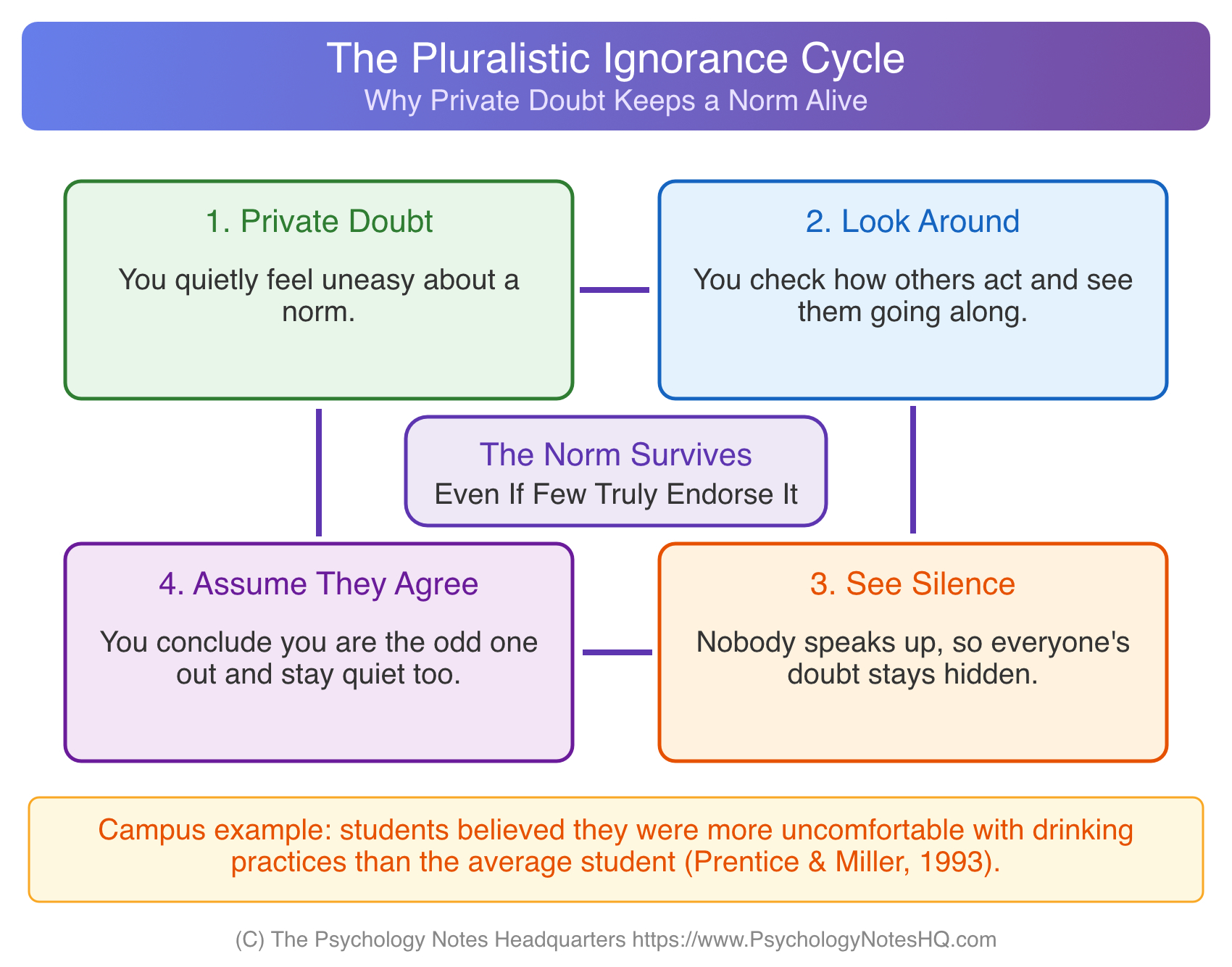
Prentice and Miller (1993) asked college students how comfortable they were with campus drinking practices, then asked how comfortable they thought the average student was. Across four studies, students believed they were more uncomfortable than their peers were.
Many students assumed they were the odd one out. When people privately doubt a norm but wrongly believe everyone else accepts it, psychologists call it pluralistic ignorance. The norm survives even though few people truly endorse it.
What the Illusion Costs
The mistaken belief had consequences. Over a semester, male students shifted their attitudes toward what they wrongly believed was the norm, while female students showed no such change. Students who felt more deviant also felt more alienated from campus, even though that deviance was illusory (Prentice & Miller, 1993).
Silence feeds the cycle. Each person stays quiet, and the quiet looks like agreement to everyone else. A similar dynamic appears in the bystander effect, where people read one another’s calm as a sign that nothing is wrong.
Norm Violation and How Norms Get Enforced
Sanctions, Gossip, and Exclusion
When someone breaks a norm, others often respond with a raised eyebrow, a joke, or a cold shoulder. If the violation seems serious, gossip and exclusion may follow. These reactions tell everyone that the norm still applies.
Norm violation is not always harmful. Reformers, whistleblowers, and activists break local norms on purpose to challenge them. How strongly a group reacts shows how deeply it holds its standards and how tightly the norm is tied to its identity.
Compliance vs Internalization
Some people follow norms only when someone is watching. Others internalize them, so the standard feels like their own preference. Much of this happens in childhood. Gender socialization, for example, teaches expectations about how boys and girls should act long before anyone can question them.
Age norms work the same way. The social clock is a cultural timetable for when to study, marry, or retire, and people often measure themselves against it without ever choosing it.
Tight vs Loose Cultures
What Tight and Loose Mean
Gelfand and colleagues (2011) compared 33 nations and described two patterns. Tight cultures have many strong norms and little tolerance for deviant behavior. Loose cultures have weaker norms and much more tolerance for deviance.
Neither pattern is simply better. Researchers often note that tight societies tend to be more orderly and coordinated, while loose ones tend to be more open to change and variety, and each brings trade-offs that shift with circumstances.
Why Threat Matters
The study linked tightness to ecological and historical pressures, including high population density, scarce resources, a history of territorial conflict, and threats from disease and the environment. Institutions such as autocracy and media regulation were part of the same system (Gelfand et al., 2011).
When survival feels at risk, coordination matters more, and strict norms may help groups act together. Loose norms may be more affordable when threats are lower.
Norms and Belonging
Norms also signal who belongs. Groups often treat shared standards as proof of membership, which connects to social identity theory and to the way in-group vs out-group thinking sorts people into us and them. Someone who ignores the norms may be treated as an outsider, even when the norms themselves are arbitrary.
That is why norm violation can feel risky. The cost is not only disapproval but a threat to belonging.
How Psychologists Use Norms to Change Behavior
Norm-Based Interventions
Miller and Prentice (2016) reviewed programs that give people information about the behavior and attitudes of their peers. Two areas received special attention: reducing college student drinking and increasing environmentally friendly behavior.
The logic is to correct misperceptions and make healthy choices look typical. The review also points out that norm information changes behavior more reliably under some conditions than others, which is why the details of a campaign matter as much as the idea behind it.
The Hotel Towel Study
Goldstein, Cialdini, and Griskevicius (2008) tested signs asking hotel guests to reuse towels. Appeals stating that most guests reuse their towels worked better than the traditional appeal focused on protecting the environment.
The strongest version referred to guests who had stayed in the same room. The authors called these provincial norms: norms tied to the setting closest to a person’s own situation. People seem to weigh the behavior of similar, nearby others more than that of a distant crowd.
Limits and Ethics
Norm messages are not magic. The energy study shows they can backfire, and effects vary by setting and audience. Ethical questions follow too. Is it fair to steer people by shaping what they believe their peers do?
Accurate information is the safer route. If a campaign inflates or invents statistics, people who discover the trick may distrust both the message and the messenger. Honest norm information also helps correct real misperceptions, as pluralistic ignorance research suggests.
Norms vs Laws vs Values
Norms, laws, and values are easy to mix up. Values are broad beliefs about what matters, such as fairness or loyalty. Norms are the group expectations that put those values into practice. Laws are formal written rules backed by official penalties.
They can also clash. Crossing a street against the light may be illegal yet common, while a polite custom may have no legal force at all. Conformity, as classic studies like Asch’s line judgment experiments show, is the act of going along with a group, not the norm itself.
Why Social Norms Matter
Social norms work best when nobody is talking about them. The types of social norms, descriptive and injunctive, explain why the same situation can send mixed messages. Pluralistic ignorance shows how private doubt hides behind public silence, and tight vs loose cultures show how context shapes what counts as acceptable.
Next time you fall in line without being told, ask which norm you are following and whether anyone actually endorses it. Understanding social norms in psychology starts with noticing the rules you never signed up for.
References
- Cialdini, R. B., Reno, R. R., & Kallgren, C. A. (1990). A focus theory of normative conduct: Recycling the concept of norms to reduce littering in public places. Journal of Personality and Social Psychology, 58(6), 1015-1026.
- Gelfand, M. J., Raver, J. L., Nishii, L., Leslie, L. M., Lun, J., Lim, B. C., Duan, L., Almaliach, A., Ang, S., Arnadottir, J., Aycan, Z., Boehnke, K., Boski, P., Cabecinhas, R., Chan, D., Chhokar, J., D’Amato, A., Ferrer, M., Fischlmayr, I. C., … Yamaguchi, S. (2011). Differences between tight and loose cultures: A 33-nation study. Science, 332(6033), 1100-1104.
- Goldstein, N. J., Cialdini, R. B., & Griskevicius, V. (2008). A room with a viewpoint: Using social norms to motivate environmental conservation in hotels. Journal of Consumer Research, 35(3), 472-482.
- Miller, D. T., & Prentice, D. A. (2016). Changing norms to change behavior. Annual Review of Psychology, 67, 339-361.
- Prentice, D. A., & Miller, D. T. (1993). Pluralistic ignorance and alcohol use on campus: Some consequences of misperceiving the social norm. Journal of Personality and Social Psychology, 64(2), 243-256.
- Schultz, P. W., Nolan, J. M., Cialdini, R. B., Goldstein, N. J., & Griskevicius, V. (2007). The constructive, destructive, and reconstructive power of social norms. Psychological Science, 18(5), 429-434.
- Sherif, M. (1936). The psychology of social norms. Harper & Brothers.
How to cite this article:
The Psychology Notes Headquarters. (2026). Social Norms in Psychology: The Unwritten Rules Running Your Day. Retrieved from https://www.psychologynoteshq.com/social-norms/