
Vygotsky Metacognition: Why Kids Don’t Learn to Think About Thinking Alone
Vygotsky’s sociocultural theory explains how metacognition — the ability to monitor and regulate one’s own thinking — develops through social interaction, not spontaneous individual maturation. Researchers now study this as Vygotsky metacognition: children internalize planning, monitoring, and evaluation strategies from adults and peers who model them through dialogue and scaffolding. Cognitive functions appear first on the social level through guided interaction, then become internalized as children appropriate metacognitive questioning for themselves. Private speech is the visible bridge between that social guidance and the inner speech of mature metacognitive thinking.
Key Takeaways
- Metacognition—awareness and control of your own thinking—develops through social interaction rather than emerging spontaneously from individual maturation.
- Adults model metacognitive strategies through questions like “What do you need to do first?” that children eventually internalize as self-directed thinking.
- Private speech serves specific metacognitive functions: planning actions, monitoring progress, evaluating outcomes, and regulating attention during challenging tasks.
- A solid metacognition framework involves temporarily supporting children’s self-monitoring and strategy selection, then gradually withdrawing as internalization occurs.
- Effective classrooms foster metacognition by making thinking visible through think-alouds, collaborative reflection, and explicit teaching of self-monitoring strategies.
Understanding Metacognition: Thinking About Thinking
Metacognition encompasses two interconnected dimensions that together enable strategic, self-regulated learning (Schraw & Dennison, 1994). Metacognitive knowledge represents what you understand about thinking and learning processes—knowing which study strategies work best for different material, recognizing when tasks will be difficult, and understanding your own cognitive strengths and weaknesses. Metacognitive regulation involves actively controlling your cognitive processes—planning how to approach tasks, monitoring comprehension during reading, evaluating whether your strategies are working, and adjusting when they’re not. Together, these dimensions form the basic metacognition framework that researchers use to study self-regulated learning.
Consider a student studying for an exam. Metacognitive knowledge tells them that self-testing works better than rereading notes, that they learn math best through practice problems, and that they struggle with abstract concepts without concrete examples. Metacognitive regulation means they actually use this knowledge by creating practice tests, working problems systematically, and seeking examples when confused. They monitor whether they’re truly understanding material or just fooling themselves, and they adjust their approach when progress stalls.
These metacognitive abilities profoundly impact academic achievement. Students with strong metacognition can assess what they know and don’t know accurately, select appropriate strategies for different learning goals, recognize when they’re not understanding and take corrective action, persist strategically rather than giving up or continuing ineffective approaches, and transfer learning strategies across different subjects and contexts. Research consistently shows that metacognitive skills predict academic success as strongly as—and sometimes more strongly than—general intelligence measures (Veenman et al., 2006).
The critical question is: how do children develop these sophisticated self-regulatory capacities? This is where Vygotsky’s theory of social learning provides essential insights that complement individual cognitive development accounts. Much of the current Vygotsky metacognition research builds directly on this foundation.
The Social Origins of Self-Awareness
Vygotsky (1978) proposed that all higher mental functions, including metacognition, follow a fundamental developmental law: they appear first on the social level between people before becoming internalized on the individual level within the person. This means the metacognitive monitoring and regulation you perform independently as a skilled learner originated in social interactions where others performed these functions for you and with you. Researchers describe this shift as moving from interpsychological to intrapsychological functioning—thinking that starts out shared between people before it becomes a private, individual capacity.
When a parent helps a preschooler build a puzzle, the metacognitive work initially exists in the social interaction. The parent asks, “Where should we start?”—modeling planning. “Does that piece fit?”—modeling evaluation. “What should we try next?”—prompting strategy selection. The child participates in these metacognitive processes through the supported interaction long before they can execute them independently. Through countless such experiences, external metacognitive dialogue gradually transforms into internal metacognitive thinking.
This social-to-individual progression explains why explicit metacognitive instruction proves so effective. When teachers think aloud while solving problems—”Hmm, this is confusing. Let me reread this sentence. What is the question actually asking?”—they externalize metacognitive processes that students can observe and appropriate. When peers explain their thinking to each other, they make metacognitive strategies visible and available for internalization (Fox & Riconscente, 2008). The social world provides the metacognitive models that children transform into personal cognitive tools.
The transformation from other-regulation to self-regulation represents the core of metacognitive development. Initially, adults and teachers regulate children’s thinking for them—telling them to slow down and think carefully, reminding them to check their work, or asking whether they really understand. Gradually, children begin performing this regulation themselves, first aloud through private speech, eventually silently through inner speech. The questions adults asked them become questions they ask themselves. For a deeper exploration of how this regulatory development occurs, see Applying Vygotsky’s Sociocultural Theory to Children’s Self-Regulation.
Private Speech as Externalized Metacognition
Private speech—children’s audible self-talk during activities—provides a unique window into developing metacognition because it externalizes mental processes that will eventually become internal and invisible. Unlike social speech directed toward others, private speech serves self-regulatory functions, helping children guide their own behavior and thinking (Winsler, 2009).
The metacognitive functions of private speech become evident through careful observation. A four-year-old working a puzzle might say aloud: “Where does this go? Try here… no, doesn’t fit. Turn it around. There!” This running commentary demonstrates multiple metacognitive processes: questioning, evaluation, strategy adjustment, and outcome assessment. A seven-year-old doing math homework whispers: “First I need to… okay, add these… wait, let me check… yes, that’s right.” This shows planning, execution monitoring, and evaluation.
Critically, children use more private speech during difficult tasks than easy ones (Fernyhough & Fradley, 2005). This pattern reveals private speech’s functional significance for metacognition. When tasks are simple and automatic, minimal metacognitive monitoring is needed. When tasks become challenging, metacognitive self-regulation becomes essential. Private speech provides that regulation externally before children can maintain it purely internally.
Research demonstrates that preventing children from using private speech during challenging tasks impairs their performance, confirming its functional rather than merely epiphenomenal role (Berk & Winsler, 1995). Conversely, teaching children to use task-relevant self-talk improves performance, showing that externalized metacognitive dialogue supports learning and problem-solving. As children mature, private speech becomes progressively abbreviated and internalized, eventually transforming into the silent inner speech characteristic of mature metacognitive thinking. For comprehensive coverage of this speech development trajectory, see From External Speech to Inner Voice: Vygotsky’s Theory of Thought Development.
Scaffolding Metacognitive Development
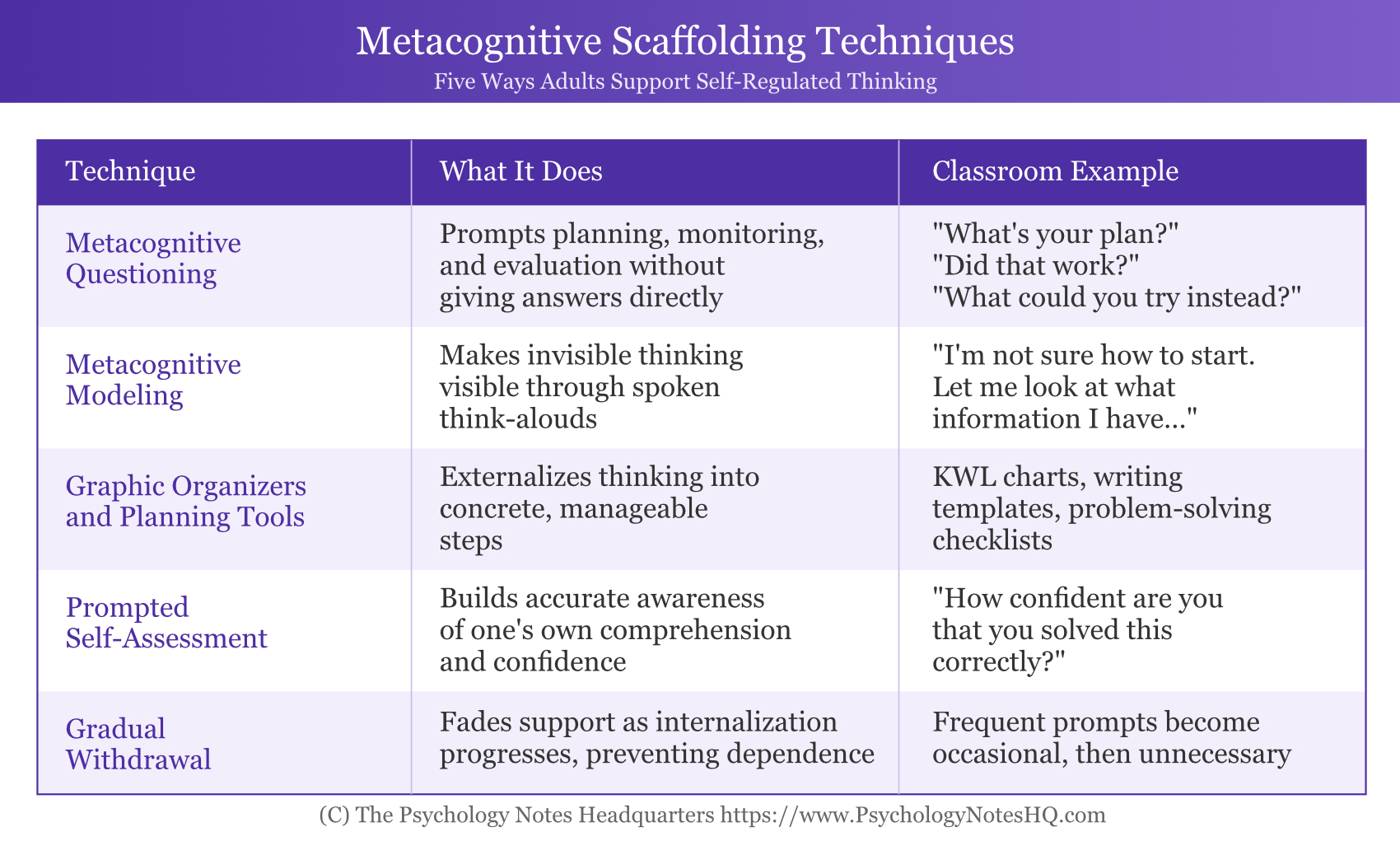
Adults scaffold metacognitive development by providing temporary external supports that prompt the self-monitoring and strategic thinking children don’t yet generate independently. This scaffolding takes multiple forms, each targeting specific metacognitive skills.
Metacognitive questioning represents the most common and powerful scaffold. Questions like “What’s your plan?” prompt planning. “How is it going?” encourages monitoring. “Did that work?” promotes evaluation. These questions don’t provide answers but rather prompt metacognitive thinking. Over time, as children internalize the questioning stance, they begin asking themselves these questions without external prompting.
Metacognitive modeling makes invisible thinking processes visible and available for observation and appropriation. When a teacher solving a problem says aloud, “I’m not sure how to start this. Let me look at what information I have… What am I trying to find?”—they demonstrate strategies including problem analysis, information gathering, and strategic planning. Students observing this kind of metacognitive modeling gain access to expert processes they can practice and eventually internalize.
Graphic organizers and planning tools externalize metacognitive processes, making them concrete and manageable. A KWL chart, a writing planning template, or a problem-solving checklist all help children execute metacognitive processes they cannot yet maintain purely mentally.
Prompted self-assessment develops metacognitive awareness about learning and understanding. Questions like “How confident are you that you solved this correctly?” require children to evaluate their own comprehension—with feedback and practice, they develop more realistic metacognitive monitoring.
The essential feature of effective scaffolding is gradual withdrawal as internalization progresses. Early scaffolding is extensive and explicit. As children demonstrate growing metacognitive competence, scaffolds diminish until they initiate monitoring and strategy use independently.
Peer Collaboration and Metacognitive Growth
While adult-child interaction provides essential scaffolding, peer collaboration offers unique benefits for metacognitive development. When children work together on learning tasks, they must externalize and negotiate their thinking in ways that wouldn’t occur during solitary work.
Explaining thinking to peers requires metacognitive articulation and organization. When a student explains their solution strategy to a classmate, they must make explicit the thinking processes that might remain implicit during independent work—this articulation itself promotes metacognitive awareness.
Questioning and challenging during collaboration prompts metacognitive reflection. When a peer asks “How do you know that’s right?”—they require metacognitive justification and evaluation. These peer challenges often prove more effective than adult questioning because peers frame questions in accessible language at similar developmental levels.
Peer feedback on comprehension and performance calibrates metacognitive judgments, helping children develop more realistic assessments of their own understanding.
Collaborative problem-solving distributes metacognitive work across participants, making each element more visible and explicit. Through this distributed metacognition, children experience and practice functions they’ll eventually consolidate and execute individually.
Study groups and reciprocal teaching formalize peer-mediated metacognitive development. In reciprocal teaching, students take turns leading discussions about texts, practicing comprehension strategies like questioning, clarifying, summarizing, and predicting—all fundamentally metacognitive activities.
Practical Classroom Applications
Translating Vygotskian principles into classroom practice requires systematic attention to creating socially rich learning environments that foster metacognitive development.
Creating a metacognitive classroom culture means regularly discussing not just what students learned but how they learned it, and building shared vocabulary around comprehension monitoring and strategy evaluation.
Explicit metacognitive strategy instruction teaches strategies directly rather than assuming they’ll develop implicitly—previewing texts, generating questions, checking predictions, and summarizing for reading; analyzing problems and checking solutions for math.
Metacognitive dialogue during instruction transforms typical teacher-student interaction. Instead of “Here’s how to solve this problem,” ask “What do you think we should do first?” These questions prompt student thinking rather than bypassing it.
Collaborative metacognitive activities like think-pair-share and jigsaw structures create opportunities to articulate and refine thinking while monitoring others’ understanding.
Metacognitive reflection and self-assessment, through exit tickets, learning journals, and self-assessment rubrics, build regular opportunities for students to evaluate their own work and progress.
Differentiating metacognitive support matters too: struggling learners typically need more explicit, sustained scaffolding, while advanced learners benefit from complex problems and opportunities to teach others.
Domain-Specific Metacognition
While metacognitive principles apply broadly, their specific manifestations vary across academic domains.
Reading comprehension metacognition involves continuously monitoring understanding while reading and employing fix-up strategies when comprehension breaks down—previewing texts, self-questioning, and rereading confusing passages.
Mathematics metacognition emphasizes planning solution approaches, monitoring calculation accuracy, and evaluating answer reasonableness before moving on.
Writing metacognition spans planning, drafting, revising, and editing, each requiring distinct metacognitive activities—from audience and purpose during planning to grammar and clarity during editing.
Science inquiry metacognition demands oversight of experimental design, data collection, and interpretation. This metacognition framework helps students think like scientists rather than merely following procedures.
Cultural and Individual Considerations
Metacognitive development doesn’t follow identical paths across all children. Cultural background, individual learning preferences, and social experiences all influence how metacognitive capacities emerge.
Cultural variations in interaction styles affect metacognitive development. Some cultures emphasize explicit verbal articulation while others value quiet observation and implicit learning. Effective educators provide multiple pathways—verbal and non-verbal, individual and collective—rather than assuming one approach suits all students.
Individual differences in temperament mean some children naturally engage in extensive self-talk while others process internally. Effective instruction offers varied metacognitive supports matching diverse student needs.
Students with learning difficulties often struggle particularly with metacognition and benefit from especially explicit, sustained scaffolding—for these learners, metacognitive support isn’t optional enrichment but essential accommodation enabling academic access.
Assessing Metacognitive Development
Measuring metacognitive growth presents challenges since metacognition is inherently internal and not directly observable. However, several approaches provide useful information about students’ developing metacognitive capacities.
Think-aloud protocols require students to verbalize their thinking while completing tasks, making metacognition observable for assessment and instruction.
Metacognitive questionnaires ask students to self-report about their metacognitive knowledge and regulation, providing windows into students’ metacognitive awareness despite accuracy limitations.
Strategy use observations during classroom work reveal whether students spontaneously employ metacognitive strategies taught, suggesting internalization of metacognitive practices.
Learning journals and reflection prompts provide written evidence of metacognitive thinking, showing developing sophistication over time.
Performance patterns can indirectly indicate metacognitive development: fewer careless errors, improved performance on challenging tasks, and greater learning efficiency over time.
The Role of Inner Speech in Mature Metacognition
As metacognitive self-regulation becomes fully internalized, it operates primarily through inner speech—the silent verbal thinking characterizing mature cognition. This inner dialogue retains the regulatory functions of earlier private speech but operates invisibly and with greater efficiency.
Adults engage inner speech for multiple metacognitive purposes: planning, monitoring, evaluating, strategizing, and self-coaching. This internal metacognitive dialogue represents the culmination of development from external social dialogue through private speech to internalized self-regulation.
Interestingly, inner speech isn’t permanently internalized—adults often revert to audible private speech when facing particularly challenging tasks. Under high cognitive load or novel problem-solving demands, adults verbalize their thinking aloud. This regression to earlier developmental forms demonstrates that audible self-talk remains available as a metacognitive tool throughout life, not just during childhood.
The structure of inner speech differs from external speech. While social speech must be explicit and complete for others to understand, inner speech becomes highly abbreviated and personally symbolic. A lengthy verbal plan might reduce to a few key words in inner speech—a condensation that increases metacognitive efficiency while preserving regulatory function.
Conclusion
Metacognition—the capacity to monitor and regulate your own thinking—develops fundamentally through social processes before becoming internalized as individual capability. Vygotsky’s account of social learning reveals how self-awareness originates in adult questions and guidance that children eventually appropriate as self-directed thinking. Private speech serves as the visible bridge between social scaffolding and internalized self-regulation. Understanding these social origins, organized around a clear metacognition framework, empowers educators to foster metacognitive development through explicit strategy instruction, metacognitive modeling, and carefully calibrated scaffolding that promotes rather than prevents internalization.
References
- Berk, L. E., & Winsler, A. (1995). Scaffolding children’s learning: Vygotsky and early childhood education. National Association for the Education of Young Children.
- Fernyhough, C., & Fradley, E. (2005). Private speech on an executive task: Relations with task difficulty and task performance. Cognitive Development, 20(1), 103-120.
- Fox, E., & Riconscente, M. M. (2008). Metacognition and self-regulation in James, Piaget, and Vygotsky. Educational Psychology Review, 20(4), 373-389.
- Schraw, G., & Dennison, R. S. (1994). Assessing metacognitive awareness. Contemporary Educational Psychology, 19(4), 460-475.
- Veenman, M. V., Van Hout-Wolters, B. H., & Afflerbach, P. (2006). Metacognition and learning: Conceptual and methodological considerations. Metacognition and Learning, 1(1), 3-14.
- Vygotsky, L. S. (1978). Mind in society: The development of higher psychological processes. Harvard University Press.
- Winsler, A. (2009). Still talking to ourselves after all these years: A review of current research on private speech. In A. Winsler, C. Fernyhough, & I. Montero (Eds.), Private speech, executive functioning, and the development of verbal self-regulation (pp. 3-41). Cambridge University Press.
How to cite this article:
The Psychology Notes Headquarters. (2026). Vygotsky Metacognition: Why Kids Don’t Learn to Think About Thinking Alone. Retrieved from https://www.psychologynoteshq.com/vygotsky-metacognition/