
Piaget vs Vygotsky on Language: Egocentric vs Private Speech
When a four-year-old narrates their play aloud, talking to no one in particular—”Now the car goes up the ramp… oops, it crashed… I need to fix it”—what’s happening? Egocentric speech vs private speech is the heart of one of developmental psychology’s most famous disagreements. Piaget interpreted this self-talk as egocentric speech, a sign of cognitive immaturity reflecting the child’s inability to consider others’ perspectives. Vygotsky reinterpreted the identical behavior as private speech, a sophisticated cognitive tool children use to guide their thinking and regulate behavior. This fundamental disagreement about whether language follows thought or shapes thought carries profound implications for understanding child development and education.
Key Takeaways
- Piaget viewed egocentric speech as cognitive immaturity—children talking without awareness of listeners because they cannot yet take others’ perspectives
- Vygotsky reinterpreted the same behavior as private speech, a critical cognitive tool children use for self-regulation and problem-solving
- Piaget argued cognitive development must precede language use; children must reach the preoperational stage before truly using language
- Vygotsky proposed language drives cognitive development through internalization—social dialogue transforms into inner speech, becoming the foundation of thought
- In the Zone of Proximal Development, language serves as the primary scaffolding tool, with the More Knowledgeable Other using verbal guidance to pull children through their learning zone
Setting the Stage: The Core Debate
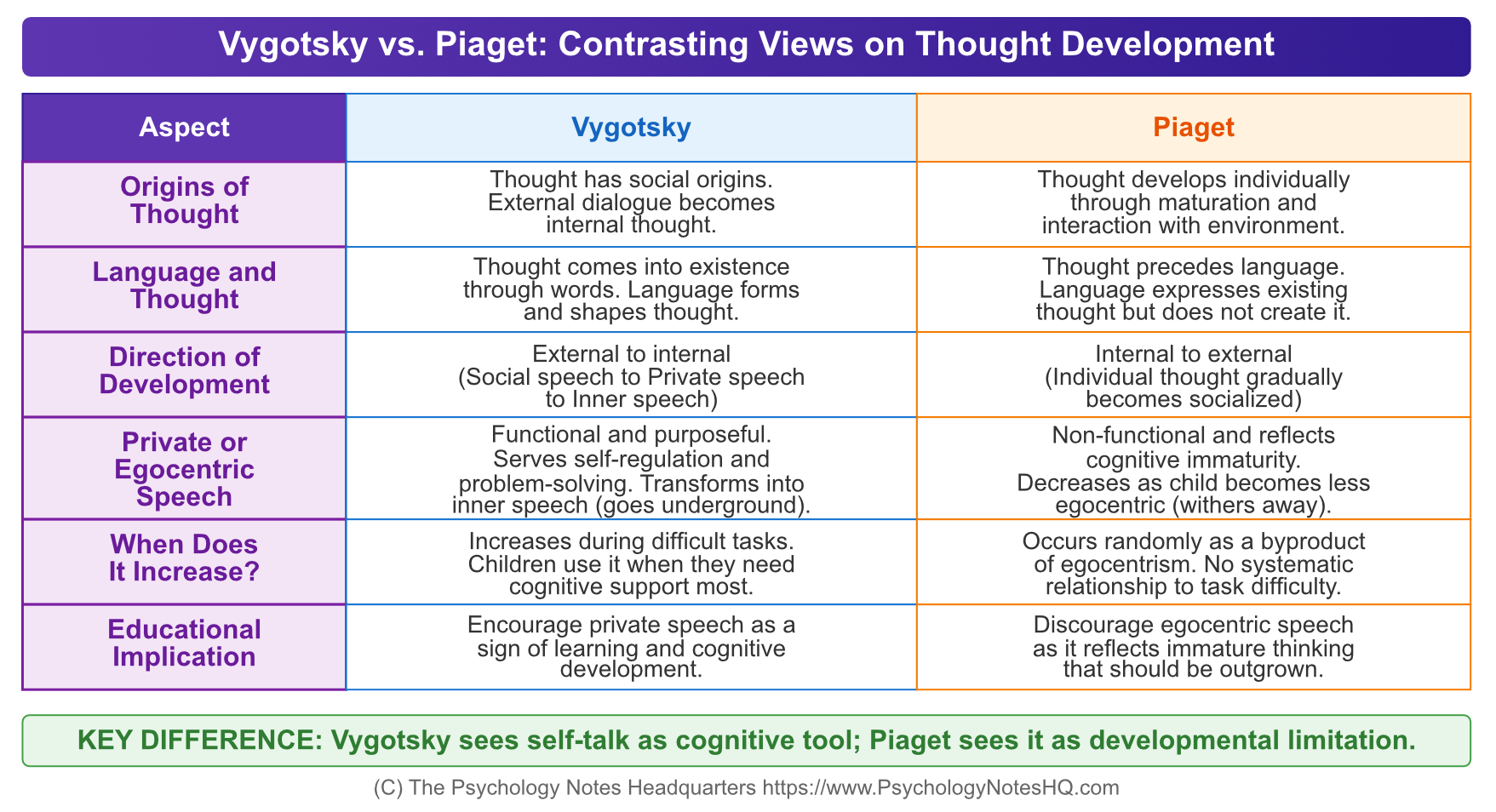
The fundamental question separating Piaget and Vygotsky asks: does language follow thought, or does language shape thought? This seemingly abstract question has concrete implications. If language merely expresses pre-existing thoughts, as Piaget proposed, then cognitive structures must develop first through direct experience with the physical world. If language actively constructs thought, as Vygotsky argued, then social interaction and cultural tools become primary drivers of development. The piaget vs vygotsky language development debate ultimately comes down to which direction this arrow points.
Historical context shaped these contrasting views. Jean Piaget, working in Switzerland from a Western individualist perspective, emphasized universal biological stages of cognitive development. Lev Vygotsky, working in Soviet Russia during the 1920s and 1930s, emphasized sociocultural factors in development. They developed their theories somewhat independently—Vygotsky died tragically young in 1934 at age 37, before full engagement with Piaget’s work. Both observed the same phenomenon—children talking to themselves during play and problem-solving. Their radically different interpretations of this behavior crystallize their theoretical differences.
Why does this debate matter beyond academic psychology? Educational practices flow from these theories. Should teachers wait for developmental readiness or actively scaffold learning? Should classrooms encourage or discourage children talking during work? How important is social interaction for cognitive development? Assessment approaches differ—testing what children can do alone versus what they can do with help. Understanding cultural differences in development timing depends on resolving whether development follows universal biological stages or varies by cultural tools and practices.
Piaget’s Perspective: Language Follows Development
Piaget positioned language as a consequence rather than cause of cognitive development. In his view, thought precedes language—children must first develop mental representations and symbolic thinking before they can meaningfully use language. Development follows universal cognitive stages driven primarily by biological maturation and individual interaction with the physical world. Language expresses thoughts already formed through action on objects and logical operations emerging from those actions.
Egocentric Speech
Piaget observed young children frequently talking to themselves without apparent concern for whether anyone listened or understood. This phenomenon, which he termed egocentric speech, appeared pervasive in children aged three to seven years. Unlike true communication requiring adaptation to a listener’s perspective, egocentric speech seemed to serve no social function.
Egocentric speech manifests in several characteristic forms. Children engage in repetition, repeating words or sounds for pleasure without communicative intent. Monologue occurs during solitary play—children narrate actions, describe what they’re doing, express thoughts aloud to no one. Collective monologue appears in groups where multiple children talk simultaneously, each pursuing their own verbal thread without listening to or responding to others. In all these forms, children show no concern for whether others understand, no adjustment of message based on listener needs, no checking for comprehension.
Why does egocentric speech occur, in Piaget’s framework? It reflects cognitive egocentrism—the young child’s inability to differentiate their own perspective from others’. Children in the preoperational stage cannot yet decentre—cannot simultaneously consider multiple viewpoints. They assume others see, think, and feel exactly as they do. Egocentric speech represents immature thinking, lack of developed social awareness, and limitations characteristic of preoperational cognition. The child doesn’t adapt speech to listeners because they cannot yet understand that others have different perspectives requiring such adaptation.
The Cognitive Milestone View
Piaget insisted that language requires prior cognitive development as prerequisite. Children must reach the preoperational stage before genuine language use becomes possible. Specifically, symbolic thought—the ability to mentally represent objects and events not physically present—must develop before language can function meaningfully. Mental representations develop first through sensorimotor action; then language maps onto those existing mental structures.
Piaget’s stage sequence clarifies this relationship. During the sensorimotor stage (birth to approximately two years), infants lack true language because they haven’t yet developed symbolic function. Thought exists only in action—grasping, sucking, looking. Around age two, the dramatic shift to the preoperational stage brings symbolic function—the ability to let one thing stand for another. Mental representations emerge, enabling pretend play where a block represents a phone. This symbolic capacity makes language possible. Words can now represent objects, actions, and concepts because the underlying cognitive capacity for symbolic representation exists.
The developmental sequence Piaget proposed follows this invariant order: First, cognitive structures develop through physical interaction with the environment and maturation of logical operations. Second, symbolic thought emerges as cognitive structures permit mental representation. Third, language becomes possible once the cognitive foundation exists. Fourth, language expresses already-existing thought patterns. Language cannot be taught before cognitive readiness because children lack the mental structures needed to use it meaningfully. This view implies universal stage sequences determined by biology, with social and cultural factors playing secondary roles in fundamental cognitive development.
The Goal: Socialized Speech
Piaget’s developmental trajectory for language progresses from egocentric to socialized speech. Children begin with egocentric speech reflecting cognitive immaturity. They end with socialized speech reflecting cognitive maturity. The transition occurs through cognitive decentering—developing the ability to consider others’ perspectives.
As children mature cognitively and become less egocentric, their language simultaneously becomes more social. Cognitive development enabling perspective-taking directly causes the decline in egocentric speech and rise in socialized communication. Piaget documented this relationship quantitatively, measuring the percentage of children’s utterances classified as egocentric versus social. He found egocentric speech comprising roughly 40-50% of young children’s speech, declining steadily until around age seven or eight.
Socialized speech possesses distinct characteristics absent in egocentric speech. Children adapt messages to listeners’ knowledge and perspective, showing true communication intent rather than mere verbal expression. They monitor whether others understand, adjusting explanations as needed. Reciprocal dialogue replaces parallel monologue. Questions genuinely seek information rather than rhetorical expression. This mature language use signals underlying cognitive advances—operational thinking, decreased egocentrism, and genuine perspective-taking ability.
The mechanism driving this transformation is purely cognitive. As mental operations become more sophisticated and logical structures develop, egocentrism naturally declines. Language automatically becomes more social as the cognitive capacity for considering others emerges. Piaget predicted egocentric speech should essentially disappear by age seven or eight, replaced entirely by socialized communication. The percentage of egocentric speech serves as a measurable marker of cognitive maturity—high percentages indicate immature, egocentric thinking; low percentages indicate mature, operational thought.
Vygotsky’s Perspective: Language as a Cultural Tool
Vygotsky fundamentally disagreed with Piaget’s interpretation, proposing instead that language actively drives cognitive development rather than merely following it. Language functions as a cultural tool for thinking itself, not just for expressing pre-existing thoughts. Far from being secondary to cognitive development, social interaction and language acquisition constitute the primary mechanisms through which children develop higher mental functions. Development proceeds from social to individual, from external to internal, through a process of internalization.
Private Speech
Vygotsky reinterpreted children’s self-talk not as egocentric flaw but as critical cognitive tool. What Piaget called egocentric speech, Vygotsky termed private speech, emphasizing its positive developmental function. Private speech represents children using language as a psychological tool—talking to themselves to guide behavior, plan actions, and solve problems. Rather than indicating cognitive immaturity, private speech demonstrates children actively employing language for self-regulation.
Private speech serves multiple sophisticated functions. Children use it to guide behavior step-by-step through complex tasks—”First I put this piece here, then that one there.” They plan actions before executing them—”I’m going to build a tall tower.” During problem-solving, they verbalize strategies and evaluate options—”That didn’t work, maybe if I try this way.” Private speech helps regulate emotions—”It’s okay, I can do it.” It focuses attention on relevant aspects of tasks and organizes thinking by breaking problems into manageable verbal components.
Critically, private speech increases systematically during difficult tasks and when facing problems, contrary to what Piaget’s immaturity interpretation would predict. When tasks are easy or well-practiced, children use less private speech. When tasks are novel, complex, or frustrating, private speech increases dramatically. Private speech also increases when adults are unavailable to provide external guidance—children provide themselves the verbal scaffolding adults might otherwise offer. This pattern peaks during ages three to seven, exactly when Piaget observed maximum egocentric speech.
Research evidence strongly supports Vygotsky’s interpretation. Studies consistently show positive correlations between private speech use and task performance—children who use more private speech solve problems better, not worse. Private speech decreases as children master tasks, suggesting it serves a functional role that becomes unnecessary once skills are internalized. Experimental studies increasing task difficulty systematically increase private speech production. Children demonstrating better self-regulation and cognitive control use private speech more effectively. All these findings contradict the notion that self-talk reflects cognitive limitation.
Social Origins of Thought
Vygotsky’s most famous claim articulated his core theoretical principle: every function in the child’s cultural development appears twice, first on the social level and later on the individual level, first between people and then inside the child. This deceptively simple statement revolutionizes understanding of cognitive development.
What does this mean concretely? All higher mental functions—voluntary attention, logical memory, concept formation, voluntary action—originate in social interaction, not inside the individual mind. Cognitive abilities children eventually perform independently first occur in social exchanges with more capable others. External dialogue between people becomes internal thought within the individual. Social interaction doesn’t just support or facilitate cognitive development—it is the source of cognitive development. Culture transmits itself through language in social interaction, fundamentally shaping how children think.
The developmental process Vygotsky described follows a clear sequence. Development begins with social interaction involving external language use. Language mediates social exchanges—parents and children coordinate actions verbally, solve problems together through dialogue, share cultural knowledge through conversation. Internalization gradually begins as children start appropriating the social language they’ve experienced. Private speech emerges as a transitional stage—children talk aloud to themselves using language patterns they’ve learned socially. Finally, inner speech develops as private speech goes underground, becoming silent thought while retaining its social origins.
Consider how children learn counting. Initially, parents count with children—”One, two, three blocks!” This social activity provides the cultural tool (number words) and the cognitive operation (one-to-one correspondence). Children then count aloud alone, using private speech to guide their own counting actions. They might count each block while touching it, verbalizing the number sequence to organize their behavior. Eventually, counting becomes internalized as inner speech—silent mental counting using the same number sequence originally learned socially. The mathematical thinking is fundamentally social in origin, transmitted through cultural tools, and internalized through language.
The Internalization Process
Vygotsky described language development not as egocentric speech disappearing but as social speech transforming through private speech into inner speech—the verbal foundation of mature thinking.
Stage one is social speech, characterized by external communication with others. Young children (birth to approximately age three) use language primarily for social functions—requesting, commanding, questioning, sharing experiences. Speech involves full sentences with complete articulation, loud and clear to reach intended listeners. The audience consists of others—parents, caregivers, peers. Language at this stage serves interpersonal functions.
Stage two introduces private speech as a transitional form. Between roughly ages three and seven, children increasingly direct speech toward themselves rather than others. This speech remains audible but serves self-regulatory rather than social functions. Children guide their own behavior verbally, plan actions, and solve problems through self-talk. Private speech peaks during this period, representing a crucial transition phase. Critically, private speech doesn’t disappear—it transforms. Unlike Piaget’s prediction that egocentric speech vanishes with maturity, Vygotsky argued private speech goes underground rather than extinct.
Stage three establishes inner speech as the internalized form. From approximately age seven onward, overt self-directed speech becomes increasingly covert. Children whisper, move lips silently, or produce completely silent inner speech. This inner speech functions as the primary medium of verbal thinking. Unlike external social speech requiring complete grammatical sentences for comprehensible communication, inner speech becomes highly abbreviated and condensed. It uses predicative structures—expressing the comment about something while omitting the topic already present in consciousness. Personal meanings predominate over conventional definitions. This inner speech, entirely internalized, provides the foundation for all verbal thinking in mature cognition.
The key difference from Piaget’s account bears repeating: Piaget believed egocentric speech disappears as children mature. Vygotsky argued the same speech doesn’t vanish but rather transforms from external to internal. The decline in observable private speech doesn’t indicate its abandonment but its internalization. Evidence supports Vygotsky’s interpretation. Private speech doesn’t simply cease—it becomes covert. Researchers can measure subtle indicators of inner speech even when children produce no audible self-talk. Adults continue using inner speech constantly, and under high cognitive demands, even adults revert to audible private speech—whispering to themselves, moving lips silently, or talking aloud during difficult problem-solving. The speech hasn’t disappeared; it’s gone underground.
The Zone of Proximal Development and Language
The Zone of Proximal Development (ZPD) represents perhaps Vygotsky’s most influential concept, and language functions as the primary tool operating within it. The ZPD defines the gap between what a child can accomplish independently and what that same child can achieve with guidance from someone more knowledgeable. This zone represents the optimal space for learning—tasks neither so easy the child already masters them nor so difficult that even assistance cannot bridge the gap.
Three levels define any child’s capabilities at a given moment. The first level encompasses what the child can do completely independently without any help—their current developmental level. The ZPD itself constitutes the second level—skills and knowledge the child can access with scaffolding from others. This represents potential development, abilities on the verge of emerging. The third level lies beyond current reach even with maximal support—skills requiring substantial additional development before becoming accessible.
Language serves as the primary scaffolding tool within the ZPD, used by the More Knowledgeable Other (MKO) to guide children through learning challenges. The MKO—parent, teacher, more capable peer, or anyone possessing relevant expertise—employs language systematically to support the child’s movement through the ZPD toward independent mastery.
How does language scaffold learning? The MKO uses multiple verbal strategies simultaneously. They provide instructions and directions breaking complex tasks into manageable steps—”First do this, then do that.” They ask questions prompting children to think through problems—”What do you think should come next? Why?” They offer explanations making invisible thinking processes visible—”I’m doing this because…” They model problem-solving by thinking aloud, demonstrating the inner speech children will eventually internalize—”Hmm, this piece doesn’t fit, so I need to try rotating it.” They adjust language complexity dynamically, using simpler language for initial attempts and more sophisticated vocabulary as mastery develops.
Specific scaffolding techniques leverage language’s power. Breaking tasks into manageable verbal steps transforms overwhelming challenges into sequences of achievable actions. Providing hints rather than answers maintains cognitive engagement while preventing complete frustration. Asking leading questions focuses attention on critical features without removing problem-solving agency. Offering encouragement sustains motivation during difficulty. Adjusting language complexity ensures communication matches the child’s current understanding.
The process through which language pulls children through the ZPD follows predictable patterns. Initially, the child cannot complete the task independently despite motivation and effort. The MKO introduces verbal support—instructions, questions, modeling—providing external cognitive structure. With this language-based scaffolding, the child successfully completes the task. Through repeated experiences, the child internalizes the dialogue, beginning to use private speech to self-scaffold using strategies originally provided by the MKO. Gradually, even private speech becomes unnecessary as skills become automatic. The child now performs independently what previously required external support. Language has literally pulled the child through the ZPD.
Consider learning to tie shoes—a task requiring complex sequencing and fine motor control. An adult MKO begins with verbal guidance: “First, cross the laces. Now make a loop with this one.” The child attempts each step, guided by language. Initially, every movement requires verbal prompting. The child begins using private speech, repeating instructions aloud: “Make a loop, now wrap around.” This private speech guides hand movements and sequences actions. With practice, private speech becomes abbreviated whispers, then silent inner speech. Eventually, shoe-tying becomes automatic, requiring no conscious verbal thought. The social dialogue has been completely internalized, transforming an impossible task into an effortless skill.
Mathematics learning exemplifies language scaffolding in academic contexts. A teacher working within a student’s ZPD asks “What’s the first step in solving this equation?” rather than immediately showing the solution. The student thinks through the problem verbally, externalizing reasoning. The teacher adjusts support based on student responses—more hints if the student struggles, more challenge if the student succeeds easily. The student internalizes this problem-solving dialogue, using private speech while doing homework—”First isolate the variable, then…” Eventually, these verbal strategies become inner speech enabling independent mathematical thinking.
Why is language essential for ZPD scaffolding? Language serves as the primary medium for transmitting cultural knowledge across generations. Through language, adults share thinking strategies, problem-solving approaches, and conceptual frameworks children cannot discover independently. Language makes invisible cognitive processes visible—adults can verbalize their thinking, demonstrating mental operations children cannot observe directly. Cultural tools and symbol systems transmit primarily through language. Most critically, language provides flexible, responsive scaffolding adjusted in real-time based on learner needs. Without language, scaffolding within the ZPD becomes extremely difficult, limited to modeling observable actions without verbal explanation. Language is not just a scaffold—it is the scaffold.
Educational implications flow directly from understanding language’s role in the ZPD. Social interaction during learning proves crucial rather than peripheral. Children need opportunities to talk during learning, making private speech not a distraction but a learning tool. Silent classrooms prevent the very verbalization driving cognitive development. Collaborative learning where children work together provides opportunities for peer scaffolding through dialogue. Teachers should maximize guided participation—working alongside students with verbal support—rather than only lecturing or assigning independent work without support.
Direct Comparison: Egocentric Speech vs Private Speech
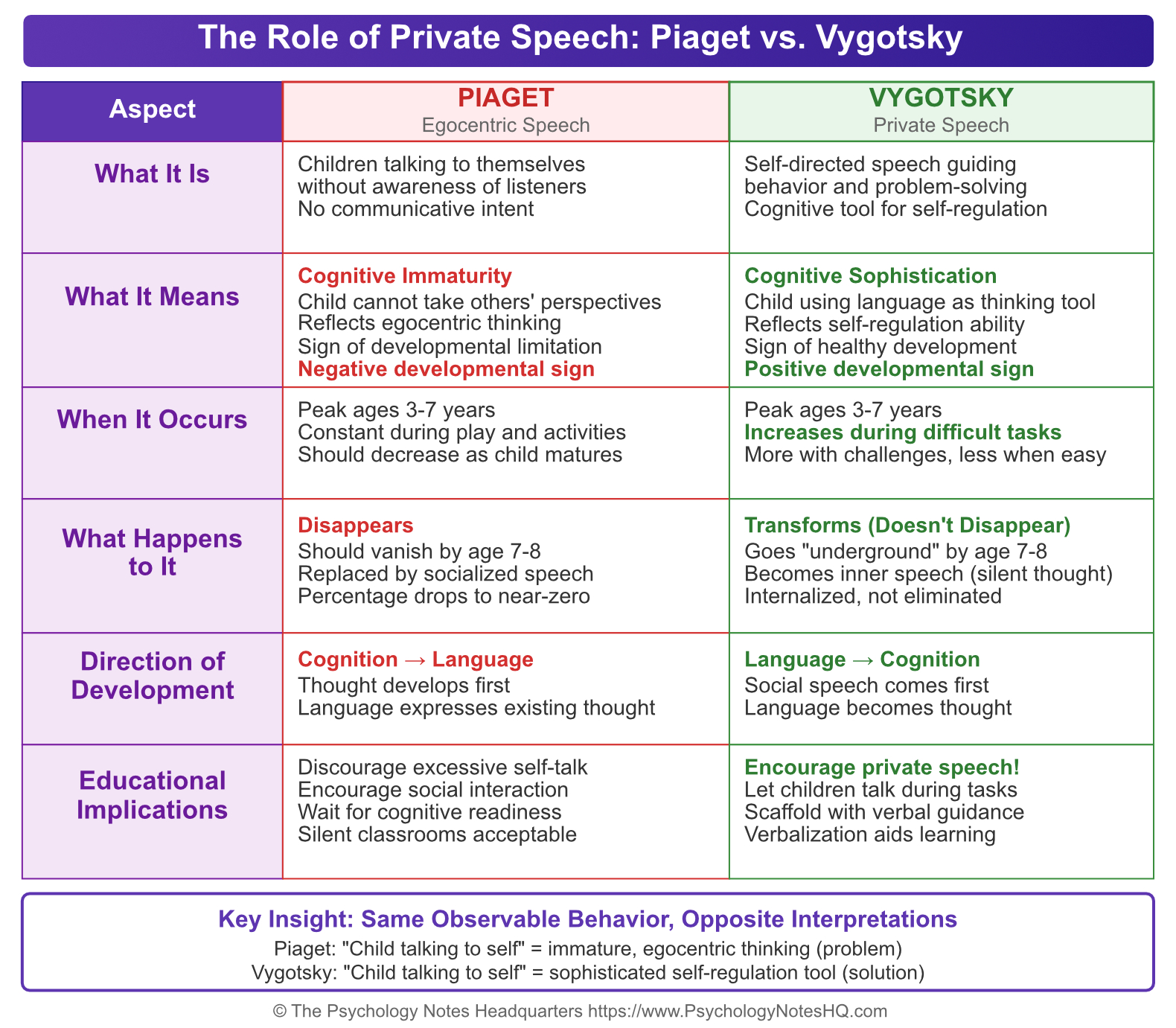
The contrast between Piaget and Vygotsky crystallizes around their interpretations of identical observable behavior—children talking to themselves. This divergence in egocentric speech vs private speech reveals fundamentally different theories of development.
On the phenomenon of children talking aloud during play and problem-solving, Piaget labeled this egocentric speech, interpreting it as cognitive immaturity. The child cannot take others’ perspectives, lacks awareness that others possess different viewpoints, and fails to adapt communication accordingly. Egocentric speech should disappear with development as cognitive structures mature and egocentrism declines. High levels of self-talk indicate developmental delay or immaturity. This behavior represents a negative developmental sign requiring remediation.
Vygotsky called the identical behavior private speech, interpreting it as a sophisticated cognitive tool. The child uses language to self-regulate, guide behavior through complex tasks, and solve problems systematically. Private speech transforms into inner speech rather than disappearing. Increased private speech during challenging tasks indicates healthy cognitive development and effective self-regulation. This behavior represents a positive developmental sign deserving encouragement.
The direction of development flows oppositely in each theory. Piaget proposed cognition precedes and enables language. Thought develops first through physical action on objects and maturation of logical structures. Language follows, expressing already-formed thoughts. Cognitive stages, driven by biological maturation, enable corresponding language capabilities. Development is universal, following invariant sequences across all cultures. Language functions primarily to express existing thought rather than create it.
Vygotsky proposed language drives and shapes cognition. Social speech comes first, originating in cultural interaction. Language becomes thinking through internalization. Higher mental functions are socially constructed through language. Development varies by culture depending on available tools and practices. Language doesn’t just express thought—it actively constructs thought through internalization of social dialogue.
The role of social interaction carries vastly different importance. In Piaget’s framework, social interaction holds secondary importance. Development proceeds primarily through individual action on physical objects. Biological maturation provides the primary engine of development. Peer interaction can facilitate perspective-taking and reduce egocentrism, but it’s not essential. Children isolated from peers would still develop cognitive structures through maturation and object manipulation.
In Vygotsky’s framework, social interaction proves absolutely essential. Development is fundamentally social, occurring first between people before becoming individual capability. Cultural transmission through interaction provides the very content of higher thinking. More knowledgeable others are crucial, serving as guides through ZPDs. Children cannot develop fully in isolation because higher mental functions originate in social interaction, not individual discovery.
Regarding what happens to self-directed speech, Piaget predicted egocentric speech disappears entirely, replaced by socialized speech. The percentage of egocentric utterances steadily declines from 40-50% at age four to near-zero by age eight. This decline indicates cognitive maturity and successful decentering. Persistent egocentric speech suggests developmental delay.
Vygotsky argued private speech doesn’t disappear but rather goes underground, becoming covert inner speech. The decline in audible private speech indicates internalization, not abandonment. This transformation shows development progressing as social speech becomes individual thought. Adults continue using inner speech constantly, sometimes reverting to audible private speech under high cognitive demands.
Educational implications diverge dramatically. Piaget-informed education emphasizes waiting for developmental readiness before introducing new concepts. Teachers cannot force development beyond current stage capabilities. Age-appropriate expectations respect biological limitations. Discovery learning allows children to construct knowledge through object interaction. Minimize direct instruction, maximize exploratory play and peer collaboration. Assess what children can do alone, without support.
Vygotsky-informed education emphasizes active teaching within the ZPD. Teachers should scaffold new learning, stretching children beyond current capabilities with support. Social interaction proves crucial, making collaborative learning and dialogue central. Maximize guided participation where teachers work alongside students. Encourage verbalization during learning—private speech helps, not hinders. Assess not just current capabilities but potential development with support, measuring what children can achieve with guidance.
Conclusion
The piaget vs vygotsky language development debate fundamentally asks whether language follows or leads cognitive development. Piaget interpreted egocentric speech as cognitive immaturity that disappears as children develop socialized communication through biological maturation and declining egocentrism. Vygotsky reframed the identical behavior as private speech—a critical cognitive tool transforming into inner speech through internalization. Language in the ZPD serves as the primary scaffolding tool, with More Knowledgeable Others using dialogue to guide children through learning challenges. Modern research supports elements of both theories while recognizing their interaction. Understanding this classic debate illuminates fundamental questions about human development and optimal educational practice.
References
- Piaget, J. (1959). The language and thought of the child (3rd ed.). Routledge & Kegan Paul.
- Vygotsky, L. S. (1978). Mind in society: The development of higher psychological processes. Harvard University Press.
- Vygotsky, L. S. (1987). Thinking and speech. In R. W. Rieber & A. S. Carton (Eds.), The collected works of L. S. Vygotsky, Vol. 1: Problems of general psychology (pp. 39-285). Plenum Press.
- Berk, L. E. (1992). Children’s private speech: An overview of theory and the status of research. In R. M. Diaz & L. E. Berk (Eds.), Private speech: From social interaction to self-regulation (pp. 17-53). Lawrence Erlbaum.
- Winsler, A., Fernyhough, C., & Montero, I. (Eds.). (2009). Private speech, executive functioning, and the development of verbal self-regulation. Cambridge University Press.
- Fernyhough, C. (2008). Getting Vygotskian about theory of mind: Mediation, dialogue, and the development of social understanding. Developmental Review, 28(2), 225-262.
How to cite this article:
The Psychology Notes Headquarters. (2026). Piaget vs Vygotsky on Language: Egocentric vs Private Speech. Retrieved from https://www.psychologynoteshq.com/piaget-vs-vygotsky-language/