
More Knowledgeable Other: Why Vygotsky’s MKO Still Matters
A five-year-old cannot tie her shoes alone, then one afternoon her older brother sits beside her, wraps his hands loosely around hers, and talks her through the loop and pull three times. By the fourth try, she does it without him. Nothing about her brain changed in that hour. What changed was who was next to her. Lev Vygotsky built an entire theory of learning around that moment, and he had a name for the brother’s role: the more knowledgeable other, or MKO. The concept sits at the center of Vygotsky’s sociocultural theory, and it reframes learning as something that happens between people before it happens inside one person’s head.
Key Takeaways
- Vygotsky argued that skill rarely develops in isolation. It develops through a relationship with someone who already has it, whether that person is a teacher, a sibling, or a friend.
- The “more knowledgeable” label is domain-specific and temporary. The same person can be a guide in one skill and a beginner in another, sometimes on the same afternoon.
- An MKO’s real job is not knowing more. It is knowing how to hand that knowledge over, through scaffolding that shrinks as the learner’s competence grows.
- Classrooms now build the more knowledgeable other in the classroom deliberately, through reciprocal teaching and peer tutoring, instead of leaving it to chance.
- The MKO and the Zone of Proximal Development work as a pair. One names the space where learning happens, the other names the person who opens it up.
What Actually Makes Someone an MKO
Vygotsky’s own writing never reduces the more knowledgeable other to a job title or a diploma. The MKO is simply whoever, in a given moment, knows how to do the thing the learner is trying to do, and is able to show them. That includes teachers, but it also includes an eight-year-old who figured out a video game level an hour before her cousin did.
This is where people trip up: they assume the MKO has to outrank the learner in some general, permanent sense. It does not. The relationship is contextual. A calculus tutor may be the MKO for derivatives and the total novice when that same student explains a TikTok trend to them five minutes later. What makes the label useful is that it is narrow. It applies to one skill, at one moment, not to a person’s overall standing.
Vygotsky positioned this against a rival idea popular in his era, the notion of the child as a solitary discoverer, working things out through trial and error with no one’s help. He thought that picture missed how much of human learning is borrowed before it is owned. The MKO psychology concept exists to name exactly that borrowing.
Not Just Knowledge, But the Ability to Hand It Over
Plenty of experts make poor teachers. Someone can be brilliant at chess and still have no idea how to explain a fork to a nine-year-old. Vygotsky’s framework quietly separates expertise from the skill of transferring it, and the second one is what actually makes an MKO effective.
A handful of traits show up again and again in people who fill this role well.
They read where the learner actually is. Before offering help, an effective MKO figures out what the learner can already do alone versus what still requires support. Get this wrong in either direction, offer help too early and the learner checks out from boredom, offer it too late and they give up from frustration, and the whole relationship stalls.
They build supports that are meant to come down. This is scaffolding: breaking a task into steps, asking a leading question instead of supplying the answer, modeling a strategy out loud. The scaffolds are temporary by design. A good MKO is always quietly planning their own exit.
They adjust in real time. Struggle prompts more support. A flash of confidence prompts the MKO to step back and let the learner take the next step alone. This back-and-forth, more than any single technique, is what separates responsive teaching from a scripted lesson.
They stay patient with mistakes. Errors get treated as information, not failure, which keeps learners willing to attempt things that are slightly outside what they can already do.
None of these traits need to show up perfectly. Even a rough, partially skilled MKO usually beats no guidance at all, particularly for anything complicated enough that a learner would struggle to reverse-engineer it solo.
The People Who End Up Playing This Role
Almost anyone can become an MKO, and most people cycle through the role constantly without labeling it.
Teachers are the version most people picture first, and for good reason. Training, subject expertise, and repeated practice working with learners let them structure lessons deliberately around what a given group of students is ready to handle.
Parents usually get there first, though, well before any classroom. A parent narrating a recipe while a toddler stirs, or walking a child through crossing a street safely, is doing MKO work without ever naming it that way.
Peers turn out to matter more than most formal education gives them credit for. A classmate who understood a concept last week often explains it in language that lands better than an adult’s explanation, precisely because the classmate remembers what confused them and hasn’t lost that vantage point yet. The exchange helps both sides: explaining something to someone else tends to sharpen the explainer’s own grasp of it.
Older siblings sit in an interesting middle position, more experienced than a younger sibling but still closer to that sibling’s world than a parent or teacher is, which sometimes makes their guidance land more naturally.
Coaches, mentors, and even well-designed learning software or a solid how-to video can serve the function too, though written or digital resources cannot read a learner’s confusion the way a person can and adjust on the spot.
Most people are drawing on several MKOs across different parts of life simultaneously, a coach for a sport, a friend for social advice, a professor for a subject, without ever needing one person to fill the role for everything.
How the MKO and the Zone of Proximal Development Fit Together
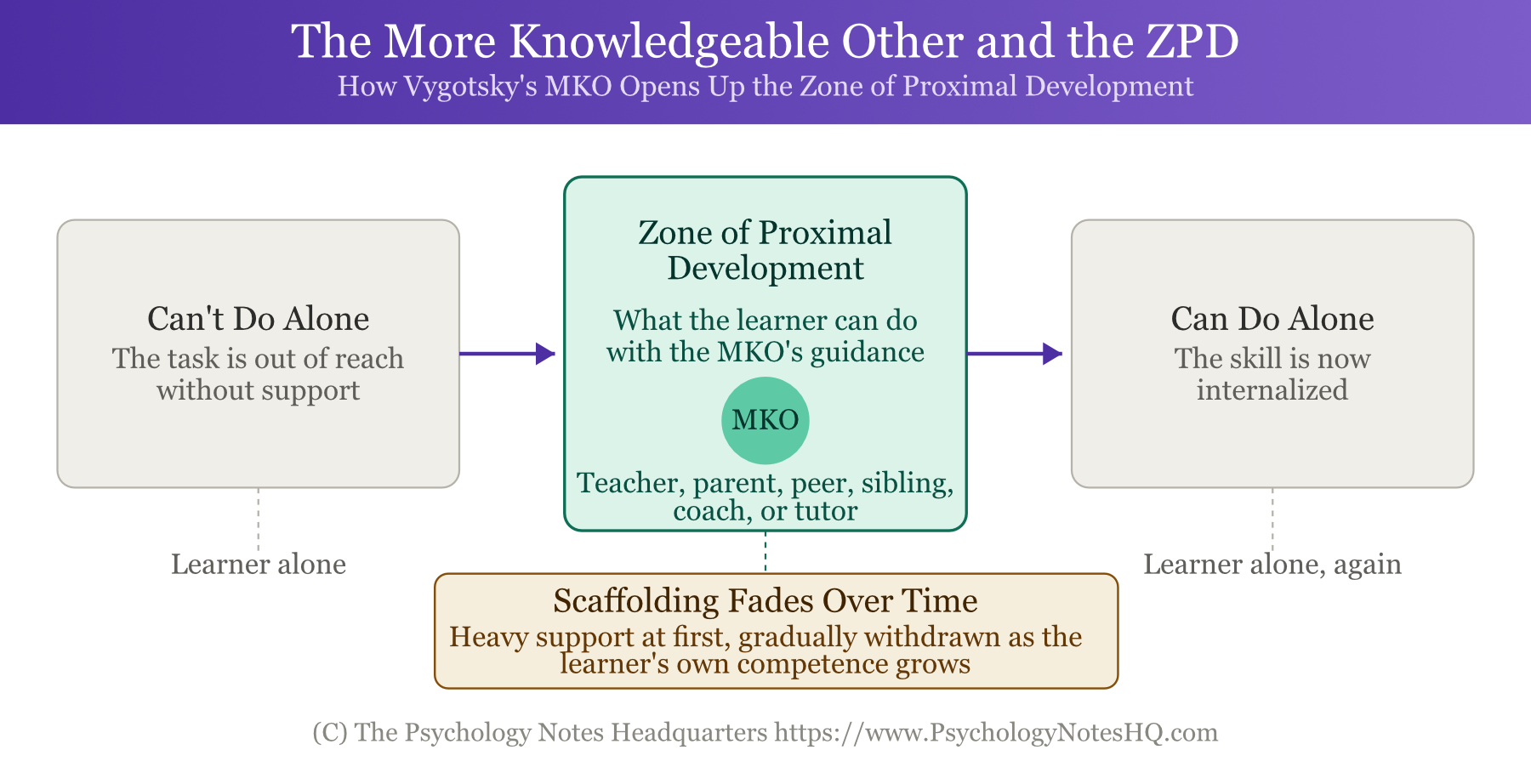
The Zone of Proximal Development describes the gap between what a learner can do completely alone and what they can pull off with the right support. The MKO is the person standing in that gap, doing the pulling.
Finding that zone is the MKO’s first task, and it usually happens through a bit of trial and observation rather than a formal test. They watch for the difference between a learner who struggles despite genuine effort and one who breezes through without needing help. Once that boundary is roughly located, the MKO can pitch tasks that sit right at the edge of what the learner can manage, hard enough to stretch them, not so hard that even with help they cannot get there.
Scaffolding is the tool that makes this workable in practice. As competence builds, the MKO pulls support back in a process sometimes called fading, doing less of the task themselves and letting the learner absorb more of it, until eventually the scaffold disappears and the skill belongs to the learner outright.
Vygotsky tied this to a broader claim: that any new mental function shows up first between people and only later becomes something a person can do on their own. What starts as a shared task, learner and MKO working through something jointly, eventually becomes something the learner carries out solo, having internalized the strategy the MKO modeled. The relationship is uneven by design, the MKO knows more, but it is not one-directional. Good MKOs pay close attention to what the learner is already trying to do and work with that, rather than simply issuing instructions.
Zones of proximal development also do not sit still. A task that needed heavy support last month might be second nature now, while a brand-new challenge opens up its own zone. MKOs who keep adjusting to that shift stay useful. Ones who keep treating a learner like a beginner after they have moved past that stage tend to become more of an obstacle than a help.
More Knowledgeable Other in the Classroom Today
Modern teaching has taken Vygotsky’s fairly loose concept and built structured routines around it, turning the more knowledgeable other in the classroom into something schools plan for rather than leave to chance.
Reciprocal teaching is probably the clearest example. Palincsar and Brown (1984) designed it around four moves readers make almost automatically once they are skilled: predicting what’s coming, questioning to check their own understanding, clarifying anything murky, and summarizing. Students rotate through leading these steps for their group, essentially becoming the more knowledgeable other in the classroom for their peers in short bursts. A teacher models the moves first, but the responsibility shifts to students quickly. Studies on the approach show real gains in reading comprehension, especially among students who were struggling beforehand.
Collaborative structures do similar work. In a jigsaw activity, each student masters one slice of a topic and then teaches it to the rest of the group, meaning every student ends up as someone else’s MKO for at least one piece. Peer tutoring pairs work the same way more directly, matching a stronger and weaker student on purpose. What keeps this from collapsing into one student doing all the work is deliberate structuring, genuine back-and-forth rather than a lecture in miniature.
Technology has stretched the concept further still. Adaptive software that adjusts difficulty based on a student’s answers, or an online tutor a student can message at 11pm before an exam, both extend MKO-style support past the hours a teacher is physically present, even if they still cannot match a person’s read on confusion or frustration.
Why the Acronym Trips People Up
Anyone searching around this topic runs into the acronym constantly, and it is worth being direct about it: the mko full form is simply more knowledgeable other, nothing more exotic than that. The confusion usually comes from the term showing up across such different settings, textbooks, teacher training materials, parenting blogs, that it can read like jargon specific to one field when it is really just Vygotsky’s shorthand, used the same way across all of them.
Conclusion
Vygotsky’s more knowledgeable other reframes something people usually take for granted, that a good chunk of what we know, we picked up from someone standing next to us at the right moment. Whether that person is a parent, teacher, older sibling, or classmate, the MKO operates inside the Zone of Proximal Development, offering just enough scaffolding to close the gap between what a learner can do alone and what they can do with a bit of help. Reciprocal teaching and peer tutoring show how deliberately schools now build this relationship into daily practice, rather than hoping it happens on its own.
References
- Palincsar, A. S., & Brown, A. L. (1984). Reciprocal teaching of comprehension-fostering and comprehension-monitoring activities. Cognition and Instruction, 1(2), 117-175.
- Rogoff, B. (1990). Apprenticeship in thinking: Cognitive development in social context. Oxford University Press.
- Vygotsky, L. S. (1978). Mind in society: The development of higher psychological processes. Harvard University Press.
- Wertsch, J. V. (1985). Vygotsky and the social formation of mind. Harvard University Press.
- Wood, D., Bruner, J. S., & Ross, G. (1976). The role of tutoring in problem solving. Journal of Child Psychology and Psychiatry, 17(2), 89-100.
How to cite this article:
The Psychology Notes Headquarters. (2026). More Knowledgeable Other: Why Vygotsky’s MKO Still Matters. Retrieved from https://www.psychologynoteshq.com/more-knowledgeable-other/